
Time to First Token · DeepSeek V4 Pro 0813 (Reasoning, Max Effort)
1043ms
Time to First Token · GPT-5 mini (high)
0ms
Deep dive into reasoning, benchmarks, and latency insights.
The current catalog does not contain complete performance evidence for both models, so this page does not declare an overall winner. Use the available fields as comparison signals and validate the models on your own workload.
Key decision metrics at a glance.
| Model | Metric | Value | Unit | Source / snapshot |
|---|---|---|---|---|
| DeepSeek V4 Pro 0813 (Reasoning, Max Effort) | Reasoning | 6.0 | benchmark or capability score | Artificial Analysis · current catalog |
| GPT-5 mini (high) | Reasoning | 9.0 | benchmark or capability score | Artificial Analysis · current catalog |
| DeepSeek V4 Pro 0813 (Reasoning, Max Effort) | Coding | 7.0 | benchmark or capability score | Artificial Analysis · current catalog |
| GPT-5 mini (high) | Coding | 2.0 | benchmark or capability score | Artificial Analysis · current catalog |
| DeepSeek V4 Pro 0813 (Reasoning, Max Effort) | Multimodal | 4.0 | benchmark or capability score | Artificial Analysis · current catalog |
| GPT-5 mini (high) | Multimodal | 2.0 | benchmark or capability score | Artificial Analysis · current catalog |
| DeepSeek V4 Pro 0813 (Reasoning, Max Effort) | Long Context | 7.0 | benchmark or capability score | Artificial Analysis · current catalog |
| GPT-5 mini (high) | Long Context | 3.0 | benchmark or capability score | Artificial Analysis · current catalog |
| DeepSeek V4 Pro 0813 (Reasoning, Max Effort) | Blended Price / 1M tokens | $1.98 | USD per 1M tokens | Artificial Analysis · current catalog |
| GPT-5 mini (high) | Blended Price / 1M tokens | $0.688 | USD per 1M tokens | Artificial Analysis · current catalog |
| DeepSeek V4 Pro 0813 (Reasoning, Max Effort) | P95 Latency | — | milliseconds | Artificial Analysis · current catalog |
| GPT-5 mini (high) | P95 Latency | — | milliseconds | Artificial Analysis · current catalog |
| DeepSeek V4 Pro 0813 (Reasoning, Max Effort) | Tokens per second | 75.255 | tokens per second | Artificial Analysis · current catalog |
| GPT-5 mini (high) | Tokens per second | 0 | tokens per second | Artificial Analysis · current catalog |
Data provided by Artificial Analysis; live values use the current catalog.
This radar chart visually maps the core capabilities (reasoning, coding, math proxy, multimodal, long context) of `DeepSeek V4 Pro 0813 (Reasoning, Max Effort)` vs `GPT-5 mini (high)`.
This grouped bar chart provides a side-by-side comparison for each benchmark metric.
Lower time to first token is better; higher tokens per second is better.
Compare input and output pricing in USD per 1M tokens.
DeepSeek V4 Pro 0813 (Reasoning, Max Effort)$2.31
GPT-5 mini (high)$0.75
GPT-5 mini (high) costs $1.56 less per run
This article is a dated snapshot published on 2026-08-07. Live cards above use the current catalog; missing live fields are not inferred.
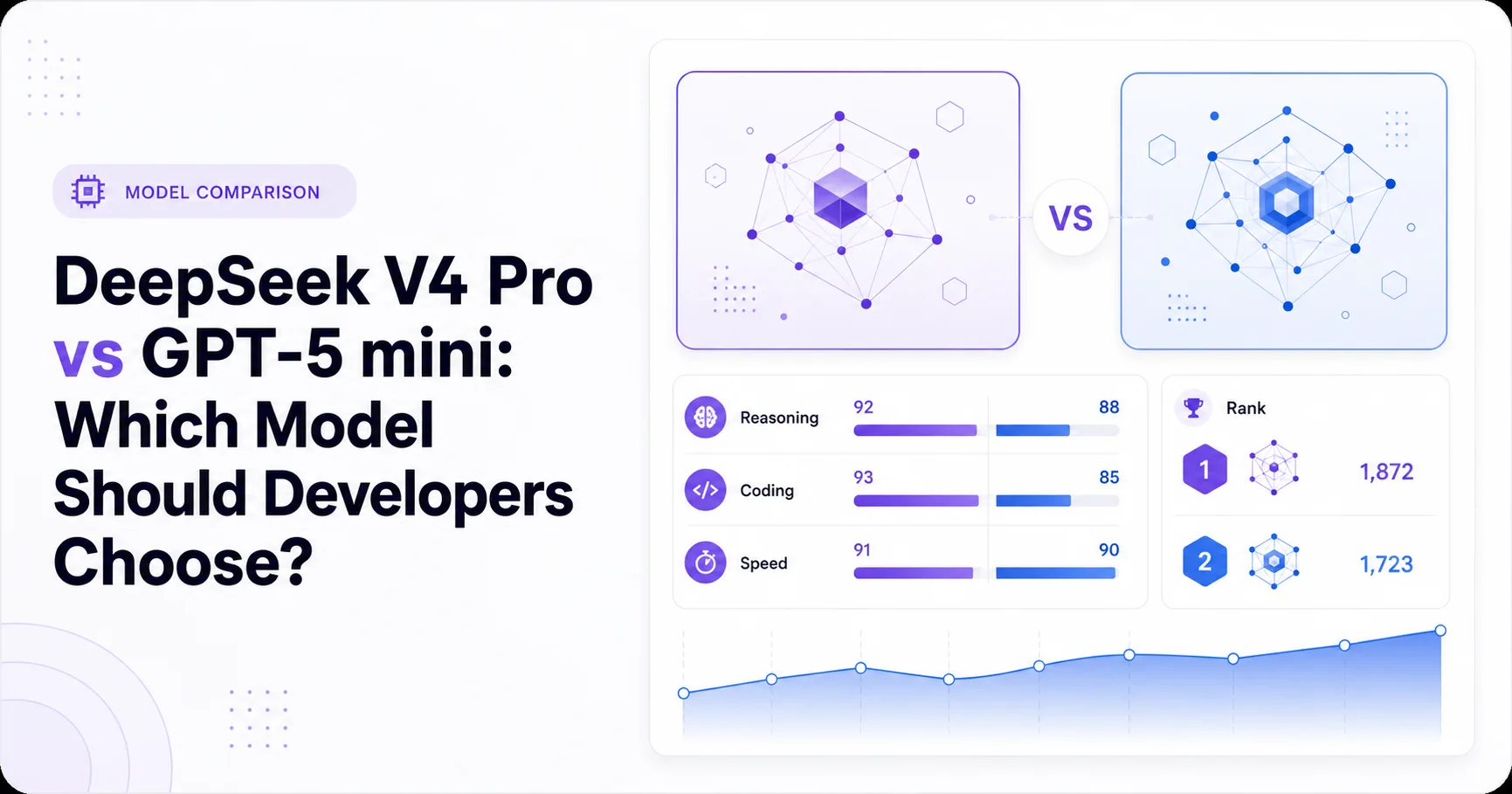
DeepSeek V4 Pro (Reasoning, Max Effort) is the stronger default for coding-focused applications, while GPT-5 mini (high) remains relevant for math-heavy or input-dominant workloads. The Artificial Analysis snapshot gives DeepSeek V4 Pro a 59.4 coding index versus 15.6 for GPT-5 mini, and a 44.3 intelligence index versus 25.3. Data provided by https://artificialanalysis.ai/
The comparison has an important qualification: the names in the data snapshot do not map cleanly to the current official documentation. DeepSeek’s official page lists deepseek-v4-pro, but it does not list the longer “Reasoning, Max Effort” label as a separate API alias. DeepSeek’s pricing and model documentation OpenAI’s current model directory and pricing page do not list gpt-5-mini or confirm “high” as an independent model identifier. OpenAI Models OpenAI Pricing
Developers should therefore treat the benchmark comparison as useful selection evidence, not as proof that both displayed names are stable production API identifiers. DeepSeek has the clearer verified operational profile, with documented context and output limits, supported interfaces, pricing, and concurrency. GPT-5 mini has a compelling math result, but the supplied official sources do not establish its current availability, limits, or API configuration.
DeepSeek V4 Pro (Reasoning, Max Effort) offers the clearest overall choice because its available benchmark evidence is materially stronger for coding and general intelligence. Its coding index is 59.4, compared with 15.6 for GPT-5 mini, a difference of 43.8 points. Its intelligence index is 44.3, compared with 25.3, a difference of 18.999999999999996 points. Data provided by https://artificialanalysis.ai/
GPT-5 mini (high) should not be dismissed as a weaker model in every workload. The snapshot records a 90.7 math index for GPT-5 mini, while no DeepSeek V4 Pro math index is available. That missing value prevents a defensible claim that DeepSeek is better for mathematical reasoning. It also means the overall winner can change if the application is dominated by mathematical problem solving rather than code generation or broad reasoning.
DeepSeek also has the more transparent published API profile. The official DeepSeek page identifies deepseek-v4-pro, documents a 1M tokens context length, a 384K tokens maximum output, JSON Output, Tool Calls, Anthropic API access, and OpenAI-format API access. DeepSeek pricing and API documentation The same page states that Responses API support is not currently available for this model and was planned for 2026年8月初. GPT-5 mini’s official model and pricing status is not verified by the supplied OpenAI pages.
For a production coding assistant, repository agent, or tool-using developer workflow, DeepSeek is the evidence-backed pick. For input-heavy requests, GPT-5 mini has the lower listed input price at $0.25 per 1M tokens, but that advantage must be weighed against its $2 output price and uncertain current availability.
DeepSeek V4 Pro (Reasoning, Max Effort) has the stronger measured coding profile, but the evidence does not establish equal reliability across every software task. The coding index gap is large enough to matter for code generation, debugging, refactoring, and repository-level reasoning, especially when the task requires the model to preserve constraints across several files. DeepSeek’s 59.4 coding index versus GPT-5 mini’s 15.6 should be read as a meaningful selection signal for developer tooling, not as a guarantee of defect-free code. Data provided by https://artificialanalysis.ai/
The general intelligence result points in the same direction. DeepSeek scores 44.3 versus 25.3 for GPT-5 mini. That alignment reduces the chance that the coding result is an isolated benchmark artifact, although the supplied research brief does not provide the test methodology, task distribution, or confidence information needed to judge how broadly the result transfers. No official benchmark result is provided for either model in the cited vendor documentation. DeepSeek’s official documentation OpenAI Models
Speed evidence is asymmetric. DeepSeek records a median output rate of 59.583 tokens per second, while GPT-5 mini has no corresponding value in the snapshot. Both models have a measured latency of 0.3 seconds, so the available data supports a latency tie, not a complete speed victory for either model. A streaming interface may feel faster with DeepSeek during long answers, but the brief does not provide a matched GPT-5 mini throughput measurement.
GPT-5 mini’s 90.7 math index is the main performance counterweight. Since DeepSeek has no math value in the snapshot, developers working on symbolic reasoning, quantitative verification, or math tutoring should run task-specific tests before choosing. The evidence is insufficient to rank the models for multimodal work, because DeepSeek’s official page does not document vision or other multimodal capabilities, and the OpenAI source only gives general model-directory language that is not explicitly tied to GPT-5 mini.
DeepSeek V4 Pro (Reasoning, Max Effort) is cheaper on the supplied blended workload, but GPT-5 mini can be cheaper when requests are dominated by input tokens. The blended comparison uses a 3-to-1 mix and shows $0.54375 per 1M blended tokens for DeepSeek versus $0.6875 for GPT-5 mini. Data provided by https://artificialanalysis.ai/
That result comes from a clear tradeoff. DeepSeek lists $0.435 per 1M input tokens and $0.87 per 1M output tokens. GPT-5 mini lists $0.25 for input and $2 for output in the data snapshot. Data provided by https://artificialanalysis.ai/ GPT-5 mini therefore has the lower input rate, but its output rate is substantially higher. Long generated patches, detailed explanations, agent traces, and repeated tool-planning responses can erase the input-price advantage quickly.
The practical cost question is not simply which model has the lowest input price. It is how much output the application produces per request, how much context is repeatedly sent, and whether the model’s coding quality reduces retries or human review. DeepSeek’s stronger coding index could lower operational cost if it produces fewer failed attempts, but the supplied sources do not provide retry rates, token usage distributions, or production error costs. That conclusion must be validated with application telemetry.
DeepSeek’s official page also warns that API prices may rise substantially and says later official notices should be used for the current pricing plan. DeepSeek pricing and API documentation GPT-5 mini’s official pricing is likewise not verifiable from the supplied OpenAI pricing page because the model is not listed there. OpenAI Pricing Cost planning should therefore include price revalidation before launch and a fallback budget for model migration.
GPT-5 mini (high) leads on 3 of 3 metrics
DeepSeek V4 Pro (Reasoning, Max Effort) is the recommended first choice for coding agents, code review systems, and developer assistants that need documented API behavior. The benchmark evidence favors DeepSeek for coding and general intelligence, while its official documentation confirms deepseek-v4-pro, a 1M tokens context length, a 384K tokens maximum output, Tool Calls, JSON Output, and OpenAI-format API access. Data provided by https://artificialanalysis.ai/ DeepSeek pricing and API documentation
Choose GPT-5 mini (high) only after confirming the exact API model ID, availability, pricing, and reasoning configuration in the target account. The supplied OpenAI Models page does not list gpt-5-mini, and the pricing page does not list its standard, Batch, Flex, or Fast mode prices. OpenAI Models OpenAI Pricing This is an operational risk, not merely a documentation inconvenience. A model that cannot be reliably resolved in the deployment environment cannot serve as a stable production dependency.
GPT-5 mini is still a rational candidate for math-centered products because its snapshot contains a 90.7 math index and a $0.25 per 1M input-token price. Those advantages matter for workloads with short answers, large repeated prompts, or strong mathematical structure. The evidence does not show whether its math result transfers to the application’s exact domain, and it does not provide a comparable DeepSeek math score.
DeepSeek also has limits that can change the recommendation. Responses API support is currently unavailable according to the official page, and the documented concurrency limit is 500. DeepSeek pricing and API documentation Teams already committed to Responses API integration or workloads exceeding that concurrency boundary need an integration review and load test. The research brief contains no verified community reports, stable failure patterns, or independent evaluations for either model, so application-specific testing remains necessary.
DeepSeek V4 Pro (Reasoning, Max Effort) has better documented evidence in the supplied materials, but several production questions remain unanswered. No reliable community testing was found for either model’s coding experience, response consistency, model habits, or failure patterns. No official benchmark scores were found in the vendor documentation. DeepSeek pricing and API documentation OpenAI Models
The release-status comparison is also uneven. The data snapshot gives DeepSeek a release date of 2026-04-24 and GPT-5 mini a release date of 2025-08-07, but the research brief says the cited official DeepSeek page does not provide a release announcement or publication date. The OpenAI sources do not confirm the current status of GPT-5 mini. Developers should not infer that either displayed name is a stable long-term alias from the snapshot alone.
The most important unresolved issue is model identity. DeepSeek’s official page supports deepseek-v4-pro, while the data label adds “Reasoning, Max Effort.” OpenAI’s current sources do not establish whether “GPT-5 mini (high)” maps to a model ID or to a parameter setting. Confirming this mapping should be part of pre-production validation.
The evidence also cannot establish multimodal support, repository-scale reliability, tool-call accuracy, or cost under real retry behavior. Those gaps favor a controlled bake-off using representative prompts, expected output lengths, tool traces, and failure recovery. The benchmark snapshot can select the first candidate, but it cannot replace application measurement.
Developers should start with DeepSeek V4 Pro because the available snapshot gives it a 59.4 coding index versus 15.6 for GPT-5 mini, while its official documentation also confirms tool support and API access.
GPT-5 mini is cheaper for input tokens at $0.25 per 1M tokens, but DeepSeek V4 Pro is cheaper on the supplied 3-to-1 blended measure at $0.54375 versus $0.6875.
DeepSeek V4 Pro has the only reported throughput value, at 59.583 median output tokens per second, while both models show 0.3 seconds of measured latency in the snapshot.
Developers should consider GPT-5 mini for math-centered or input-heavy workloads because its snapshot includes a 90.7 math index and a $0.25 per 1M input-token price, subject to API verification.
DeepSeek V4 Pro’s biggest risks are unavailable Responses API support, a documented concurrency limit of 500, and an official warning that API prices may rise substantially.