
Time to First Token · DeepSeek V4 Pro 0813 (Reasoning, Max Effort)
1043ms
Time to First Token · Grok 4.6 (high)
39819ms
Deep dive into reasoning, benchmarks, and latency insights.
The current catalog does not contain complete performance evidence for both models, so this page does not declare an overall winner. Use the available fields as comparison signals and validate the models on your own workload.
Key decision metrics at a glance.
| Model | Metric | Value | Unit | Source / snapshot |
|---|---|---|---|---|
| DeepSeek V4 Pro 0813 (Reasoning, Max Effort) | Reasoning | 6.0 | benchmark or capability score | Artificial Analysis · current catalog |
| Grok 4.6 (high) | Reasoning | 6.0 | benchmark or capability score | Artificial Analysis · current catalog |
| DeepSeek V4 Pro 0813 (Reasoning, Max Effort) | Coding | 7.0 | benchmark or capability score | Artificial Analysis · current catalog |
| Grok 4.6 (high) | Coding | 8.0 | benchmark or capability score | Artificial Analysis · current catalog |
| DeepSeek V4 Pro 0813 (Reasoning, Max Effort) | Multimodal | 4.0 | benchmark or capability score | Artificial Analysis · current catalog |
| Grok 4.6 (high) | Multimodal | 5.0 | benchmark or capability score | Artificial Analysis · current catalog |
| DeepSeek V4 Pro 0813 (Reasoning, Max Effort) | Long Context | 7.0 | benchmark or capability score | Artificial Analysis · current catalog |
| Grok 4.6 (high) | Long Context | 8.0 | benchmark or capability score | Artificial Analysis · current catalog |
| DeepSeek V4 Pro 0813 (Reasoning, Max Effort) | Blended Price / 1M tokens | $1.98 | USD per 1M tokens | Artificial Analysis · current catalog |
| Grok 4.6 (high) | Blended Price / 1M tokens | $3 | USD per 1M tokens | Artificial Analysis · current catalog |
| DeepSeek V4 Pro 0813 (Reasoning, Max Effort) | P95 Latency | — | milliseconds | Artificial Analysis · current catalog |
| Grok 4.6 (high) | P95 Latency | — | milliseconds | Artificial Analysis · current catalog |
| DeepSeek V4 Pro 0813 (Reasoning, Max Effort) | Tokens per second | 75.255 | tokens per second | Artificial Analysis · current catalog |
| Grok 4.6 (high) | Tokens per second | 65.976 | tokens per second | Artificial Analysis · current catalog |
Data provided by Artificial Analysis; live values use the current catalog.
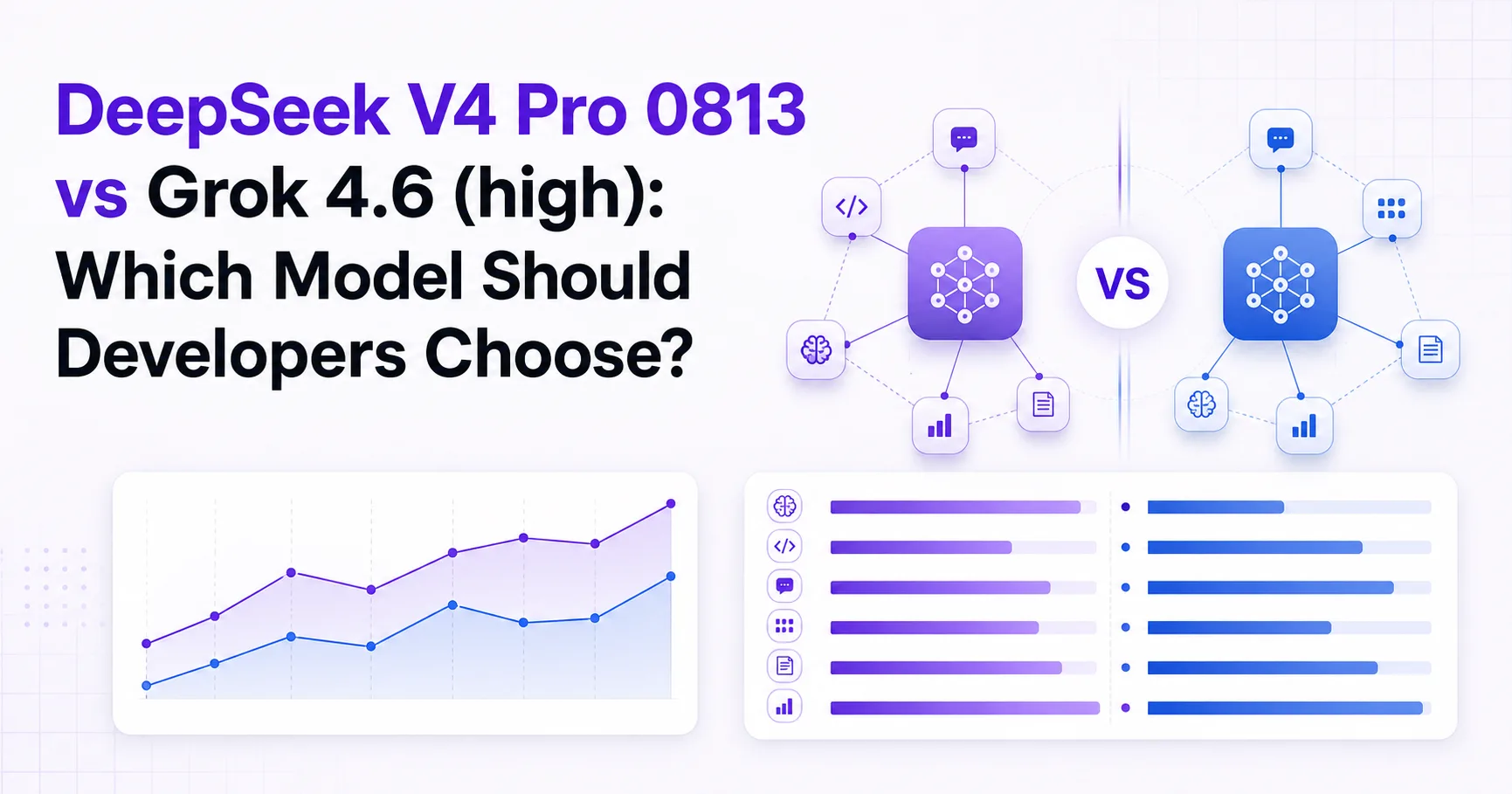
This radar chart visually maps the core capabilities (reasoning, coding, math proxy, multimodal, long context) of `DeepSeek V4 Pro 0813 (Reasoning, Max Effort)` vs `Grok 4.6 (high)`.
This grouped bar chart provides a side-by-side comparison for each benchmark metric.
Lower time to first token is better; higher tokens per second is better.
Compare input and output pricing in USD per 1M tokens.
DeepSeek V4 Pro 0813 (Reasoning, Max Effort)$2.31
Grok 4.6 (high)$3.5
DeepSeek V4 Pro 0813 (Reasoning, Max Effort) costs $1.19 less per run
This article is a dated snapshot published on 2026-08-13. Live cards above use the current catalog; missing live fields are not inferred.
Grok 4.6 (high) is the stronger default for quality-sensitive coding work, while DeepSeek V4 Pro 0813 is the practical default for cost-sensitive production workloads.
The measured gap favors Grok 4.6 (high) on the broad intelligence index, coding index, scientific reasoning evaluation, terminal task evaluation, and banking-agent evaluation. DeepSeek V4 Pro 0813 still offers a credible engineering alternative because it has lower listed blended pricing and lower measured latency.
The decisive question is not which model wins more tests. The decisive question is whether a failed coding attempt costs your team more than a higher model bill. Choose Grok when difficult repository changes, tool-driven tasks, and higher first-pass quality affect developer time. Choose DeepSeek when your product sends many routine requests, needs predictable request economics, or can validate outputs through tests and review.
The official product positioning reinforces this split, but it does not prove it. xAI presents Grok 4.6 as its flagship for code and general tasks, with agent tool use and configurable reasoning in the xAI model documentation. DeepSeek documents a broad API feature set, including JSON output, tool calling, Responses API support, and an Anthropic-compatible endpoint in its pricing and model documentation.
Several procurement questions remain unresolved. Neither supplied official source gives a complete, model-specific public benchmark record. Neither source provides verified community evidence about coding reliability, response feel, or recurring failure patterns. Treat the measurements here as a useful starting point, then run a small evaluation with your own codebase and tool loop before committing a critical workflow.
Data provided by Artificial Analysis.
DeepSeek V4 Pro 0813 offers the clearer low-cost API proposition, while Grok 4.6 (high) offers the clearer quality-first product proposition.
The two models are close in release timing, but their product contracts look different. DeepSeek identifies the listed version as DeepSeek-V4-Pro-0813 and exposes named OpenAI-compatible and Anthropic-compatible API endpoints in the DeepSeek documentation. That reduces integration ambiguity for teams already using those request formats.
Grok 4.6 uses the stable grok-4.6 alias, while grok-4.6-latest follows the latest version within that family, according to the xAI model documentation. This can be attractive for teams that want product updates automatically. It can also require stronger regression checks, because an alias can change the behavior your application receives.
| Decision area | Better current fit | Why it matters |
|---|---|---|
| Highest measured coding capability | Grok 4.6 (high) | Prefer it when coding quality affects delivery speed. |
| Lowest listed token cost | DeepSeek V4 Pro 0813 | Prefer it when request volume drives the budget. |
| Lower measured latency | DeepSeek V4 Pro 0813 | Prefer it for interactive flows where waiting is noticeable. |
| Explicit API compatibility details | DeepSeek V4 Pro 0813 | Useful for teams standardizing on familiar request formats. |
| Real-time factual work with a tool | Grok 4.6 (high) | xAI explicitly documents Web Search and X Search for fresh information. |
A subtle but important difference concerns current information. Grok 4.6 has a stated knowledge cutoff, and xAI says applications must enable Web Search or X Search for information after that point in the xAI model documentation. DeepSeek's supplied documentation does not state an equivalent knowledge cutoff or real-time search policy. That is not proof that DeepSeek has fresher knowledge. It is evidence that the supplied material leaves the comparison unanswered.
For a model-selection decision, documented limits matter almost as much as model scores. DeepSeek publishes a concurrency limit and warns that pricing may rise materially in the future through the DeepSeek documentation. xAI recommends Grok 4.6 for code and general work, but its supplied model page does not publish its price. The data snapshot supplies a price comparison, but teams should still verify commercial terms before signing a budget-sensitive commitment.
Grok 4.6 (high) leads the available quality measurements, but DeepSeek V4 Pro 0813 may feel more responsive in request-to-result workflows.
The chart below matters most for work that cannot be cheaply checked. Grok's advantage on the coding index suggests a better starting point for tasks such as unfamiliar code changes, multi-file reasoning, debugging with incomplete clues, and tool-driven repository work. Its advantage on terminal and banking-agent evaluations also supports using it where a model must navigate a sequence of constrained actions instead of returning one isolated answer.
That does not make Grok automatically better for every developer. The practical benefit of a higher benchmark result depends on your verification loop. If every answer runs through unit tests, static checks, code review, or deterministic business rules, a lower-cost model can be the better system choice. It can generate drafts, classify requests, write routine transformations, and propose narrow changes while your pipeline catches mistakes.
DeepSeek has lower measured latency, at 30.851 seconds versus 49.322 seconds. This gap can matter more than output-token speed in chat-based developer tools, approval workflows, and repeated agent turns. A model that starts and completes a request sooner can reduce interruption, even if another model has a slightly higher median generation rate.
The reported output speeds are nearly alike, at 67.102 and 67.375 median output tokens per second. That means throughput alone should not decide this comparison. Request design can easily dominate the visible difference: prompt length, retrieved files, tool latency, retry behavior, output constraints, and whether the application requests extensive reasoning can all change total completion time.
Evidence is still incomplete in several ways. The supplied DeepSeek official page does not publish official benchmark results, while the supplied xAI page markets Grok as its strongest and fastest model without public benchmark figures in that page. The DeepSeek documentation also limits FIM Completion to non-thinking mode. If your editor integration depends on fill-in-the-middle completion plus reasoning, do not assume DeepSeek can serve that exact workflow without a prototype. The xAI model documentation does not establish model-specific context or output limits for Grok 4.6, so long-context agent use needs direct testing too.
Grok 4.6 (high) leads on 2 of 2 metrics
DeepSeek V4 Pro 0813 is cheaper at every listed token price, but Grok 4.6 (high) can cost less per successful complex task.
The pricing chart below gives the immediate budget answer. DeepSeek's $0.544 blended price is far below Grok's $3 blended price under the supplied pricing assumption. That makes DeepSeek a strong option for high-volume workloads with known formats, short feedback loops, and reliable automated checks.
Token cost is only one part of delivery cost. A lower-priced model becomes expensive when it creates more failed attempts, longer human review, extra tool calls, or repeated repair cycles. This is most likely in ambiguous engineering work, where the model must infer architecture, choose between competing fixes, and preserve behavior across multiple files. Grok's stronger measured coding and agent-task results may justify its higher token price when a good first attempt saves a developer from a long correction cycle.
The reverse is also true. Grok's stronger benchmark position may not justify its price for predictable jobs. Examples include extracting structured fields, drafting a standard response, generating a narrow data transformation, or creating a first-pass test fixture that a deterministic workflow validates. For these cases, DeepSeek's lower listed input and output prices give room to use validation, retries, or separate review steps without immediately making the system uneconomic.
DeepSeek's official pricing page adds two operational caveats. It distinguishes cached and uncached input pricing, which means prompt caching can materially affect actual billing, and it warns that DeepSeek API pricing may increase substantially in the future in the DeepSeek documentation. A production budget should therefore use observed request logs, not only the blended figure in this snapshot.
The supplied xAI model page does not list Grok 4.6 pricing in the xAI model documentation. The snapshot provides comparison values, but the official-source gap means buyers should confirm current billing, cache behavior, rate limits, and any tool-related charges before treating the displayed number as a contract. Neither supplied source answers how reasoning effort changes token usage, which is a major evidence gap for agent workloads.
DeepSeek V4 Pro 0813 (Reasoning, Max Effort) leads on 3 of 3 metrics
Grok 4.6 (high) is the recommended primary model for high-stakes coding agents, while DeepSeek V4 Pro 0813 is the recommended primary model for cost-controlled production automation.
Pick Grok 4.6 (high) when the model changes production code, operates developer tools, investigates difficult failures, or completes tasks where one strong answer is more valuable than several cheap attempts. Its measured lead on coding and related agent-style evaluations gives it the better evidence base for this role. If the work depends on current external facts, enable the documented Web Search or X Search capability because xAI says the model otherwise relies on knowledge through its stated cutoff in the xAI model documentation.
Pick DeepSeek V4 Pro 0813 when you have large request volume, strong output validation, and an application that can tolerate model review or retries. Its pricing advantage is meaningful for classification, extraction, structured generation, routine code assistance, and internal tools with well-defined guardrails. Its documented JSON output, tool calling, Responses API support, and Anthropic-compatible API also make it straightforward to fit into existing application patterns through the DeepSeek documentation.
For many teams, the most sensible architecture is a routing policy rather than a permanent single-model decision. Send low-risk, repeatable requests to DeepSeek. Escalate ambiguous code changes, multi-step tool tasks, and expensive failures to Grok. This recommendation is an engineering judgment based on the supplied measurements, not a claim that either vendor documents such a routing strategy.
Before rollout, run an internal evaluation that mirrors the actual job. Include representative prompts, retrieved context, tool calls, malformed-input handling, expected output format, retry behavior, and human review time. Record success rate, time to accepted result, and total token use. Do not rely only on public benchmarks because the supplied materials leave several selection-critical facts unresolved: Grok 4.6 model-specific context and output limits, DeepSeek official benchmark evidence, model-specific log probability behavior for Grok, and verified community reports for either model.
DeepSeek's documented concurrency limit is 500, so high-volume deployments should include queues, rate limiting, and retries as described by the DeepSeek documentation. Grok applications should also test alias-update behavior before using a moving alias in a regulated or regression-sensitive workflow.
DeepSeek V4 Pro 0813 and Grok 4.6 (high) should both be tested against your own production tasks before a final model commitment.
Public measurements are helpful because they identify a likely trade-off: Grok has the stronger available capability evidence, while DeepSeek has the lower listed cost and latency. They cannot answer whether either model understands your domain language, respects your output schema, handles your repository conventions, or succeeds with your specific tools.
The most important unanswered question is how much quality variance your application can absorb. A customer-facing answer with human review can accept a different error profile than an autonomous code-change agent. The second unanswered question is contract stability. DeepSeek warns that API pricing may rise, while xAI documents stable and latest aliases that may behave differently over time. The third unanswered question is long-context behavior. DeepSeek documents its own context and output limits, but the supplied xAI material does not provide equivalent Grok 4.6-specific limits.
Use the FAQ below as a pre-purchase checklist. It separates facts supported by the supplied sources from conclusions that require direct API testing. The DeepSeek documentation and xAI model documentation are product documentation, not independent reliability studies. The benchmark data is attributed to Artificial Analysis, and it should be read alongside your own acceptance tests.
Grok 4.6 (high) is the better starting choice for an autonomous coding agent because it leads the supplied coding and tool-oriented evaluations. Validate it against your repository, test suite, tool permissions, and review process before allowing autonomous changes.
DeepSeek V4 Pro 0813 is the better starting choice for a high-volume API product because its listed blended, input, and output prices are lower. Confirm actual cache behavior, retry rates, output length, and future pricing before setting a long-term budget.
Grok 4.6 can support current-information tasks only when the application enables Web Search or X Search. xAI states that without those tools, the model relies on training knowledge through 2026-02-01, so current facts require retrieval.
DeepSeek V4 Pro 0813 may fit some completion workflows, but its documented FIM Completion capability only supports non-thinking mode. Teams that require fill-in-the-middle completion with reasoning should prototype the exact editor flow before choosing it.
No, the published figures are enough to shortlist a model, not to approve a final production choice. The supplied sources leave context behavior, output limits, reasoning-token usage, community reliability evidence, and several API compatibility details insufficiently documented.