
Time to First Token · DeepSeek V4 Pro 0813 (Reasoning, Max Effort)
1043ms
Time to First Token · Muse Spark 1.2 (xhigh)
0ms
Deep dive into reasoning, benchmarks, and latency insights.
The current catalog does not contain complete performance evidence for both models, so this page does not declare an overall winner. Use the available fields as comparison signals and validate the models on your own workload.
Key decision metrics at a glance.
| Model | Metric | Value | Unit | Source / snapshot |
|---|---|---|---|---|
| DeepSeek V4 Pro 0813 (Reasoning, Max Effort) | Reasoning | 6.0 | benchmark or capability score | Artificial Analysis · current catalog |
| Muse Spark 1.2 (xhigh) | Reasoning | 6.0 | benchmark or capability score | Artificial Analysis · current catalog |
| DeepSeek V4 Pro 0813 (Reasoning, Max Effort) | Coding | 7.0 | benchmark or capability score | Artificial Analysis · current catalog |
| Muse Spark 1.2 (xhigh) | Coding | 7.0 | benchmark or capability score | Artificial Analysis · current catalog |
| DeepSeek V4 Pro 0813 (Reasoning, Max Effort) | Multimodal | 4.0 | benchmark or capability score | Artificial Analysis · current catalog |
| Muse Spark 1.2 (xhigh) | Multimodal | 5.0 | benchmark or capability score | Artificial Analysis · current catalog |
| DeepSeek V4 Pro 0813 (Reasoning, Max Effort) | Long Context | 7.0 | benchmark or capability score | Artificial Analysis · current catalog |
| Muse Spark 1.2 (xhigh) | Long Context | 7.0 | benchmark or capability score | Artificial Analysis · current catalog |
| DeepSeek V4 Pro 0813 (Reasoning, Max Effort) | Blended Price / 1M tokens | $1.98 | USD per 1M tokens | Artificial Analysis · current catalog |
| Muse Spark 1.2 (xhigh) | Blended Price / 1M tokens | $2 | USD per 1M tokens | Artificial Analysis · current catalog |
| DeepSeek V4 Pro 0813 (Reasoning, Max Effort) | P95 Latency | — | milliseconds | Artificial Analysis · current catalog |
| Muse Spark 1.2 (xhigh) | P95 Latency | — | milliseconds | Artificial Analysis · current catalog |
| DeepSeek V4 Pro 0813 (Reasoning, Max Effort) | Tokens per second | 75.255 | tokens per second | Artificial Analysis · current catalog |
| Muse Spark 1.2 (xhigh) | Tokens per second | 0 | tokens per second | Artificial Analysis · current catalog |
Data provided by Artificial Analysis; live values use the current catalog.
This radar chart visually maps the core capabilities (reasoning, coding, math proxy, multimodal, long context) of `DeepSeek V4 Pro 0813 (Reasoning, Max Effort)` vs `Muse Spark 1.2 (xhigh)`.
This grouped bar chart provides a side-by-side comparison for each benchmark metric.
Lower time to first token is better; higher tokens per second is better.
Compare input and output pricing in USD per 1M tokens.
DeepSeek V4 Pro 0813 (Reasoning, Max Effort)$2.31
Muse Spark 1.2 (xhigh)$2.313
DeepSeek V4 Pro 0813 (Reasoning, Max Effort) costs $0.002 less per run
This article is a dated snapshot published on 2026-08-13. Live cards above use the current catalog; missing live fields are not inferred.
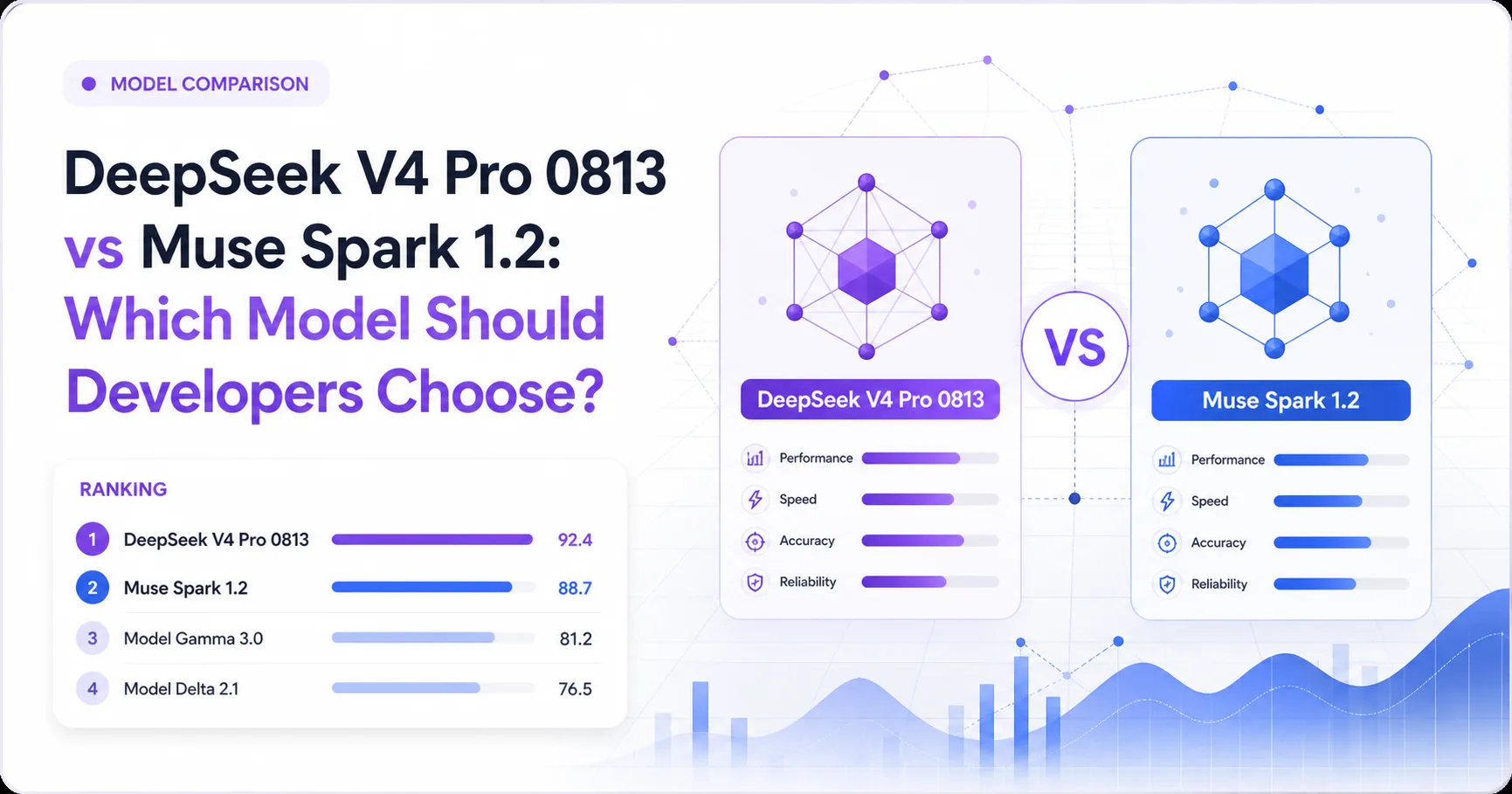
DeepSeek V4 Pro 0813 is the safer production choice because its vendor documents an active API, supported features, and operating limits. Muse Spark 1.2 has stronger results on several measured evaluations, yet its public Meta documentation does not identify that model name or its API alias (Meta AI Documentation: Get started with Llama).
That distinction matters more than a small benchmark lead when a team must ship. A model choice includes procurement, authentication, API compatibility, incident handling, limits, and the ability to reproduce a successful test. DeepSeek explicitly lists deepseek-v4-pro, identifies the version as DeepSeek-V4-Pro-0813, and provides OpenAI-format and Anthropic-format API endpoints (DeepSeek Models & Pricing).
Muse Spark 1.2 should therefore be treated as a benchmark candidate, not a confirmed default vendor integration. The data snapshot lists a release date and token prices for Muse Spark 1.2, but the supplied Meta documentation does not confirm its public model entry, stable alias, pricing, context limit, or request parameters (Meta AI Documentation: Get started with Llama). That is not evidence that the model is unusable. It is evidence that a buyer cannot validate the normal production contract from the supplied official source.
The benchmark and price figures discussed here come from Artificial Analysis. Data provided by https://artificialanalysis.ai/.
For most developers, start with DeepSeek for the first deployable implementation. Keep Muse in a gated evaluation only if you have a verified access path and can reproduce the results on your own workload.
DeepSeek V4 Pro 0813 wins the operational comparison, while Muse Spark 1.2 wins the available aggregate intelligence and coding measurements. The evidence supports two different conclusions, so treating them as one overall ranking would hide the real trade-off.
| Decision area | Better-supported choice | What the evidence says |
|---|---|---|
| Production integration | DeepSeek V4 Pro 0813 | DeepSeek documents model identity, API formats, JSON output, tool calling, Responses API, and Chat Prefix Completion (DeepSeek Models & Pricing). |
| Measured coding quality | Muse Spark 1.2 | Muse records 72.2 on the coding index, compared with 68.8 for DeepSeek in the supplied snapshot. |
| Listed blended token cost | DeepSeek V4 Pro 0813 | DeepSeek is listed at $0.544 per 1M blended tokens, while Muse is listed at $2. |
| Documented long-context use | DeepSeek V4 Pro 0813 | DeepSeek lists a 1M context window and a 384K maximum output (DeepSeek Models & Pricing). |
| Official availability confidence | DeepSeek V4 Pro 0813 | Meta's supplied overview documents Llama models, not Muse Spark 1.2 (Meta AI Documentation: Get started with Llama). |
The important uncertainty is not a missing benchmark. It is whether Muse Spark 1.2 can be acquired and used under a documented, stable interface. The supplied material does not answer that question. It also does not establish Muse's context window, maximum output, multimodal boundary, rate limits, or failure behavior.
DeepSeek has its own unresolved points. Its official page does not publish model-specific benchmark results or a multimodal description. It also does not explain whether the 384K maximum output changes by endpoint, request type, or account configuration (DeepSeek Models & Pricing).
Use this comparison as a routing decision. Choose DeepSeek when implementation certainty matters now. Consider Muse only after vendor access, endpoint behavior, and pricing are verified against your intended deployment.
Muse Spark 1.2 leads the supplied coding and intelligence indexes, but DeepSeek V4 Pro 0813 is the only model here with a nonzero measured output-speed figure. Muse reaches 72.2 on the coding index and 56.8 on the intelligence index, while DeepSeek reaches 68.8 and 53 respectively. Those results make Muse worth testing for difficult code generation, repository changes, and multi-step reasoning tasks.
The chart below this section already shows the metric-by-metric comparison. The practical reading is more nuanced. Muse also leads on HLE, SciCode, LCR, and TerminalBench v2.1 in the supplied snapshot. That pattern suggests a plausible advantage on tasks where a developer cares most about completing a hard technical objective correctly. DeepSeek leads on GPQA and Tau Banking, so the available evidence is not a universal quality verdict.
DeepSeek reports 67.102 median output tokens per second and 30.851 seconds of latency in the snapshot. Muse shows 0 for both speed fields. Those zeroes should not be interpreted as proof that Muse has zero output speed or zero latency. The supplied research brief provides no official Muse endpoint or measurement explanation, and therefore cannot establish what those fields mean for an actual request.
For interactive coding, speed can alter the preferred model even when benchmark differences favor another model. A tool-using agent often waits for several model turns, file reads, command results, and user approvals. Slow or unknown response behavior can make a high-quality model harder to use in a tight developer loop. Conversely, a slower model can still be the right choice for a background review job where one successful answer avoids repeated human work.
Run a controlled evaluation before choosing on scores alone. Give each candidate the same prompts, repository context, tools, retry policy, and acceptance tests. The supplied sources contain no reliable community reports for either model, so there is insufficient evidence about real-world coding style, responsiveness under load, or recurring failure patterns.
Muse Spark 1.2 (xhigh) leads on 2 of 2 metrics
DeepSeek V4 Pro 0813 is the lower-cost option in the supplied snapshot, but its listed price should not be treated as a permanent budget guarantee. The blended 3-to-1 figure is $0.544 per 1M tokens for DeepSeek and $2 for Muse. The chart below provides the full price comparison, so the decision is about what can make that apparent saving disappear.
DeepSeek can become more expensive in practice if a task needs more retries, longer prompts, or more output to reach an accepted result. The supplied materials do not measure task completion cost, retry rate, cache-hit rate, or human review time for either model. They therefore cannot prove that the lower token price produces a lower cost per resolved developer task.
DeepSeek's official page adds a second pricing caveat. It lists separate cache-hit input, cache-miss input, and output prices, then warns that future DeepSeek API prices may increase substantially (DeepSeek Models & Pricing). A team should budget from its own input and output patterns rather than assume every workload resembles the blended ratio.
Muse's $2 figure is useful for a benchmark comparison, but it is not confirmed by the supplied Meta official documentation. Meta's overview does not list Muse Spark 1.2 as a public model or provide a price page for it (Meta AI Documentation: Get started with Llama). Do not use that figure alone for a purchase order, customer commitment, or long-term unit-cost forecast.
The sensible cost decision is simple. Use DeepSeek's documented pricing for an initial forecast, add a contingency for its stated price-change risk, and require a verified commercial quote before assigning Muse a production budget.
DeepSeek V4 Pro 0813 (Reasoning, Max Effort) leads on 2 of 3 metrics
DeepSeek V4 Pro 0813 should be the default choice for developers who need to integrate a model now. Its official documentation establishes a named model, an API route, OpenAI-format compatibility, Anthropic-format compatibility, JSON output, tool calling, and a 500 concurrency limit (DeepSeek Models & Pricing). That is enough information to design a real integration path.
Choose DeepSeek for agent workflows that need structured output and tool calls, especially where the team values a documented 1M context window. Choose it for cost-sensitive workloads that can benefit from its lower listed token prices. Choose it cautiously for fill-in-the-middle workflows, because FIM Completion is documented only for non-thinking mode (DeepSeek Models & Pricing).
Muse Spark 1.2 should remain a conditional option. Its stronger coding index can justify evaluation when code quality is the primary objective and a verified provider offers access. However, the provided official Meta page only presents Llama family documentation and does not confirm Muse Spark 1.2's public API, technical limits, or pricing (Meta AI Documentation: Get started with Llama).
Before approving Muse for production, require three proofs: a vendor-supported model identifier and endpoint, written price and limit details, and a repeatable test on your own accepted tasks. Before scaling DeepSeek, validate queueing and retries around the documented 500 concurrency limit. Also test the exact endpoint and account tier you will use, because the available material does not explain every output-limit condition.
This recommendation does not claim DeepSeek is inherently more capable. It says DeepSeek is the better supported procurement and integration decision on the evidence available. Muse may become the stronger choice if official documentation and reproducible access confirm that its benchmark advantage can be delivered in your environment.
DeepSeek V4 Pro 0813 offers enough documented information for a pilot, while Muse Spark 1.2 requires access verification before a comparable pilot can be planned. The most important unanswered questions concern Muse availability and both models' task-level reliability.
Ask your provider whether the exact model alias is stable, whether prices are contractual, and which endpoint supports your required tools. Ask whether limits vary by account, region, request type, or thinking mode. DeepSeek documents several capabilities, but its source does not provide every operational detail (DeepSeek Models & Pricing).
Ask your engineering team to define success before running benchmarks. An accepted patch, a passing test suite, a correct structured response, and a safe tool action are better decision measures than one headline score. The supplied research contains no reliable community evidence for either model, so it cannot substitute for workload-specific testing.
Finally, ask who owns the fallback path. DeepSeek has a documented official route today. The supplied source set does not establish an equivalent public route for Muse (Meta AI Documentation: Get started with Llama). That gap should be resolved before a critical product flow depends on Muse.
DeepSeek V4 Pro 0813 should be deployed first because its official documentation identifies the model, API formats, tool calling, and a 500 concurrency limit (DeepSeek Models & Pricing). Muse Spark 1.2 may warrant testing, but its supplied Meta documentation does not confirm a public model entry or API alias.
Muse Spark 1.2 has the higher supplied coding index, 72.2 versus 68.8, so it is the stronger benchmark candidate for coding quality. That result does not confirm production superiority because the supplied official Meta source does not document Muse Spark 1.2 access, limits, or API behavior (Meta AI Documentation: Get started with Llama).
DeepSeek V4 Pro 0813 has the lower listed blended token price, $0.544 versus $2 per 1M tokens, but it is not always cheaper per completed task. The supplied evidence does not report retry rates, prompt sizes, cache-hit behavior, accepted-output rates, or review time. DeepSeek also warns that API prices may increase (DeepSeek Models & Pricing).
DeepSeek V4 Pro 0813 supports tool calling, JSON output, Responses API, and OpenAI-format and Anthropic-format APIs according to its official pricing page (DeepSeek Models & Pricing). That makes it suitable for a tool-using pilot, although you should test rate limits, retries, and output constraints in your own account.
Muse Spark 1.2 speed fields showing 0 should be treated as unavailable measurement evidence, not as proof of instant responses or no throughput. The supplied research gives no official Muse API documentation or test-method explanation, so developers cannot infer real latency or streaming behavior from those values alone (Meta AI Documentation: Get started with Llama).