
Time to First Token · EXAONE 4.5 33B (Non-reasoning)
0ms
Time to First Token · Gemini 1.5 Pro (Sep '24)
0ms
Deep dive into reasoning, benchmarks, and latency insights.
The current catalog does not contain complete performance evidence for both models, so this page does not declare an overall winner. Use the available fields as comparison signals and validate the models on your own workload.
Key decision metrics at a glance.
| Model | Metric | Value | Unit | Source / snapshot |
|---|---|---|---|---|
| EXAONE 4.5 33B (Non-reasoning) | Reasoning | 6.0 | benchmark or capability score | Artificial Analysis · current catalog |
| Gemini 1.5 Pro (Sep '24) | Reasoning | 6.0 | benchmark or capability score | Artificial Analysis · current catalog |
| EXAONE 4.5 33B (Non-reasoning) | Coding | 6.0 | benchmark or capability score | Artificial Analysis · current catalog |
| Gemini 1.5 Pro (Sep '24) | Coding | 2.0 | benchmark or capability score | Artificial Analysis · current catalog |
| EXAONE 4.5 33B (Non-reasoning) | Multimodal | 5.0 | benchmark or capability score | Artificial Analysis · current catalog |
| Gemini 1.5 Pro (Sep '24) | Multimodal | 1.0 | benchmark or capability score | Artificial Analysis · current catalog |
| EXAONE 4.5 33B (Non-reasoning) | Long Context | 8.0 | benchmark or capability score | Artificial Analysis · current catalog |
| Gemini 1.5 Pro (Sep '24) | Long Context | 1.0 | benchmark or capability score | Artificial Analysis · current catalog |
| EXAONE 4.5 33B (Non-reasoning) | Blended Price / 1M tokens | $0 | USD per 1M tokens | Artificial Analysis · current catalog |
| Gemini 1.5 Pro (Sep '24) | Blended Price / 1M tokens | $0 | USD per 1M tokens | Artificial Analysis · current catalog |
| EXAONE 4.5 33B (Non-reasoning) | P95 Latency | — | milliseconds | Artificial Analysis · current catalog |
| Gemini 1.5 Pro (Sep '24) | P95 Latency | — | milliseconds | Artificial Analysis · current catalog |
| EXAONE 4.5 33B (Non-reasoning) | Tokens per second | 0 | tokens per second | Artificial Analysis · current catalog |
| Gemini 1.5 Pro (Sep '24) | Tokens per second | 0 | tokens per second | Artificial Analysis · current catalog |
Data provided by Artificial Analysis; live values use the current catalog.
This radar chart visually maps the core capabilities (reasoning, coding, math proxy, multimodal, long context) of `EXAONE 4.5 33B (Non-reasoning)` vs `Gemini 1.5 Pro (Sep '24)`.
This grouped bar chart provides a side-by-side comparison for each benchmark metric.
Lower time to first token is better; higher tokens per second is better.
Compare input and output pricing in USD per 1M tokens.
EXAONE 4.5 33B (Non-reasoning)$0
Gemini 1.5 Pro (Sep '24)$0
This article is a dated snapshot published on 2026-08-16. Live cards above use the current catalog; missing live fields are not inferred.
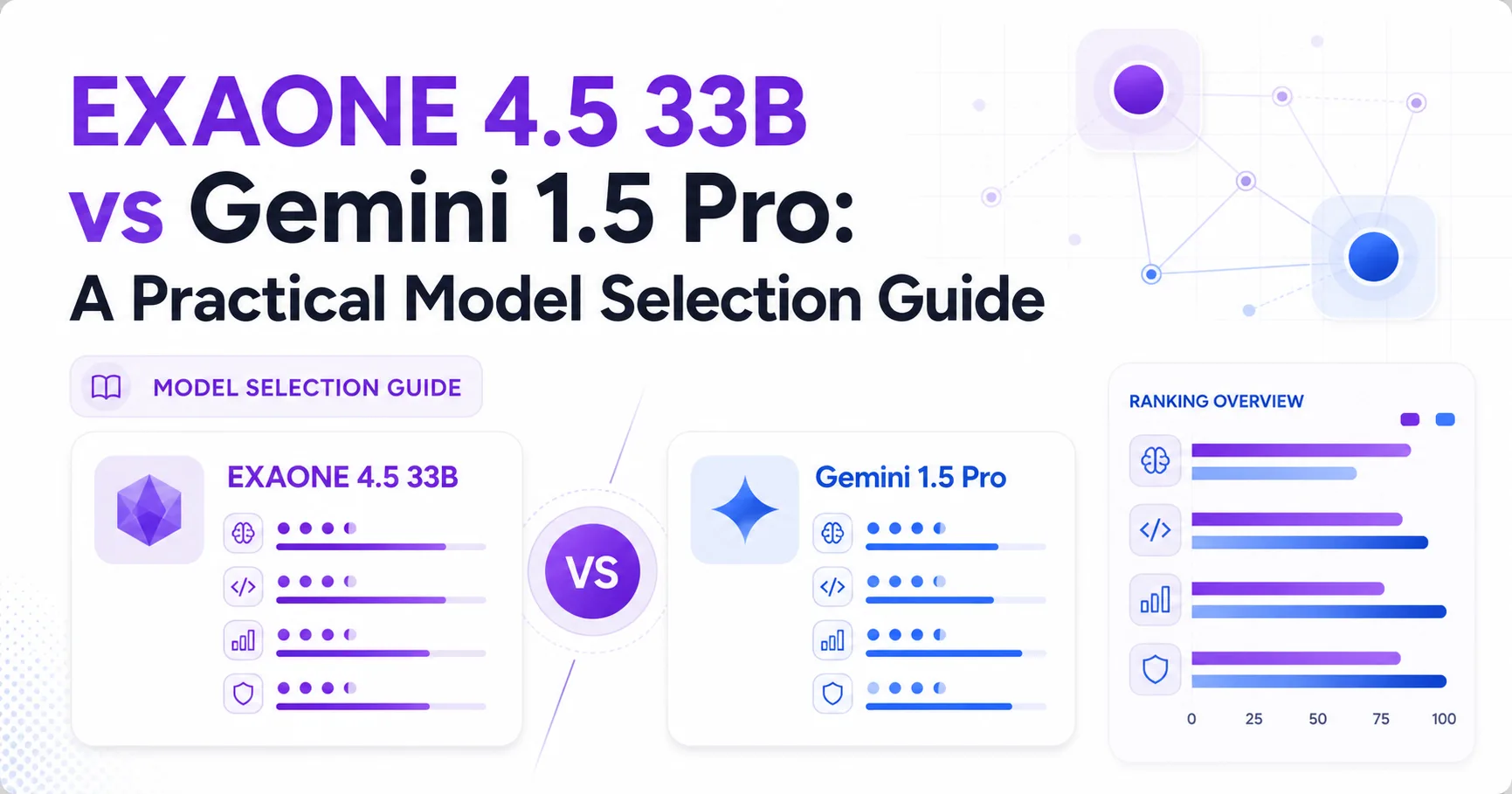
Gemini 1.5 Pro is the safer documented choice, while EXAONE 4.5 33B remains impossible to validate from the supplied evidence.\n\nThis comparison is unusual because the models do not arrive with equal evidence. Gemini 1.5 Pro has official historical positioning, current documentation showing that its active model entry is no longer maintained, and benchmark records in the data brief. EXAONE 4.5 33B has no verifiable vendor announcement, developer documentation, pricing page, or reliable community testing in the supplied research.\n\nThe practical decision is therefore not simply about which model scores higher. It is about whether a development team can verify access, behavior, support, and operating cost before committing production work. The supplied benchmark snapshot reports 0 for EXAONE 4.5 33B output speed, latency, and pricing, but those zeros do not establish that the model is free, instantaneous, or available. They indicate missing or unusable comparison data.\n\nData provided by https://artificialanalysis.ai/.
Gemini 1.5 Pro offers the stronger selection case because its capabilities and benchmark record are observable, even though its current product status is uncertain.\n\nGemini 1.5 Pro was positioned by Google as a multimodal model for complex tasks, accepting text, images, video, and audio inputs while producing text output. The official Gemini API models documentation also preserves the model family’s long-context positioning, historically described as reaching about 2 million tokens, although the current page does not preserve a standalone parameter record for the Sep '24 version.\n\nThe data brief gives Gemini 1.5 Pro measurable results across several developer-relevant evaluations. Its Artificial Analysis coding index is 23.6, its general intelligence index is 9.9, and its MMLU Pro score is 0.75. It also records 0.316 on LiveCodeBench, 0.295 on SciCode, and 0.876 on Math 500. These values do not prove that Gemini will win every production workload, but they provide a starting point for testing.\n\nEXAONE 4.5 33B cannot receive the same positive assessment because the research found no reliable evidence for its context window, output limit, API parameters, multimodal support, pricing, coding behavior, speed, or failure patterns. A missing score is not a low score. It is an evidence gap that prevents a fair capability ranking.\n\n| Decision factor | Practical reading |\n|---|---|\n| Evidence quality | Gemini 1.5 Pro has official and benchmark evidence; EXAONE 4.5 33B does not have verifiable supporting material in this brief. |\n| Current availability | Gemini 1.5 Pro is absent from the current active model list; EXAONE 4.5 33B availability is also unverified. |\n| Capability comparison | Gemini has recorded scores; EXAONE has no comparable values. |\n| Listed cost | The snapshot reports $0 for both, but neither figure should be treated as a confirmed current price. |
Gemini 1.5 Pro is the only model with usable benchmark evidence, but the evidence does not answer every production-performance question.\n\nThe recorded scores suggest that Gemini 1.5 Pro can be evaluated as a general-purpose model with meaningful coding and reasoning signals. A coding index of 23.6 is useful for screening software tasks, while 0.75 on MMLU Pro indicates measurable performance across broad knowledge and reasoning questions. The 0.316 LiveCodeBench result is relevant to coding evaluation, but it should not be treated as a direct forecast of repository-level engineering success. Real applications also depend on tool use, context quality, instruction following, and error recovery.\n\nThe 0.876 Math 500 score gives Gemini a stronger signal for structured mathematical work than the supplied EXAONE evidence can provide. The 0.589 GPQA score and 0.046 HLE score show that performance varies by evaluation type. That variation matters for developers: a model can be useful for routine coding assistance while remaining unreliable on difficult research questions.\n\nEXAONE 4.5 33B has no reported evaluation values in the snapshot. Its 0 median output tokens per second and 0 latency seconds should not be read as a performance advantage. The research also found no community material that verifies coding experience, speed perception, stable behavior, or repeatable failure cases. The correct conclusion is that EXAONE needs a direct access test before it can be compared on quality or responsiveness.\n\nGemini’s historical long-context positioning may make it attractive for large documents, code repositories, and multimodal inputs. However, the current official documentation does not preserve a verified context or output limit for this exact version. Developers should therefore test the actual endpoint and model response limits rather than design around the historical positioning.\n\nThe key performance risk is version drift. Gemini’s benchmark values describe a dated model entry, not necessarily an active service with unchanged behavior. EXAONE’s risk is earlier in the process: the team cannot confirm the model’s behavior or access path from the supplied sources.
Gemini 1.5 Pro and EXAONE 4.5 33B appear tied at $0 in the snapshot, but neither model has a verified current production price in the supplied research.\n\nThe data brief reports $0 for each model’s blended price, input-token price, and output-token price. It also reports 0 for output speed and latency. Those values create a numerical tie, but they do not establish a commercial tie. The research explicitly says that no current price could be verified for EXAONE 4.5 33B, and Google’s current Gemini API pricing page does not list Gemini 1.5 Pro as an active priced model.\n\nFor a developer choosing a production model, an unknown price can be more expensive than a known high price. The team cannot create a reliable budget, quota policy, or unit-economics estimate if the endpoint, billing category, and token rates are unclear. A model that appears free in an incomplete dataset may require migration work, special access, or a different provider route.\n\nGemini 1.5 Pro also carries a commercial continuity risk because it is absent from the current active model list. The official models page places some older models in a closed category, but it does not provide a clear retirement date for this exact Sep '24 entry. That creates uncertainty about how long an integration can remain unchanged.\n\nEXAONE 4.5 33B has a different cost problem. Its listed $0 price cannot be connected to a confirmed API, public quota, or vendor billing policy. The research found no verified pricing page. Teams should not select it for cost savings until access and billing are confirmed in writing or through a controlled account test.\n\nThe chart below should be read as a data-availability snapshot, not as a final purchasing recommendation. The commercial decision requires verified current pricing, rate limits, endpoint stability, and migration terms.
Gemini 1.5 Pro is the better default for a new evaluation, while neither model should be accepted into production without an availability check.\n\nChoose Gemini 1.5 Pro when the project needs a documented multimodal direction, a measurable starting point for coding or reasoning tests, and a model whose historical product role is understandable. Its recorded 23.6 coding index, 0.75 MMLU Pro score, and 0.876 Math 500 score give the team concrete hypotheses to validate with its own prompts. The official Google documentation also supports the conclusion that Gemini 1.5 Pro was designed for complex multimodal tasks, even though the exact old version is no longer represented as an active model entry.\n\nDo not choose EXAONE 4.5 33B solely because the snapshot shows $0 pricing or 0 latency. The supplied research cannot confirm whether the model is callable, whether a stable alias exists, whether it supports the required inputs, or whether its behavior is suitable for coding. Those are foundational selection questions, and the current evidence does not answer them.\n\nA reasonable selection rule is simple: use Gemini as the benchmarked reference, and treat EXAONE as an unverified candidate. Run the same private test set against any accessible endpoint. Include repository edits, long-document extraction, structured output, error recovery, and the project’s most important multimodal task. Record successful task completion, retry frequency, response stability, and the actual billed amount.\n\nThe decision can change if EXAONE gains reliable documentation and a repeatable access path. It can also change if Gemini’s endpoint is unavailable or its current replacement requires migration. The supplied research does not establish which model has better real-world coding quality, lower operational cost, or higher uptime. It establishes that Gemini has more visible evidence and that both models have unresolved availability questions.\n\n| Choose this model | Only if this condition is true |\n|---|---|\n| Gemini 1.5 Pro | The team can access a working endpoint and accepts the risk of using a dated model entry. |\n| EXAONE 4.5 33B | The team can verify an official access route, current pricing, model limits, and task quality through direct testing. |\n| Neither yet | The project requires guaranteed long-term support, stable pricing, or documented production limits. |
Gemini 1.5 Pro is easier to evaluate because the supplied material includes official documentation and multiple benchmark values.\n\nThe unanswered questions are important. The research does not provide a verified current endpoint, current price, exact context limit, output limit, or reproducible community test for Gemini 1.5 Pro (Sep '24). It provides even less for EXAONE 4.5 33B. Developers should treat the comparison as a decision-risk assessment, then validate the specific service configuration they plan to use.
Gemini 1.5 Pro is the stronger starting choice because it has official historical positioning and measurable benchmark evidence, while EXAONE 4.5 33B has no verified access or capability documentation in this research.
EXAONE 4.5 33B should not be assumed free because the research found no verified pricing page, public endpoint, or billing explanation connecting the reported $0 value to a usable production service.
Gemini 1.5 Pro does not have a verified active endpoint in the supplied evidence because the current official model directory no longer lists an active entry for this specific Sep '24 version.
Neither model can be identified as faster from the supplied snapshot because EXAONE 4.5 33B and Gemini 1.5 Pro are both recorded at 0 median output tokens per second and 0 latency seconds.
Gemini 1.5 Pro’s 23.6 coding index and 0.316 LiveCodeBench result provide useful screening signals, but they cannot predict repository-level success without testing tools, context handling, instruction following, and error recovery.
Availability is the biggest unresolved risk because Gemini 1.5 Pro is absent from the current active model list, while EXAONE 4.5 33B lacks verified documentation proving that developers can call it reliably.