
Time to First Token · EXAONE 4.5 33B (Non-reasoning)
0ms
Time to First Token · GPT-4
0ms
Deep dive into reasoning, benchmarks, and latency insights.
The current catalog does not contain complete performance evidence for both models, so this page does not declare an overall winner. Use the available fields as comparison signals and validate the models on your own workload.
Key decision metrics at a glance.
| Model | Metric | Value | Unit | Source / snapshot |
|---|---|---|---|---|
| EXAONE 4.5 33B (Non-reasoning) | Reasoning | 6.0 | benchmark or capability score | Artificial Analysis · current catalog |
| GPT-4 | Reasoning | 6.0 | benchmark or capability score | Artificial Analysis · current catalog |
| EXAONE 4.5 33B (Non-reasoning) | Coding | 6.0 | benchmark or capability score | Artificial Analysis · current catalog |
| GPT-4 | Coding | 1.0 | benchmark or capability score | Artificial Analysis · current catalog |
| EXAONE 4.5 33B (Non-reasoning) | Multimodal | 5.0 | benchmark or capability score | Artificial Analysis · current catalog |
| GPT-4 | Multimodal | 1.0 | benchmark or capability score | Artificial Analysis · current catalog |
| EXAONE 4.5 33B (Non-reasoning) | Long Context | 8.0 | benchmark or capability score | Artificial Analysis · current catalog |
| GPT-4 | Long Context | 1.0 | benchmark or capability score | Artificial Analysis · current catalog |
| EXAONE 4.5 33B (Non-reasoning) | Blended Price / 1M tokens | $0 | USD per 1M tokens | Artificial Analysis · current catalog |
| GPT-4 | Blended Price / 1M tokens | $37.5 | USD per 1M tokens | Artificial Analysis · current catalog |
| EXAONE 4.5 33B (Non-reasoning) | P95 Latency | — | milliseconds | Artificial Analysis · current catalog |
| GPT-4 | P95 Latency | — | milliseconds | Artificial Analysis · current catalog |
| EXAONE 4.5 33B (Non-reasoning) | Tokens per second | 0 | tokens per second | Artificial Analysis · current catalog |
| GPT-4 | Tokens per second | 0 | tokens per second | Artificial Analysis · current catalog |
Data provided by Artificial Analysis; live values use the current catalog.
This radar chart visually maps the core capabilities (reasoning, coding, math proxy, multimodal, long context) of `EXAONE 4.5 33B (Non-reasoning)` vs `GPT-4`.
This grouped bar chart provides a side-by-side comparison for each benchmark metric.
Lower time to first token is better; higher tokens per second is better.
Compare input and output pricing in USD per 1M tokens.
EXAONE 4.5 33B (Non-reasoning)$0
GPT-4$45
EXAONE 4.5 33B (Non-reasoning) costs $45 less per run
This article is a dated snapshot published on 2026-08-16. Live cards above use the current catalog; missing live fields are not inferred.
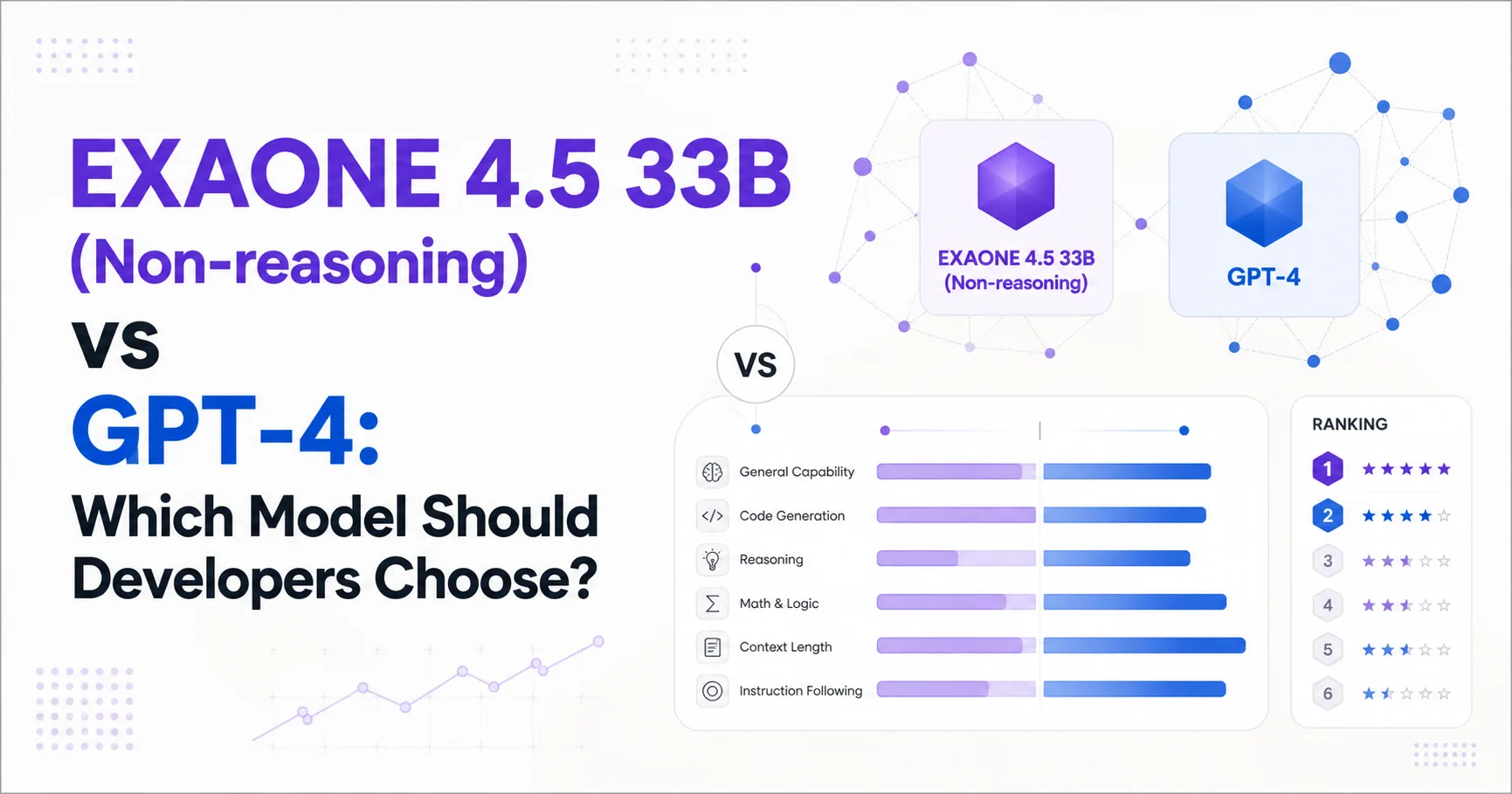
GPT-4 is the safer documented choice for developers, while EXAONE 4.5 33B (Non-reasoning) is cheaper on the supplied snapshot but not sufficiently documented for confident production selection.
The supplied data lists EXAONE 4.5 33B (Non-reasoning) with a release date of 2026-04-09 and a blended price of $0 per 1M tokens. It lists GPT-4 with a release date of 2023-03-14 and a blended price of $37.5 per 1M tokens. Data provided by Artificial Analysis.
That price difference looks decisive until availability and meaning are examined. The research found no verified EXAONE official announcement, developer documentation, pricing page, community testing, or failure analysis. A listed price of $0 may represent missing commercial information, free access, or an unavailable route. The supplied evidence does not establish which explanation is correct.
GPT-4 has measurable results in the supplied snapshot, including a 13.1 coding index, a 6.8 intelligence index, a 0.562 MMLU-Pro score, a 0.349 GPQA score, a 0.568 Math-500 score, and a 0.331972789115646 IFBench score. These figures do not prove current access or current product support, but they give developers a visible quality baseline.
GPT-4 offers the stronger selection case because its quality evidence is visible, while EXAONE 4.5 33B (Non-reasoning) offers only an apparently lower price without enough operational proof.
The comparison is not a normal benchmark contest. The supplied snapshot contains no evaluation values for EXAONE 4.5 33B (Non-reasoning), so no score difference or quality winner can be calculated. GPT-4 has a 13.1 coding index and a 6.8 intelligence index, but the absence of EXAONE results means these values show documented performance rather than a verified head-to-head advantage.
The official evidence also creates a version-status problem for GPT-4. OpenAI's current model documentation focuses on GPT-5.6, GPT-5.5, and GPT-5.4, and does not provide current GPT-4 capability parameters. The current pricing documentation does not list GPT-4, GPT-4-0314, or GPT-4-0613. Therefore, the snapshot's GPT-4 price is useful for comparison, but it should not be treated as a confirmed current purchase price.
For a developer, the decision depends on what must be proven before launch. GPT-4 is the better candidate for a quality-sensitive evaluation because its supplied evidence includes coding, intelligence, instruction-following, knowledge, reasoning, and mathematics indicators. EXAONE may become attractive if a reachable endpoint, stable model identifier, current license, and reproducible tests confirm the $0 price. The research does not confirm any of those conditions.
GPT-4 has the stronger documented performance position, but the supplied evidence cannot establish a direct performance winner against EXAONE 4.5 33B (Non-reasoning).
The most useful signal for software teams is GPT-4's 13.1 coding index. That result supports testing GPT-4 for code generation, code explanation, refactoring, and debugging workflows. It does not guarantee success on a particular repository. Coding quality can change with prompt structure, tool access, context selection, test coverage, and the model endpoint actually serving the request.
GPT-4 also records a 6.8 intelligence index, a 0.562 MMLU-Pro score, a 0.349 GPQA score, a 0.568 Math-500 score, and a 0.331972789115646 IFBench score. Together, these values suggest that the supplied evaluation coverage is broader than coding alone. The scores still describe measured tasks, not business outcomes. They cannot confirm response consistency, repository-level reliability, tool-use behavior, or production error rates.
EXAONE 4.5 33B (Non-reasoning) has null values across the supplied evaluation fields. That is not evidence of poor performance. It is evidence that this comparison lacks a verified measurement for the model. The research also found no reliable community posts that could fill the gap with coding experience, speed impressions, or known failure patterns.
Speed is unresolved for the same reason. The supplied snapshot records 0 median output tokens per second and 0 latency seconds for each model. Those values should not be interpreted as equal real-world speed. They indicate that the snapshot provides no usable speed comparison. Developers should run the same prompts, output limits, region, provider, and concurrency settings before making a latency decision.
The practical implication is simple: use GPT-4 as the measurable baseline, then treat EXAONE as an unverified candidate that requires a controlled test. Do not infer an EXAONE quality or speed advantage from missing values.
EXAONE 4.5 33B (Non-reasoning) is the apparent cost winner at $0, but GPT-4 has the more interpretable commercial record in the supplied comparison.
The data lists EXAONE at $0 per 1M blended tokens, $0 per 1M input tokens, and $0 per 1M output tokens. It lists GPT-4 at $37.5 per 1M blended tokens, $30 per 1M input tokens, and $60 per 1M output tokens. The difference is large enough to change the business case if EXAONE is genuinely available under those terms.
The key problem is that the research found no verified EXAONE pricing page or product documentation. Therefore, $0 may mean no published price in the data source rather than a confirmed free production API. Developers should verify whether the model can be called, whether access is stable, whether the license permits the intended use, and whether infrastructure or hosting costs sit outside the listed token price. The supplied research does not answer these questions.
GPT-4's listed values should also be handled carefully. OpenAI's current pricing page does not list GPT-4 or its named dated variants. The supplied $37.5 blended figure therefore describes the comparison snapshot, not a current official quotation. The same applies to the $30 input and $60 output values.
Cheap inference can still become expensive if a model needs more retries, stronger validation, human review, or migration work. A model with an apparent $0 token price may cost more in engineering time when its endpoint, behavior, or license is uncertain. Conversely, GPT-4's documented evaluation record may reduce evaluation effort, but its current availability remains unconfirmed. The correct cost test includes token spend, integration work, reliability, review burden, and exit risk.
EXAONE 4.5 33B (Non-reasoning) leads on 3 of 3 metrics
GPT-4 should be the default evaluation baseline, while EXAONE 4.5 33B (Non-reasoning) should enter the shortlist only after its access and evidence gaps are closed.
Choose GPT-4 when the team needs a known reference point for coding and general task quality. The supplied 13.1 coding index gives engineering teams a concrete starting signal. The 6.8 intelligence index and additional values for MMLU-Pro, GPQA, Math-500, and IFBench support broader testing. These results do not settle production suitability, but they make GPT-4 easier to evaluate against a real task set.
Choose EXAONE when the team can verify that the $0 pricing is real, the model is reachable, the model identifier is stable, and the license fits the product. The data lists its release date as 2026-04-09, but the research found no official material confirming its current product status. That gap matters more than the price because an unavailable or unstable model cannot serve a production workflow.
Do not make a final decision from the supplied benchmark snapshot alone. EXAONE has no recorded evaluation values, and neither model has usable speed values because each is listed at 0 median output tokens per second and 0 latency seconds. GPT-4 also lacks current official capability and pricing details in the reviewed OpenAI pages. The evidence supports a staged selection rule: establish GPT-4 as the reference, then promote EXAONE only if direct testing validates quality, reliability, access, and total operating cost.
The unresolved questions are material. The research does not confirm EXAONE's context window, output limit, API parameters, multimodal support, failure modes, community usage, or current availability. It also does not confirm which GPT-4 endpoint, if any, remains callable. Those unknowns should be recorded as launch risks, not silently filled with assumptions.
GPT-4 is the better starting point for a developer evaluation because the supplied snapshot contains documented quality indicators, while EXAONE 4.5 33B (Non-reasoning) has no comparable evaluation evidence.
The apparent $0 price for EXAONE 4.5 33B (Non-reasoning) is not enough to confirm free production use because the research found no verified pricing page, endpoint status, stable alias, or license information.
GPT-4 should not be assumed to be currently available merely because the supplied snapshot lists a $37.5 blended price, since OpenAI's current pricing page does not list GPT-4 or its dated variants.
The supplied snapshot cannot identify a faster model because EXAONE 4.5 33B (Non-reasoning) and GPT-4 are each recorded at 0 median output tokens per second and 0 latency seconds, values that provide no usable real-world speed evidence.
No defensible quality winner can be established because EXAONE 4.5 33B (Non-reasoning) has no supplied benchmark values, while GPT-4 has documented results including a 13.1 coding index and a 6.8 intelligence index.
The supplied snapshot lists EXAONE 4.5 33B (Non-reasoning) at $0, but the research found no verified pricing page or access details confirming that developers can use it freely in production.
EXAONE 4.5 33B (Non-reasoning) is the apparent cheaper option at $0 per 1M blended tokens, compared with GPT-4 at $37.5, although EXAONE's commercial availability remains unverified.
Neither model can be identified as faster from the supplied data because EXAONE 4.5 33B (Non-reasoning) and GPT-4 are both recorded at 0 median output tokens per second and 0 latency seconds.
GPT-4 is a reasonable evaluation baseline because its supplied results include coding, intelligence, knowledge, reasoning, instruction-following, and mathematics signals, but current endpoint availability requires verification.
Developers should verify a reachable endpoint, stable model identifier, current license, reproducible task results, context limits, output limits, failure behavior, and whether the listed $0 price represents real production access.