
Time to First Token · EXAONE 4.5 33B (Non-reasoning)
0ms
Time to First Token · GPT-4o (Nov '24)
0ms
Deep dive into reasoning, benchmarks, and latency insights.
The current catalog does not contain complete performance evidence for both models, so this page does not declare an overall winner. Use the available fields as comparison signals and validate the models on your own workload.
Key decision metrics at a glance.
| Model | Metric | Value | Unit | Source / snapshot |
|---|---|---|---|---|
| EXAONE 4.5 33B (Non-reasoning) | Reasoning | 6.0 | benchmark or capability score | Artificial Analysis · current catalog |
| GPT-4o (Nov '24) | Reasoning | 1.0 | benchmark or capability score | Artificial Analysis · current catalog |
| EXAONE 4.5 33B (Non-reasoning) | Coding | 6.0 | benchmark or capability score | Artificial Analysis · current catalog |
| GPT-4o (Nov '24) | Coding | 6.0 | benchmark or capability score | Artificial Analysis · current catalog |
| EXAONE 4.5 33B (Non-reasoning) | Multimodal | 5.0 | benchmark or capability score | Artificial Analysis · current catalog |
| GPT-4o (Nov '24) | Multimodal | 1.0 | benchmark or capability score | Artificial Analysis · current catalog |
| EXAONE 4.5 33B (Non-reasoning) | Long Context | 8.0 | benchmark or capability score | Artificial Analysis · current catalog |
| GPT-4o (Nov '24) | Long Context | 1.0 | benchmark or capability score | Artificial Analysis · current catalog |
| EXAONE 4.5 33B (Non-reasoning) | Blended Price / 1M tokens | $0 | USD per 1M tokens | Artificial Analysis · current catalog |
| GPT-4o (Nov '24) | Blended Price / 1M tokens | $4.375 | USD per 1M tokens | Artificial Analysis · current catalog |
| EXAONE 4.5 33B (Non-reasoning) | P95 Latency | — | milliseconds | Artificial Analysis · current catalog |
| GPT-4o (Nov '24) | P95 Latency | — | milliseconds | Artificial Analysis · current catalog |
| EXAONE 4.5 33B (Non-reasoning) | Tokens per second | 0 | tokens per second | Artificial Analysis · current catalog |
| GPT-4o (Nov '24) | Tokens per second | 0 | tokens per second | Artificial Analysis · current catalog |
Data provided by Artificial Analysis; live values use the current catalog.
This radar chart visually maps the core capabilities (reasoning, coding, math proxy, multimodal, long context) of `EXAONE 4.5 33B (Non-reasoning)` vs `GPT-4o (Nov '24)`.
This grouped bar chart provides a side-by-side comparison for each benchmark metric.
Lower time to first token is better; higher tokens per second is better.
Compare input and output pricing in USD per 1M tokens.
EXAONE 4.5 33B (Non-reasoning)$0
GPT-4o (Nov '24)$5
EXAONE 4.5 33B (Non-reasoning) costs $5 less per run
This article is a dated snapshot published on 2026-08-16. Live cards above use the current catalog; missing live fields are not inferred.
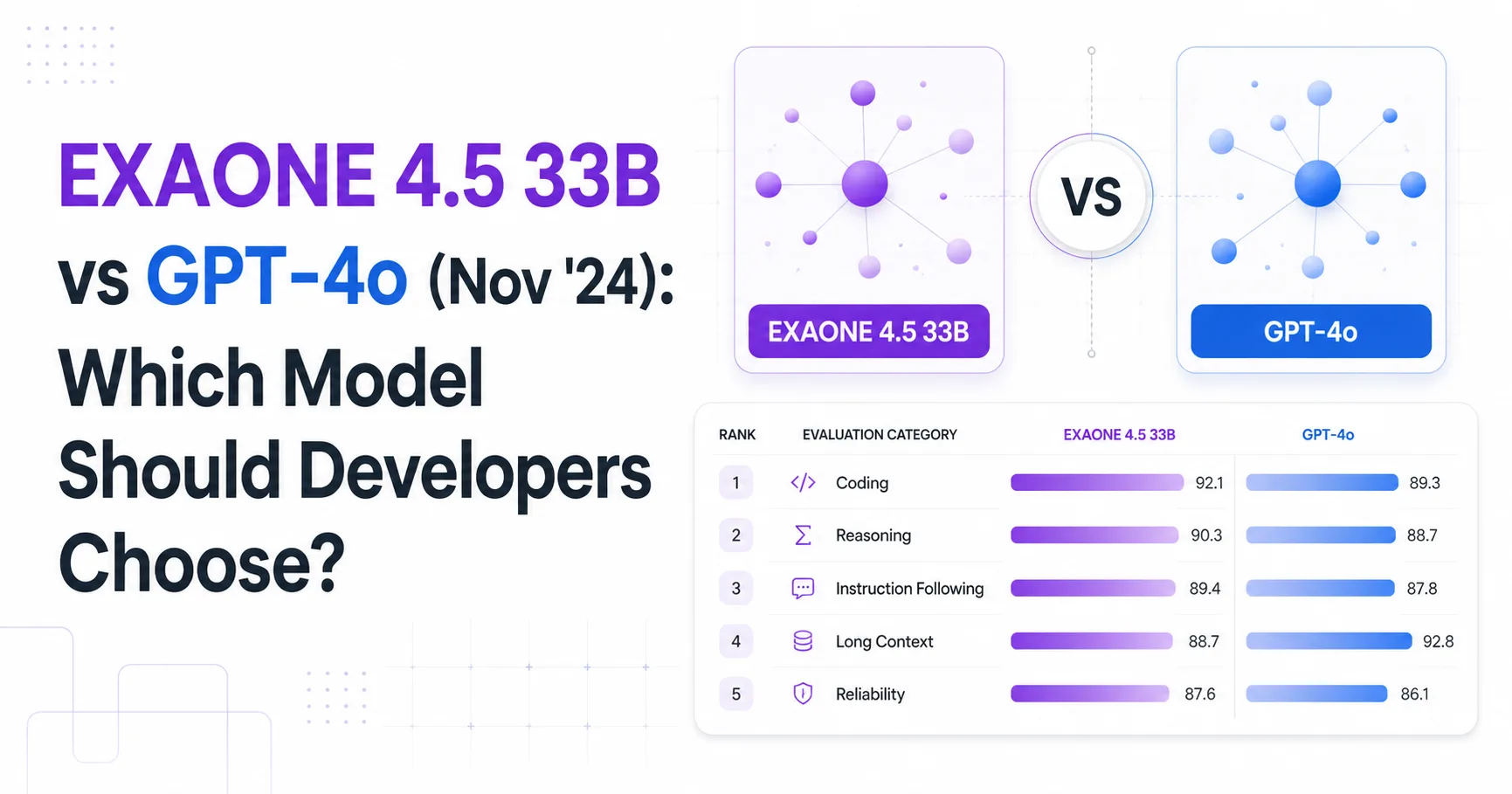
GPT-4o (Nov '24) is the safer developer choice because the supplied evidence documents measurable capability, while EXAONE 4.5 33B (Non-reasoning) is cheaper on paper but largely unverified.
The data snapshot reports EXAONE 4.5 33B (Non-reasoning) at $0 per 1M blended tokens, while GPT-4o (Nov '24) is listed at $4.375. That price gap looks decisive until you ask whether EXAONE can be accessed reliably, configured correctly, and evaluated on your workload.
The supplied EXAONE research contains no verifiable official announcement, developer documentation, pricing page, benchmark report, or reliable community post. That means the comparison cannot confirm its context window, output limit, API parameters, multimodal support, aliases, availability, or failure modes.
GPT-4o (Nov '24) also has important evidence gaps. OpenAI's current model directory does not list gpt-4o, and OpenAI's current pricing directory does not list its prices. The data brief still records a release date of 2024-11-20 and a price of $4.375 per 1M blended tokens, so developers should treat those figures as snapshot data rather than proof of current availability.
GPT-4o (Nov '24) has the stronger decision case because it is the only model with reported benchmark coverage and a documented provider ecosystem.
| Decision factor | EXAONE 4.5 33B (Non-reasoning) | GPT-4o (Nov '24) |
|---|---|---|
| Release date in the data snapshot | 2026-04-09 | 2024-11-20 |
| Reported Intelligence Index | Not reported | 11.1 |
| Reported MMLU-Pro score | Not reported | 0.748 |
| Reported LiveCodeBench score | Not reported | 0.309 |
| Blended price per 1M tokens | $0 | $4.375 |
| Median output speed | 0 | 0 |
| Latency | 0 | 0 |
GPT-4o's reported results include 0.748 on MMLU-Pro, 0.543 on GPQA, 0.759333333333333 on Math 500, and 0.309 on LiveCodeBench. These values do not prove that GPT-4o will win every software task, but they give a developer something concrete to compare against a private test set.
EXAONE's $0 price is a meaningful commercial signal only if the model is callable under the conditions your product needs. The supplied materials do not establish a stable alias, hosted endpoint, licensing route, or support path. A zero listed price can therefore describe missing commercial data rather than a guaranteed free production service.
GPT-4o's provider documentation gives more operational context. OpenAI's model documentation describes current OpenAI models as supporting text and image input, text output, and multilingual capabilities, with access through the Responses API and official SDKs. The page does not provide model-specific confirmation for GPT-4o (Nov '24), so that general guidance should not be treated as a complete version specification.
GPT-4o (Nov '24) is the only model with reported performance evidence, but the supplied data cannot prove that it is faster or better for your specific application.
The data brief reports EXAONE 4.5 33B (Non-reasoning) with no values across the listed evaluations. GPT-4o has an Artificial Analysis Intelligence Index of 11.1, an Artificial Analysis Math Index of 6, and scores of 0.748 on MMLU-Pro, 0.543 on GPQA, 0.024 on HLE, 0.309 on LiveCodeBench, and 0.333 on SciCode. It also reports 0.342857142857143 on IFBench, 0 on LCR, 0.0833333333333333 on TerminalBench Hard, and 0.251461988304094 on tau2.
Those results suggest that GPT-4o has a measurable baseline for general knowledge, reasoning, coding-related tasks, instruction following, and tool-oriented evaluation. They do not establish a direct winner because EXAONE has no corresponding scores. A missing value is not a low score, and it cannot support a claim that EXAONE performs poorly.
The speed comparison is also inconclusive. Both models have a reported median output speed of 0 and latency of 0. Those values do not provide a useful real-world ranking. They may reflect unavailable measurements, a measurement convention, or a snapshot without live serving observations. Developers should not select either model based on these fields.
The research evidence adds another constraint. No reliable community posts were found for either exact model version, so there is no verified evidence about coding feel, response consistency, prompt sensitivity, or recurring failure cases. OpenAI's model documentation also does not provide GPT-4o (Nov '24)-specific benchmark or failure-mode documentation.
EXAONE 4.5 33B (Non-reasoning) wins the recorded price comparison at $0, but GPT-4o (Nov '24) may still have the lower total operating cost if EXAONE requires custom hosting or integration work.
The snapshot lists EXAONE at $0 for blended, input, and output pricing. GPT-4o is listed at $4.375 per 1M blended tokens, $2.5 per 1M input tokens, and $10 per 1M output tokens. These figures make EXAONE the obvious candidate for a cost-sensitive experiment, provided the zero price represents an actual usable route to inference.
The important unknown is what the listed price includes. The supplied EXAONE materials do not confirm whether $0 means free hosted access, an open-weight model with self-hosting costs outside the model price, incomplete pricing data, or a temporary availability state. Infrastructure, engineering time, monitoring, scaling, and support can turn a zero model price into a higher product cost.
GPT-4o's output price is four times its input price, based on the supplied values of $10 and $2.5. That structure matters for applications that generate long answers, repeated code patches, or large structured outputs. It matters less for workloads dominated by short responses and substantial input context.
OpenAI's pricing page does not currently list gpt-4o, so the snapshot price should not be assumed to be a live offer. Before approving either model, verify the actual billing route, access terms, and representative token mix. Data provided by https://artificialanalysis.ai/.
EXAONE 4.5 33B (Non-reasoning) leads on 3 of 3 metrics
GPT-4o (Nov '24) is the default recommendation for teams that need an evidence-backed starting point, while EXAONE 4.5 33B (Non-reasoning) is a conditional option for teams willing to validate unknowns.
Choose GPT-4o when your team needs a documented integration path, a measurable baseline, or a known set of evaluation results. Its reported 0.748 MMLU-Pro score and 0.309 LiveCodeBench score give you reference points for acceptance testing. The official OpenAI documentation also describes API and SDK access patterns for current models, although it does not confirm that those details apply specifically to this older version. OpenAI's model documentation is therefore useful for ecosystem context, not as a complete GPT-4o (Nov '24) contract.
Choose EXAONE when the recorded $0 price is central to the business case and your team can verify the serving path before committing. The model could become attractive if it is accessible, stable, legally usable, and strong on your own coding or language tasks. The supplied materials provide no evidence to confirm any of those conditions.
Do not present the comparison as a proven quality contest. EXAONE has no reported benchmark values, while GPT-4o has no matching EXAONE measurements. The result is an evidence asymmetry, not a measured capability gap.
A practical selection rule is simple: use GPT-4o as the baseline for a controlled evaluation, then test EXAONE only after confirming access and deployment requirements. Keep the decision tied to pass rates on your own tasks, not to the $0 label alone.
GPT-4o (Nov '24) is easier to evaluate immediately because the supplied data contains benchmark results, while EXAONE requires more basic verification before comparison.
EXAONE 4.5 33B (Non-reasoning) is listed at $0 per 1M blended tokens in the supplied data, but the materials do not confirm hosted access, licensing, infrastructure costs, or a stable production endpoint.
GPT-4o (Nov '24) has the stronger evidence for coding-related selection because it reports a 0.309 LiveCodeBench score, while EXAONE has no supplied coding benchmark or verified developer experience.
Neither model can be ranked by context window from the supplied materials because the data brief reports no context value for either model, and the cited documentation does not provide version-specific confirmation.
GPT-4o (Nov '24) cannot be confirmed as currently available from the supplied official pages because OpenAI's current model directory does not list gpt-4o, and no stable alias is documented.
A production team should start with GPT-4o (Nov '24) as the measurable baseline, then evaluate EXAONE only after verifying access, licensing, deployment cost, and task quality on representative workloads.