
Time to First Token · EXAONE 4.5 33B (Non-reasoning)
0ms
Time to First Token · GPT-4o mini
0ms
Deep dive into reasoning, benchmarks, and latency insights.
The current catalog does not contain complete performance evidence for both models, so this page does not declare an overall winner. Use the available fields as comparison signals and validate the models on your own workload.
Key decision metrics at a glance.
| Model | Metric | Value | Unit | Source / snapshot |
|---|---|---|---|---|
| EXAONE 4.5 33B (Non-reasoning) | Reasoning | 6.0 | benchmark or capability score | Artificial Analysis · current catalog |
| GPT-4o mini | Reasoning | 1.0 | benchmark or capability score | Artificial Analysis · current catalog |
| EXAONE 4.5 33B (Non-reasoning) | Coding | 6.0 | benchmark or capability score | Artificial Analysis · current catalog |
| GPT-4o mini | Coding | 1.0 | benchmark or capability score | Artificial Analysis · current catalog |
| EXAONE 4.5 33B (Non-reasoning) | Multimodal | 5.0 | benchmark or capability score | Artificial Analysis · current catalog |
| GPT-4o mini | Multimodal | 1.0 | benchmark or capability score | Artificial Analysis · current catalog |
| EXAONE 4.5 33B (Non-reasoning) | Long Context | 8.0 | benchmark or capability score | Artificial Analysis · current catalog |
| GPT-4o mini | Long Context | 1.0 | benchmark or capability score | Artificial Analysis · current catalog |
| EXAONE 4.5 33B (Non-reasoning) | Blended Price / 1M tokens | $0 | USD per 1M tokens | Artificial Analysis · current catalog |
| GPT-4o mini | Blended Price / 1M tokens | $0.262 | USD per 1M tokens | Artificial Analysis · current catalog |
| EXAONE 4.5 33B (Non-reasoning) | P95 Latency | — | milliseconds | Artificial Analysis · current catalog |
| GPT-4o mini | P95 Latency | — | milliseconds | Artificial Analysis · current catalog |
| EXAONE 4.5 33B (Non-reasoning) | Tokens per second | 0 | tokens per second | Artificial Analysis · current catalog |
| GPT-4o mini | Tokens per second | 0 | tokens per second | Artificial Analysis · current catalog |
Data provided by Artificial Analysis; live values use the current catalog.
This radar chart visually maps the core capabilities (reasoning, coding, math proxy, multimodal, long context) of `EXAONE 4.5 33B (Non-reasoning)` vs `GPT-4o mini`.
This grouped bar chart provides a side-by-side comparison for each benchmark metric.
Lower time to first token is better; higher tokens per second is better.
Compare input and output pricing in USD per 1M tokens.
EXAONE 4.5 33B (Non-reasoning)$0
GPT-4o mini$0.3
EXAONE 4.5 33B (Non-reasoning) costs $0.3 less per run
This article is a dated snapshot published on 2026-08-16. Live cards above use the current catalog; missing live fields are not inferred.
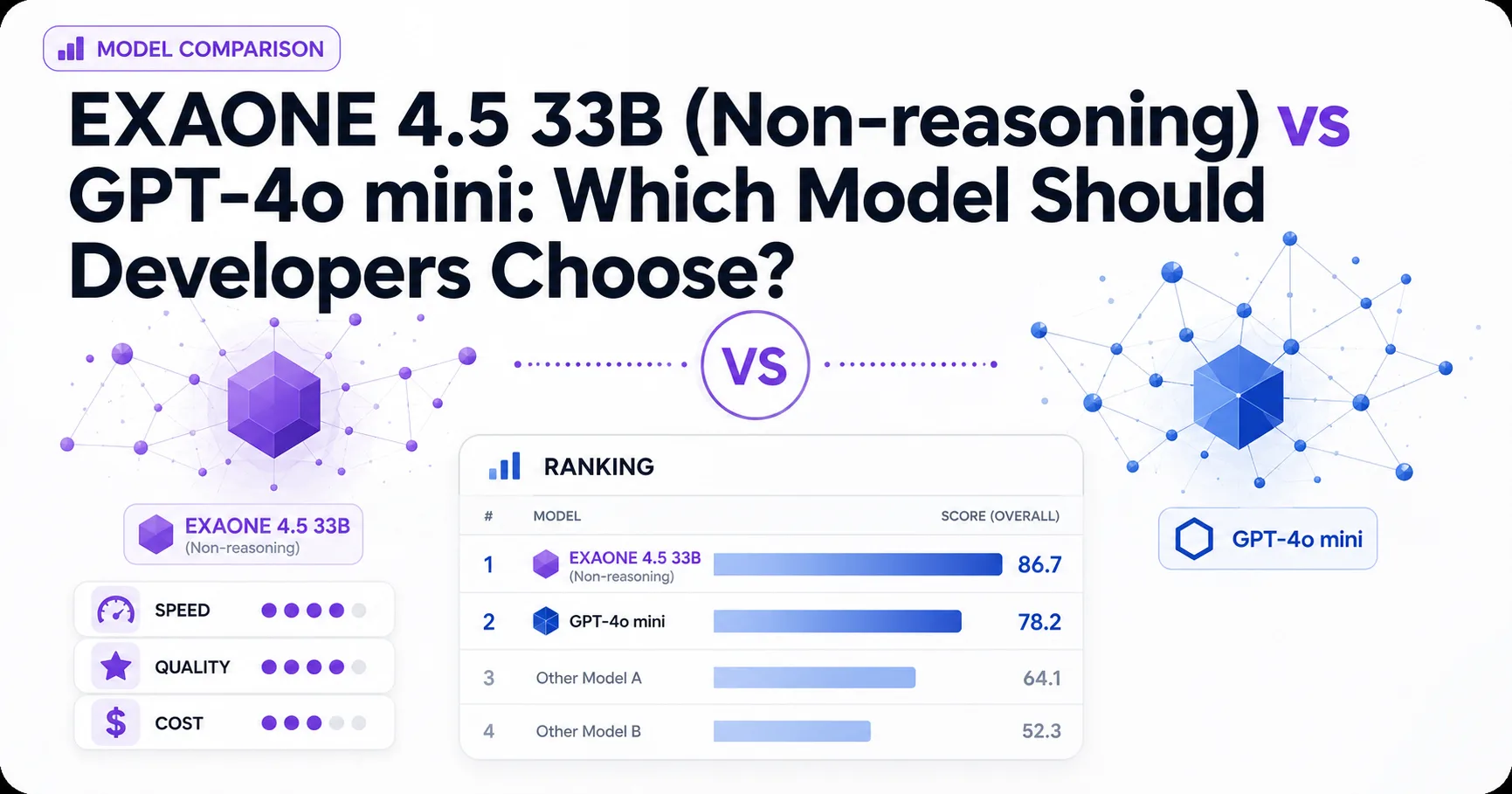
GPT-4o mini is the safer developer choice because its public documentation supports a real integration decision, while EXAONE 4.5 33B (Non-reasoning) remains largely unverified in the supplied research.
The comparison is unusual because the two models do not have equally strong evidence behind them. The data snapshot lists EXAONE 4.5 33B (Non-reasoning) with a release date of 2026-04-09, but the research brief found no verifiable vendor announcement, developer documentation, pricing page, community discussion, or failure analysis. That absence does not prove the model is weak. It does mean a development team cannot confidently assess availability, supported inputs, context behavior, operational limits, or production support.
GPT-4o mini has a clearer public record. OpenAI describes it as a small model intended for high-volume, cost-sensitive workloads, with text and image input and text output documented in the GPT-4o mini release announcement. The model documentation also identifies the public model alias and a fixed release snapshot.
For model selection, evidence quality is part of the product decision. A model that looks cheaper in a data table can still be more expensive if the team must discover its API behavior, validate its outputs, build workarounds, or migrate after an availability surprise. The supplied materials do not establish whether EXAONE is accessible to the reader, so its apparent price advantage should be treated as an unresolved procurement question.
GPT-4o mini is the better default for most developers because it offers documented behavior, while EXAONE 4.5 33B (Non-reasoning) offers only an unverified zero-cost entry in the supplied data.
The strongest numerical advantage belongs to EXAONE 4.5 33B (Non-reasoning) on price: the snapshot records $0 per 1M blended tokens, $0 per 1M input tokens, and $0 per 1M output tokens. However, the research brief explicitly found no verified current price or stable access path. The $0 figures therefore cannot be read as proof of a free production API. They may represent an unavailable endpoint, an incomplete listing, or a data convention that needs confirmation.
GPT-4o mini is listed at $0.262 per 1M blended tokens, with $0.15 per 1M input tokens and $0.6 per 1M output tokens in the data snapshot. Those figures are useful for relative budgeting, but the supplied research also says the current OpenAI pricing page does not list the model. Developers should confirm that the account, region, and endpoint still accept the model before committing to a new service.
The performance comparison is not a contest in the supplied snapshot. EXAONE 4.5 33B (Non-reasoning) has no reported evaluation values, while GPT-4o mini has reported values for several evaluations, including an Artificial Analysis coding index of 11.4, an Artificial Analysis math index of 14.7, and MMLU Pro at 0.648. These numbers show that GPT-4o mini has measurable public coverage. They do not prove it will win every application-specific workload.
The practical conclusion is narrow but actionable: choose GPT-4o mini for a documented, general-purpose starting point. Consider EXAONE only after confirming access, pricing, supported interfaces, and task performance through a controlled pilot.
GPT-4o mini is the only model in this comparison with enough public evidence to form a performance-related deployment hypothesis.
The data snapshot reports GPT-4o mini results across multiple evaluation families. Its Artificial Analysis coding index is 11.4, its Artificial Analysis math index is 14.7, and its MMLU Pro result is 0.648. The same snapshot reports 0.426 on GPQA, 0.234 on LiveCodeBench, 0.229 on SciCode, and 0.788666666666667 on Math 500. These results suggest that GPT-4o mini has a measurable baseline across coding, mathematics, knowledge, and scientific programming tasks.
The chart can show that coverage exists, but it cannot answer whether the model is good enough for a particular developer workflow. A coding assistant may need reliable repository edits, consistent formatting, tool use, and predictable refusal behavior. A customer-support classifier may care more about instruction adherence and latency under concurrency. A document workflow may depend on image input quality and the model’s ability to preserve important details. The supplied research does not provide task-specific community evidence for either model.
EXAONE 4.5 33B (Non-reasoning) has null values across the supplied evaluation fields. That is evidence of missing measurement, not evidence of zero capability. The distinction matters because comparing a documented score against an unmeasured model can create false certainty. The supplied research also found no reliable community posts that could confirm coding experience, speed perception, or recurring failure modes for EXAONE.
GPT-4o mini’s documented input boundary is text and image input with text output, according to the GPT-4o mini model documentation. The same source does not establish native audio or video support. EXAONE’s modality boundary is unknown from the supplied materials. Teams requiring audio, video, or specialized structured output should treat both the evidence gap and integration contract as open validation items.
The speed fields require similar caution. Both models show 0 median output tokens per second and 0 latency seconds in the data snapshot. That produces a tie in the table, but it should be interpreted as unavailable or unreported speed data. Developers should not promise equal responsiveness from these values.
EXAONE 4.5 33B (Non-reasoning) appears cheaper in the supplied snapshot, but GPT-4o mini is easier to budget because its integration path is better documented.
The cost chart captures listed token prices, not the full cost of operating a model. EXAONE is recorded at $0 for blended, input, and output pricing. That can be attractive for experiments, internal tools, or a high-volume product with strict cost limits. It becomes a liability if the endpoint is not publicly reachable, if the price is a placeholder, or if production access requires an arrangement not described in the research brief.
GPT-4o mini is recorded at $0.262 per 1M blended tokens, with output priced at $0.6 per 1M tokens. The difference between blended and output pricing matters for applications that generate long answers, code patches, or structured documents. A workload with modest input but heavy output can spend more than a blended estimate suggests. The data snapshot gives the relevant prices, but it does not provide a workload distribution for either model, so no further cost calculation is justified here.
The official evidence is also mixed for GPT-4o mini’s current commercial status. The OpenAI model directory currently emphasizes the GPT-5 family and does not show GPT-4o mini’s current product positioning. The OpenAI pricing page does not list a current price for gpt-4o-mini in the supplied research. The launch announcement documents historical pricing, but that is not enough to guarantee current direct-call availability.
This creates two different kinds of cost risk. EXAONE has an unknown-access risk before the first production request. GPT-4o mini has a current-status risk that should be checked before implementation. If a team values predictable delivery more than the lowest apparent token price, GPT-4o mini is the lower-risk economic choice. If EXAONE can be verified through a stable, supported endpoint, its recorded $0 price would justify a focused pilot.
EXAONE 4.5 33B (Non-reasoning) leads on 3 of 3 metrics
GPT-4o mini should be the default shortlist candidate, while EXAONE 4.5 33B (Non-reasoning) should remain a validation candidate until its basic product facts are confirmed.
Choose GPT-4o mini when the team needs a known API alias, documented text and image input, text output, and a public baseline across coding and reasoning-related evaluations. It is the more defensible option for a product manager who must explain why a model was selected. The GPT-4o mini release announcement provides the model’s intended cost-sensitive positioning and reported launch evaluations.
Choose EXAONE 4.5 33B (Non-reasoning) only when the team can answer four questions before building around it: where the model can be called, whether the recorded $0 price is real and current, which inputs and outputs it supports, and how it performs on the team’s own tasks. The research brief does not answer any of those questions. A small pilot can resolve them, but the supplied evidence cannot.
For coding workflows, GPT-4o mini has the stronger starting case because the data snapshot reports an Artificial Analysis coding index of 11.4 and LiveCodeBench at 0.234, while EXAONE has no reported values. Those numbers should guide test design rather than replace it. The team should evaluate representative repository tasks, not rely on a general score alone.
For cost-sensitive automation, EXAONE deserves investigation because the snapshot records $0 per 1M blended tokens. That advantage disappears if access is unstable or if engineers spend significant time adapting an undocumented interface. GPT-4o mini’s listed blended price of $0.262 per 1M tokens is easier to place in an initial budget, but its current listing still requires confirmation.
The evidence is insufficient to declare a universal quality winner. It is sufficient to declare an evidence and delivery winner: GPT-4o mini is the safer default, and EXAONE is an unverified upside opportunity.
GPT-4o mini is easier to evaluate today, but unresolved availability questions still apply before production adoption.
The supplied data records EXAONE 4.5 33B (Non-reasoning) at $0 across the listed token prices, but the research found no verified pricing page or stable public access path. Treat the value as unconfirmed until an endpoint, account requirement, and production price are tested.
Neither model can be declared faster from the supplied data because both show 0 median output tokens per second and 0 latency seconds. Those entries indicate missing or unusable measurements, so a real comparison requires identical prompts, infrastructure, and concurrency conditions.
GPT-4o mini supports text and image input with text output according to the official model documentation. The supplied research does not establish native audio or video support, and EXAONE’s supported modalities remain undocumented.
GPT-4o mini has a documented public alias and fixed release snapshot, but its current product status is not fully clear. The OpenAI model directory does not show its current positioning, and the pricing page does not list a current price in the supplied research.
Developers should trust the presence of GPT-4o mini measurements, but they should not infer a complete quality ranking because EXAONE has no reported values. Missing EXAONE results show an evidence gap, not a measured performance failure.
A team should first verify endpoint access, price, supported modalities, output behavior, and representative task quality for both models. This sequence resolves the risks that the supplied research leaves unanswered before broader engineering investment.
The supplied data records EXAONE 4.5 33B (Non-reasoning) at $0 across the listed token prices, but the research found no verified pricing page or stable public access path. Treat the value as unconfirmed until an endpoint, account requirement, and production price are tested.
Neither model can be declared faster from the supplied data because both show 0 median output tokens per second and 0 latency seconds. Those entries indicate missing or unusable measurements, so a real comparison requires identical prompts, infrastructure, and concurrency conditions.
GPT-4o mini supports text and image input with text output according to the official model documentation. The supplied research does not establish native audio or video support, and EXAONE’s supported modalities remain undocumented.
GPT-4o mini has a documented public alias and fixed release snapshot, but its current product status is not fully clear. The OpenAI model directory does not show its current positioning, and the pricing page does not list a current price in the supplied research.
Developers should trust the presence of GPT-4o mini measurements, but they should not infer a complete quality ranking because EXAONE has no reported values. Missing EXAONE results show an evidence gap, not a measured performance failure.
A team should first verify endpoint access, price, supported modalities, output behavior, and representative task quality for both models. This sequence resolves the risks that the supplied research leaves unanswered before broader engineering investment.