
Time to First Token · EXAONE 4.5 33B (Non-reasoning)
0ms
Time to First Token · GPT-5 (high)
0ms
Deep dive into reasoning, benchmarks, and latency insights.
The current catalog does not contain complete performance evidence for both models, so this page does not declare an overall winner. Use the available fields as comparison signals and validate the models on your own workload.
Key decision metrics at a glance.
| Model | Metric | Value | Unit | Source / snapshot |
|---|---|---|---|---|
| EXAONE 4.5 33B (Non-reasoning) | Reasoning | 6.0 | benchmark or capability score | Artificial Analysis · current catalog |
| GPT-5 (high) | Reasoning | 9.0 | benchmark or capability score | Artificial Analysis · current catalog |
| EXAONE 4.5 33B (Non-reasoning) | Coding | 6.0 | benchmark or capability score | Artificial Analysis · current catalog |
| GPT-5 (high) | Coding | 4.0 | benchmark or capability score | Artificial Analysis · current catalog |
| EXAONE 4.5 33B (Non-reasoning) | Multimodal | 5.0 | benchmark or capability score | Artificial Analysis · current catalog |
| GPT-5 (high) | Multimodal | 3.0 | benchmark or capability score | Artificial Analysis · current catalog |
| EXAONE 4.5 33B (Non-reasoning) | Long Context | 8.0 | benchmark or capability score | Artificial Analysis · current catalog |
| GPT-5 (high) | Long Context | 4.0 | benchmark or capability score | Artificial Analysis · current catalog |
| EXAONE 4.5 33B (Non-reasoning) | Blended Price / 1M tokens | $0 | USD per 1M tokens | Artificial Analysis · current catalog |
| GPT-5 (high) | Blended Price / 1M tokens | $3.438 | USD per 1M tokens | Artificial Analysis · current catalog |
| EXAONE 4.5 33B (Non-reasoning) | P95 Latency | — | milliseconds | Artificial Analysis · current catalog |
| GPT-5 (high) | P95 Latency | — | milliseconds | Artificial Analysis · current catalog |
| EXAONE 4.5 33B (Non-reasoning) | Tokens per second | 0 | tokens per second | Artificial Analysis · current catalog |
| GPT-5 (high) | Tokens per second | 0 | tokens per second | Artificial Analysis · current catalog |
Data provided by Artificial Analysis; live values use the current catalog.
This radar chart visually maps the core capabilities (reasoning, coding, math proxy, multimodal, long context) of `EXAONE 4.5 33B (Non-reasoning)` vs `GPT-5 (high)`.
This grouped bar chart provides a side-by-side comparison for each benchmark metric.
Lower time to first token is better; higher tokens per second is better.
Compare input and output pricing in USD per 1M tokens.
EXAONE 4.5 33B (Non-reasoning)$0
GPT-5 (high)$3.75
EXAONE 4.5 33B (Non-reasoning) costs $3.75 less per run
This article is a dated snapshot published on 2026-08-16. Live cards above use the current catalog; missing live fields are not inferred.
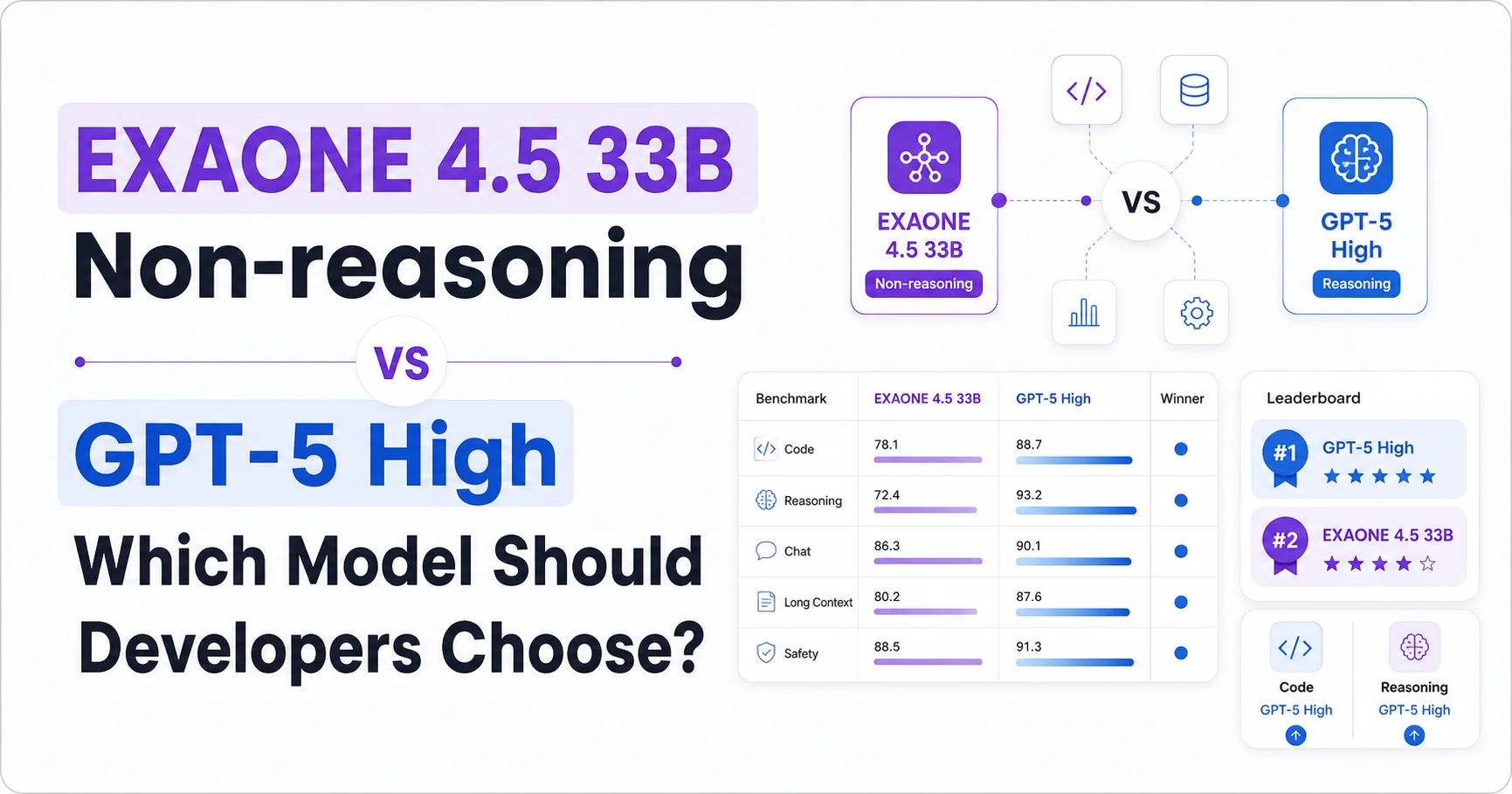
GPT-5 (high) is the safer developer choice because EXAONE 4.5 33B (Non-reasoning) cannot be verified as a currently callable, documented, or benchmarked service from the supplied evidence.
The comparison is therefore not a conventional contest between two measured models. GPT-5 has a public API identity, documented capabilities, published evaluations, and a stated price. EXAONE 4.5 33B has a release date in the data snapshot, but the research brief provides no verifiable vendor announcement, developer documentation, pricing page, community test, or failure analysis.
That evidence gap matters more than the apparent price advantage. A developer selecting a model needs to know whether the endpoint exists, whether the name is stable, which inputs it accepts, how much context it can process, and how failures should be handled. The supplied material answers those questions for GPT-5, but not for EXAONE.
The data snapshot records EXAONE at $0 for blended, input, and output pricing. That value should not be treated as confirmed free access. It may represent missing commercial data, an unavailable endpoint, or a genuinely free offering, and the research brief does not establish which explanation is correct. Data provided by Artificial Analysis.
GPT-5 (high) has the stronger selection case because its public documentation turns model claims into operational facts.
| Decision area | EXAONE 4.5 33B (Non-reasoning) | GPT-5 (high) |
|---|---|---|
| Public API status | Not confirmed by the supplied research | gpt-5 is listed as a callable alias |
| Context window | Not confirmed | 400,000 tokens |
| Maximum output | Not confirmed | 128,000 tokens |
| Input and output modes | Not confirmed | Text and image input, text output |
| Tool support | Not confirmed | Function calling, structured outputs, Streaming, and custom tools |
| Published coding evidence | None found in the supplied research | 74.9% on SWE-bench Verified and 88% on Aider polyglot |
| Published reasoning evidence | None found in the supplied research | 96.7% on τ²-bench telecom and 69.6% on Scale MultiChallenge |
| Price evidence | Data snapshot shows $0, but the reason is unknown | $1.25 input and $10 output per 1M tokens |
GPT-5 is documented as a reasoning model for coding, reasoning, and agentic tasks in GPT-5 for developers. Its model page also documents endpoint support, limits, modalities, and pricing in GPT-5 model documentation.
EXAONE could still be useful in a private, local, research, or newly launched environment. The current materials simply do not prove that proposition. Developers should treat its attractive cost as an unverified lead rather than a purchasing fact.
The comparison also exposes an important naming issue. “GPT-5 (high)” is not a separate official API model name in the supplied research. It refers to GPT-5 using reasoning_effort=high, while the API model identity remains gpt-5 or its fixed snapshot.
GPT-5 (high) is the only model in this comparison with public performance evidence that connects to developer workflows.
The supplied data records GPT-5 with a 37.8 Artificial Analysis coding index, a 35.3 Artificial Analysis intelligence index, and a 94.3 Artificial Analysis math index. It also records 0.846 on LiveCodeBench, 0.871 on MMLU Pro, 0.854 on GPQA, and 0.847953216374269 on τ²-bench. These results suggest broad coverage across coding, general knowledge, difficult questions, and tool-oriented tasks, but they do not establish how GPT-5 will behave on a particular codebase or agent loop.
OpenAI reports 74.9% on SWE-bench Verified and 88% on Aider polyglot in GPT-5 for developers. The SWE-bench result excludes 23 issues from 500 because they could not pass reliably on OpenAI’s infrastructure, and the Aider result uses high reasoning effort. Those conditions make the results useful evidence, not a guarantee of identical performance in your environment.
The practical implication is clear. GPT-5 has enough published evidence to justify a controlled pilot for code repair, repository navigation, structured tool use, and reasoning-heavy automation. EXAONE has no comparable evidence in the brief. Its missing scores do not prove poor performance, but they prevent a defensible claim that it matches GPT-5.
The speed comparison is also inconclusive. The supplied dataset records 0 median output tokens per second and 0 latency seconds for both models. That is a data limitation, not proof that the models respond equally fast. Teams with interactive latency requirements need to measure time to first token and completion time directly through the intended deployment path.
Community evidence adds caution around GPT-5. A Reddit author reported fast small-bug diagnosis, but described shorter and less complete results for full applications and user interfaces. Comments also described hallucinations or incorrect edits in complex existing codebases. The post was an uncontrolled personal test, so it should inform safeguards rather than decide the purchase. See Tried GPT-5 Here Are My First Impressions.
EXAONE 4.5 33B (Non-reasoning) appears cheaper in the snapshot, but GPT-5 (high) is easier to budget because its commercial terms are documented.
The data snapshot lists EXAONE at $0 blended cost, $0 input cost, and $0 output cost. That is a decisive apparent advantage on paper. It becomes a real advantage only if developers can confirm access, throughput, service stability, usage limits, and the deployment conditions behind the number. The research brief found no verified pricing page or product documentation for those details.
GPT-5 is listed at $3.438 per 1M blended tokens using the supplied 3:1 blend, with input priced at $1.25 per 1M tokens and output priced at $10 per 1M tokens. The output rate deserves special attention for agentic coding. A model that writes long plans, tool arguments, patches, or explanations can create a higher bill even when input volume is modest. Shorter answers do not automatically mean lower total cost if they cause more repair cycles.
The cost conclusion can therefore flip by workload. If EXAONE is genuinely available at the recorded price and produces acceptable results without repeated retries, it may be the right choice for high-volume, low-risk generation. If its access is unstable, undocumented, or unable to complete tasks, the apparent savings may be offset by engineering time, fallback calls, and operational uncertainty.
GPT-5 may also be cheaper in a broader business sense when a documented capability reduces integration work. Its function calling, structured outputs, Streaming, and custom tools are described in GPT-5 for developers. Developers should compare cost per completed task, not only cost per token, after testing representative prompts and retry behavior.
No supplied evidence establishes EXAONE’s output limits, context size, endpoint availability, or service-level terms. Those missing facts are the main cost risk, and the page should not present its $0 value as a confirmed free plan.
EXAONE 4.5 33B (Non-reasoning) leads on 3 of 3 metrics
GPT-5 (high) should be the default pick for developers who need an auditable API contract and measurable task performance.
Choose GPT-5 when the project depends on any of the following:
gpt-5 alias or the documented fixed snapshot gpt-5-2025-08-07.Treat EXAONE as a candidate for validation, not as the current winner on price. Before choosing it, confirm the actual endpoint, model identifier, context limit, output limit, supported modalities, authentication process, rate limits, and billing terms. Then run the same task set against both models. The supplied research provides no EXAONE-specific community or official evidence that can replace this test.
GPT-5 also needs safeguards. The fixed snapshot is marked Deprecated in GPT-5 model documentation, and the documentation recommends GPT-5.6. An application tied to the snapshot therefore needs a migration plan. GPT-5 does not support audio or video input and output, and the model page marks fine-tuning and Predicted outputs as unsupported.
For existing repositories, require patch review, tests, type checks, and a human approval step. The Reddit evidence reports useful small-bug fixes but also possible hallucinations and incorrect edits in complex codebases. That evidence is subjective and not reproducible, yet the failure mode is important enough to design around.
The decision rule is simple: use GPT-5 when delivery certainty matters now; consider EXAONE only after its $0 access and technical contract are independently verified. If EXAONE passes that check, compare completed-task quality and operational effort rather than assuming its missing benchmark data means parity.
GPT-5 (high) is easier to evaluate before adoption because its API identity, limits, tools, pricing, and public tests are documented.
The questions below focus on decisions that the supplied comparison data cannot answer directly, especially EXAONE’s availability and the difference between token cost and usable engineering output.
EXAONE 4.5 33B appears free in the supplied data snapshot because blended, input, and output prices are all $0, but the research found no verified pricing page, endpoint, access policy, or service terms.
GPT-5 (high) is the defensible coding choice because it has a 37.8 Artificial Analysis coding index, 74.9% on SWE-bench Verified, and 88% on Aider polyglot, while EXAONE has no comparable evidence.
GPT-5 (high) is not identified as a separate official API model in the supplied research; “high” refers to the reasoning_effort=high setting applied to the gpt-5 model.
Neither model wins on latency in the supplied dataset because both record 0 latency seconds and 0 median output tokens per second, values that indicate missing or unusable measurements rather than proven equal speed.
GPT-5 can support coding agents through documented tool features, but autonomous changes still require tests and review because community reports describe hallucinations and incorrect edits in complex existing codebases.
GPT-5’s biggest documented selection risk is version continuity because the fixed snapshot gpt-5-2025-08-07 is marked Deprecated, creating a migration obligation for applications that depend on it.
A fair EXAONE comparison needs a verifiable API, stable model name, context and output limits, supported modalities, pricing terms, latency measurements, coding benchmarks, and reproducible failure tests.