
Time to First Token · Gemini 1.5 Pro (Sep '24)
0ms
Time to First Token · GPT-5.5 (xhigh)
0ms
Deep dive into reasoning, benchmarks, and latency insights.
The current catalog does not contain complete performance evidence for both models, so this page does not declare an overall winner. Use the available fields as comparison signals and validate the models on your own workload.
Key decision metrics at a glance.
| Model | Metric | Value | Unit | Source / snapshot |
|---|---|---|---|---|
| Gemini 1.5 Pro (Sep '24) | Reasoning | 6.0 | benchmark or capability score | Artificial Analysis · current catalog |
| GPT-5.5 (xhigh) | Reasoning | 6.0 | benchmark or capability score | Artificial Analysis · current catalog |
| Gemini 1.5 Pro (Sep '24) | Coding | 2.0 | benchmark or capability score | Artificial Analysis · current catalog |
| GPT-5.5 (xhigh) | Coding | 7.0 | benchmark or capability score | Artificial Analysis · current catalog |
| Gemini 1.5 Pro (Sep '24) | Multimodal | 1.0 | benchmark or capability score | Artificial Analysis · current catalog |
| GPT-5.5 (xhigh) | Multimodal | 5.0 | benchmark or capability score | Artificial Analysis · current catalog |
| Gemini 1.5 Pro (Sep '24) | Long Context | 1.0 | benchmark or capability score | Artificial Analysis · current catalog |
| GPT-5.5 (xhigh) | Long Context | 7.0 | benchmark or capability score | Artificial Analysis · current catalog |
| Gemini 1.5 Pro (Sep '24) | Blended Price / 1M tokens | $0 | USD per 1M tokens | Artificial Analysis · current catalog |
| GPT-5.5 (xhigh) | Blended Price / 1M tokens | $11.25 | USD per 1M tokens | Artificial Analysis · current catalog |
| Gemini 1.5 Pro (Sep '24) | P95 Latency | — | milliseconds | Artificial Analysis · current catalog |
| GPT-5.5 (xhigh) | P95 Latency | — | milliseconds | Artificial Analysis · current catalog |
| Gemini 1.5 Pro (Sep '24) | Tokens per second | 0 | tokens per second | Artificial Analysis · current catalog |
| GPT-5.5 (xhigh) | Tokens per second | 0 | tokens per second | Artificial Analysis · current catalog |
Data provided by Artificial Analysis; live values use the current catalog.
This radar chart visually maps the core capabilities (reasoning, coding, math proxy, multimodal, long context) of `Gemini 1.5 Pro (Sep '24)` vs `GPT-5.5 (xhigh)`.
This grouped bar chart provides a side-by-side comparison for each benchmark metric.
Lower time to first token is better; higher tokens per second is better.
Compare input and output pricing in USD per 1M tokens.
Gemini 1.5 Pro (Sep '24)$0
GPT-5.5 (xhigh)$12.5
Gemini 1.5 Pro (Sep '24) costs $12.5 less per run
This article is a dated snapshot published on 2026-08-07. Live cards above use the current catalog; missing live fields are not inferred.
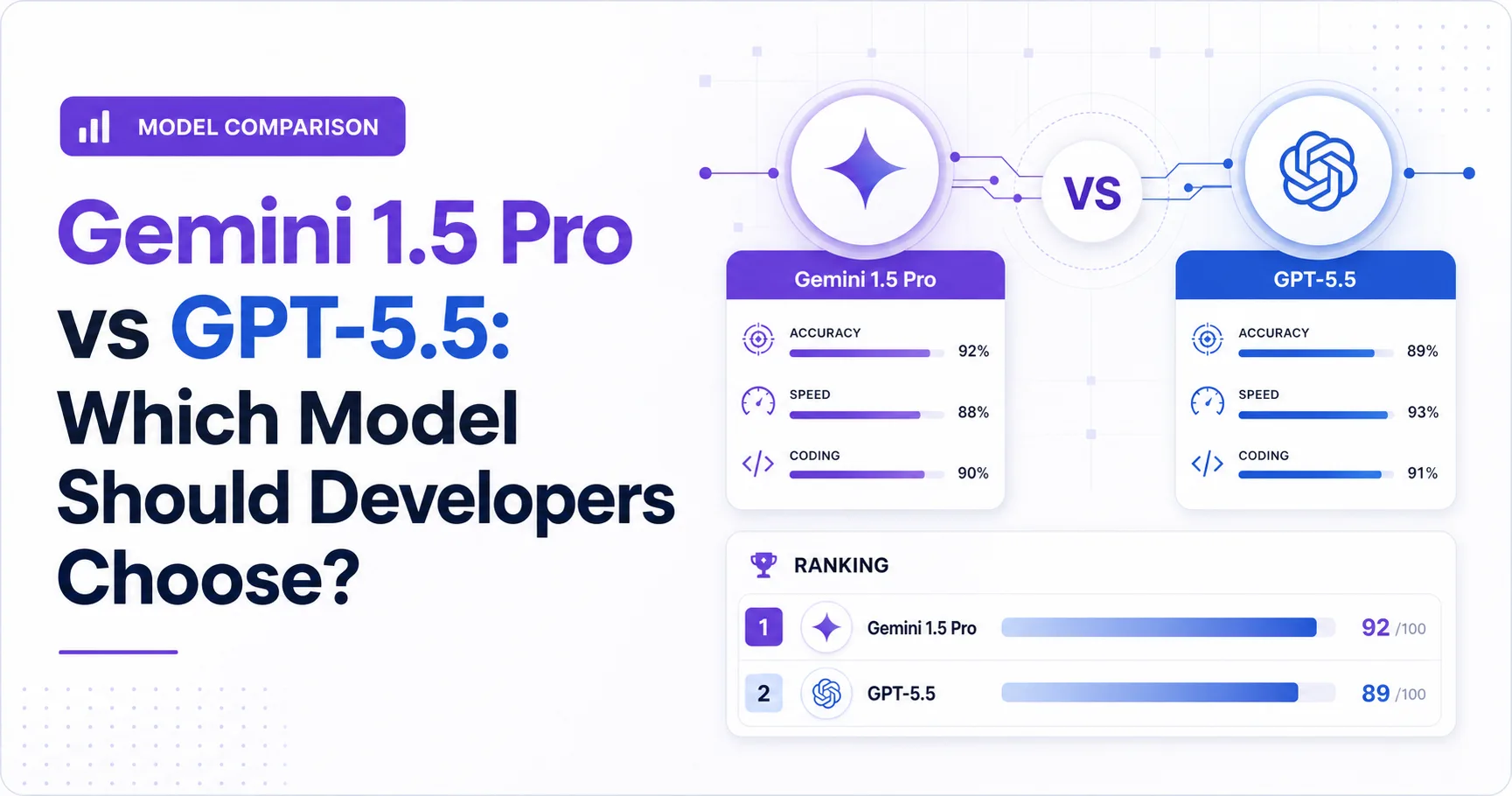
GPT-5.5 (xhigh) is the stronger default for new developer projects because it combines higher measured capability with an active API model ID and lower blended pricing.
The data brief reports an Artificial Analysis Intelligence Index of 54.8 for GPT-5.5 (xhigh), compared with 10 for Gemini 1.5 Pro (Sep '24). Its Coding Index is 74.9, compared with 23.6 for Gemini 1.5 Pro (Sep '24). GPT-5.5 also costs $11.25 per 1M blended tokens, while Gemini 1.5 Pro costs $15 on the same measure.
The comparison is not perfectly symmetrical. Google’s current Gemini API model documentation no longer presents Gemini 1.5 Pro (Sep '24) as an active model entry. Google’s current Gemini API pricing page also does not list a current price for that specific version. OpenAI documents GPT-5.5 with the stable model ID gpt-5.5 and the snapshot gpt-5.5-2026-04-23 in its GPT-5.5 model documentation.
That makes GPT-5.5 the safer production choice. Gemini 1.5 Pro remains relevant only when an existing system already depends on it and its deployment path has been verified independently.
GPT-5.5 (xhigh) leads this comparison on measured intelligence, coding, current API support, and blended token cost, while Gemini 1.5 Pro’s strongest historical differentiator is long-context multimodal positioning.
| Decision factor | Gemini 1.5 Pro (Sep '24) | GPT-5.5 (xhigh) |
|---|---|---|
| Current API status | Active endpoint not confirmed in current Google documentation | Stable model ID gpt-5.5 documented by OpenAI |
| Intelligence Index | 10 | 54.8 |
| Coding Index | 23.6 | 74.9 |
| Blended price per 1M tokens | $15 | $11.25 |
| Median latency | 0.3 seconds | 0.3 seconds |
| Input modalities | Text, images, video, and audio historically documented | Text and images |
| Output modality | Text | Text |
Google historically positioned the Gemini 1.5 Pro family around very long context, with official materials describing support for approximately 2 million tokens. However, the current model page does not preserve a version-specific context table for the Sep '24 entry, so developers should not treat that historical positioning as a confirmed current contract. See the Gemini API model documentation.
OpenAI documents GPT-5.5 as a reasoning model for coding, tool-intensive agents, knowledge work, long-context retrieval, and converting product specifications into execution plans. The Using GPT-5.5 guide also explains that xhigh is a reasoning effort setting, not a separate model ID.
The key selection issue is therefore lifecycle risk. The evidence does not establish that Gemini 1.5 Pro is unusable everywhere, but it does establish that its current endpoint, pricing, and version-specific limits are not clearly maintained in the active official pages.
GPT-5.5 (xhigh) is the better fit for software engineering and agentic workflows because its coding and intelligence scores indicate a much wider quality margin than the equal latency suggests.
The data brief shows GPT-5.5 at 74.9 on the Artificial Analysis Coding Index and Gemini 1.5 Pro at 23.6. It also shows GPT-5.5 at 54.8 on the Artificial Analysis Intelligence Index, compared with 10 for Gemini 1.5 Pro. These are large capability differences, but they should be read as selection signals rather than guarantees for every repository, prompt, or tool environment.
In practical terms, a stronger coding result matters most when the model must inspect an unfamiliar codebase, preserve architectural constraints, reason across multiple files, or decide whether a proposed fix is safe. OpenAI’s published GPT-5.5 announcement reports results across coding, computer-use, browsing, tool-use, and mathematical evaluations. The Using GPT-5.5 guide recommends specifying reuse requirements, delegated subtasks, tests, acceptance criteria, and stopping conditions.
The latency result does not create a counterargument. Both models are listed at 0.3 seconds median latency, and neither has a reported median output speed in the data brief. Equal latency means the decision should focus on completed-task quality, not a presumed response-speed advantage.
Gemini 1.5 Pro may still be attractive for applications that specifically require its historically documented combination of text, image, video, and audio input. Yet the supplied materials do not provide a current, reproducible comparison of multimodal quality, long-context recall, or output reliability. That evidence gap should be tested with the developer’s own workload before migration or commitment.
GPT-5.5 (xhigh) leads on 2 of 2 metrics
GPT-5.5 (xhigh) is cheaper on blended usage, but its reasoning behavior and long-context pricing rules can still make poorly designed workflows expensive.
The data brief lists GPT-5.5 at $11.25 per 1M blended tokens and Gemini 1.5 Pro at $15. GPT-5.5 therefore has the lower listed blended price in this comparison. Input pricing also favors GPT-5.5 at $5 versus Gemini 1.5 Pro at $10 per 1M input tokens, while output pricing is tied at $30.
The blended result is most useful for workloads with a stable input-to-output mix. It can mislead teams whose application sends large prompts but produces short answers, because input pricing then dominates. It can also mislead teams that repeatedly submit the same context, since cache behavior and prompt construction affect the actual bill.
OpenAI’s API pricing page states that Standard, Batch, and Flex requests using more than 272K input tokens are charged at higher input and output rates. The GPT-5.5 model documentation also describes the corresponding long-context pricing rule. The same documentation identifies xhigh as an optional reasoning effort, and the Using GPT-5.5 guide warns that higher reasoning effort can add latency and cost without guaranteeing better results.
Gemini 1.5 Pro’s apparent cost advantage cannot be evaluated from the current official Google pricing page because that page does not list a current price for the specific version. A nominally cheaper legacy deployment may become more expensive if it requires migration work, compatibility fixes, fallback routing, or an unverified endpoint. The materials do not provide enough evidence to quantify those operational costs.
Gemini 1.5 Pro (Sep '24) leads on 3 of 3 metrics
GPT-5.5 (xhigh) is the recommended default for new production systems, while Gemini 1.5 Pro should be selected only after its legacy deployment path passes a focused compatibility check.
Choose GPT-5.5 when the application needs code generation, repository-level reasoning, structured outputs, function calling, file search, web search, or other tool-driven execution. OpenAI documents these capabilities in the GPT-5.5 model documentation. The model’s Coding Index of 74.9 and Intelligence Index of 54.8 provide stronger evidence for this class of work than the corresponding Gemini scores of 23.6 and 10.
Choose GPT-5.5 with a lower reasoning setting when the task is routine, latency-sensitive, or cost-sensitive. Reserve xhigh for evaluations that show a meaningful quality gain. OpenAI explicitly warns that open-ended tool access, conflicting instructions, and missing stopping conditions can cause over-searching, extra cost, or quality regression. See the Using GPT-5.5 guide.
Consider Gemini 1.5 Pro only when an existing Google-based integration already depends on its multimodal inputs or historical long-context behavior. Before choosing it, verify the exact model name, endpoint, quotas, billing, context limits, and shutdown or migration path against the Gemini API model documentation and Gemini API pricing.
The supplied community evidence does not settle the choice. Some Reddit users describe GPT-5.5 as useful for architecture, debugging, planning, and large refactors, while others report terse explanations, weak domain mapping, or fragile code without strict constraints. The positive workflow report appears in this r/AIcodingProfessionals discussion, and the critical reports appear in this r/codex discussion. Neither discussion provides a reproducible benchmark.
GPT-5.5 (xhigh) deserves a controlled acceptance test before deployment because model capability does not eliminate prompt, tool, or repository design requirements.
A useful test should measure completed tasks, regression rate, required human corrections, tool-call failures, and token usage on representative work. The research materials do not provide enough independent evidence to claim a universal success rate for either model. They also do not establish a current, version-specific benchmark for Gemini 1.5 Pro (Sep '24).
For GPT-5.5, define file-reuse rules, test expectations, success criteria, and stopping conditions before allowing broad tool access. OpenAI recommends these controls in the Using GPT-5.5 guide. For Gemini 1.5 Pro, treat current availability as an open verification item because the active Google model documentation does not show a maintained entry for this version.
Data provided by https://artificialanalysis.ai/
GPT-5.5 is the stronger coding choice in the supplied comparison, with a Coding Index of 74.9 versus 23.6, although repository constraints and evaluation design still affect the final result.
GPT-5.5 is cheaper on the supplied blended measure at $11.25 per 1M tokens versus $15, and its input price is $5 versus $10, while output pricing is tied at $30.
The supplied evidence does not confirm a current usable endpoint for Gemini 1.5 Pro (Sep '24), because Google’s active model documentation no longer shows a maintained entry or version-specific parameter record.
The data brief lists equal median latency of 0.3 seconds for both models, but it reports no median output speed, so the evidence cannot establish equal streaming or long-answer responsiveness.
Developers should not use xhigh by default; OpenAI recommends it only when evaluations show enough quality improvement to justify additional latency and cost, and warns that higher effort can sometimes reduce quality.