
Time to First Token · Gemini 1.5 Pro (Sep '24)
0ms
Time to First Token · GPT-5.5 (high)
0ms
Deep dive into reasoning, benchmarks, and latency insights.
The current catalog does not contain complete performance evidence for both models, so this page does not declare an overall winner. Use the available fields as comparison signals and validate the models on your own workload.
Key decision metrics at a glance.
| Model | Metric | Value | Unit | Source / snapshot |
|---|---|---|---|---|
| Gemini 1.5 Pro (Sep '24) | Reasoning | 6.0 | benchmark or capability score | Artificial Analysis · current catalog |
| GPT-5.5 (high) | Reasoning | 6.0 | benchmark or capability score | Artificial Analysis · current catalog |
| Gemini 1.5 Pro (Sep '24) | Coding | 2.0 | benchmark or capability score | Artificial Analysis · current catalog |
| GPT-5.5 (high) | Coding | 7.0 | benchmark or capability score | Artificial Analysis · current catalog |
| Gemini 1.5 Pro (Sep '24) | Multimodal | 1.0 | benchmark or capability score | Artificial Analysis · current catalog |
| GPT-5.5 (high) | Multimodal | 5.0 | benchmark or capability score | Artificial Analysis · current catalog |
| Gemini 1.5 Pro (Sep '24) | Long Context | 1.0 | benchmark or capability score | Artificial Analysis · current catalog |
| GPT-5.5 (high) | Long Context | 7.0 | benchmark or capability score | Artificial Analysis · current catalog |
| Gemini 1.5 Pro (Sep '24) | Blended Price / 1M tokens | $0 | USD per 1M tokens | Artificial Analysis · current catalog |
| GPT-5.5 (high) | Blended Price / 1M tokens | $11.25 | USD per 1M tokens | Artificial Analysis · current catalog |
| Gemini 1.5 Pro (Sep '24) | P95 Latency | — | milliseconds | Artificial Analysis · current catalog |
| GPT-5.5 (high) | P95 Latency | — | milliseconds | Artificial Analysis · current catalog |
| Gemini 1.5 Pro (Sep '24) | Tokens per second | 0 | tokens per second | Artificial Analysis · current catalog |
| GPT-5.5 (high) | Tokens per second | 0 | tokens per second | Artificial Analysis · current catalog |
Data provided by Artificial Analysis; live values use the current catalog.
This radar chart visually maps the core capabilities (reasoning, coding, math proxy, multimodal, long context) of `Gemini 1.5 Pro (Sep '24)` vs `GPT-5.5 (high)`.
This grouped bar chart provides a side-by-side comparison for each benchmark metric.
Lower time to first token is better; higher tokens per second is better.
Compare input and output pricing in USD per 1M tokens.
Gemini 1.5 Pro (Sep '24)$0
GPT-5.5 (high)$12.5
Gemini 1.5 Pro (Sep '24) costs $12.5 less per run
This article is a dated snapshot published on 2026-08-07. Live cards above use the current catalog; missing live fields are not inferred.
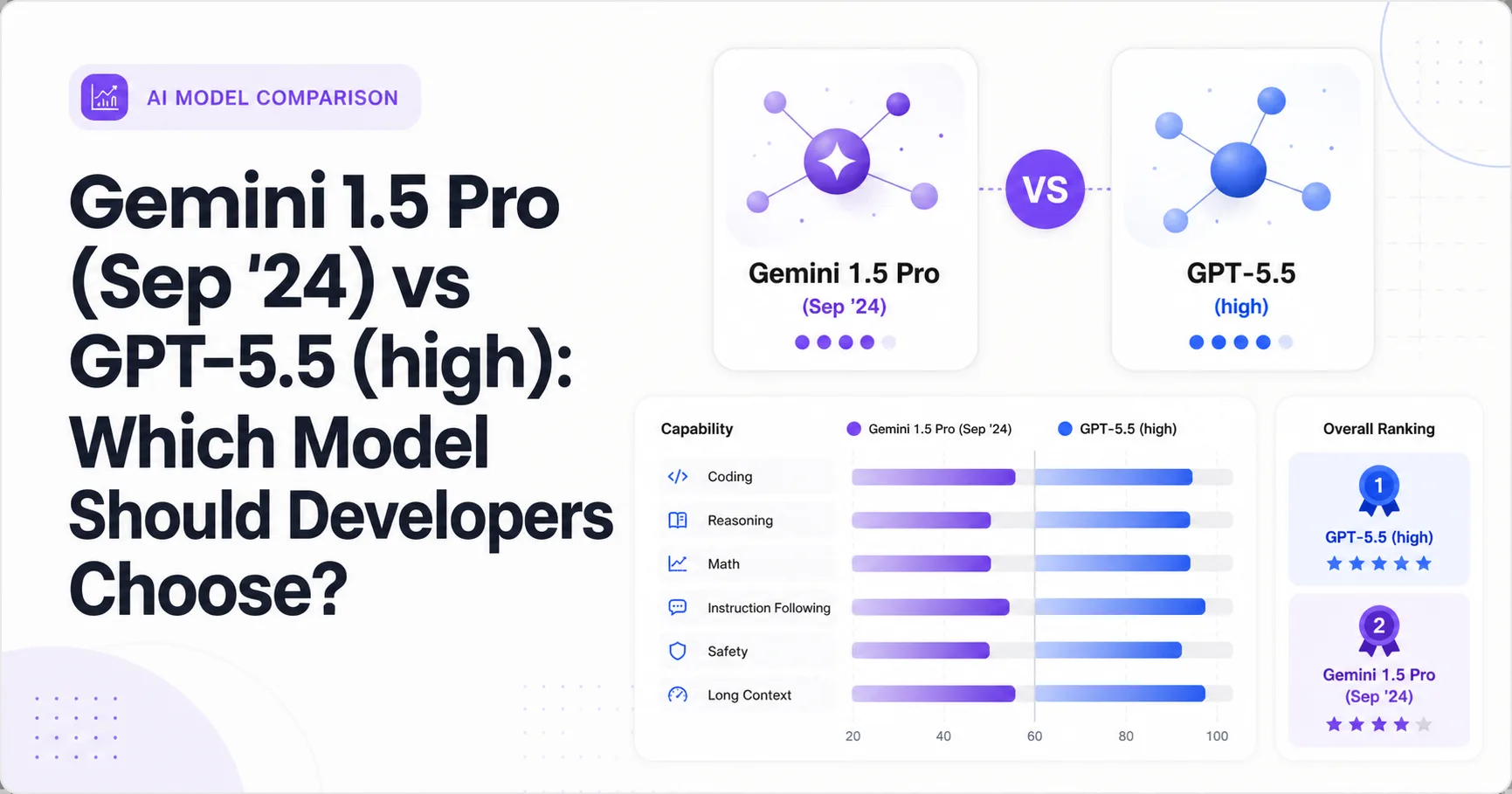
GPT-5.5 (high) is the safer developer choice because it combines stronger available evaluation results, a lower blended price, and a currently documented API surface.
The comparison is unusually asymmetric. Gemini 1.5 Pro (Sep '24) is an older Google model entry whose active model card, endpoint, current limits, and current price are no longer available in Google’s model documentation. Google’s Gemini API model documentation no longer lists an active entry for this specific version. Google’s pricing documentation also does not list a current price for it.
GPT-5.5 (high) maps to the gpt-5.5 API model with reasoning.effort set to high. OpenAI documents a current snapshot, supported APIs, tool access, structured outputs, image input, and adjustable reasoning behavior. The GPT-5.5 model page provides the current operational details.
Data provided by https://artificialanalysis.ai/
GPT-5.5 (high) leads this comparison for new development because its documented availability and measured capability advantage reduce the largest risks in model selection.
| Decision area | Better-supported choice | Why it matters |
|---|---|---|
| Coding capability | GPT-5.5 (high) | The Artificial Analysis Coding Index is 71.6 for GPT-5.5 (high) and 23.6 for Gemini 1.5 Pro (Sep '24). |
| General intelligence signal | GPT-5.5 (high) | The Artificial Analysis Intelligence Index is 53.1 for GPT-5.5 (high) and 10 for Gemini 1.5 Pro (Sep '24). |
| Measured latency | Tie | Both models show 0.3 seconds in the supplied data. |
| Blended token price | GPT-5.5 (high) | GPT-5.5 (high) is listed at $11.25 per 1M blended tokens, compared with $15 for Gemini 1.5 Pro (Sep '24). |
| Current API confidence | GPT-5.5 (high) | OpenAI documents gpt-5.5 as callable, while Google’s current directory does not show an active Gemini 1.5 Pro entry. |
| Historical long-context appeal | Gemini 1.5 Pro (Sep '24) | Google historically positioned the Gemini 1.5 Pro family around context windows of up to about 2 million tokens, but the supplied material does not confirm a current, version-specific limit. |
The headline result is not simply that GPT-5.5 (high) has higher scores. The practical difference is that GPT-5.5 has a current integration path, while Gemini’s strongest historical selling point is now difficult to operationalize. Google’s documentation supports Gemini 1.5 Pro as a multimodal model family, but it does not preserve a complete active specification for this September version. Google’s model documentation is therefore evidence for historical positioning and current absence, not proof of a current Gemini deployment contract.
The evidence does not answer whether Gemini 1.5 Pro would outperform GPT-5.5 (high) on a particular private workload. No reproducible community benchmark for this exact Gemini version is supplied, and the GPT-5.5 benchmark results are vendor-published rather than independently reproduced. OpenAI’s GPT-5.5 announcement identifies the benchmark results as official results, so teams should validate their own tasks before making a high-volume commitment.
GPT-5.5 (high) is the stronger documented option for coding and complex agent work, but the supplied evidence cannot predict every production workload.
The coding score gap is large enough to change engineering workflow, not merely leaderboard rank. A higher coding capability signal can reduce the amount of correction needed for repository changes, tool orchestration, debugging, and multi-step implementation. The supplied Artificial Analysis Coding Index gives GPT-5.5 (high) a score of 71.6 and Gemini 1.5 Pro (Sep '24) a score of 23.6. Those values support a preference for GPT-5.5 when code quality and task completion are central selection criteria.
The general intelligence signal points in the same direction. GPT-5.5 (high) scores 53.1 on the supplied Intelligence Index, while Gemini 1.5 Pro (Sep '24) scores 10. This supports GPT-5.5 for tasks that combine planning, reasoning, research, and execution. OpenAI describes GPT-5.5 as a model for coding, tool-based agents, long-context retrieval, computer operation, knowledge work, and scientific research. The GPT-5.5 usage guide gives the corresponding workflow guidance.
Latency does not settle the choice. Both models are listed at 0.3 seconds, and neither model has a supplied median output speed. That means teams should not infer a throughput winner from the available snapshot. Streaming behavior, queueing, tool-call duration, prompt size, output length, and regional routing could dominate user-perceived latency, but the research material does not provide a controlled comparison for those factors.
GPT-5.5’s reasoning setting also creates a deployment tradeoff. OpenAI supports none, low, medium, high, and xhigh, while the compared variant uses high. Higher reasoning effort may help difficult tasks, but OpenAI warns that it does not always improve results and can cause unnecessary searching or overthinking when instructions and stopping conditions are weak. The official usage guide supports using explicit success criteria, tool rules, verification steps, and stopping conditions.
Gemini’s historical context positioning remains relevant for document-heavy applications, especially if a team already has a validated Google workflow. However, the current materials do not confirm a version-specific context window, output limit, endpoint, or reproducible task result for Gemini 1.5 Pro (Sep '24). That evidence gap prevents a defensible claim that Gemini is better for long documents today.
GPT-5.5 (high) leads on 2 of 2 metrics
GPT-5.5 (high) is cheaper on the supplied blended and input prices, but long prompts and high reasoning effort can still make the real bill unpredictable.
The data lists GPT-5.5 (high) at $11.25 per 1M blended tokens and Gemini 1.5 Pro (Sep '24) at $15. That gives GPT-5.5 the direct price advantage for the supplied 3-to-1 input-to-output mix. Input pricing also favors GPT-5.5 at $5 versus Gemini’s $10 per 1M input tokens. Output pricing is tied at $30 per 1M output tokens.
The price comparison has an important limitation. Gemini’s values come from the supplied Artificial Analysis snapshot, while Google’s current pricing page does not list an active Gemini 1.5 Pro price. Google’s pricing page therefore cannot be used to confirm that the Gemini figure remains purchasable through a current endpoint. The listed Gemini price may describe a historical or externally measured state rather than a new-project quote.
GPT-5.5’s lower input price helps workloads with large prompts, repeated repository context, and retrieval-heavy agent loops. Yet OpenAI states that sessions exceeding 272K input tokens receive higher pricing across the session, with input and output multipliers. The GPT-5.5 model page documents that threshold and its billing effect. A team building a very long-context workflow should therefore model prompt size, cache behavior, reasoning calls, and tool retries instead of multiplying a short request by monthly volume.
Batch and Flex processing can change the operating decision for asynchronous workloads. OpenAI lists lower Batch and Flex prices than Standard pricing, while Fast mode is priced higher. The OpenAI API pricing page contains those modes and their published rates. Gemini could still be cheaper in a specific legacy arrangement if an existing contract, cached workflow, or migration cost changes the total economic picture, but the supplied material does not provide those variables.
The practical conclusion is simple: GPT-5.5 wins the visible price comparison, while workload shape determines the final cost. A team should measure tokens per completed task, correction calls, tool retries, and human review time before selecting solely on per-token rates.
Gemini 1.5 Pro (Sep '24) leads on 3 of 3 metrics
GPT-5.5 (high) should be the default shortlist choice for new developer products, while Gemini 1.5 Pro should remain a conditional legacy or migration candidate.
Choose GPT-5.5 (high) when the product needs a currently documented API, code generation, repository modification, tool calls, structured outputs, or multi-step agent behavior. OpenAI documents support for the Responses API, Chat Completions API, Batch API, function calling, file search, web search, code execution, computer use, MCP, and related tools. The GPT-5.5 model page describes the available surface, and the GPT-5.5 usage guide recommends Responses API for reasoning, tools, and multi-turn state.
Choose Gemini 1.5 Pro only when an existing system already depends on it and the team can prove that the current access path still works. Its historical multimodal design and long-context positioning may fit a validated Google stack. The current Google documentation does not show an active model entry for this exact version, however, so a new dependency creates endpoint, compatibility, and support uncertainty. Google’s model documentation supports that operational warning.
Treat GPT-5.5’s high reasoning setting as a controlled configuration, not a universal quality switch. Define completion criteria, restrict tools, require tests or verification, and monitor unnecessary searches. Community reports describe large files, duplicated logic, regressions, instruction drift, unrelated edits, and premature completion in some projects, but those reports lack reproducible test methods. The Reddit discussion and the OpenAI Developer Community discussion should be treated as risk signals rather than benchmark evidence.
The evidence does not justify a claim that GPT-5.5 is universally more reliable. It does justify choosing GPT-5.5 for a new project when availability, coding capability, and documented tool support matter more than preserving a historical Gemini integration. Teams with strict requirements should run a private bake-off using representative repositories, multimodal inputs, long documents, tool failures, and review effort.
GPT-5.5 (high) is the more defensible default when the main question is whether a new developer integration can be launched with current documentation.
The remaining uncertainty concerns workload-specific quality, actual Gemini availability for an existing account, and the cost impact of long prompts and repeated reasoning.
GPT-5.5 (high) is the stronger choice on the supplied coding evidence, scoring 71.6 versus 23.6 on the Artificial Analysis Coding Index. The result does not guarantee superiority on every private repository, so teams should still test framework conventions, editing workflows, and review requirements.
GPT-5.5 (high) is cheaper in the supplied comparison at $11.25 versus $15 per 1M blended tokens, and its input price is $5 versus $10. Output pricing is tied at $30, while very long sessions and processing modes can change the final bill.
Gemini 1.5 Pro (Sep '24) should be treated as operationally uncertain for a new project because Google’s current model directory does not show an active entry for that version. The supplied research found no current stable endpoint, current parameter page, or current official price.
GPT-5.5 (high) does not have a demonstrated speed advantage in the supplied data because both models show 0.3 seconds of latency and neither has a supplied median output speed. Real application latency may depend more on prompt size, streaming, tools, queues, and regional routing.
Developers should not always use high reasoning effort because OpenAI states that higher effort does not necessarily improve results and may cause unnecessary searching or overthinking. Clear success criteria, stopping conditions, tool rules, and verification should accompany the setting.