
Time to First Token · Gemini 1.5 Pro (Sep '24)
0ms
Time to First Token · GPT-5.6 Sol (medium)
4237ms
Deep dive into reasoning, benchmarks, and latency insights.
The current catalog does not contain complete performance evidence for both models, so this page does not declare an overall winner. Use the available fields as comparison signals and validate the models on your own workload.
Key decision metrics at a glance.
| Model | Metric | Value | Unit | Source / snapshot |
|---|---|---|---|---|
| Gemini 1.5 Pro (Sep '24) | Reasoning | 6.0 | benchmark or capability score | Artificial Analysis · current catalog |
| GPT-5.6 Sol (medium) | Reasoning | 6.0 | benchmark or capability score | Artificial Analysis · current catalog |
| Gemini 1.5 Pro (Sep '24) | Coding | 2.0 | benchmark or capability score | Artificial Analysis · current catalog |
| GPT-5.6 Sol (medium) | Coding | 8.0 | benchmark or capability score | Artificial Analysis · current catalog |
| Gemini 1.5 Pro (Sep '24) | Multimodal | 1.0 | benchmark or capability score | Artificial Analysis · current catalog |
| GPT-5.6 Sol (medium) | Multimodal | 5.0 | benchmark or capability score | Artificial Analysis · current catalog |
| Gemini 1.5 Pro (Sep '24) | Long Context | 1.0 | benchmark or capability score | Artificial Analysis · current catalog |
| GPT-5.6 Sol (medium) | Long Context | 7.0 | benchmark or capability score | Artificial Analysis · current catalog |
| Gemini 1.5 Pro (Sep '24) | Blended Price / 1M tokens | $0 | USD per 1M tokens | Artificial Analysis · current catalog |
| GPT-5.6 Sol (medium) | Blended Price / 1M tokens | $11.25 | USD per 1M tokens | Artificial Analysis · current catalog |
| Gemini 1.5 Pro (Sep '24) | P95 Latency | — | milliseconds | Artificial Analysis · current catalog |
| GPT-5.6 Sol (medium) | P95 Latency | — | milliseconds | Artificial Analysis · current catalog |
| Gemini 1.5 Pro (Sep '24) | Tokens per second | 0 | tokens per second | Artificial Analysis · current catalog |
| GPT-5.6 Sol (medium) | Tokens per second | 55.669 | tokens per second | Artificial Analysis · current catalog |
Data provided by Artificial Analysis; live values use the current catalog.
This radar chart visually maps the core capabilities (reasoning, coding, math proxy, multimodal, long context) of `Gemini 1.5 Pro (Sep '24)` vs `GPT-5.6 Sol (medium)`.
This grouped bar chart provides a side-by-side comparison for each benchmark metric.
Lower time to first token is better; higher tokens per second is better.
Compare input and output pricing in USD per 1M tokens.
Gemini 1.5 Pro (Sep '24)$0
GPT-5.6 Sol (medium)$12.5
Gemini 1.5 Pro (Sep '24) costs $12.5 less per run
This article is a dated snapshot published on 2026-08-07. Live cards above use the current catalog; missing live fields are not inferred.
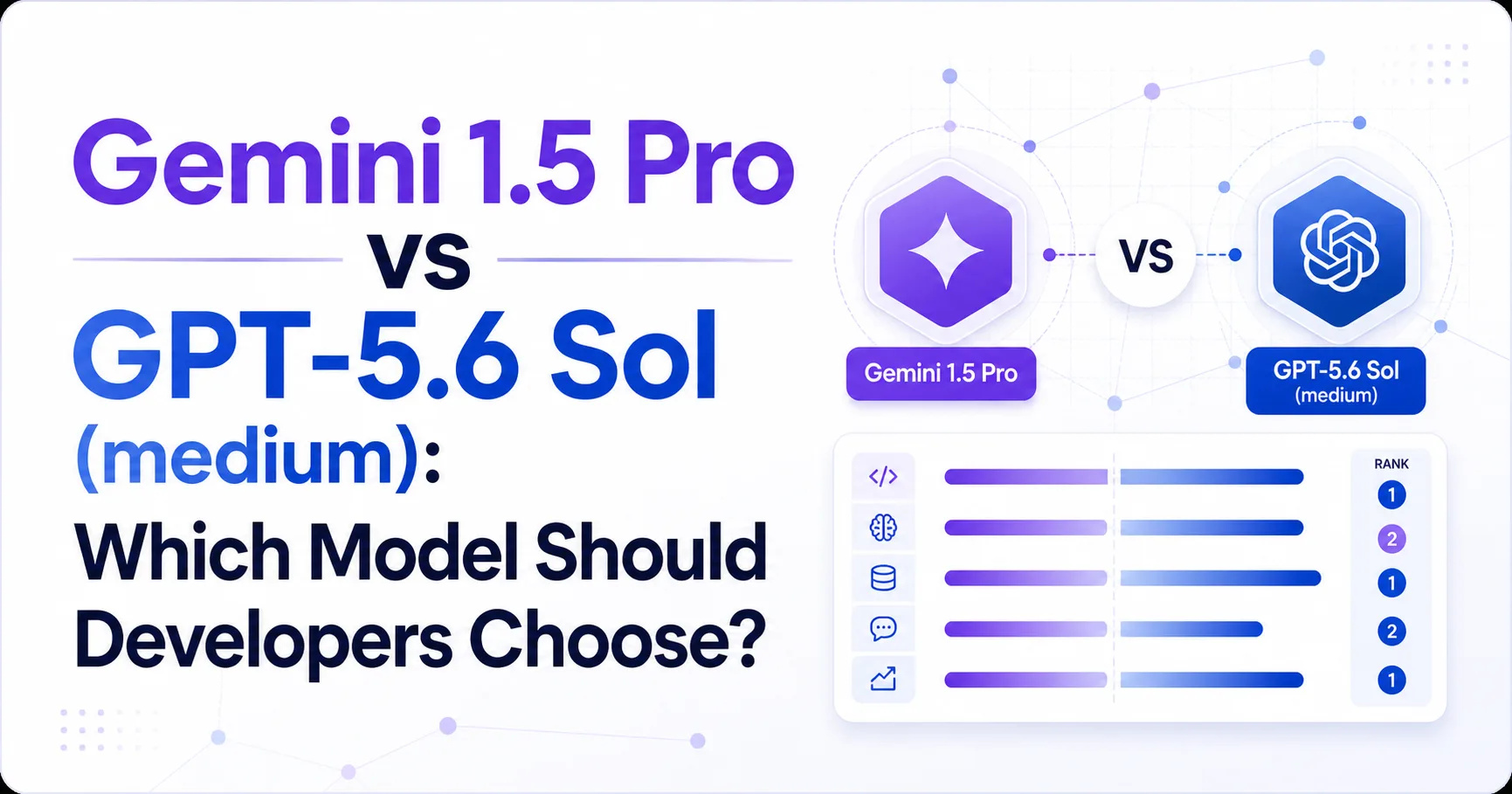
GPT-5.6 Sol (medium) is the safer default for new developer projects because it combines stronger supplied evaluation results, lower blended pricing, and a currently documented production path. The Artificial Analysis snapshot gives GPT-5.6 Sol (medium) a coding index of 76.3 and an intelligence index of 53.6, compared with 23.6 and 10 for Gemini 1.5 Pro. Artificial Analysis supplies these comparison values.\n\nGemini 1.5 Pro remains relevant as a historical long-context and multimodal reference, but the supplied official research cannot confirm a currently active endpoint, current price, or maintained model card for the Sep '24 entry. Google's Gemini API model documentation no longer presents that version as an active model entry. GPT-5.6 Sol, by contrast, remains listed as a flagship model for complex reasoning and coding in OpenAI's model directory.\n\nThe practical decision is therefore not only about benchmark leadership. It is also about whether a team can depend on a stable API contract, documented capabilities, and a price that can be verified before deployment.
GPT-5.6 Sol (medium) offers the stronger overall developer profile, while Gemini 1.5 Pro is difficult to recommend for a new dependency because its current service status is unclear.\n\n| Decision factor | Gemini 1.5 Pro (Sep '24) | GPT-5.6 Sol (medium) | What it means |\n|---|---:|---:|---|\n| Coding index | 23.6 | 76.3 | GPT-5.6 Sol has the stronger supplied coding result |\n| Intelligence index | 10 | 53.6 | GPT-5.6 Sol has the stronger supplied general capability result |\n| Blended price per 1M tokens | $15 | $11.25 | GPT-5.6 Sol has the lower blended price |\n| Input price per 1M tokens | $10 | $5 | GPT-5.6 Sol is cheaper for input-heavy workloads |\n| Output price per 1M tokens | $30 | $30 | The supplied output price is tied |\n| Latency | 0.3 seconds | 0.3 seconds | The supplied latency result is tied |\n\nGPT-5.6 Sol is the better fit for code generation, repository changes, structured application workflows, and tool-driven agents. The official model page documents text and image input, text output, Responses API, Chat Completions API, Batch API, structured outputs, function calling, file search, web search, and prompt caching. GPT-5.6 Sol's official model page provides that capability list.\n\nGemini 1.5 Pro's historical positioning centered on complex multimodal work and very long context. Google's Gemini API model documentation is not sufficient to verify the exact Sep '24 parameters today. That missing verification is itself a selection risk, especially for a project that needs reproducible deployment documentation.
GPT-5.6 Sol (medium) is the stronger choice for coding and broad reasoning workloads according to the supplied evaluation snapshot.\n\nThe coding-index gap is large enough to change the type of engineering work a team should assign to each model. A higher coding result generally supports greater confidence in repository navigation, implementation planning, code transformation, and debugging. The supplied snapshot places GPT-5.6 Sol at 76.3 and Gemini 1.5 Pro at 23.6. Artificial Analysis is the source for those values. The snapshot does not explain the exact task mix, prompts, scoring procedure, or variance, so the result should guide screening rather than replace a task-specific pilot.\n\nThe intelligence-index comparison points in the same direction. GPT-5.6 Sol records 53.6, while Gemini 1.5 Pro records 10. That difference suggests a wider margin for complex reasoning, but it does not prove that GPT-5.6 Sol wins every domain. The supplied research contains no official GPT-5.6 benchmark table, and it contains no reproducible community benchmark for the specific Gemini version. OpenAI's GPT-5.6 Sol page confirms the absence of a detailed official benchmark table in the supplied materials.\n\nSpeed requires a more careful reading. GPT-5.6 Sol has a reported median output rate of 69.865 tokens per second, while Gemini 1.5 Pro has no supplied output-speed value. Latency is 0.3 seconds for both models in the data snapshot. A developer building an interactive agent may therefore prefer GPT-5.6 Sol for observable generation speed, but the evidence cannot establish a fair speed comparison because one model lacks a corresponding measurement.\n\nGPT-5.6's reasoning setting also matters. The GPT-5.6 usage guide describes medium reasoning effort as a balanced starting point and states that medium is the default when the parameter is not explicitly set. That makes the compared configuration operationally meaningful, although teams should still test whether higher reasoning effort changes quality, latency, and cost for their own tasks.
GPT-5.6 Sol (medium) leads on 2 of 2 metrics
GPT-5.6 Sol is cheaper on the supplied blended and input prices, but Gemini 1.5 Pro's unverified current price makes its total project cost impossible to forecast confidently.\n\nThe data snapshot lists GPT-5.6 Sol at $11.25 per 1M blended tokens and Gemini 1.5 Pro at $15. Artificial Analysis provides those comparison values. GPT-5.6 Sol also has a $5 input price versus Gemini 1.5 Pro's $10 input price, while both models show a $30 output price. This favors GPT-5.6 Sol for workloads that send large prompts, repeatedly inspect code, or maintain long agent histories.\n\nThe price chart cannot show the cost of failure. A model that produces weaker code may require more retries, longer review cycles, additional test runs, or a second model for repair. Those engineering costs can outweigh a small token-price advantage. Here, the supplied coding-index difference makes that question particularly important, because Gemini 1.5 Pro's lower apparent capability could increase human and tool-mediated correction work. The evidence does not quantify retry rates or total task cost, so this remains a deployment hypothesis rather than a measured conclusion.\n\nGPT-5.6 Sol also has documented service tiers and caching behavior in OpenAI's API pricing documentation. The supplied official research warns that large inputs can receive higher pricing treatment on the GPT-5.6 Sol model page. The official model page should be checked before production budgeting.\n\nGemini 1.5 Pro is harder to compare operationally. Google's current Gemini API pricing page does not list a current price for that specific model in the supplied research. A nominal historical figure cannot substitute for a price that a team can still obtain and contract against.
Gemini 1.5 Pro (Sep '24) leads on 3 of 3 metrics
GPT-5.6 Sol (medium) should be the default selection for a new developer-facing application unless a verified Gemini deployment requirement already exists.\n\nChoose GPT-5.6 Sol (medium) for coding agents, pull-request assistance, structured extraction, tool orchestration, and applications that need documented API features. The official materials describe function calling, structured outputs, file search, web search, prompt caching, streaming, and several supported APIs. GPT-5.6 Sol's model page documents these capabilities. The supplied Artificial Analysis snapshot also gives it the higher coding and intelligence results. Artificial Analysis is the source for those measurements.\n\nConsider Gemini 1.5 Pro only when a team has a specific, already verified reason to keep it, such as an existing Google integration, a tested historical workflow, or a dependency on its previously documented multimodal and long-context positioning. Google's Gemini API model documentation supports the historical product positioning, but it does not provide enough current information to treat the Sep '24 model as a dependable new default.\n\nDo not make the decision from benchmark scores alone. Run a small acceptance set containing representative code changes, tests, tool calls, image inputs, long documents, refusal-sensitive requests, and recovery after a failed tool call. Compare successful task completion, review effort, retries, latency, and actual token usage. The supplied research does not provide these application-level measurements.\n\nGPT-5.6 Sol has documented limitations that should shape the pilot. The GPT-5.6 usage guide describes possible safety-related pauses and occasional refusal risks in dual-use domains. It also warns that detailed image inputs can increase token use and latency. Gemini 1.5 Pro has no maintained limitation list in the supplied materials, which means unknown behavior should be treated as uncertainty, not as evidence of better behavior.
GPT-5.6 Sol has better available evidence, but the supplied materials do not establish a complete production comparison between the two models.\n\nThe clearest evidence gap concerns Gemini 1.5 Pro. The supplied research does not confirm a current endpoint, current official price, maintained parameter page, output limit, or exact context window for the Sep '24 entry. Google's Gemini API model documentation and Google's Gemini API pricing page are the relevant official references, but they do not close those gaps. The research also does not identify a clear retirement announcement for this exact version.\n\nThe second gap concerns independent validation of GPT-5.6 Sol. A Reddit report describes excessive output, slow task progress, difficult-to-track code, and incorrect final implementations during a personal coding test. The Reddit report does not provide reproducible prompts, task sets, or quantitative measurements. Comments in the same discussion challenge the conclusion. The Reddit comment thread therefore records disagreement rather than a reliable failure rate.\n\nA Hacker News discussion mentions fast deployment and possible usefulness for codebase retrieval and agent workflows, but it provides no independent GPT-5.6 Sol measurement. The discussion and the corresponding comment are useful signals, not benchmark evidence.\n\nThe strongest conclusion is consequently asymmetric: GPT-5.6 Sol is easier to justify, while Gemini 1.5 Pro is harder to verify. That is a production-readiness conclusion, not proof that GPT-5.6 Sol dominates every possible workload.
GPT-5.6 Sol (medium) gives developers the clearest starting point, but unresolved Gemini availability questions should be answered before any migration decision.\n\nThe FAQ below separates measured comparison points from claims that still require a project-specific test. The supplied data reports latency of 0.3 seconds for both models, but it does not report Gemini 1.5 Pro output speed. Artificial Analysis is the source for the supplied data snapshot.\n\nTeams should also confirm endpoint access, authentication, quotas, regional availability, retention requirements, and exact billing behavior directly with each provider before committing production traffic. The supplied research does not provide those operational details for a complete side-by-side assessment.
Choose GPT-5.6 Sol (medium) for a new coding application because the supplied snapshot reports a 76.3 coding index, the official documentation confirms an active model path, and its blended price is $11.25 per 1M tokens.
The supplied data does not support that conclusion. Gemini 1.5 Pro is listed at $15 per 1M blended tokens, while GPT-5.6 Sol is listed at $11.25, but Google's current pricing page does not verify an active Gemini price.
GPT-5.6 Sol is the only model with a supplied output-speed measurement, at 69.865 median output tokens per second. Latency is tied at 0.3 seconds, while Gemini 1.5 Pro has no reported output-speed value.
The supplied research cannot confirm a currently usable endpoint for Gemini 1.5 Pro (Sep '24). Google's current model documentation does not show it as an active entry, so developers must verify access directly before relying on it.
GPT-5.6 Sol supports image input and text output, plus tools and APIs such as function calling, file search, web search, structured outputs, and computer-oriented integrations documented by OpenAI.
No. The supplied scores favor GPT-5.6 Sol, but they do not measure your prompts, retry rate, review effort, tool failures, or total task completion cost. A representative acceptance set remains necessary.