
Time to First Token · Gemini 1.5 Pro (Sep '24)
0ms
Time to First Token · Mi:dm K 2.5 Pro Preview
0ms
Deep dive into reasoning, benchmarks, and latency insights.
The current catalog does not contain complete performance evidence for both models, so this page does not declare an overall winner. Use the available fields as comparison signals and validate the models on your own workload.
Key decision metrics at a glance.
| Model | Metric | Value | Unit | Source / snapshot |
|---|---|---|---|---|
| Gemini 1.5 Pro (Sep '24) | Reasoning | 6.0 | benchmark or capability score | Artificial Analysis · current catalog |
| Mi:dm K 2.5 Pro Preview | Reasoning | 8.0 | benchmark or capability score | Artificial Analysis · current catalog |
| Gemini 1.5 Pro (Sep '24) | Coding | 2.0 | benchmark or capability score | Artificial Analysis · current catalog |
| Mi:dm K 2.5 Pro Preview | Coding | 6.0 | benchmark or capability score | Artificial Analysis · current catalog |
| Gemini 1.5 Pro (Sep '24) | Multimodal | 1.0 | benchmark or capability score | Artificial Analysis · current catalog |
| Mi:dm K 2.5 Pro Preview | Multimodal | 5.0 | benchmark or capability score | Artificial Analysis · current catalog |
| Gemini 1.5 Pro (Sep '24) | Long Context | 1.0 | benchmark or capability score | Artificial Analysis · current catalog |
| Mi:dm K 2.5 Pro Preview | Long Context | 8.0 | benchmark or capability score | Artificial Analysis · current catalog |
| Gemini 1.5 Pro (Sep '24) | Blended Price / 1M tokens | $0 | USD per 1M tokens | Artificial Analysis · current catalog |
| Mi:dm K 2.5 Pro Preview | Blended Price / 1M tokens | $0 | USD per 1M tokens | Artificial Analysis · current catalog |
| Gemini 1.5 Pro (Sep '24) | P95 Latency | — | milliseconds | Artificial Analysis · current catalog |
| Mi:dm K 2.5 Pro Preview | P95 Latency | — | milliseconds | Artificial Analysis · current catalog |
| Gemini 1.5 Pro (Sep '24) | Tokens per second | 0 | tokens per second | Artificial Analysis · current catalog |
| Mi:dm K 2.5 Pro Preview | Tokens per second | 0 | tokens per second | Artificial Analysis · current catalog |
Data provided by Artificial Analysis; live values use the current catalog.
This radar chart visually maps the core capabilities (reasoning, coding, math proxy, multimodal, long context) of `Gemini 1.5 Pro (Sep '24)` vs `Mi:dm K 2.5 Pro Preview`.
This grouped bar chart provides a side-by-side comparison for each benchmark metric.
Lower time to first token is better; higher tokens per second is better.
Compare input and output pricing in USD per 1M tokens.
Gemini 1.5 Pro (Sep '24)$0
Mi:dm K 2.5 Pro Preview$0
This article is a dated snapshot published on 2026-08-16. Live cards above use the current catalog; missing live fields are not inferred.
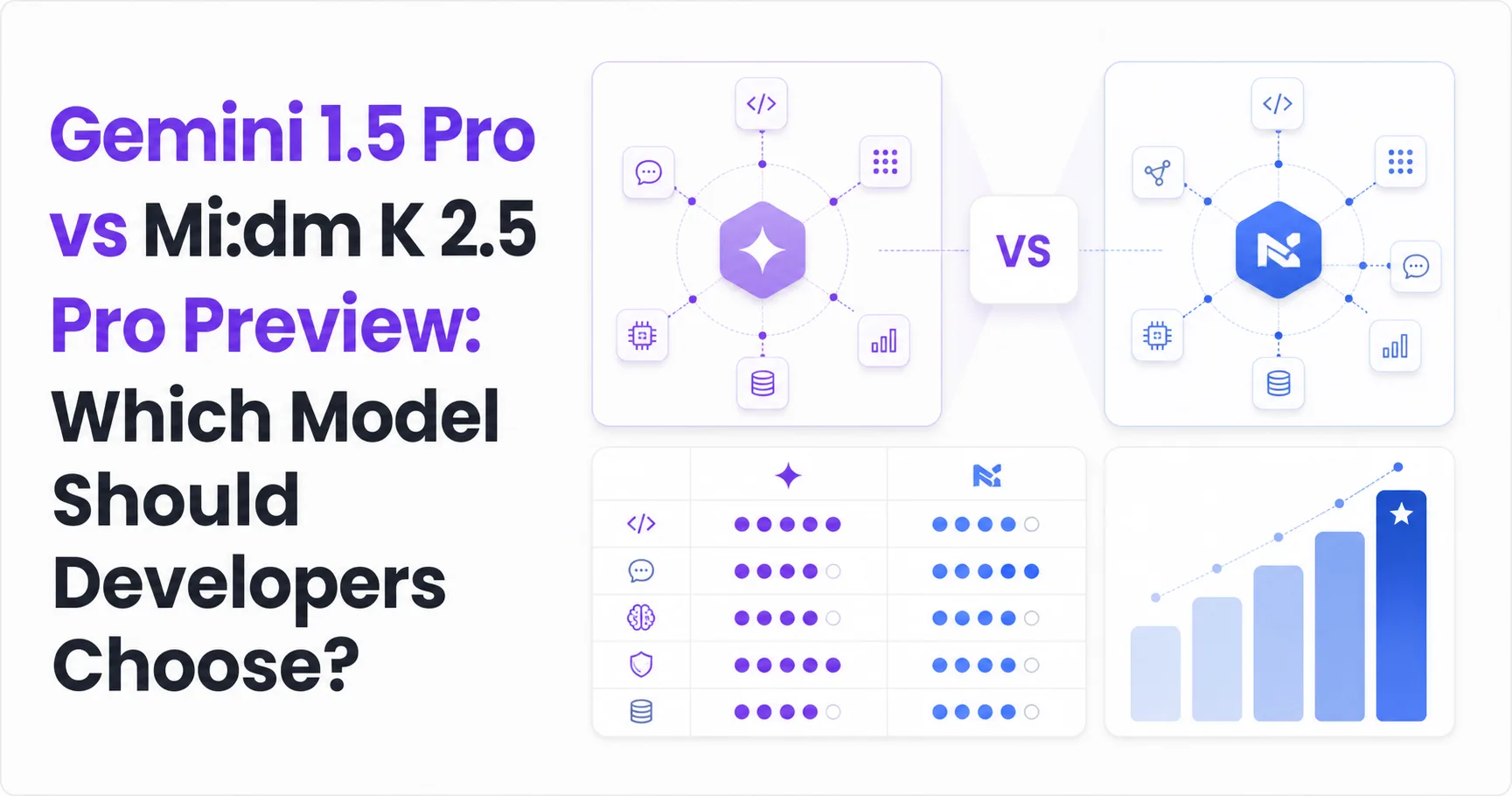
Mi:dm K 2.5 Pro Preview has the stronger reported benchmark profile, but Gemini 1.5 Pro has the clearer provider identity and documented historical positioning.
The comparison is difficult because the two models are not equally documented. Gemini 1.5 Pro (Sep '24) is associated with Google and has historical official material describing multimodal input and long-context use. The current Gemini API model documentation no longer presents an active model card for this specific version. Mi:dm K 2.5 Pro Preview is associated with Korea Telecom, but the supplied research found no verifiable official announcement, developer documentation, pricing page, or endpoint.
The benchmark snapshot supplied by Artificial Analysis gives Mi:dm K 2.5 Pro Preview higher reported scores on GPQA, HLE, LiveCodeBench, MMLU Pro, and SciCode where comparable values exist. Gemini 1.5 Pro leads on the reported Math 500 result, while several tests have data for only one model. Those results create a performance signal, not a complete production recommendation.
For a developer choosing a dependable API, the central issue is not only capability. It is whether the model can be called, priced, monitored, and supported under a documented contract. The supplied evidence does not establish that for Mi:dm K 2.5 Pro Preview, and the current Google pages do not establish it for Gemini 1.5 Pro either.
Mi:dm K 2.5 Pro Preview looks better on the available shared benchmarks, while Gemini 1.5 Pro is easier to place in a known vendor ecosystem.
The strongest direct comparison favors Mi:dm K 2.5 Pro Preview. Its reported GPQA score is 0.722 versus Gemini 1.5 Pro at 0.589. GPQA is designed to test difficult graduate-level questions, so the result suggests a stronger signal for demanding reasoning tasks. Its reported LiveCodeBench score is 0.576 versus 0.316, which is the clearest available coding-oriented advantage. MMLU Pro also favors Mi:dm K 2.5 Pro Preview at 0.813 versus 0.75.
The evidence is incomplete. Gemini 1.5 Pro has a reported Math 500 score of 0.876, while Mi:dm K 2.5 Pro Preview has no value in that test. Mi:dm K 2.5 Pro Preview has a reported Artificial Analysis Math Index of 78.7, but Gemini 1.5 Pro has no corresponding value. These are not interchangeable measurements, so they cannot establish a single overall math winner.
The operational comparison is even less settled. Both models are listed at $0 for the supplied pricing fields, but the research found no current public price for either model in the relevant official material. Both are also listed at 0 median output tokens per second and 0 latency seconds in the supplied snapshot. Those zeros should be treated as unavailable or non-actionable measurements, not proof that the models have identical speed.
The practical decision is therefore conditional: Mi:dm K 2.5 Pro Preview deserves a controlled technical evaluation for capability-led workloads. Gemini 1.5 Pro should be considered only if an existing, working deployment can be verified, because the current Google catalog does not show it as an active model.
Mi:dm K 2.5 Pro Preview shows the stronger available reasoning and coding signal, but the evidence does not prove reliable production performance.
The clearest pattern appears across the shared evaluations. Mi:dm K 2.5 Pro Preview scores 0.722 on GPQA compared with Gemini 1.5 Pro at 0.589, and 0.091 on HLE compared with 0.046. The model also scores 0.576 on LiveCodeBench compared with Gemini 1.5 Pro at 0.316. For a developer, that combination points toward testing Mi:dm K 2.5 Pro Preview on difficult code generation, debugging, and research-style tasks first.
The coding signal is not universal. SciCode is nearly level, with Mi:dm K 2.5 Pro Preview at 0.297 and Gemini 1.5 Pro at 0.295. Mi:dm K 2.5 Pro Preview also reports 0.45578231292517 on IFBench and 0.494152046783626 on τ2, but Gemini 1.5 Pro has no corresponding values. The supplied research provides no test method, prompt set, version details, or reproducible community experiment for Mi:dm K 2.5 Pro Preview. That makes the scores useful for forming a test hypothesis, not for accepting a quality guarantee.
Gemini 1.5 Pro has one important historical capability signal. Google positioned the Gemini 1.5 Pro family around multimodal inputs and very long context, with historical material describing support for up to approximately 2 million tokens. The current Gemini API model documentation does not retain a separate parameter record for the Sep '24 version, so the exact context window and output limit for this entry remain unverified.
The missing evidence changes the evaluation design. Test both models with the same private code tasks, long documents, structured output requirements, and failure recovery prompts. Confirm that the exact model identifier remains callable before interpreting any benchmark advantage as a deployable advantage.
Gemini 1.5 Pro and Mi:dm K 2.5 Pro Preview appear tied at $0 in the supplied snapshot, but neither zero establishes a production cost.
The data snapshot lists $0 for both models across blended, input, and output pricing fields. The same snapshot lists 0 median output tokens per second and 0 latency seconds for both models. These values cannot answer the operational questions a developer needs answered: whether requests are accepted, what quota applies, whether free access is temporary, or how output is billed.
Google's current Gemini API pricing page does not list Gemini 1.5 Pro's free tier, paid tier, or batch price. The supplied research also found no current stable endpoint for gemini-1.5-pro. That means the apparent $0 price can conceal migration work, unavailable access, or a need to select a newer Google model.
Mi:dm K 2.5 Pro Preview has a more serious pricing information gap. The supplied research found no verifiable official pricing page, developer documentation, stable alias, or direct-call confirmation. A $0 entry therefore cannot be used to forecast spend or compare total cost of ownership.
The cheaper option may become the more expensive option if it requires custom integration, repeated access checks, manual fallback handling, or a later model migration. Conversely, Mi:dm K 2.5 Pro Preview could be attractive if a real provider endpoint is available and its benchmark advantage reduces retries or human review. The supplied evidence does not measure either effect.
Before choosing, request a real sample of production-like calls from each candidate. Record accepted model identifiers, quotas, input and output billing, response latency, rate-limit behavior, and failure recovery. Without those observations, the cost comparison remains an unverified data placeholder.
Mi:dm K 2.5 Pro Preview is the better capability candidate, while Gemini 1.5 Pro is the better-known ecosystem candidate only if an existing endpoint still works.
Choose Mi:dm K 2.5 Pro Preview for a capability experiment when your application can tolerate preview status and you can run a private acceptance test. The reported results are stronger on GPQA at 0.722, HLE at 0.091, LiveCodeBench at 0.576, and MMLU Pro at 0.813. Those results make it the logical first candidate for difficult reasoning and coding workflows. They do not prove stable access, because the research found no verifiable official technical source for the model.
Choose Gemini 1.5 Pro only when your team already has a verified working integration or needs to investigate Google's historical multimodal and long-context positioning. Google historically described Gemini 1.5 Pro as accepting text, images, video, and audio inputs while producing text output. However, the current Gemini API model documentation does not show this Sep '24 entry as an active model, and the current pricing documentation does not provide a current price.
Do not select either model for a production commitment based on the supplied evidence alone. The research does not confirm a current endpoint, service-level expectations, context limit, output limit, or support path for the exact versions in this comparison. It also does not provide reliable community reports for coding behavior, speed, or failure patterns.
The next decision should be a short go or no-go evaluation. A model passes only if it is callable under the intended identifier, returns acceptable results on your own tasks, exposes predictable limits, and has a cost that can be verified in the provider account. If Mi:dm K 2.5 Pro Preview fails the access test, its benchmark lead has no practical value. If Gemini 1.5 Pro fails the same test, its historical strengths cannot justify new implementation work.
Mi:dm K 2.5 Pro Preview should be tested first for capability, while Gemini 1.5 Pro should be tested first for endpoint continuity.
The available material leaves several questions unanswered. Those gaps matter because developers do not deploy benchmark scores alone. They deploy a specific model identifier with a known request format, predictable limits, measurable latency, and a recoverable failure path.
The FAQ below separates what the supplied evidence supports from what still requires direct validation.
Mi:dm K 2.5 Pro Preview is the stronger coding candidate in the supplied data because its LiveCodeBench score is 0.576, compared with Gemini 1.5 Pro at 0.316. The result still requires validation on your own repository and prompts.
Neither model can be confirmed as cheaper for production. The snapshot lists both at $0, while the research found no current public price for Gemini 1.5 Pro and no verifiable pricing source for Mi:dm K 2.5 Pro Preview.
The supplied research does not confirm a usable current endpoint for Gemini 1.5 Pro (Sep '24). Google's current model catalog does not show an active entry for this version, so developers must verify access directly before implementation.
Mi:dm K 2.5 Pro Preview cannot be approved for production from the supplied evidence alone. No verifiable official documentation, endpoint, pricing page, support information, or reproducible community testing was found for the exact preview model.
Both models show 0 median output tokens per second and 0 latency seconds in the supplied snapshot, but those values should not be read as identical real-world performance. The evidence does not explain whether the fields are unavailable or measured as zero.
Gemini 1.5 Pro has the stronger historical long-context positioning because Google described the Gemini 1.5 Pro family as supporting up to approximately 2 million tokens. The exact Sep '24 context limit is not currently documented in the supplied official page.