
Time to First Token · Gemini 3.1 Pro Preview
30852ms
Time to First Token · GPT-5 (high)
0ms
Deep dive into reasoning, benchmarks, and latency insights.
The current catalog does not contain complete performance evidence for both models, so this page does not declare an overall winner. Use the available fields as comparison signals and validate the models on your own workload.
Key decision metrics at a glance.
| Model | Metric | Value | Unit | Source / snapshot |
|---|---|---|---|---|
| Gemini 3.1 Pro Preview | Reasoning | 6.0 | benchmark or capability score | Artificial Analysis · current catalog |
| GPT-5 (high) | Reasoning | 9.0 | benchmark or capability score | Artificial Analysis · current catalog |
| Gemini 3.1 Pro Preview | Coding | 7.0 | benchmark or capability score | Artificial Analysis · current catalog |
| GPT-5 (high) | Coding | 4.0 | benchmark or capability score | Artificial Analysis · current catalog |
| Gemini 3.1 Pro Preview | Multimodal | 4.0 | benchmark or capability score | Artificial Analysis · current catalog |
| GPT-5 (high) | Multimodal | 3.0 | benchmark or capability score | Artificial Analysis · current catalog |
| Gemini 3.1 Pro Preview | Long Context | 6.0 | benchmark or capability score | Artificial Analysis · current catalog |
| GPT-5 (high) | Long Context | 4.0 | benchmark or capability score | Artificial Analysis · current catalog |
| Gemini 3.1 Pro Preview | Blended Price / 1M tokens | $4.5 | USD per 1M tokens | Artificial Analysis · current catalog |
| GPT-5 (high) | Blended Price / 1M tokens | $3.438 | USD per 1M tokens | Artificial Analysis · current catalog |
| Gemini 3.1 Pro Preview | P95 Latency | — | milliseconds | Artificial Analysis · current catalog |
| GPT-5 (high) | P95 Latency | — | milliseconds | Artificial Analysis · current catalog |
| Gemini 3.1 Pro Preview | Tokens per second | 126.262 | tokens per second | Artificial Analysis · current catalog |
| GPT-5 (high) | Tokens per second | 0 | tokens per second | Artificial Analysis · current catalog |
Data provided by Artificial Analysis; live values use the current catalog.
This radar chart visually maps the core capabilities (reasoning, coding, math proxy, multimodal, long context) of `Gemini 3.1 Pro Preview` vs `GPT-5 (high)`.
This grouped bar chart provides a side-by-side comparison for each benchmark metric.
Lower time to first token is better; higher tokens per second is better.
Compare input and output pricing in USD per 1M tokens.
Gemini 3.1 Pro Preview$5
GPT-5 (high)$3.75
GPT-5 (high) costs $1.25 less per run
This article is a dated snapshot published on 2026-08-07. Live cards above use the current catalog; missing live fields are not inferred.
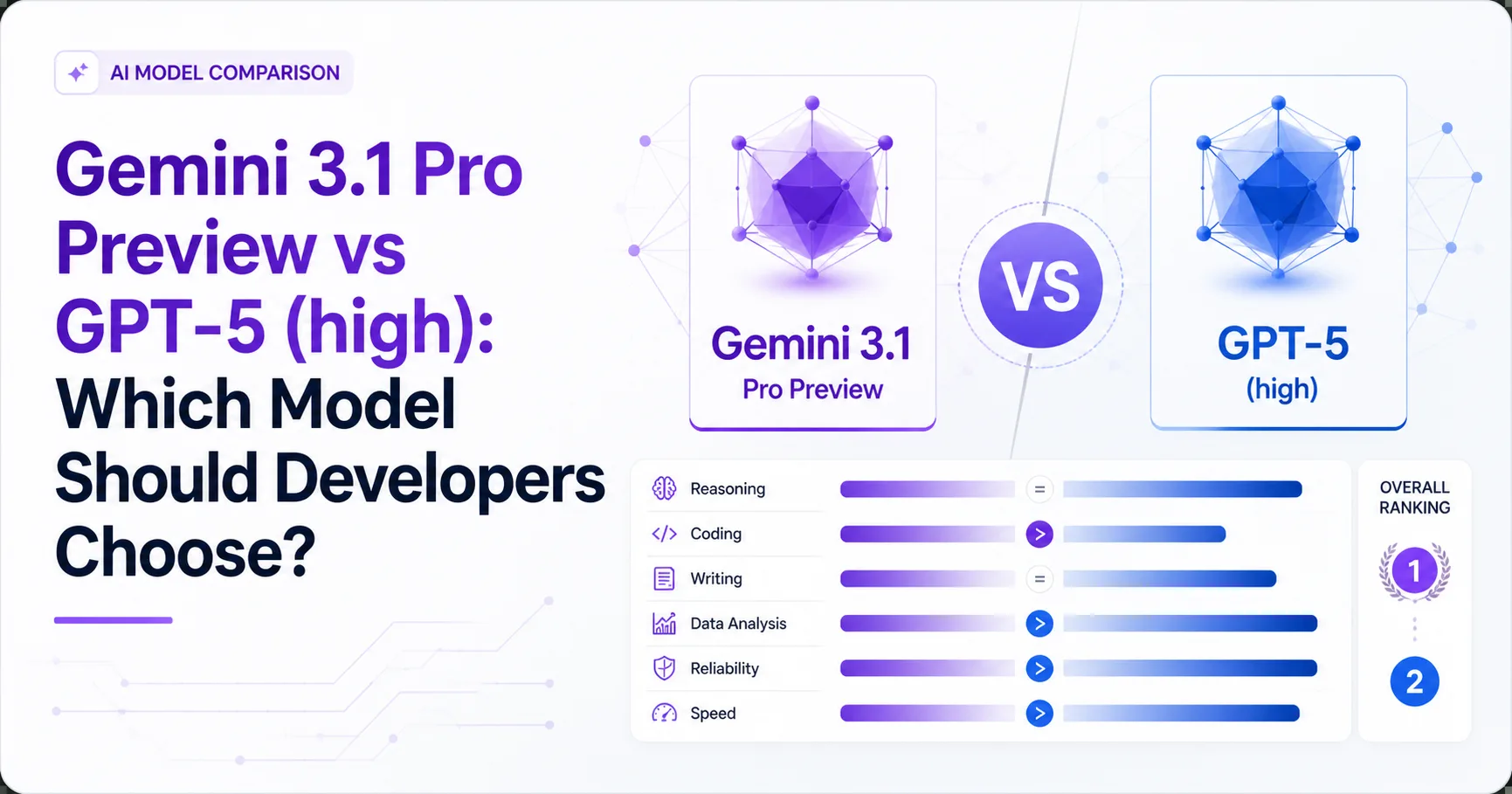
Gemini 3.1 Pro Preview is the stronger capability candidate, while GPT-5 (high) is the clearer operational choice for teams that value documented API behavior and lower measured cost. The supplied Artificial Analysis data gives Gemini a coding index of 68.8 versus 37.8 for GPT-5 (high), and an intelligence index of 46.5 versus 34.7. GPT-5 (high) has the stronger documented mathematical signal, with a math index of 94.3.\n\nThe comparison is not a simple quality ranking. Gemini is listed by Google as a Preview model, and the supplied official materials do not confirm its context window, output limit, or model-specific price. GPT-5 has detailed public documentation, but its fixed snapshot is marked Deprecated and the model page recommends GPT-5.6. Developers therefore face a tradeoff between stronger measured coding capability and clearer production constraints.\n\nThe practical decision depends on workload shape. Coding-heavy agents, repository transformation, and broad intelligence tasks favor Gemini in the supplied benchmark snapshot. Math-heavy reasoning, predictable interface design, and teams that need explicit limits favor GPT-5 (high).
Gemini 3.1 Pro Preview leads the supplied capability comparison, but GPT-5 (high) provides the better-documented deployment contract. The Artificial Analysis snapshot reports Gemini at 68.8 on coding and 46.5 on intelligence, compared with GPT-5 (high) at 37.8 and 34.7. The coding gap is 31 points, which is large enough to change the expected value of an autonomous coding workflow.\n\nGPT-5 (high) remains attractive where mathematical reasoning is central. The same dataset reports a 94.3 math index for GPT-5 (high), while no Gemini math value is supplied. That missing Gemini value does not prove a weakness, but it prevents a direct math comparison.\n\nThe official product states also diverge. Google lists Gemini 3.1 Pro as gemini-3.1-pro-preview, with Preview status and positioning around advanced intelligence, complex problem solving, agentic coding, and vibe coding. OpenAI documents GPT-5 with a 400,000-token context window, a maximum output of 128,000 tokens, text and image input, and text output.\n\nGPT-5 is cheaper in the supplied blended-cost comparison, at $3.4375 versus Gemini at $4.5 per 1M blended tokens. However, Gemini’s official model-specific price is not confirmed in the supplied materials, so the data snapshot and the official price page cannot be treated as a fully reconciled commercial quote.
Gemini 3.1 Pro Preview is the better measured coding and general-intelligence candidate, while GPT-5 (high) is the better documented math specialist. The Artificial Analysis comparison reports a coding index of 68.8 for Gemini and 37.8 for GPT-5 (high), plus an intelligence index of 46.5 versus 34.7. Those results suggest Gemini may reduce intervention in coding agents that must inspect, modify, and extend unfamiliar code. They do not establish universal superiority across every repository, language, tool chain, or prompt style.\n\nThe measured latency is 0.3 seconds for each model, so the supplied snapshot does not show a latency advantage. Gemini also reports a median output rate of 129.625 tokens per second. GPT-5 has no corresponding output-speed value in the supplied dataset, which means a direct throughput comparison is unavailable.\n\nThe practical implication is that response speed and task completion are different concerns. A fast stream can improve interactive coding, but a model that requires fewer corrections can still produce a better end-to-end experience. The supplied Reddit report describes GPT-5 as useful for locating and fixing small bugs, while also reporting concerns about hallucinations or incorrect edits in complex existing codebases. That is a subjective, uncontrolled account, so it should guide testing rather than serve as a general performance claim. See the Reddit field report.\n\nGemini’s coding advantage should be validated with the team’s own repository tasks. The supplied materials contain no reliable community testing for Gemini 3.1 Pro Preview, so its failure patterns, speed feel, and coding ergonomics remain evidence gaps.
GPT-5 (high) is the cheaper measured option, but Gemini 3.1 Pro Preview can still be economically preferable if its coding advantage reduces correction work. The Artificial Analysis data places GPT-5 (high) at $3.4375 and Gemini at $4.5 per 1M blended tokens. GPT-5 is also lower on input cost at $1.25 versus $2, and on output cost at $10 versus $12.\n\nThe price table alone cannot show the cost of a completed engineering task. A cheaper model may consume more turns, require more review, or produce edits that engineers must repair. Those effects can outweigh token price in repository agents, especially when the workflow includes tests, retries, code review, and tool calls. The supplied materials do not provide correction rates, task completion costs, or production token mixes, so the break-even point is unknown.\n\nGPT-5 has explicit official pricing in the model documentation, including cached input at $0.125 per 1M tokens. The supplied Gemini pricing extract does not include a model-specific price. Google’s pricing documentation describes paid-plan features and a 50% Batch API cost discount, but the brief states that this general explanation cannot substitute for Gemini 3.1 Pro’s exact price.\n\nTeams should therefore separate two decisions. Use GPT-5 (high) when predictable published pricing is a hard requirement. Test Gemini when higher task success could reduce human review, because token price is only one part of engineering cost.
GPT-5 (high) leads on 3 of 3 metrics
Gemini 3.1 Pro Preview is the default pick for coding-first experiments, while GPT-5 (high) is the safer pick for documented production constraints and math-heavy work. Google’s model catalog positions Gemini around advanced intelligence, complex problem solving, agentic coding, and vibe coding. The supplied coding index supports that positioning, although the official materials do not describe detailed failure boundaries.\n\nChoose Gemini for repository agents, code generation, refactoring, and broad problem-solving pilots when the team can tolerate Preview status. The 68.8 coding index versus 37.8 for GPT-5 (high) makes Gemini the more compelling first test for tasks where implementation quality matters more than published operational certainty. Keep human review and rollback controls in the loop until internal evidence establishes stability.\n\nChoose GPT-5 (high) for mathematical reasoning, explicit tool contracts, or applications that benefit from documented controls. OpenAI documents function calling, structured outputs, streaming, custom tools, reasoning_effort, and verbosity in its developer announcement and model documentation. GPT-5 also has the supplied math index of 94.3.\n\nDo not treat gpt-5-high as a separate API model. The supplied OpenAI materials describe high as the reasoning_effort=high setting for gpt-5, not an independent model identifier. Do not treat Gemini’s Preview label as a stable specification either. Google’s catalog does not confirm the context window, output limit, API parameters, or model-specific pricing in the supplied brief.\n\nA sensible evaluation uses the team’s own tasks, with success criteria for correctness, repair turns, latency, review time, and output cost. The supplied sources do not provide enough evidence to predict those production outcomes directly.
GPT-5 (high) is easier to specify from public documentation, while Gemini 3.1 Pro Preview requires more internal validation before production selection. The supplied sources document GPT-5’s context, output, modalities, tools, pricing, and model status, but leave several Gemini deployment details unresolved.\n\nThe key uncertainty is not whether Gemini has a strong benchmark signal. The supplied Artificial Analysis data clearly places Gemini ahead on coding and intelligence. The uncertainty is how that signal maps to the team’s repositories, tool integrations, rate limits, failure recovery, and commercial usage.\n\nThe community evidence is also asymmetric. The supplied Reddit post offers subjective GPT-5 observations, including fast small-bug work and possible incorrect edits in complex codebases. No similarly reliable community material was supplied for Gemini 3.1 Pro Preview. That absence should be recorded as missing evidence, not interpreted as positive or negative sentiment.\n\nBefore committing, verify the exact API alias, pricing, context behavior, output limits, rate limits, tool behavior, and migration path. GPT-5’s fixed snapshot is Deprecated according to OpenAI’s model documentation, while Google’s catalog still lists Gemini 3.1 Pro as Preview. These version states create different operational risks.
Gemini 3.1 Pro Preview is the stronger first choice for coding agents because the supplied comparison reports a 68.8 coding index versus 37.8 for GPT-5 (high). Teams should still validate repository-specific correctness, repair frequency, and stability because Gemini remains a Preview model and its detailed failure boundaries are not supplied.
GPT-5 (high) is cheaper in the supplied blended comparison at $3.4375 versus $4.5 per 1M blended tokens. OpenAI also publishes input and output prices, while the supplied Gemini pricing extract does not confirm a model-specific price, so Gemini’s commercial cost requires direct verification before budgeting.
GPT-5 (high) is the only model with a supplied math index, at 94.3. Gemini 3.1 Pro Preview has no corresponding math value in the dataset, so the available evidence supports GPT-5 for this use case but cannot establish a complete head-to-head math ranking.
GPT-5 (high) is not presented as a separate API model in the supplied OpenAI documentation. The high label refers to the reasoning_effort=high parameter for gpt-5, while the documented API alias is gpt-5 and the fixed snapshot is gpt-5-2025-08-07.
Gemini 3.1 Pro Preview should be treated as an evaluation candidate rather than a fully specified production default. Google lists it as Preview, and the supplied materials do not confirm its context window, output limit, rate limits, tool boundaries, or exact model-specific pricing.