
Time to First Token · Gemini 3.1 Pro Preview
30852ms
Time to First Token · GPT-5 nano (high)
0ms
Deep dive into reasoning, benchmarks, and latency insights.
The current catalog does not contain complete performance evidence for both models, so this page does not declare an overall winner. Use the available fields as comparison signals and validate the models on your own workload.
Key decision metrics at a glance.
| Model | Metric | Value | Unit | Source / snapshot |
|---|---|---|---|---|
| Gemini 3.1 Pro Preview | Reasoning | 6.0 | benchmark or capability score | Artificial Analysis · current catalog |
| GPT-5 nano (high) | Reasoning | 8.0 | benchmark or capability score | Artificial Analysis · current catalog |
| Gemini 3.1 Pro Preview | Coding | 7.0 | benchmark or capability score | Artificial Analysis · current catalog |
| GPT-5 nano (high) | Coding | 6.0 | benchmark or capability score | Artificial Analysis · current catalog |
| Gemini 3.1 Pro Preview | Multimodal | 4.0 | benchmark or capability score | Artificial Analysis · current catalog |
| GPT-5 nano (high) | Multimodal | 2.0 | benchmark or capability score | Artificial Analysis · current catalog |
| Gemini 3.1 Pro Preview | Long Context | 6.0 | benchmark or capability score | Artificial Analysis · current catalog |
| GPT-5 nano (high) | Long Context | 3.0 | benchmark or capability score | Artificial Analysis · current catalog |
| Gemini 3.1 Pro Preview | Blended Price / 1M tokens | $4.5 | USD per 1M tokens | Artificial Analysis · current catalog |
| GPT-5 nano (high) | Blended Price / 1M tokens | $0.138 | USD per 1M tokens | Artificial Analysis · current catalog |
| Gemini 3.1 Pro Preview | P95 Latency | — | milliseconds | Artificial Analysis · current catalog |
| GPT-5 nano (high) | P95 Latency | — | milliseconds | Artificial Analysis · current catalog |
| Gemini 3.1 Pro Preview | Tokens per second | 126.262 | tokens per second | Artificial Analysis · current catalog |
| GPT-5 nano (high) | Tokens per second | 0 | tokens per second | Artificial Analysis · current catalog |
Data provided by Artificial Analysis; live values use the current catalog.
This radar chart visually maps the core capabilities (reasoning, coding, math proxy, multimodal, long context) of `Gemini 3.1 Pro Preview` vs `GPT-5 nano (high)`.
This grouped bar chart provides a side-by-side comparison for each benchmark metric.
Lower time to first token is better; higher tokens per second is better.
Compare input and output pricing in USD per 1M tokens.
Gemini 3.1 Pro Preview$5
GPT-5 nano (high)$0.15
GPT-5 nano (high) costs $4.85 less per run
This article is a dated snapshot published on 2026-08-07. Live cards above use the current catalog; missing live fields are not inferred.
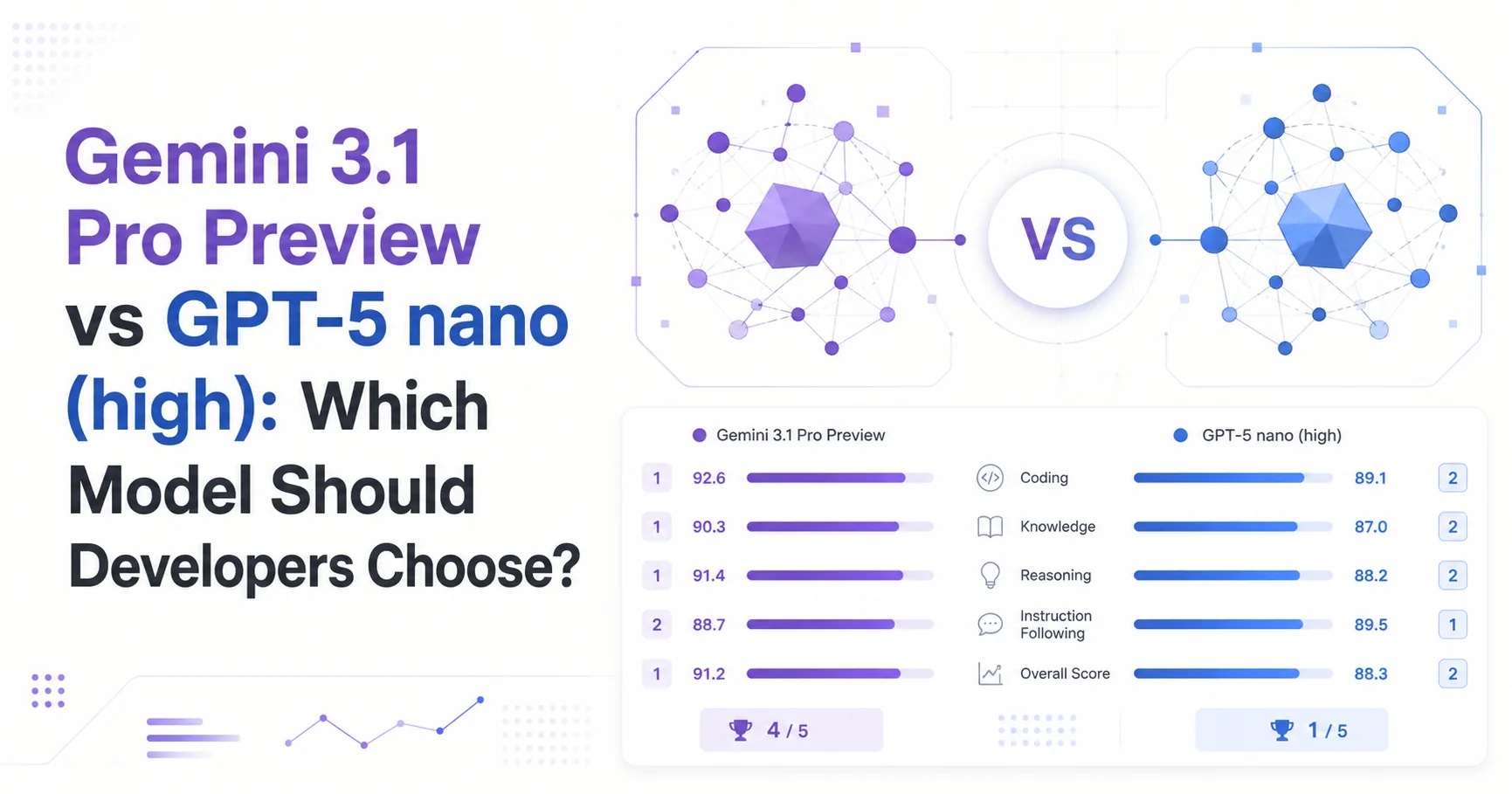
Gemini 3.1 Pro Preview is the stronger measured general-purpose choice, while GPT-5 nano (high) is the safer cost-first hypothesis for lightweight workloads. Artificial Analysis reports an Intelligence Index of 46.5 for Gemini and 19.9 for GPT-5 nano (high), a difference of 26.6 points. The same dataset reports a Math Index of 83.7 for GPT-5 nano (high), while no comparable Gemini math score is provided. Data provided by Artificial Analysis
The practical decision is therefore not a simple quality ranking. Gemini has stronger available evidence for broad intelligence, coding positioning, and output speed. GPT-5 nano (high) has a dramatically lower listed blended price and a strong measured math result. Neither model has a confirmed context window in the supplied official materials. Developers should treat this as a decision under uneven evidence, not as a complete capability benchmark.
Gemini 3.1 Pro Preview is the better default for complex developer tasks because its measured intelligence score and stated product positioning are stronger. Google describes Gemini 3.1 Pro as a Preview model for advanced intelligence, complex problem solving, agentic coding, and vibe coding, using the API alias gemini-3.1-pro-preview. Google’s model documentation
GPT-5 nano (high) is the better candidate for cost-sensitive applications because its blended price is $0.1375 per 1M tokens, compared with $4.500000000000001 for Gemini. Artificial Analysis also reports GPT-5 nano (high) at 83.7 on its Math Index. Artificial Analysis
The version-status comparison creates an important operational risk. Gemini is explicitly listed as Preview in Google’s model directory. GPT-5 nano is absent from the supplied current OpenAI model directory, so the available evidence does not confirm its current callable status, stable alias, or replacement path. OpenAI’s model documentation
This makes Gemini easier to identify but less mature in status, while GPT-5 nano (high) is cheaper but less clearly documented. The choice should depend on whether capability evidence or deployment certainty dominates the project.
Gemini 3.1 Pro Preview has the stronger available broad-intelligence signal, but the evidence cannot prove that it will win every coding workflow. Artificial Analysis gives Gemini an Intelligence Index of 46.5 and a Coding Index of 68.8. GPT-5 nano (high) has an Intelligence Index of 19.9 and a Math Index of 83.7, but the supplied comparison contains no GPT-5 nano coding score. Artificial Analysis
That missing coding comparison changes how developers should read the result. Gemini’s coding score supports using it for repository-level reasoning, debugging, and code generation experiments. It does not establish superiority for every language, framework, or tool-use pattern. GPT-5 nano (high)’s math score suggests a potentially useful niche for constrained numerical or symbolic tasks, but the available material does not show whether that strength transfers to software maintenance.
Gemini also has a reported median output speed of 129.625 tokens per second. Both models have a reported latency of 0.3 seconds in the supplied dataset, while GPT-5 nano (high) has no reported median output speed. That combination suggests Gemini may feel more productive during long responses, but it does not establish end-to-end application latency.
Google’s documentation positions Gemini for complex problem solving and agentic coding, yet it does not provide the model-specific context window, output limit, multimodal range, or tool boundary in the supplied material. Google’s model documentation Those omissions make workload-specific testing essential.
GPT-5 nano (high) is the clear price leader, but its economic advantage depends on whether its quality and availability are adequate for the task. Artificial Analysis lists GPT-5 nano (high) at $0.05 input and $0.4 output per 1M tokens, compared with Gemini at $2 input and $12 output per 1M tokens. The blended figures are $0.1375 for GPT-5 nano (high) and $4.500000000000001 for Gemini. Artificial Analysis
The price gap strongly favors GPT-5 nano (high) for high-volume classification, extraction, routing, and other tasks that tolerate smaller capability margins. A cheaper token is less valuable if the application needs repeated retries, additional validation, manual review, or a second model to repair weak outputs. The supplied evidence does not measure those operational effects, so developers should not convert token price directly into total application cost.
Gemini’s higher price may be justified when stronger reasoning reduces downstream work. Its Intelligence Index is 46.5, compared with 19.9 for GPT-5 nano (high), and its reported Coding Index is 68.8. Those measurements do not provide a direct cost-per-success calculation, but they identify the type of workload where paying more could be rational.
Google’s pricing documentation says paid plans provide higher limits, context caching, Batch API access, and advanced model access. It also describes Batch API pricing as a 50% discount, but the supplied page does not confirm Gemini 3.1 Pro’s specific price or whether every listed pricing mode applies to it. Google’s pricing documentation OpenAI’s supplied pricing page likewise does not list GPT-5 nano, and its listed gpt-5.4-nano prices must not be transferred to this model. OpenAI’s pricing documentation
GPT-5 nano (high) leads on 3 of 3 metrics
Gemini 3.1 Pro Preview is the recommended starting point for complex coding and reasoning workflows, provided Preview status is acceptable. Google explicitly positions the model for complex problem solving, agentic coding, and vibe coding. Google’s model documentation Artificial Analysis reports a 46.5 Intelligence Index, a 68.8 Coding Index, and 129.625 median output tokens per second. Artificial Analysis
GPT-5 nano (high) is the recommended starting point for applications where token economics dominate and the task can be narrowly evaluated. Its blended price is $0.1375 per 1M tokens, and its Math Index is 83.7. Artificial Analysis This profile makes it attractive for inexpensive first-pass processing, provided the model can be called reliably and its outputs meet the application’s acceptance tests.
Developers should not make a final production choice from the supplied material alone. Gemini’s context window, maximum output, parameters, multimodal limits, rate limits, and failure modes are not provided. GPT-5 nano (high) has the same evidence gap, while its absence from the supplied OpenAI model directory leaves current availability and alias stability unresolved. OpenAI’s model documentation
A sensible evaluation should test representative prompts, structured-output validity, tool-call behavior, retry frequency, and successful task completion. The result should be judged by cost per accepted result, not token price alone. The supplied evidence supports Gemini for capability-led selection and GPT-5 nano (high) for cost-led experimentation, but it does not establish a universally safe production winner.
Gemini 3.1 Pro Preview requires a validation pass before production adoption because the supplied official documentation confirms its Preview status but omits several deployment-critical limits. Google’s model documentation
GPT-5 nano (high) requires an availability check before architecture decisions because the supplied OpenAI model directory does not list the model or confirm its current API alias. OpenAI’s model documentation
The most important unresolved comparison is coding reliability. Gemini has a reported Coding Index of 68.8, while the supplied data provides no GPT-5 nano coding score. Artificial Analysis A controlled task set is therefore needed before claiming that Gemini’s measured advantage transfers to the exact repository, language, and tool chain in use.
Pricing also needs direct verification. Google’s supplied pricing material describes general paid-plan features and a 50% Batch API discount, but it does not provide a model-specific Gemini 3.1 Pro price. Google’s pricing documentation OpenAI’s supplied pricing page does not list GPT-5 nano and instead lists gpt-5.4-nano, which cannot serve as a price proxy. OpenAI’s pricing documentation
Gemini 3.1 Pro Preview is the better-supported coding choice because Artificial Analysis reports a Coding Index of 68.8, while the supplied evidence provides no comparable GPT-5 nano (high) coding score.
GPT-5 nano (high) is cheaper on listed token pricing, with a blended price of $0.1375 per 1M tokens versus $4.500000000000001 for Gemini 3.1 Pro Preview.
Gemini 3.1 Pro Preview should be production-tested cautiously because Google lists it as Preview and the supplied documentation does not provide model-specific stability commitments or failure limits.
The supplied evidence cannot confirm current direct availability because the current OpenAI model directory does not list GPT-5 nano, its stable alias, or a documented replacement path.
GPT-5 nano (high) is the stronger cost-first candidate for narrowly defined tasks because its input price is $0.05 and its output price is $0.4 per 1M tokens.