
Time to First Token · Gemini 3.5 Flash (high)
0ms
Time to First Token · o3
7185ms
Deep dive into reasoning, benchmarks, and latency insights.
The current catalog does not contain complete performance evidence for both models, so this page does not declare an overall winner. Use the available fields as comparison signals and validate the models on your own workload.
Key decision metrics at a glance.
| Model | Metric | Value | Unit | Source / snapshot |
|---|---|---|---|---|
| Gemini 3.5 Flash (high) | Reasoning | 6.0 | benchmark or capability score | Artificial Analysis · current catalog |
| o3 | Reasoning | 9.0 | benchmark or capability score | Artificial Analysis · current catalog |
| Gemini 3.5 Flash (high) | Coding | 7.0 | benchmark or capability score | Artificial Analysis · current catalog |
| o3 | Coding | 6.0 | benchmark or capability score | Artificial Analysis · current catalog |
| Gemini 3.5 Flash (high) | Multimodal | 4.0 | benchmark or capability score | Artificial Analysis · current catalog |
| o3 | Multimodal | 3.0 | benchmark or capability score | Artificial Analysis · current catalog |
| Gemini 3.5 Flash (high) | Long Context | 7.0 | benchmark or capability score | Artificial Analysis · current catalog |
| o3 | Long Context | 4.0 | benchmark or capability score | Artificial Analysis · current catalog |
| Gemini 3.5 Flash (high) | Blended Price / 1M tokens | $3.375 | USD per 1M tokens | Artificial Analysis · current catalog |
| o3 | Blended Price / 1M tokens | $3.5 | USD per 1M tokens | Artificial Analysis · current catalog |
| Gemini 3.5 Flash (high) | P95 Latency | — | milliseconds | Artificial Analysis · current catalog |
| o3 | P95 Latency | — | milliseconds | Artificial Analysis · current catalog |
| Gemini 3.5 Flash (high) | Tokens per second | 0 | tokens per second | Artificial Analysis · current catalog |
| o3 | Tokens per second | 119.185 | tokens per second | Artificial Analysis · current catalog |
Data provided by Artificial Analysis; live values use the current catalog.
This radar chart visually maps the core capabilities (reasoning, coding, math proxy, multimodal, long context) of `Gemini 3.5 Flash (high)` vs `o3`.
This grouped bar chart provides a side-by-side comparison for each benchmark metric.
Lower time to first token is better; higher tokens per second is better.
Compare input and output pricing in USD per 1M tokens.
Gemini 3.5 Flash (high)$3.75
o3$4
Gemini 3.5 Flash (high) costs $0.25 less per run
This article is a dated snapshot published on 2026-08-07. Live cards above use the current catalog; missing live fields are not inferred.
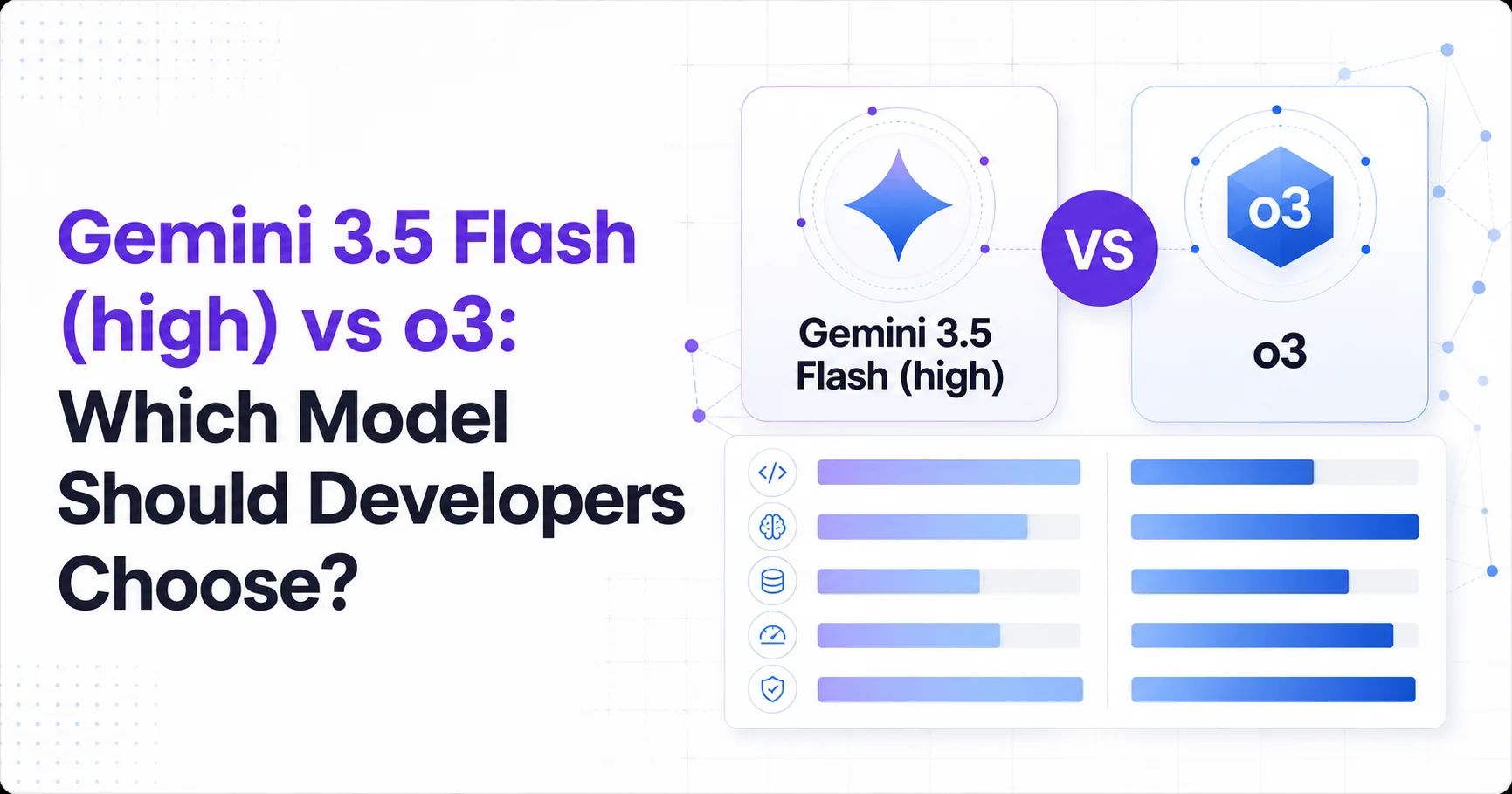
Gemini 3.5 Flash (high) is the stronger default for developers who need a fast, production-oriented model with current official documentation. Artificial Analysis reports an Intelligence Index of 50.2 for Gemini 3.5 Flash (high), compared with 30.4 for o3, while Gemini also produces 270.227 median output tokens per second versus 128.056 for o3 (Artificial Analysis).
The comparison is asymmetric in an important way. Google documents Gemini 3.5 Flash as a Stable model for agentic and coding work, with a stable model alias, multimodal input, tool support, and published pricing (Gemini API model overview; Gemini 3.5 Flash model page). OpenAI’s current model directory does not list o3, and the provided official material does not establish its current alias, endpoint, context window, or supported capabilities (OpenAI Models).
That makes Gemini the safer general selection today. o3 remains relevant for math-heavy workloads because its Artificial Analysis Math Index is 88.3, but the available evidence does not establish an equally current production path for that model (Artificial Analysis).
Gemini 3.5 Flash (high) offers the more complete production case, while o3 has the clearer evidence advantage for mathematical reasoning.
| Decision factor | Gemini 3.5 Flash (high) | o3 |
|---|---|---|
| Current official visibility | Google lists it as Stable and documents a stable alias | The current OpenAI model directory does not list it |
| Intelligence Index | 50.2 | 30.4 |
| Coding Index | 70.1 | No comparable value in the data brief |
| Math Index | No comparable value in the data brief | 88.3 |
| Blended price per 1M tokens | $3.375 | $3.5 |
| Median output speed | 270.227 tokens per second | 128.056 tokens per second |
| Latency | 0.3 seconds | 0.3 seconds |
The performance values come from the supplied Artificial Analysis snapshot (Artificial Analysis). They support a practical conclusion, not a universal quality ranking. Gemini has the stronger reported general intelligence and speed profile. o3 has the only reported math score in this comparison, so the evidence cannot show whether Gemini is better or worse at math.
Google positions Gemini 3.5 Flash for complex, long-running agentic workflows and coding tasks (Google’s Gemini 3.5 announcement). Its documented tools include function calling, code execution, file search, structured output, URL Context, Google Search grounding, and Google Maps grounding (Gemini 3.5 Flash model page).
The strongest reason to select o3 is narrower: math may dominate the workload, and the available score is materially more informative than a generic model label. The strongest reason to avoid making o3 the default is evidence quality. The supplied OpenAI pages do not provide current model-specific availability, pricing, or limits for o3 (OpenAI Models; OpenAI API Pricing).
Gemini 3.5 Flash (high) is the better fit for interactive coding and agent loops because its reported output speed is much higher while measured latency is equal.
The supplied data reports 270.227 median output tokens per second for Gemini and 128.056 for o3, with 0.3 seconds of latency for each model (Artificial Analysis). Equal latency means the first response can begin under the same measured condition. The output-speed gap matters after generation starts, especially when a model must produce a patch, explain a change, emit structured data, or continue a tool-driven loop.
For developers, this distinction affects user experience more than a single benchmark score suggests. A coding assistant that streams generated edits faster can shorten the visible wait for a complete answer. An agent that emits intermediate reasoning or tool arguments faster can also reduce the time spent between orchestration steps. That advantage is most useful when requests produce substantial output or when several model calls occur in one workflow.
The speed result does not prove that Gemini will finish every task sooner. Tool execution, retrieval, network calls, safety checks, and application-side processing can dominate total wall-clock time. The data brief provides no model-specific system-level task duration, so developers should test complete workflows rather than infer end-to-end performance from generation speed alone.
The quality evidence also has an important boundary. Gemini has a reported Coding Index of 70.1, but the data brief has no comparable o3 Coding Index (Artificial Analysis). Gemini therefore has the stronger documented coding signal, not a proven coding win against o3. Google’s own published results include Terminal-Bench 2.1 at 76.2%, GDPval-AA at 1656 Elo, MCP Atlas at 83.6%, and CharXiv Reasoning at 84.2%, but those are vendor-reported results and the announcement does not provide the complete test configuration in the cited passage (Google’s Gemini 3.5 announcement).
Gemini 3.5 Flash (high) is slightly cheaper on the supplied blended-token measure, but o3 can be cheaper for output-heavy workloads.
Artificial Analysis lists a blended price of $3.375 per 1M tokens for Gemini and $3.5 for o3 (Artificial Analysis). That small blended difference favors Gemini for a balanced workload. The input price also favors Gemini at $1.5 per 1M input tokens versus $2 for o3. However, o3’s output price is $8 per 1M tokens, compared with $9 for Gemini (Artificial Analysis).
This creates a clear selection condition. Applications that repeatedly send large prompts, retrieve documents, or maintain long instructions benefit more from Gemini’s lower input price. Applications that generate large answers, code patches, reports, or multi-step agent output may find o3’s lower output price attractive. The blended figure cannot decide between those cases because it compresses input and output behavior into one assumed mix.
Thinking configuration makes the Gemini cost decision more operationally important. Google documents minimal, low, medium, and high thinking levels, with medium as the default, and recommends high for complex reasoning, difficult mathematics, complex coding, and difficult agent tasks (What’s new in Gemini 3.5 Flash). The pricing documentation states that Gemini output pricing includes thinking tokens (Gemini API Pricing). A team that applies high to every request may therefore spend more than a team that reserves it for hard cases, although the supplied materials do not provide a universal per-task consumption rate.
Gemini also has documented Batch and Flex prices of $0.75 per 1M input tokens and $4.5 per 1M output tokens, while Priority prices are $2.7 for input and $16.2 for output (Gemini API Pricing). The supplied OpenAI pricing page does not list a current o3 price, so an actual procurement comparison requires verification before deployment (OpenAI API Pricing).
Gemini 3.5 Flash (high) leads on 2 of 3 metrics
Gemini 3.5 Flash (high) has the clearer documented interface contract, while o3’s current contract is not established by the supplied official sources.
Google identifies the model code as gemini-3.5-flash and explains that (high) refers to the thinking_level=high configuration rather than a separate model alias (Gemini 3.5 Flash model page). The same page documents text, image, video, audio, and PDF input, text output, a 1,048,576-token input limit, and a 65,536-token output limit. It also lists context caching, code execution, file search, function calling, structured output, URL Context, and grounding features.
Those capabilities make Gemini suitable for applications that combine code, documents, tool calls, and multimodal context. Google marks Computer Use as Preview, so production teams should treat that interface as subject to stability and behavior changes (Gemini 3.5 Flash model page). Gemini does not support audio generation, image generation, or Live API, which rules it out for applications requiring those native outputs (Gemini 3.5 Flash model page).
Gemini’s API also has configuration pitfalls. Google recommends thinking_level for Gemini 3.x and says that sending it together with the older thinking_budget causes a 400 error (What’s new in Gemini 3.5 Flash). The update notes also describe strict matching requirements for function-call identifiers, names, and response counts (What’s new in Gemini 3.5 Flash).
o3 has no equivalent current model-specific contract in the supplied evidence. The current OpenAI model directory does not list o3, and the provided official pages do not establish its context window, output limit, API parameters, stable alias, endpoint, or current replacement status (OpenAI Models). That absence is evidence about documentation visibility, not proof that o3 cannot be called in every environment.
Gemini 3.5 Flash (high) should be the default choice for most new production applications, while o3 should be isolated to validated math-heavy use cases.
Choose Gemini when the product needs a current stable alias, published API behavior, multimodal inputs, tool calling, coding support, or predictable procurement review. Google explicitly positions Gemini 3.5 Flash for agentic and coding workloads, and the supplied data reports stronger general intelligence and faster output (Google’s Gemini 3.5 announcement; Artificial Analysis).
Choose o3 when mathematical reasoning is the primary acceptance criterion and the team can verify that its intended API route remains available. The supplied Artificial Analysis snapshot gives o3 a Math Index of 88.3, while it gives no Gemini math value (Artificial Analysis). That is a reason to run a focused math evaluation, not a reason to assume o3 wins every reasoning task.
Use Gemini’s high thinking level selectively. Google recommends it for difficult mathematics, complex coding, and difficult agent tasks, while defaulting to medium (What’s new in Gemini 3.5 Flash). A routing policy can reserve deeper thinking for requests that fail a simpler pass, but the supplied materials do not provide a measured quality or cost threshold for such routing.
Before committing to either model, test representative prompts, tool traces, long documents, and output formats. No supplied source provides systematic hallucination rates, failure rates, or long-context degradation data for Gemini 3.5 Flash, and no reliable community measurements are available for o3. A production decision should therefore treat these as open validation items.
Gemini 3.5 Flash (high) has more public evidence in the supplied materials, but that evidence does not answer every production question.
Google’s documentation establishes model features, pricing, thinking controls, and several integration requirements (Gemini 3.5 Flash model page; Gemini API Pricing). The supplied Artificial Analysis snapshot adds comparative speed, price, and evaluation values (Artificial Analysis).
The community evidence is narrower. One Reddit post reports positive speed and coding impressions for Gemini 3.5 Flash (high), alongside concern about quota consumption during continuous use. The post does not provide a reproducible benchmark with a unified task set, request count, token count, or latency statistics (Reddit discussion). No similarly verifiable community test was supplied for o3.
OpenAI’s current model and pricing pages do not list enough o3-specific information to confirm current availability or cost (OpenAI Models; OpenAI API Pricing). Developers should verify those facts directly in their target account and region before treating o3 as a procurement-ready option.
Yes, Gemini 3.5 Flash (high) is the better general-purpose choice on the supplied evidence because it has current Stable documentation, published pricing, broader documented tooling, stronger general intelligence results, and faster reported output. The comparison does not prove superiority for every task.
Developers should consider o3 for math-heavy workloads because its supplied Math Index is 88.3, while no comparable Gemini math value appears in the data brief. That score supports a targeted evaluation, but it does not establish performance across every mathematical task.
Gemini 3.5 Flash (high) is cheaper on the supplied blended measure at $3.375 versus $3.5 per 1M tokens, and its input price is lower. o3 has the lower output price, so output-heavy applications can reverse the cost preference.
No, Gemini’s high thinking level should be reserved for complex reasoning, difficult mathematics, complex coding, and difficult agent tasks. Google documents medium as the default, and the supplied materials do not prove that high produces enough quality improvement for every request.
Developers should verify o3 availability, alias, endpoint, limits, and pricing before deployment because the supplied current OpenAI model and pricing pages do not list those o3-specific details. The evidence supports caution, not a claim that o3 is universally unavailable.