
Time to First Token · Gemini 3.6 Flash (high)
13811ms
Time to First Token · o3
7185ms
Deep dive into reasoning, benchmarks, and latency insights.
The current catalog does not contain complete performance evidence for both models, so this page does not declare an overall winner. Use the available fields as comparison signals and validate the models on your own workload.
Key decision metrics at a glance.
| Model | Metric | Value | Unit | Source / snapshot |
|---|---|---|---|---|
| Gemini 3.6 Flash (high) | Reasoning | 6.0 | benchmark or capability score | Artificial Analysis · current catalog |
| o3 | Reasoning | 9.0 | benchmark or capability score | Artificial Analysis · current catalog |
| Gemini 3.6 Flash (high) | Coding | 7.0 | benchmark or capability score | Artificial Analysis · current catalog |
| o3 | Coding | 6.0 | benchmark or capability score | Artificial Analysis · current catalog |
| Gemini 3.6 Flash (high) | Multimodal | 4.0 | benchmark or capability score | Artificial Analysis · current catalog |
| o3 | Multimodal | 3.0 | benchmark or capability score | Artificial Analysis · current catalog |
| Gemini 3.6 Flash (high) | Long Context | 6.0 | benchmark or capability score | Artificial Analysis · current catalog |
| o3 | Long Context | 4.0 | benchmark or capability score | Artificial Analysis · current catalog |
| Gemini 3.6 Flash (high) | Blended Price / 1M tokens | $1.5 | USD per 1M tokens | Artificial Analysis · current catalog |
| o3 | Blended Price / 1M tokens | $3.5 | USD per 1M tokens | Artificial Analysis · current catalog |
| Gemini 3.6 Flash (high) | P95 Latency | — | milliseconds | Artificial Analysis · current catalog |
| o3 | P95 Latency | — | milliseconds | Artificial Analysis · current catalog |
| Gemini 3.6 Flash (high) | Tokens per second | 187.411 | tokens per second | Artificial Analysis · current catalog |
| o3 | Tokens per second | 119.185 | tokens per second | Artificial Analysis · current catalog |
Data provided by Artificial Analysis; live values use the current catalog.
This radar chart visually maps the core capabilities (reasoning, coding, math proxy, multimodal, long context) of `Gemini 3.6 Flash (high)` vs `o3`.
This grouped bar chart provides a side-by-side comparison for each benchmark metric.
Lower time to first token is better; higher tokens per second is better.
Compare input and output pricing in USD per 1M tokens.
Gemini 3.6 Flash (high)$1.688
o3$4
Gemini 3.6 Flash (high) costs $2.313 less per run
This article is a dated snapshot published on 2026-08-07. Live cards above use the current catalog; missing live fields are not inferred.
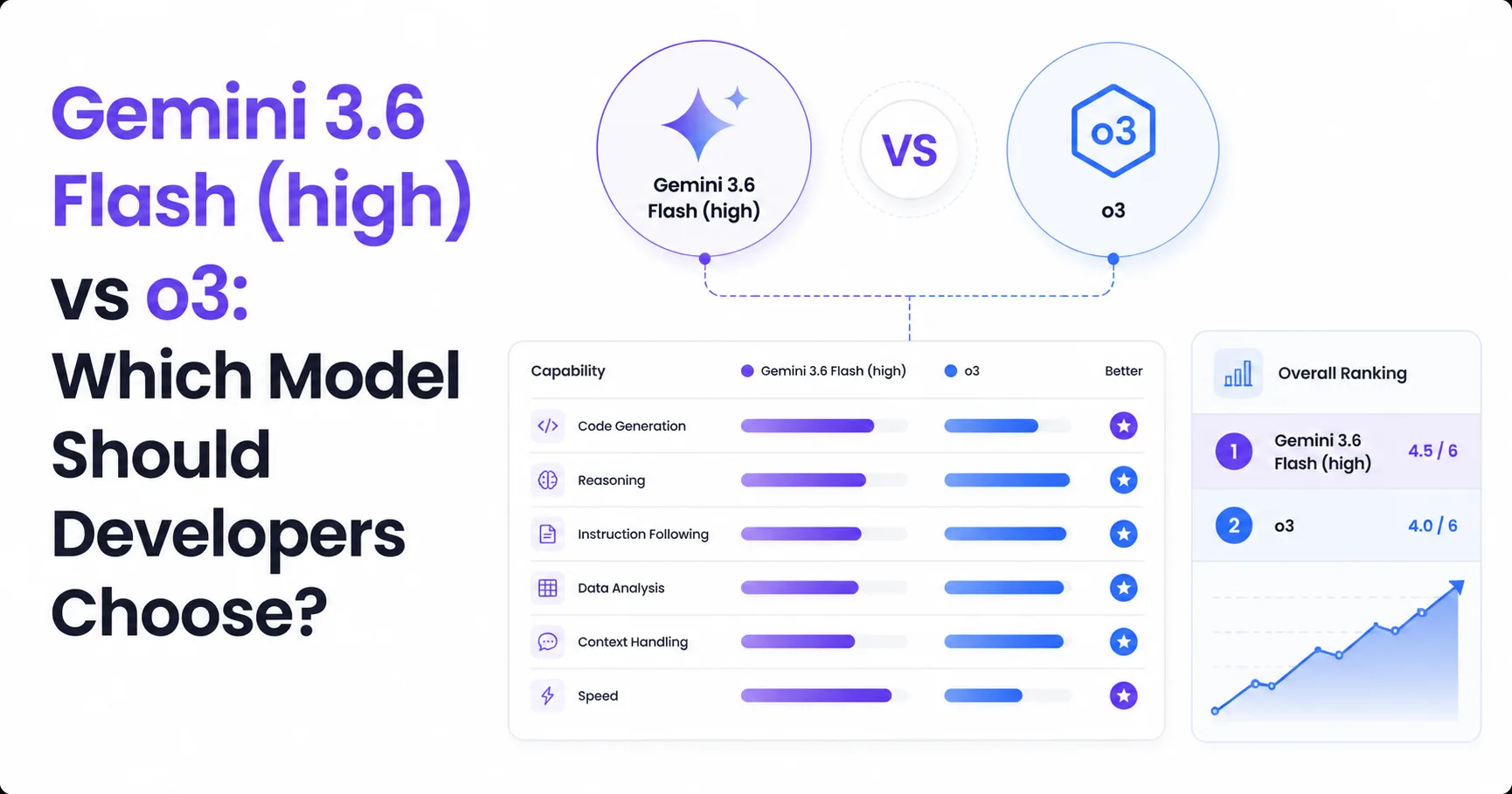
Gemini 3.6 Flash (high) is the stronger default for developers who need speed, broad agent workflows, and a currently documented API path. The data brief gives Gemini an Artificial Analysis Intelligence Index of 50.1, compared with 30.4 for o3, while Gemini also produces output at 230.958 median tokens per second versus 128.056 for o3. Its blended price is $3 per 1M tokens, compared with $3.5 for o3.\n\nThat recommendation has an important qualification. o3 records an Artificial Analysis Math Index of 88.3, and the supplied evidence does not provide a comparable o3 coding score. Developers should therefore treat the overall result as a default-platform recommendation, not proof that Gemini wins every specialized workload.\n\nGoogle documents Gemini 3.6 Flash as a stable model with the API name gemini-3.6-flash in its model documentation. The supplied OpenAI model directory does not list o3, so current direct-call availability remains an unresolved procurement question.
Gemini 3.6 Flash (high) offers the better evidence-backed default because it combines higher general intelligence, lower listed token prices, and substantially faster generation. The Artificial Analysis comparison reports 50.1 for Gemini and 30.4 for o3 on its Intelligence Index. It also reports $3 versus $3.5 for blended pricing and 230.958 versus 128.056 median output tokens per second.\n\nThe comparison is asymmetric. Gemini has official documentation covering multimodal inputs, structured output, function calling, code execution, file search, grounding, URL context, and thinking. Google’s model page also identifies Computer Use as Preview. The supplied OpenAI material does not provide verified o3 context, output, multimodal, API parameter, limitation, or failure-mode details.\n\nThat absence is evidence of missing documentation in the supplied research, not evidence that o3 lacks those capabilities. It also prevents a clean feature-by-feature capability judgment. The strongest positive case for o3 is mathematical reasoning, where its Math Index is 88.3. The strongest case against choosing it as a general default is the lack of current official listing and pricing evidence in the supplied OpenAI pricing documentation.\n\nThe benchmark and commercial figures come from Artificial Analysis.
Gemini 3.6 Flash (high) is the better fit for interactive developer tools because its measured generation speed is materially higher while reported latency is tied. The data brief reports 230.958 median output tokens per second for Gemini and 128.056 for o3, with latency at 0.3 seconds for each. In an IDE assistant, terminal agent, or debugging chat, faster streaming can reduce the perceived cost of waiting and make iterative prompting easier.\n\nThe speed advantage does not automatically mean faster task completion. Agent workflows also depend on tool calls, retries, context management, and the amount of reasoning a task needs. Google’s release announcement positions Gemini for agentic workflows, coding, and extended enterprise processes, but the supplied evidence does not establish comparable end-to-end completion times against o3.\n\nThe benchmark picture also favors caution. Gemini has a reported Coding Index of 69.2, but the corresponding o3 value is missing. o3 has a Math Index of 88.3, but the corresponding Gemini value is missing. The Intelligence Index favors Gemini at 50.1 versus 30.4, yet that aggregate cannot reveal whether a repository task, formal proof, or production migration will succeed.\n\nCommunity feedback is similarly incomplete. Hacker News discussion includes fast and capable Gemini reports, but it lacks reproducible testing and contains divided coding opinions. No reliable community evidence was supplied for o3.
Gemini 3.6 Flash (high) is cheaper on every supplied token-price comparison, but o3 can still be economically rational when its specialized reasoning prevents expensive retries or human review. Gemini costs $1.5 per 1M input tokens and $7.5 per 1M output tokens, while o3 costs $2 and $8. The blended comparison is $3 for Gemini versus $3.5 for o3.\n\nThe visible price gap is modest, so token rates should not be the only budget input. A model that produces a wrong code change, repeats tool actions, or requires additional verification can consume more engineering time than the token saving. This matters because the supplied Gemini community evidence includes unverified reports of verbose process output and execution loops in the Hacker News thread. Those reports are anecdotal and should be tested against the target workload.\n\nGemini’s official pricing page also documents separate pricing for cached inputs, Batch, Flex, Priority, Search grounding, and Maps grounding. Those options may change the cost shape for applications with repeated context, asynchronous jobs, or grounding-heavy requests. The supplied material does not provide equivalent current o3 prices or usage charges, so a complete total-cost comparison is not possible.\n\nFor a high-volume general assistant, Gemini’s lower listed rates and faster output make the starting case clear. For math-heavy or high-consequence tasks, o3’s 88.3 Math Index may justify a controlled evaluation despite its higher token price.
Gemini 3.6 Flash (high) leads on 3 of 3 metrics
Gemini 3.6 Flash (high) should be the default evaluation candidate for most new developer-facing applications. Its current official documentation, stable status, lower supplied prices, higher general intelligence score, and faster output reduce adoption uncertainty. The documented API supports text, image, video, audio, and PDF inputs, plus function calling, structured output, code execution, file search, grounding, URL context, and thinking. These capabilities make it a practical foundation for coding assistants, document-aware agents, support tools, and multimodal workflows. The boundaries are equally clear: image generation, audio generation, and Live API are unsupported, while Computer Use remains Preview, according to the official Gemini documentation.\n\nChoose o3 for a math-led workflow only after confirming that the model is still directly available through the intended OpenAI product and endpoint. Its Math Index of 88.3 is the clearest specialized signal in the supplied data. Suitable candidates include symbolic reasoning, quantitative analysis, and tasks where mathematical accuracy matters more than streaming speed. The supplied research does not establish o3’s current context window, output limit, multimodal support, pricing, or failure behavior, so procurement and integration risk remain unresolved.\n\nDo not treat Gemini’s Coding Index of 69.2 as a complete verdict over o3, because the o3 coding value is absent. Run repository-level evaluations with representative tools, tests, retries, and review gates. The supplied sources support a Gemini-first shortlist, not a universal replacement decision.
Gemini 3.6 Flash (high) has the clearer documented production path, while o3 requires additional verification before a confident deployment decision. Google labels Gemini stable in its current model overview, while the supplied OpenAI model overview does not list o3. That difference affects integration planning, version pinning, and operational ownership.\n\nThe evidence also leaves several questions open. The supplied material does not show a comparable coding score for o3, a comparable math score for Gemini, or equivalent official o3 pricing. It does not prove that o3 is unavailable, only that availability was not established from the supplied official page. Developers should validate these gaps with a workload-specific test before committing to a single provider.
Gemini 3.6 Flash (high) is the stronger default because it has the higher Intelligence Index, lower supplied token prices, faster measured output, and clearer current API documentation. Developers should still validate repository-specific coding quality before production adoption.
The supplied evidence cannot establish that o3 is better for coding because its comparable Coding Index is missing. Gemini has a reported Coding Index of 69.2, but that value does not support a direct winner determination without an o3 result or reproducible task evaluation.
o3 is the better candidate when mathematical reasoning is the primary selection criterion, because its reported Math Index is 88.3. That specialized advantage should be confirmed on representative work, especially because the supplied research lacks current o3 availability, pricing, and limitation details.
Gemini 3.6 Flash (high) has a meaningful measured generation-speed advantage, with 230.958 median output tokens per second versus 128.056 for o3. Reported latency is tied at 0.3 seconds, so end-to-end agent speed still depends on tools, retries, and task design.
Gemini 3.6 Flash (high) is cheaper on every supplied token comparison, including $3 versus $3.5 per 1M blended tokens. Production cost can still favor o3 if its reasoning quality reduces retries, failed changes, or human review, so token price alone is not total cost.
No, this comparison cannot prove that Gemini wins every developer workload. The evidence favors Gemini overall, while o3 has the stronger supplied math signal and lacks a comparable coding result. A representative evaluation remains necessary for high-consequence engineering tasks.