
Time to First Token · Gemini 3 Deep Think
0ms
Time to First Token · GPT-4
0ms
Deep dive into reasoning, benchmarks, and latency insights.
The current catalog does not contain complete performance evidence for both models, so this page does not declare an overall winner. Use the available fields as comparison signals and validate the models on your own workload.
Key decision metrics at a glance.
| Model | Metric | Value | Unit | Source / snapshot |
|---|---|---|---|---|
| Gemini 3 Deep Think | Reasoning | 6.0 | benchmark or capability score | Artificial Analysis · current catalog |
| GPT-4 | Reasoning | 6.0 | benchmark or capability score | Artificial Analysis · current catalog |
| Gemini 3 Deep Think | Coding | 6.0 | benchmark or capability score | Artificial Analysis · current catalog |
| GPT-4 | Coding | 1.0 | benchmark or capability score | Artificial Analysis · current catalog |
| Gemini 3 Deep Think | Multimodal | 5.0 | benchmark or capability score | Artificial Analysis · current catalog |
| GPT-4 | Multimodal | 1.0 | benchmark or capability score | Artificial Analysis · current catalog |
| Gemini 3 Deep Think | Long Context | 8.0 | benchmark or capability score | Artificial Analysis · current catalog |
| GPT-4 | Long Context | 1.0 | benchmark or capability score | Artificial Analysis · current catalog |
| Gemini 3 Deep Think | Blended Price / 1M tokens | $0 | USD per 1M tokens | Artificial Analysis · current catalog |
| GPT-4 | Blended Price / 1M tokens | $37.5 | USD per 1M tokens | Artificial Analysis · current catalog |
| Gemini 3 Deep Think | P95 Latency | — | milliseconds | Artificial Analysis · current catalog |
| GPT-4 | P95 Latency | — | milliseconds | Artificial Analysis · current catalog |
| Gemini 3 Deep Think | Tokens per second | 0 | tokens per second | Artificial Analysis · current catalog |
| GPT-4 | Tokens per second | 0 | tokens per second | Artificial Analysis · current catalog |
Data provided by Artificial Analysis; live values use the current catalog.
This radar chart visually maps the core capabilities (reasoning, coding, math proxy, multimodal, long context) of `Gemini 3 Deep Think` vs `GPT-4`.
This grouped bar chart provides a side-by-side comparison for each benchmark metric.
Lower time to first token is better; higher tokens per second is better.
Compare input and output pricing in USD per 1M tokens.
Gemini 3 Deep Think$0
GPT-4$45
Gemini 3 Deep Think costs $45 less per run
This article is a dated snapshot published on 2026-08-16. Live cards above use the current catalog; missing live fields are not inferred.
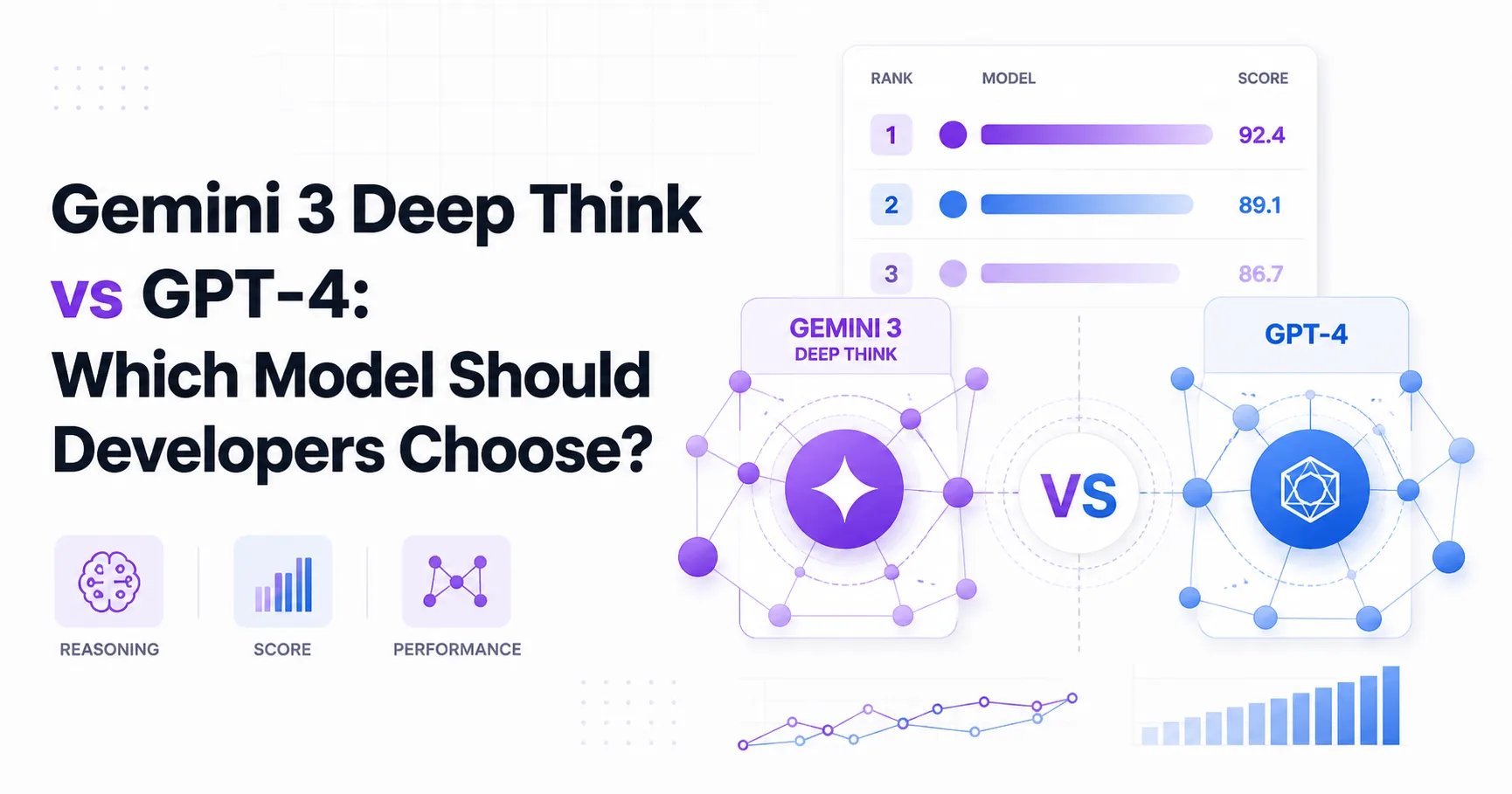
Gemini 3 Deep Think is the cheaper entry in the data snapshot, but GPT-4 is the safer developer choice because its identity and benchmark record are easier to verify. The comparison contains a major evidence problem: the data snapshot records Gemini 3 Deep Think with a release date and zero prices, while Google’s current Gemini API model documentation does not list that model name or a callable alias. OpenAI’s current model documentation also does not provide a current capability profile for GPT-4, but the data snapshot still records GPT-4 benchmark results and prices.
That difference changes the buying question. This is not a normal contest between two fully documented APIs. It is a choice between one model with measurable historical signals and one model whose listed identity, access path, and price require additional verification. Developers should treat the $0 Gemini value as an availability signal to investigate, not as a confirmed production cost.
GPT-4 is the more defensible default because developers can at least anchor decisions to recorded coding, reasoning, instruction-following, and mathematics results. The data snapshot gives GPT-4 an Artificial Analysis intelligence index of 6.8 and a coding index of 13.1. It also records GPT-4 at 0.562 on MMLU Pro, 0.349 on GPQA, 0.568 on Math 500, and 0.331972789115646 on IFBench. Gemini 3 Deep Think has no recorded evaluation values in the supplied snapshot.
The practical comparison is therefore about decision confidence rather than proven superiority. No supplied benchmark establishes that GPT-4 is better than Gemini 3 Deep Think. Instead, GPT-4 has evidence that can support a baseline, while Gemini has an unresolved product identity. Google’s pricing documentation does not list independent pricing for Gemini 3 Deep Think. OpenAI’s pricing documentation does not currently list GPT-4 either.
| Decision factor | Gemini 3 Deep Think | GPT-4 |
|---|---|---|
| Official current model listing | Not found in the supplied research | Current page does not provide GPT-4 parameters |
| Recorded benchmark values | None in the snapshot | Several values are recorded |
| Blended price in the snapshot | $0 per 1M tokens | $37.5 per 1M tokens |
| Production certainty | Requires verification | Requires verification, but has a clearer historical record |
Data provided by https://artificialanalysis.ai/.
GPT-4 has the only visible performance profile, but the available evidence cannot prove that GPT-4 outperforms Gemini 3 Deep Think in a real developer workflow. GPT-4’s recorded coding index of 13.1 gives teams a measurable starting point for code-generation experiments. Its recorded MMLU Pro, GPQA, Math 500, and IFBench values also suggest that the snapshot covers several kinds of reasoning and instruction-following behavior.
Those values still do not answer the questions developers usually face in production. The supplied research does not identify the benchmark versions, test prompts, scoring procedures, context sizes, or API settings used for the recorded results. It also contains no Gemini scores for a head-to-head comparison. A higher or lower score cannot be inferred where one model has a value and the other has null data.
The speed comparison is equally inconclusive. The snapshot records both models at 0 median output tokens per second and 0 seconds of latency. That is a tie in the supplied data, not evidence that the two APIs respond equally quickly. It may indicate missing measurements. Teams building interactive coding tools should therefore run their own test with representative prompts, streamed output, retry behavior, and the same service region.
The most important performance risk is unverified capability. Google’s Gemini API model documentation does not provide a confirmed context window, output limit, API parameter set, or multimodal specification for Gemini 3 Deep Think. The supplied OpenAI research reports the same type of gap for GPT-4 on the current OpenAI model page.
Gemini 3 Deep Think appears cheaper in the snapshot, but GPT-4 may be the cheaper production choice if Gemini cannot be called reliably. The data records Gemini at $0 per 1M blended tokens, with $0 for input and $0 for output. It records GPT-4 at $37.5 per 1M blended tokens, with $30 for input and $60 for output.
The price gap looks decisive only if Gemini has a real, accessible, and stable billing path. The supplied Google research found no independent Gemini 3 Deep Think pricing on the official Gemini pricing page. It also found no confirmed callable alias in the official model list. A zero value can therefore mean that pricing is absent from the dataset rather than that Google will bill production requests at zero.
GPT-4 has the opposite cost problem. Its listed values are visible in the data snapshot, but OpenAI’s current pricing page does not list GPT-4 as a current directly priced model. Developers should not treat the snapshot price as a guaranteed present-day quote without checking their account and provider route.
The cost conclusion can reverse under common business conditions. Gemini wins on the displayed price if a verified provider offers it at the recorded rate. GPT-4 wins on operational cost if the alternative requires custom access, migration work, repeated availability checks, or a fallback model. The supplied materials do not provide request volume, cache usage, batch pricing, or provider-specific fees, so no total monthly cost can be calculated.
Gemini 3 Deep Think leads on 3 of 3 metrics
GPT-4 is the recommended starting point for developers who need an evidence-backed baseline and can accept unresolved current pricing. GPT-4 has recorded values for coding, general intelligence, knowledge-intensive reasoning, mathematics, and instruction following. Those values do not prove current superiority, but they make it possible to design an initial evaluation around a known reference point.
Pick GPT-4 when your team needs to compare generated code against a documented historical baseline, when model behavior must be investigated before launch, or when you already have an OpenAI integration that can be checked directly. Confirm the actual model identifier, access status, and account price before committing. The current OpenAI pages do not settle those questions for GPT-4.
Consider Gemini 3 Deep Think only after a provider confirms three facts: the exact callable model name, the supported API features, and the billing terms. Google’s current official pages do not confirm those facts for the supplied model name. If a provider supplies that evidence, Gemini’s $0 snapshot entry becomes a reason to test it aggressively, not a reason to deploy it without validation.
The next selection decision should be based on a small task suite rather than the snapshot alone. Include code changes, repository-level instructions, long-context requests, structured output, and failure recovery. Record successful completion, correction effort, response time, and total billed tokens. The supplied materials do not include these real-task results, so the final production winner remains unproven.
Gemini 3 Deep Think requires an availability check before any normal capability comparison can be trusted. The current evidence describes a model name in the data snapshot, but Google’s official model list does not confirm a matching API entry. GPT-4 also requires a current access and pricing check because OpenAI’s current pages do not list a complete GPT-4 profile.
Gemini 3 Deep Think is not confirmed as directly callable through the current Google Gemini API documentation supplied for this comparison. The official model page does not list that model name, a stable alias, or its API capability details, so developers need provider confirmation before building against it.
GPT-4 availability is not resolved by the current OpenAI pages supplied here. The model documentation does not provide a current GPT-4 capability profile, and the pricing page does not list GPT-4 as a directly priced current model. Developers should verify access in their own account.
Gemini 3 Deep Think is cheaper in the supplied data snapshot, with a displayed blended price of $0 per 1M tokens versus $37.5 for GPT-4. That comparison is conditional because Google’s official pricing page does not confirm a Gemini price or even a callable model entry.
Neither model is faster according to the supplied measurements because both Gemini 3 Deep Think and GPT-4 record 0 median output tokens per second and 0 seconds of latency. Those values do not establish equal real-world speed, so teams should run identical streamed-request tests.
Developers should start with GPT-4 when they need a measurable reference model, because the snapshot records a coding index of 13.1 and several other evaluation values. Gemini should enter production consideration only after its API identity, capabilities, and price are independently verified.