
Time to First Token · Gemini 3 Deep Think
0ms
Time to First Token · GPT-5 nano (high)
0ms
Deep dive into reasoning, benchmarks, and latency insights.
The current catalog does not contain complete performance evidence for both models, so this page does not declare an overall winner. Use the available fields as comparison signals and validate the models on your own workload.
Key decision metrics at a glance.
| Model | Metric | Value | Unit | Source / snapshot |
|---|---|---|---|---|
| Gemini 3 Deep Think | Reasoning | 6.0 | benchmark or capability score | Artificial Analysis · current catalog |
| GPT-5 nano (high) | Reasoning | 8.0 | benchmark or capability score | Artificial Analysis · current catalog |
| Gemini 3 Deep Think | Coding | 6.0 | benchmark or capability score | Artificial Analysis · current catalog |
| GPT-5 nano (high) | Coding | 6.0 | benchmark or capability score | Artificial Analysis · current catalog |
| Gemini 3 Deep Think | Multimodal | 5.0 | benchmark or capability score | Artificial Analysis · current catalog |
| GPT-5 nano (high) | Multimodal | 2.0 | benchmark or capability score | Artificial Analysis · current catalog |
| Gemini 3 Deep Think | Long Context | 8.0 | benchmark or capability score | Artificial Analysis · current catalog |
| GPT-5 nano (high) | Long Context | 3.0 | benchmark or capability score | Artificial Analysis · current catalog |
| Gemini 3 Deep Think | Blended Price / 1M tokens | $0 | USD per 1M tokens | Artificial Analysis · current catalog |
| GPT-5 nano (high) | Blended Price / 1M tokens | $0.138 | USD per 1M tokens | Artificial Analysis · current catalog |
| Gemini 3 Deep Think | P95 Latency | — | milliseconds | Artificial Analysis · current catalog |
| GPT-5 nano (high) | P95 Latency | — | milliseconds | Artificial Analysis · current catalog |
| Gemini 3 Deep Think | Tokens per second | 0 | tokens per second | Artificial Analysis · current catalog |
| GPT-5 nano (high) | Tokens per second | 0 | tokens per second | Artificial Analysis · current catalog |
Data provided by Artificial Analysis; live values use the current catalog.
This radar chart visually maps the core capabilities (reasoning, coding, math proxy, multimodal, long context) of `Gemini 3 Deep Think` vs `GPT-5 nano (high)`.
This grouped bar chart provides a side-by-side comparison for each benchmark metric.
Lower time to first token is better; higher tokens per second is better.
Compare input and output pricing in USD per 1M tokens.
Gemini 3 Deep Think$0
GPT-5 nano (high)$0.15
Gemini 3 Deep Think costs $0.15 less per run
This article is a dated snapshot published on 2026-08-16. Live cards above use the current catalog; missing live fields are not inferred.
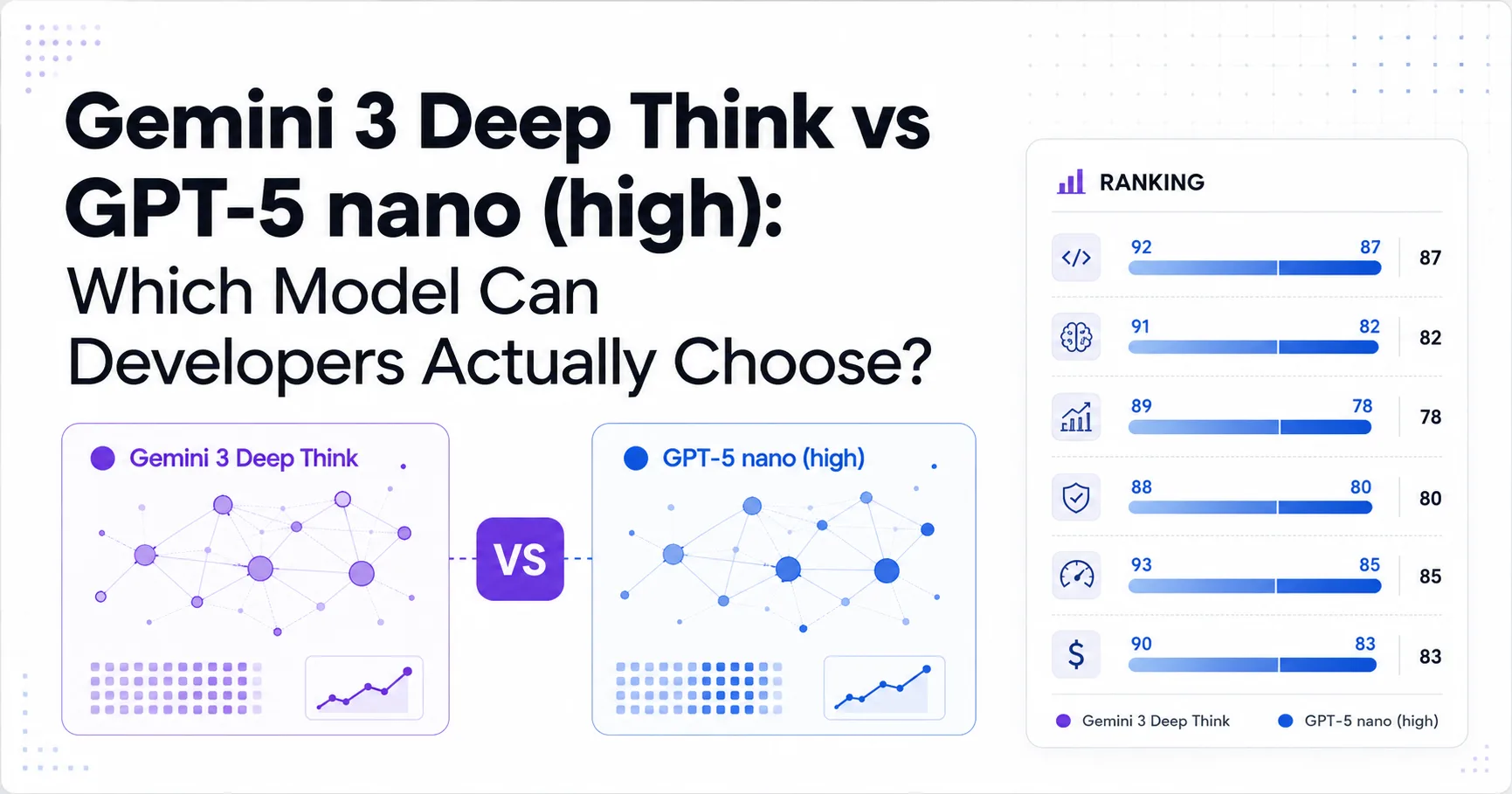
GPT-5 nano (high) is the safer developer choice because the available data shows measurable capability, while Gemini 3 Deep Think has no confirmed official API identity. The comparison is unusual: the Google model is present in the supplied dataset, but Google’s current Gemini API model documentation does not list a model named Gemini 3 Deep Think. OpenAI’s current model documentation likewise does not list GPT-5 nano, gpt-5-nano, or gpt-5-nano-2025-08-07.
That means the central selection question is not simply which model scores higher. The more important question is whether either name maps to a stable, callable product. Gemini 3 Deep Think has no confirmed API alias, context window, output limit, parameter set, or official benchmark result in the research brief. GPT-5 nano (high) has the same documentation gap for its exact name, but the data brief still provides observable evaluation results and pricing values.
The supplied benchmark source is Data provided by https://artificialanalysis.ai/. Its snapshot reports GPT-5 nano (high) at 20.1 on the Artificial Analysis Intelligence Index, 83.7 on its math index, 0.789 on LiveCodeBench, and $0.138 per 1M blended tokens. Gemini 3 Deep Think has null evaluation fields and recorded price values of $0. Those records support a cautious GPT-5 nano (high) recommendation, not a claim that it is fully documented or currently available.
GPT-5 nano (high) offers the stronger selection case because its supplied record contains evidence that developers can inspect, while Gemini 3 Deep Think is represented mainly by an unresolved product name. The difference is material for engineering planning. A model can look attractive in a comparison database, yet still be difficult to integrate if its provider does not publish a callable identifier or stable documentation.
The official evidence is incomplete for both models, but it is incomplete in different ways. Google’s model documentation does not identify Gemini 3 Deep Think. Google’s pricing documentation also has no independent price for that name. OpenAI’s model directory does not identify GPT-5 nano, and OpenAI’s pricing page does not list gpt-5-nano.
GPT-5 nano (high) still has a useful evidence advantage. The supplied data includes 0.78 on MMLU Pro, 0.676 on GPQA, 0.095 on HLE, 0.675510204081633 on IFBench, 0.436666666666667 on LCR, 0.121212121212121 on TerminalBench Hard, and 0.365497076023392 on τ². These values do not prove that the model is available today, but they make it possible to form a testable capability hypothesis.
Gemini 3 Deep Think has no comparable measured result in the supplied snapshot. Its recorded zeros for price, latency, and output speed should therefore be treated as missing or unconfirmed operational data, not as proof of free access or instant responses. Developers should require a successful API call, stable model identifier, and provider-confirmed billing before committing architecture to either model.
GPT-5 nano (high) is the only model with reported capability results, so it deserves the first engineering test even though the available data cannot establish a complete performance ranking. The page’s comparison charts provide the individual values, but the practical meaning is more important than repeating every score.
The reported 83.7 math index suggests that GPT-5 nano (high) may be a sensible candidate for structured quantitative work. Its 0.789 LiveCodeBench result also gives developers a concrete reason to test it for coding tasks. Those signals are useful for routing decisions, such as sending constrained code generation or mathematical transformations to a smaller model before considering a more expensive option. They do not establish reliability for an entire application.
The lower-level results show why task-specific validation remains necessary. GPT-5 nano (high) records 0.121212121212121 on TerminalBench Hard and 0.366 on SciCode. A model can perform well on isolated coding or mathematics evaluations while still struggling with repository navigation, shell interaction, tool sequencing, or unfamiliar scientific code. The research brief does not provide reliable community posts describing those failure modes, so no stronger claim is justified.
Gemini 3 Deep Think cannot be judged against GPT-5 nano (high) on benchmark quality because its evaluation fields are null in the supplied data. The absence of a Gemini score is not evidence of poor performance. It is evidence that this comparison lacks a verified measurement. The same caution applies to speed: both models have 0 recorded median output tokens per second and 0 recorded latency seconds. Those values do not demonstrate a tie in real response speed. They indicate that the available speed fields do not provide a usable basis for choosing.
For developers, the practical conclusion is simple. Test GPT-5 nano (high) first for the workflows represented by its available scores. Keep Gemini 3 Deep Think out of production routing until its official identifier, API behavior, and reproducible task results are confirmed.
Gemini 3 Deep Think appears cheaper in the supplied data, but GPT-5 nano (high) is the only model with a price that can be treated as a concrete budgeting signal. The chart below this section shows the recorded price fields. The decision risk comes from what those fields cannot tell you.
The dataset records Gemini 3 Deep Think at $0 for blended, input, and output pricing. Google’s pricing documentation does not list an independent price for that model name. Without a confirmed callable endpoint, the $0 value could represent unavailable data, an unpriced model, or a product state that is not open for general API use. It should not be converted into a savings forecast.
GPT-5 nano (high) is recorded at $0.138 per 1M blended tokens, with $0.05 per 1M input tokens and $0.4 per 1M output tokens. OpenAI’s current pricing documentation does not list gpt-5-nano, so these supplied values also require an integration check before procurement or capacity planning. The values are still more useful than Gemini’s recorded zero because they create a visible cost hypothesis that can be tested.
A cheaper token price can become the more expensive engineering choice if the model is unavailable, lacks a stable alias, or requires a fallback provider. Failed requests, routing complexity, manual review, and migration work all affect total application cost, yet the brief provides no data for those items. Developers should compare successful task completion cost, not just nominal token price. That requires a small production-shaped test with the actual prompts, tool calls, retry behavior, and output limits used by the application.
The current evidence therefore supports a conditional cost conclusion: Gemini 3 Deep Think has the lower recorded price, but GPT-5 nano (high) has the more actionable cost record. Neither price should be treated as final until the provider listing and billing behavior are confirmed.
Gemini 3 Deep Think leads on 3 of 3 metrics
GPT-5 nano (high) should be the default candidate for a developer evaluation because its record contains measurable task signals, while Gemini 3 Deep Think first needs identity and access verification. This recommendation is about decision quality, not a claim that GPT-5 nano (high) is definitively stronger at every task.
Pick GPT-5 nano (high) when the application needs a small-model candidate for mathematical reasoning, code generation, instruction following, or agent-style tasks. The supplied record gives you concrete starting points: 83.7 on the Artificial Analysis Math Index, 0.789 on LiveCodeBench, 0.78 on MMLU Pro, and 0.675510204081633 on IFBench. These results help define an initial test plan because they indicate where the model may be useful and where it needs scrutiny.
Do not select Gemini 3 Deep Think merely because the dataset records $0 for pricing. Google’s model documentation does not confirm the model name, and the research brief found no reliable community evidence for its coding experience, speed, behavior preferences, limitations, or failure cases. The missing evidence creates integration risk rather than a positive cost advantage.
Do not treat GPT-5 nano (high) as fully cleared either. OpenAI’s model documentation does not list the exact model name, and the supplied research could not confirm its current alias, context window, output limit, or dedicated constraints. The correct next action is an availability gate: confirm the exact model identifier, make a real API request, verify the billing record, and run representative developer tasks.
If GPT-5 nano (high) passes that gate, it is the more defensible starting point. If Gemini 3 Deep Think later receives an official listing and reproducible benchmarks, reopen the comparison. The present evidence is insufficient to claim a Gemini capability win, a real free tier, or a verified speed advantage.
GPT-5 nano (high) gives developers a clearer test target, but the official documentation gaps mean implementation should begin with verification. The questions below focus on risks that the supplied briefs do not fully resolve.
The most important unknown is whether the names in the dataset still correspond to callable provider products. A comparison page can guide investigation, but it cannot replace a successful request against the exact identifier. Pricing should be verified in the same test because an unlisted model name may not have stable billing semantics.
The second unknown is task fit. GPT-5 nano (high) has several reported evaluation values, but no supplied result covers every developer workflow. Gemini 3 Deep Think has no reported evaluation values in this snapshot, so a fair performance conclusion requires new measurements rather than inference from its name or release metadata.
The third unknown is operational behavior. The supplied speed fields report 0 for both models, and the research brief found no reliable community posts describing response speed or coding experience. Developers should therefore measure end-to-end latency, output stability, tool behavior, and failure recovery in their own environment before selecting a default.
Gemini 3 Deep Think has a recorded price of $0 versus $0.138 per 1M blended tokens for GPT-5 nano (high), but Google does not publish a confirmed price for that model name, so the apparent savings are unverified.
Developers should test GPT-5 nano (high) first because the supplied data includes a 0.789 LiveCodeBench result, while Gemini 3 Deep Think has no reported coding evaluation or confirmed official API identity.
The dataset records 0 median output tokens per second and 0 latency seconds for both models, but those values cannot prove a real speed tie because the brief does not confirm that they are measured operational results.
Developers should not assume that Gemini 3 Deep Think is callable because Google’s current model documentation does not list that name, and the research brief found no confirmed API alias or stable access path.
Developers should verify availability before implementation because OpenAI’s current model directory does not list GPT-5 nano, gpt-5-nano, or gpt-5-nano-2025-08-07, despite the supplied dataset containing evaluation and pricing values.
No verified value is available in the research brief because the current OpenAI model documentation does not identify GPT-5 nano or publish dedicated context and output limits for that exact model name.