
Time to First Token · Gemini 3 Flash Preview (Reasoning)
0ms
Time to First Token · GPT-5 mini (high)
0ms
Deep dive into reasoning, benchmarks, and latency insights.
The current catalog does not contain complete performance evidence for both models, so this page does not declare an overall winner. Use the available fields as comparison signals and validate the models on your own workload.
Key decision metrics at a glance.
| Model | Metric | Value | Unit | Source / snapshot |
|---|---|---|---|---|
| Gemini 3 Flash Preview (Reasoning) | Reasoning | 10.0 | benchmark or capability score | Artificial Analysis · current catalog |
| GPT-5 mini (high) | Reasoning | 9.0 | benchmark or capability score | Artificial Analysis · current catalog |
| Gemini 3 Flash Preview (Reasoning) | Coding | 6.0 | benchmark or capability score | Artificial Analysis · current catalog |
| GPT-5 mini (high) | Coding | 2.0 | benchmark or capability score | Artificial Analysis · current catalog |
| Gemini 3 Flash Preview (Reasoning) | Multimodal | 3.0 | benchmark or capability score | Artificial Analysis · current catalog |
| GPT-5 mini (high) | Multimodal | 2.0 | benchmark or capability score | Artificial Analysis · current catalog |
| Gemini 3 Flash Preview (Reasoning) | Long Context | 5.0 | benchmark or capability score | Artificial Analysis · current catalog |
| GPT-5 mini (high) | Long Context | 3.0 | benchmark or capability score | Artificial Analysis · current catalog |
| Gemini 3 Flash Preview (Reasoning) | Blended Price / 1M tokens | $1.125 | USD per 1M tokens | Artificial Analysis · current catalog |
| GPT-5 mini (high) | Blended Price / 1M tokens | $0.688 | USD per 1M tokens | Artificial Analysis · current catalog |
| Gemini 3 Flash Preview (Reasoning) | P95 Latency | — | milliseconds | Artificial Analysis · current catalog |
| GPT-5 mini (high) | P95 Latency | — | milliseconds | Artificial Analysis · current catalog |
| Gemini 3 Flash Preview (Reasoning) | Tokens per second | 0 | tokens per second | Artificial Analysis · current catalog |
| GPT-5 mini (high) | Tokens per second | 0 | tokens per second | Artificial Analysis · current catalog |
Data provided by Artificial Analysis; live values use the current catalog.
This radar chart visually maps the core capabilities (reasoning, coding, math proxy, multimodal, long context) of `Gemini 3 Flash Preview (Reasoning)` vs `GPT-5 mini (high)`.
This grouped bar chart provides a side-by-side comparison for each benchmark metric.
Lower time to first token is better; higher tokens per second is better.
Compare input and output pricing in USD per 1M tokens.
Gemini 3 Flash Preview (Reasoning)$1.25
GPT-5 mini (high)$0.75
GPT-5 mini (high) costs $0.5 less per run
This article is a dated snapshot published on 2026-08-07. Live cards above use the current catalog; missing live fields are not inferred.
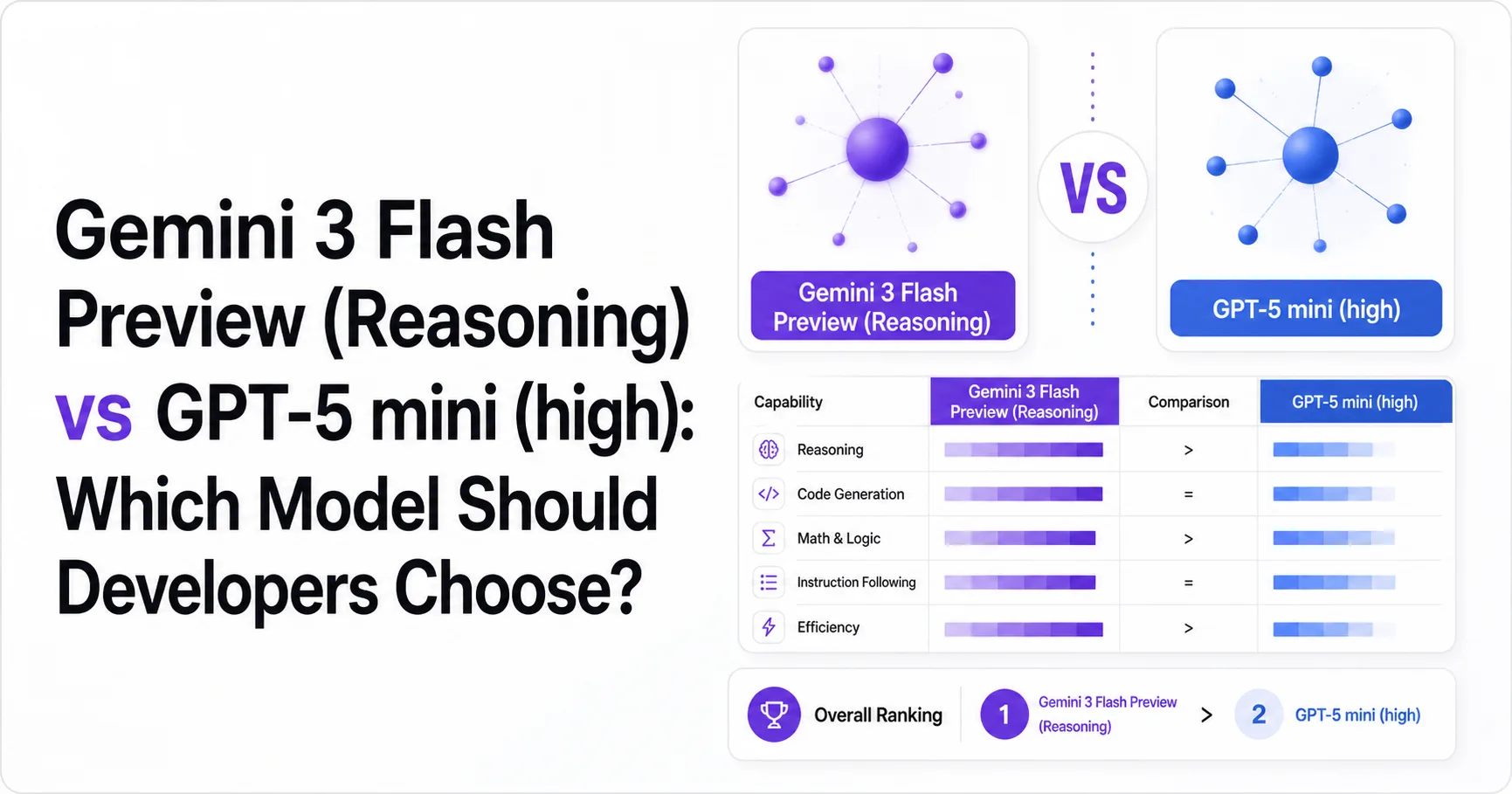
Gemini 3 Flash Preview (Reasoning) is the stronger measured general and mathematical model, while GPT-5 mini (high) is cheaper and easier to justify for cost-sensitive workloads. The supplied Artificial Analysis snapshot reports an Intelligence Index of 37.8 for Gemini and 25.3 for GPT-5 mini, plus a Math Index of 97 versus 90.7. Data provided by https://artificialanalysis.ai/.
The comparison is less complete than the model names suggest. The supplied data does not provide output-speed measurements, context windows, or a comparable coding score for Gemini. Official documentation also leaves important identity and lifecycle questions unresolved. Google lists Gemini 3 Flash as Preview with the API alias gemini-3-flash-preview in the Gemini API model documentation. OpenAI's current Models documentation does not list gpt-5-mini as an independent entry.
For developers, the practical decision is therefore conditional. Gemini has the clearer benchmark case for reasoning-heavy and mathematical work. GPT-5 mini has the clearer price case. Neither model has enough supplied evidence to support a confident claim about coding quality, context limits, or long-term production stability.
Gemini 3 Flash Preview (Reasoning) leads the measured capability comparison, but GPT-5 mini (high) offers the lower-cost default for workloads where benchmark strength is not the primary constraint. Gemini's Intelligence Index is 37.8, compared with 25.3 for GPT-5 mini. Its Math Index is 97, compared with 90.7. Those figures establish a meaningful measured advantage in the supplied snapshot, but they do not establish superiority across every developer task.
GPT-5 mini costs $0.6875 per 1M blended tokens, compared with $1.1250000000000002 for Gemini. GPT-5 mini is also cheaper on input tokens, at $0.25 versus $0.5, and on output tokens, at $2 versus $3. The supplied latency value is 0.3 seconds for each model, so the data does not show a latency winner.
The official evidence changes how strongly these results should guide a launch decision. Google's documentation confirms Gemini's Preview status and API alias, but does not provide the model's context window, output limit, parameters, or benchmark results in the reviewed page. OpenAI's reviewed model and pricing pages do not independently confirm the supplied GPT-5 mini identity or current availability. Google describes Gemini 3 Flash as offering frontier performance at lower cost in its API model documentation. OpenAI's Pricing documentation does not list gpt-5-mini in the reviewed current catalog.
The safest summary is simple: choose Gemini for measured reasoning and mathematics, choose GPT-5 mini for lower spend, and run task-specific validation before treating either result as a complete production recommendation.
Gemini 3 Flash Preview (Reasoning) has the stronger supplied performance signal, especially for mathematical and general intelligence evaluations. The Math Index reaches 97 for Gemini versus 90.7 for GPT-5 mini, while the Intelligence Index is 37.8 versus 25.3. These scores suggest that Gemini may be the better first candidate for workloads involving multi-step analysis, quantitative explanations, structured reasoning, or difficult answer verification.
A benchmark lead does not automatically translate into better application behavior. A developer tool may depend more on repository navigation, patch precision, tool-call discipline, or instruction following than on a general intelligence score. The supplied data includes a Coding Index of 15.6 for GPT-5 mini, but no corresponding Gemini value. That asymmetry prevents a coding winner from being declared. It also means the comparison cannot answer whether Gemini's higher general and math scores survive common software tasks.
The speed evidence is similarly limited. Both models have a supplied latency value of 0.3 seconds, but neither has a supplied median output speed. Latency alone cannot describe streaming experience, time to first token, throughput under concurrency, or long responses. Developers building interactive products should measure those variables with their own prompts and infrastructure.
Official sources add another limitation. Google does not publish benchmark scores for this model on the reviewed Gemini API model page. OpenAI also does not publish a dedicated GPT-5 mini (high) benchmark record on its reviewed Models page. The supplied benchmark snapshot is useful for ranking observed signals, but it is not a substitute for a representative evaluation set.
GPT-5 mini (high) is the cheaper model under every supplied token-price measure, making it the stronger default when request volume and predictable spend dominate the decision. Its blended price is $0.6875 per 1M tokens, compared with $1.1250000000000002 for Gemini. Its input price is $0.25 versus $0.5, and its output price is $2 versus $3.
The cheaper rate can still become the more expensive operational choice if it produces more retries, longer answers, weaker first-pass accuracy, or additional verification calls. The supplied materials do not measure any of those factors. They also do not show token usage by task, so the blended figure should be treated as a comparison input rather than a complete cost forecast.
Gemini's higher Math Index of 97 may justify its higher token price for workflows where an incorrect answer creates manual review or downstream computation costs. That argument is conditional, because the supplied data does not connect benchmark scores to production error rates. GPT-5 mini's lower price is more decisive for high-volume classification, transformation, summarization, or routing tasks if quality remains acceptable in testing.
Availability is another cost risk. Google's Gemini API pricing page does not list an independent price for the exact alias gemini-3-flash-preview in the reviewed material. OpenAI's Pricing page does not list a standard, Batch, Flex, or Fast mode price for gpt-5-mini. The data snapshot supplies comparable prices, but the official pages do not fully validate the current purchasing path for either exact model label.
GPT-5 mini (high) leads on 3 of 3 metrics
Gemini 3 Flash Preview (Reasoning) is the better first choice for reasoning-heavy prototypes, mathematical analysis, and applications where the supplied Intelligence Index and Math Index are relevant quality signals. Its measured scores are 37.8 and 97, respectively. The higher price should be accepted only when those capabilities improve the actual task outcome enough to offset additional spend.
GPT-5 mini (high) is the better first choice for cost-sensitive production workloads, especially when the application processes many tokens and can tolerate uncertainty about its current catalog status. Its blended price is $0.6875 per 1M tokens, and its supplied latency is 0.3 seconds. The available Coding Index of 15.6 makes it a candidate for software tasks, but the absence of a Gemini coding score means this evidence supports selection for testing, not a definitive coding verdict.
A sensible validation path is to test both models on the same representative workload. Include mathematical correctness, code-edit acceptance, tool-call success, refusal behavior, output length, and retry frequency. Keep the evaluation focused on business outcomes because the supplied sources do not provide reliable community reports, detailed failure modes, context windows, or output limits for either exact model configuration.
Production commitment also requires lifecycle checks. Google identifies Gemini 3 Flash as Preview and uses gemini-3-flash-preview as the API alias in the Gemini API model documentation. The reviewed OpenAI Models documentation does not independently list gpt-5-mini. The evidence therefore favors Gemini on measured capability and GPT-5 mini on price, while leaving availability and long-term stability unresolved.
Gemini 3 Flash Preview (Reasoning) cannot be declared the better coding model because the supplied snapshot reports no Gemini Coding Index. GPT-5 mini has a Coding Index of 15.6, but a one-sided score is not a head-to-head result. Developers should treat coding selection as an open test question.
GPT-5 mini (high) cannot be declared production-stable from the supplied material because the reviewed OpenAI catalog does not independently confirm its current model entry, exact API identity, or current pricing. Gemini has a clearer documented API alias, but Google explicitly lists it as Preview. The Gemini API model documentation supports the Preview and alias claims, while the OpenAI Models documentation supports the absence of a current independent gpt-5-mini entry in the reviewed catalog.
Neither model can be ranked confidently on context handling, output limits, tool support, multimodal range, or known failure patterns. Those gaps are material for agents, coding assistants, and long-document applications. The absence of reliable Reddit, Hacker News, or X evidence also prevents a defensible community-based judgment about coding feel, speed perception, or behavioral quirks.
The result is not a weaker comparison. It is a more precise one. The data supports a capability-versus-cost tradeoff, while the missing evidence defines the tests a developer must run before committing.
Gemini 3 Flash Preview (Reasoning) is the stronger overall choice when measured intelligence and mathematics matter most. Its supplied Intelligence Index is 37.8 and its Math Index is 97, but developers should validate coding, context, and availability before production use.
GPT-5 mini (high) is cheaper across the supplied pricing measures. It costs $0.6875 per 1M blended tokens, with input priced at $0.25 and output priced at $2, while Gemini costs $1.1250000000000002, $0.5, and $3.
The supplied evidence cannot establish a coding winner. GPT-5 mini has a Coding Index of 15.6, but Gemini has no corresponding Coding Index in the snapshot, so developers need a matched code-generation and code-editing evaluation.
The supplied data shows a latency tie at 0.3 seconds for both models, but it does not provide median output tokens per second. Developers therefore cannot infer equal streaming throughput, time to first token, or long-response performance.
Gemini 3 Flash Preview (Reasoning) should be treated as a Preview dependency rather than a fully stable production assumption. Google lists the model as Preview, while the supplied material does not provide stronger stability commitments, complete limits, or detailed failure behavior.
The supplied evidence cannot confirm current availability under the exact name GPT-5 mini (high). OpenAI's reviewed model catalog does not list an independent gpt-5-mini entry, and the reviewed pricing page does not provide an exact model price.