
Time to First Token · Gemini 3 Pro Preview (low)
0ms
Time to First Token · GPT-5 (high)
0ms
Deep dive into reasoning, benchmarks, and latency insights.
The current catalog does not contain complete performance evidence for both models, so this page does not declare an overall winner. Use the available fields as comparison signals and validate the models on your own workload.
Key decision metrics at a glance.
| Model | Metric | Value | Unit | Source / snapshot |
|---|---|---|---|---|
| Gemini 3 Pro Preview (low) | Reasoning | 9.0 | benchmark or capability score | Artificial Analysis · current catalog |
| GPT-5 (high) | Reasoning | 9.0 | benchmark or capability score | Artificial Analysis · current catalog |
| Gemini 3 Pro Preview (low) | Coding | 6.0 | benchmark or capability score | Artificial Analysis · current catalog |
| GPT-5 (high) | Coding | 4.0 | benchmark or capability score | Artificial Analysis · current catalog |
| Gemini 3 Pro Preview (low) | Multimodal | 3.0 | benchmark or capability score | Artificial Analysis · current catalog |
| GPT-5 (high) | Multimodal | 3.0 | benchmark or capability score | Artificial Analysis · current catalog |
| Gemini 3 Pro Preview (low) | Long Context | 4.0 | benchmark or capability score | Artificial Analysis · current catalog |
| GPT-5 (high) | Long Context | 4.0 | benchmark or capability score | Artificial Analysis · current catalog |
| Gemini 3 Pro Preview (low) | Blended Price / 1M tokens | $4.5 | USD per 1M tokens | Artificial Analysis · current catalog |
| GPT-5 (high) | Blended Price / 1M tokens | $3.438 | USD per 1M tokens | Artificial Analysis · current catalog |
| Gemini 3 Pro Preview (low) | P95 Latency | — | milliseconds | Artificial Analysis · current catalog |
| GPT-5 (high) | P95 Latency | — | milliseconds | Artificial Analysis · current catalog |
| Gemini 3 Pro Preview (low) | Tokens per second | 0 | tokens per second | Artificial Analysis · current catalog |
| GPT-5 (high) | Tokens per second | 0 | tokens per second | Artificial Analysis · current catalog |
Data provided by Artificial Analysis; live values use the current catalog.
This radar chart visually maps the core capabilities (reasoning, coding, math proxy, multimodal, long context) of `Gemini 3 Pro Preview (low)` vs `GPT-5 (high)`.
This grouped bar chart provides a side-by-side comparison for each benchmark metric.
Lower time to first token is better; higher tokens per second is better.
Compare input and output pricing in USD per 1M tokens.
Gemini 3 Pro Preview (low)$5
GPT-5 (high)$3.75
GPT-5 (high) costs $1.25 less per run
This article is a dated snapshot published on 2026-08-07. Live cards above use the current catalog; missing live fields are not inferred.
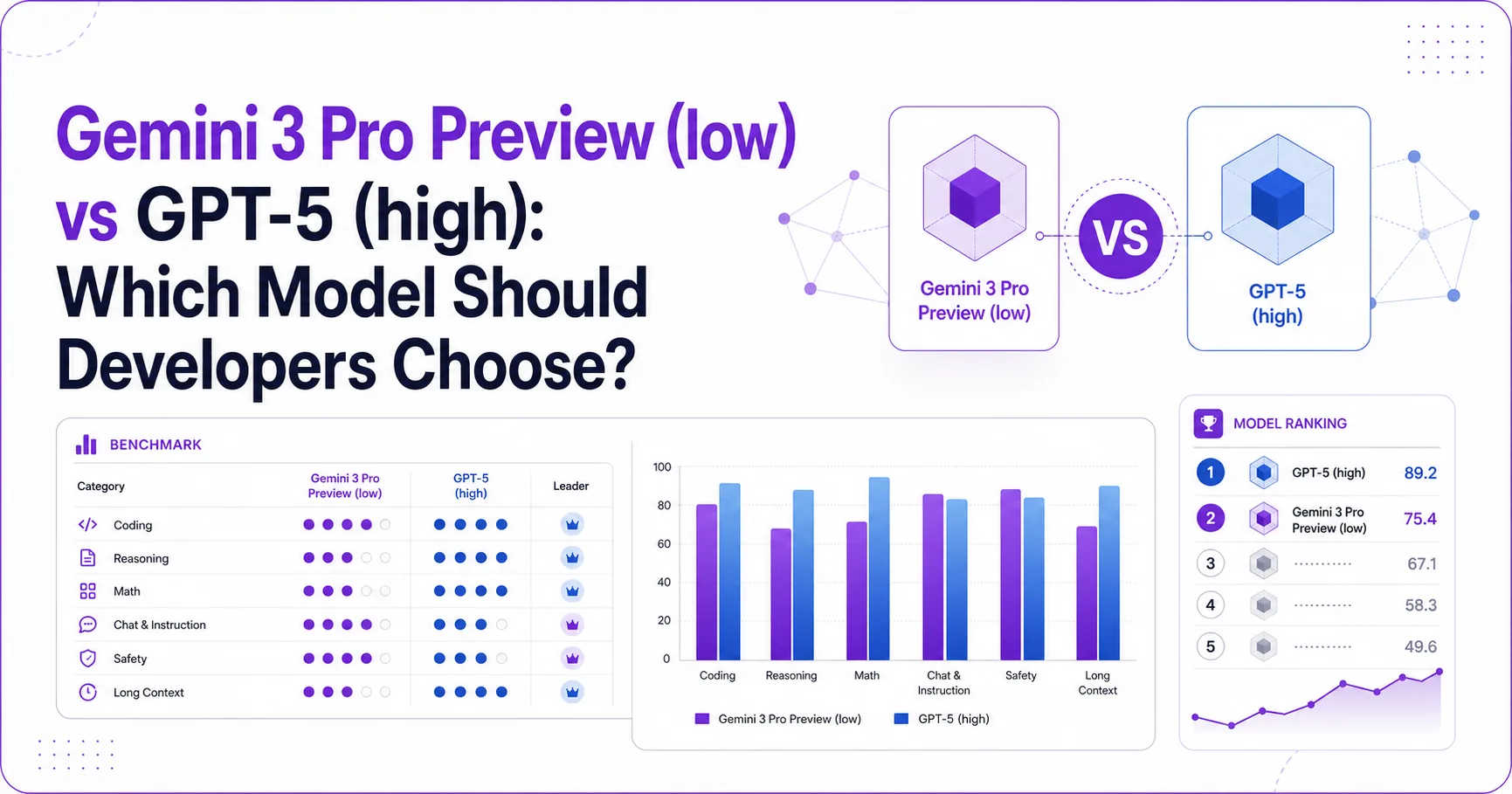
GPT-5 (high) is the safer developer choice because it combines measurable benchmark coverage, documented API behavior, and lower blended pricing. The comparison data from Artificial Analysis gives GPT-5 (high) an Intelligence Index of 34.7 versus 33.1 for Gemini 3 Pro Preview (low), and a Math Index of 94.3 versus 86.7. The same dataset lists equal latency at 0.3 seconds, so the decision is driven more by capability evidence, API certainty, and cost than by measured response delay.
Gemini 3 Pro Preview (low) remains difficult to evaluate as a production dependency. Google’s current Gemini API model directory does not list Gemini 3 Pro Preview (low), gemini-3-pro-low, or a corresponding API alias. The directory also does not provide a context window, output limit, modality description, or official benchmark result for this exact name. That absence does not prove the model is incapable. It means developers lack enough verifiable information to assess operational risk.
GPT-5 (high) is also not risk-free. OpenAI marks the fixed snapshot gpt-5-2025-08-07 as Deprecated, while continuing to list the gpt-5 alias in its model documentation. Developers should therefore distinguish current alias availability from snapshot stability before committing production workflows.
GPT-5 (high) offers the stronger evidence-backed default for coding, reasoning, and agentic development tasks. OpenAI describes GPT-5 as a reasoning model for coding, reasoning, and agentic tasks in its developer announcement. Its documentation specifies a 400,000-token context window, a maximum output of 128,000 tokens, text and image input, and text output. It also documents function calling, structured outputs, streaming, and custom tools.
Gemini 3 Pro Preview (low) cannot currently match that level of documented API certainty. Google’s model directory does show other Gemini 3 models, but it does not establish the target model’s identity, replacement path, lifecycle, or supported capabilities. The missing information is especially important for developers who need predictable deployment behavior, input limits, or tool integration.
The measurable comparison favors GPT-5 (high), but the evidence is incomplete. Artificial Analysis reports no coding index for Gemini 3 Pro Preview (low), while GPT-5 (high) has a Coding Index of 37.8. That missing value is not a failure score. It is an evidence gap, so the available coding comparison cannot be treated as a complete benchmark ranking. Data provided by https://artificialanalysis.ai/.
| Selection question | Better-supported answer | Reason |
|---|---|---|
| Which model is easier to validate for production? | GPT-5 (high) | OpenAI documents its alias, limits, modalities, tools, and pricing. |
| Which model has stronger measured math performance? | GPT-5 (high) | Its Math Index is 94.3 versus 86.7. |
| Which model is cheaper in the supplied blended view? | GPT-5 (high) | The blended price is $3.4375 versus $4.500000000000001 per 1M tokens. |
| Which model has a complete public record in this brief? | GPT-5 (high) | Gemini evidence is missing for several production-critical fields. |
| Which model should be selected for unsupported Gemini-specific workflows? | Neither by default | Gemini’s exact API availability and capability boundary remain unverified. |
GPT-5 (high) has the stronger measured performance profile, especially for math and documented software engineering use. Artificial Analysis reports a Math Index of 94.3 for GPT-5 (high) and 86.7 for Gemini 3 Pro Preview (low), while the Intelligence Index is 34.7 versus 33.1. Those results support GPT-5 for tasks where mathematical correctness, structured reasoning, or difficult problem decomposition matters.
The benchmark gap should not be treated as a universal product verdict. An index score does not reveal how either model handles a particular repository, framework, prompt style, tool schema, or evaluation rubric. OpenAI reports 74.9% on SWE-bench Verified, 88% on Aider polyglot, 96.7% on τ²-bench telecom, and 69.6% on Scale MultiChallenge in its developer announcement. The announcement also states that the SWE-bench result excluded 23 problems from 500 because they could not be passed reliably on OpenAI’s infrastructure, and that Aider used high reasoning effort. These qualifications matter when translating published results into engineering expectations.
Gemini 3 Pro Preview (low) has no corresponding official benchmark evidence in the supplied research. Artificial Analysis provides a Math Index and an Intelligence Index, but no Coding Index for the model. The missing coding score prevents a direct, apples-to-apples conclusion for repository work. Developers choosing Gemini for coding should run a task-specific evaluation before adoption.
Latency is not a differentiator in the supplied data. Both models are listed at 0.3 seconds. Output speed is unavailable for both models, so the evidence cannot support a winner for token streaming or long-answer throughput. Community evidence does not repair that gap. The available Reddit discussion describes GPT-5 as useful for small debugging tasks, but it is a subjective, uncontrolled report rather than a speed benchmark. The same discussion reports possible hallucinations or incorrect modifications in complex existing codebases, which should be treated as a risk signal rather than a measured failure rate. See the Reddit discussion.
GPT-5 (high) is cheaper across every supplied price view, so Gemini 3 Pro Preview (low) has no documented price advantage in this comparison. Artificial Analysis lists GPT-5 (high) at $3.4375 and Gemini 3 Pro Preview (low) at $4.500000000000001 per 1M blended tokens. It also lists input pricing of $1.25 versus $2, and output pricing of $10 versus $12. Data provided by https://artificialanalysis.ai/.
The practical meaning depends on traffic shape. A blended price is useful for comparing a standard input-to-output mix, but it does not predict every application’s bill. Applications that send large prompts, generate long answers, or rely heavily on cached input may experience a different cost relationship than the blended view suggests. The supplied data establishes GPT-5 as cheaper for the listed input, output, and blended prices. It does not provide a workload-specific monthly estimate.
OpenAI’s official GPT-5 model documentation lists input pricing of $1.25 per 1M tokens, cached input pricing of $0.125 per 1M tokens, and output pricing of $10 per 1M tokens. Google’s current Gemini API pricing page does not list Gemini 3 Pro Preview (low), gemini-3-pro-low, or a corresponding price. Google’s general pricing system distinguishes Free, Paid, and Enterprise access, and includes Standard, Batch, Flex, and Priority modes for some models. Those general rules cannot be used to infer the target model’s price.
The cost conclusion therefore has two layers. GPT-5 (high) is the lower-cost option in the supplied comparison and has a matching official price record. Gemini’s listed Artificial Analysis price may be useful for the dataset comparison, but its official billing status cannot be verified from the supplied Google documentation. Teams should confirm an executable Gemini route and current invoice behavior before treating its benchmark price as procurement-ready.
GPT-5 (high) leads on 3 of 3 metrics
GPT-5 (high) should be the default pick for developers who need a documented, general-purpose API with strong measured reasoning and math results. OpenAI documents the stable gpt-5 alias, the fixed snapshot gpt-5-2025-08-07, reasoning effort settings of minimal, low, medium, and high, plus verbosity settings of low, medium, and high. The developer documentation also describes function calling, structured outputs, streaming, and custom tools.
Pick GPT-5 (high) for repository debugging, agent workflows, structured automation, and applications where a known API contract matters. Its official benchmarks include coding and agent-oriented evaluations, and its measured Math Index is 94.3. The available community report also suggests that GPT-5 can be valuable for small debugging and modification tasks, although developers should review changes carefully in complex repositories. That report is subjective and does not establish universal reliability. See the Reddit report.
Consider Gemini 3 Pro Preview (low) only after verifying the exact access path, model alias, limits, supported modalities, and billing terms. Google’s Gemini API model directory does not currently provide those details for the target name. A team may still have access through a product or platform not represented in the supplied evidence, but that possibility is not enough to recommend it as a stable API dependency.
Neither model is a complete answer for every modality. GPT-5 supports text and image input with text output, but its documentation does not support audio or video input and output. Fine-tuning and Predicted outputs are also marked unsupported in the model documentation. Gemini’s modality boundary is unknown for this exact model name. For audio, video, fine-tuning, or other unsupported features, selection requires a separate model evaluation.
The main caveat is lifecycle risk. GPT-5’s fixed snapshot is marked Deprecated, while Gemini 3 Pro Preview (low) is not currently verifiable in Google’s model directory. GPT-5 is the better-supported choice today, but production teams should pin behavior through regression tests and monitor alias changes rather than assume indefinite stability.
GPT-5 (high) is the more defensible starting point when the team needs evidence that can be checked against public API documentation. The unresolved Gemini identity and lifecycle questions should be treated as deployment blockers until verified.
GPT-5 (high) is the better-supported coding choice because OpenAI documents coding-oriented benchmarks and API tools, while the supplied evidence has no Coding Index for Gemini 3 Pro Preview (low).
GPT-5 (high) is cheaper in the supplied comparison, priced at $3.4375 versus $4.500000000000001 per 1M blended tokens, with lower listed input and output prices too.
Gemini 3 Pro Preview (low) does not have a verifiable stable API listing in the supplied Google documentation, which omits the exact model name and corresponding alias.
Neither model is faster in the supplied evidence because both are listed with 0.3 seconds of latency, while output-speed data is unavailable for both models.
Teams should use the GPT-5 alias only with regression tests and migration planning, because OpenAI marks the fixed snapshot gpt-5-2025-08-07 as Deprecated.
GPT-5 cannot directly handle audio or video input and output according to its model documentation, while the exact Gemini modality support remains unverified in the supplied sources.