
Time to First Token · GLM-4.6 (Reasoning)
0ms
Time to First Token · GPT-5 (high)
0ms
Deep dive into reasoning, benchmarks, and latency insights.
The current catalog does not contain complete performance evidence for both models, so this page does not declare an overall winner. Use the available fields as comparison signals and validate the models on your own workload.
Key decision metrics at a glance.
| Model | Metric | Value | Unit | Source / snapshot |
|---|---|---|---|---|
| GLM-4.6 (Reasoning) | Reasoning | 9.0 | benchmark or capability score | Artificial Analysis · current catalog |
| GPT-5 (high) | Reasoning | 9.0 | benchmark or capability score | Artificial Analysis · current catalog |
| GLM-4.6 (Reasoning) | Coding | 5.0 | benchmark or capability score | Artificial Analysis · current catalog |
| GPT-5 (high) | Coding | 4.0 | benchmark or capability score | Artificial Analysis · current catalog |
| GLM-4.6 (Reasoning) | Multimodal | 2.0 | benchmark or capability score | Artificial Analysis · current catalog |
| GPT-5 (high) | Multimodal | 3.0 | benchmark or capability score | Artificial Analysis · current catalog |
| GLM-4.6 (Reasoning) | Long Context | 4.0 | benchmark or capability score | Artificial Analysis · current catalog |
| GPT-5 (high) | Long Context | 4.0 | benchmark or capability score | Artificial Analysis · current catalog |
| GLM-4.6 (Reasoning) | Blended Price / 1M tokens | $0.963 | USD per 1M tokens | Artificial Analysis · current catalog |
| GPT-5 (high) | Blended Price / 1M tokens | $3.438 | USD per 1M tokens | Artificial Analysis · current catalog |
| GLM-4.6 (Reasoning) | P95 Latency | — | milliseconds | Artificial Analysis · current catalog |
| GPT-5 (high) | P95 Latency | — | milliseconds | Artificial Analysis · current catalog |
| GLM-4.6 (Reasoning) | Tokens per second | 0 | tokens per second | Artificial Analysis · current catalog |
| GPT-5 (high) | Tokens per second | 0 | tokens per second | Artificial Analysis · current catalog |
Data provided by Artificial Analysis; live values use the current catalog.
This radar chart visually maps the core capabilities (reasoning, coding, math proxy, multimodal, long context) of `GLM-4.6 (Reasoning)` vs `GPT-5 (high)`.
This grouped bar chart provides a side-by-side comparison for each benchmark metric.
Lower time to first token is better; higher tokens per second is better.
Compare input and output pricing in USD per 1M tokens.
GLM-4.6 (Reasoning)$1.1
GPT-5 (high)$3.75
GLM-4.6 (Reasoning) costs $2.65 less per run
This article is a dated snapshot published on 2026-08-07. Live cards above use the current catalog; missing live fields are not inferred.
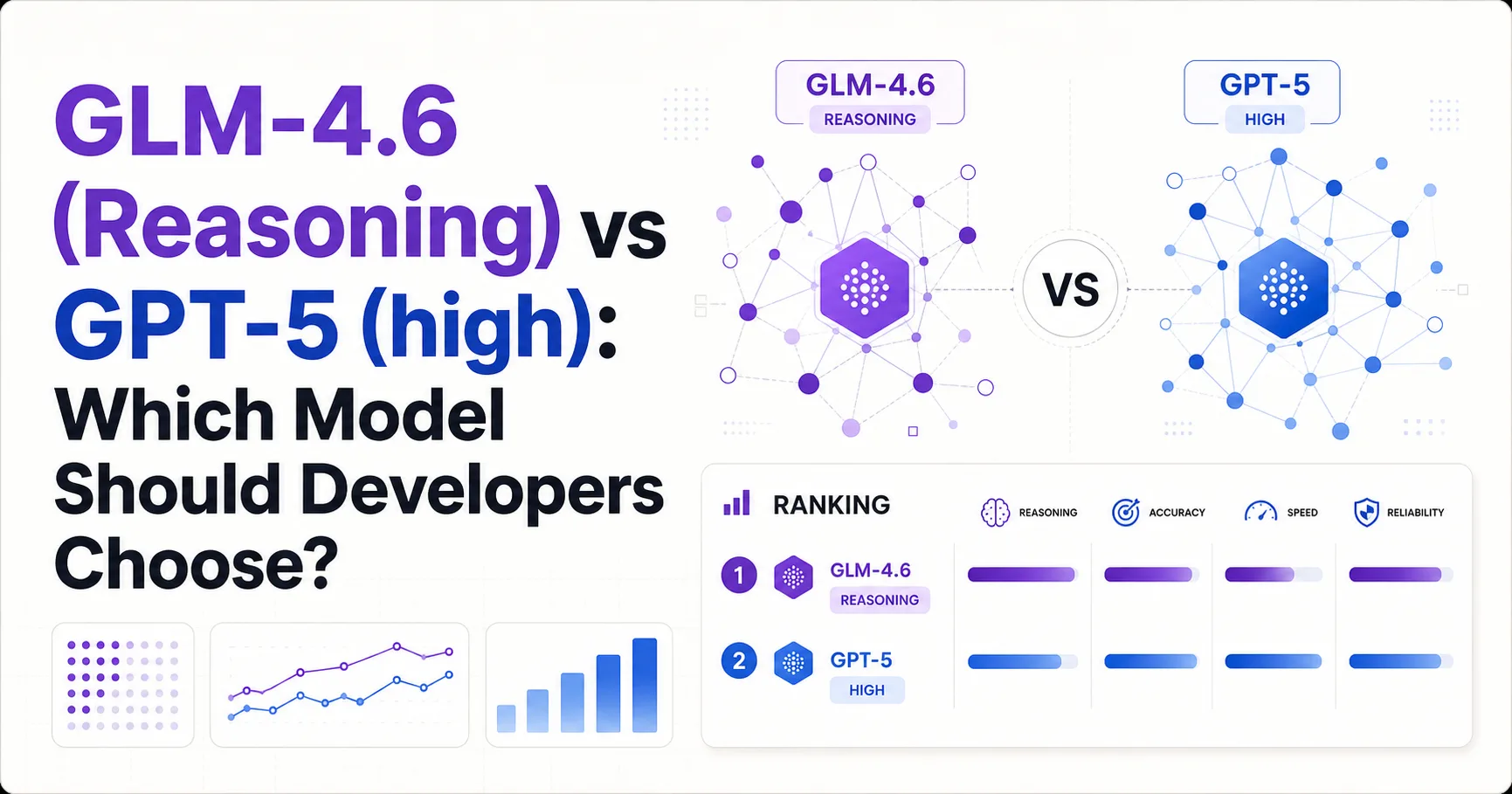
GPT-5 (high) is the safer production choice, while GLM-4.6 (Reasoning) is the cheaper and stronger coding option in the supplied data. The comparison is unusually asymmetric. GPT-5 has official documentation, API guidance, published benchmark claims, and community observations. GLM-4.6 has no verifiable release announcement, developer documentation, pricing page, or reliable community test in the supplied research.
The name “GPT-5 (high)” also needs clarification. The research did not find a separate official API model named gpt-5-high. Instead, “high” refers to the reasoning_effort=high parameter for gpt-5, as documented by OpenAI’s developer announcement and the GPT-5 model documentation.
Data provided by Artificial Analysis supplies the quantitative comparison. The data shows GLM-4.6 ahead on the coding index at 45.8 versus 37.8, while GPT-5 leads the intelligence index at 34.7 versus 28.7 and the math index at 94.3 versus 86. Pricing also favors GLM-4.6. Production readiness, however, cannot be judged from those scores alone.
GPT-5 (high) offers the stronger documented product contract, while GLM-4.6 (Reasoning) offers the stronger value signal for coding workloads. Developers choosing an API need to separate measured capability from operational certainty.
GPT-5 is explicitly positioned for coding, reasoning, and agentic tasks in OpenAI’s developer announcement. Its documentation lists a 400,000-token context window, a maximum output of 128,000 tokens, text and image input, structured outputs, function calling, streaming, and several API endpoints. Those details make architecture and integration planning possible.
GLM-4.6 has no comparable verified documentation in the supplied research. Its context window, output limit, API parameters, multimodal support, stable alias, availability, and failure modes remain unknown. That uncertainty is not evidence that the model lacks those capabilities. It means a buyer cannot safely assume them.
The quantitative result is therefore workload-dependent. GLM-4.6 leads the supplied coding index and costs less on every listed token-price measure. GPT-5 leads the intelligence and math indexes and has a documented tool-use surface. The models share a listed latency of 0.3 seconds, but no median output-speed value is available for either model. A team that values predictable integration should favor GPT-5. A team validating a cost-sensitive coding workload should test GLM-4.6 before committing.
GLM-4.6 (Reasoning) is the better first candidate for coding-heavy evaluation, while GPT-5 (high) is the better candidate for math and broader reasoning tasks. The chart’s coding result gives GLM-4.6 a clear lead at 45.8 versus 37.8. That difference suggests GLM-4.6 may deserve priority in repository edits, code generation, and implementation-focused trials.
The coding index is not a complete measure of production software quality. It does not establish that GLM-4.6 will make fewer regressions, understand an unfamiliar codebase better, or produce better tests. The research contains no verified GLM-4.6 implementation study. GPT-5 also has community warnings about hallucinations and incorrect modifications in complex existing codebases, based on an uncontrolled Reddit discussion. Those observations are useful risk signals, not controlled evidence.
GPT-5 leads the intelligence index at 34.7 versus 28.7 and the math index at 94.3 versus 86. The math lead may matter for symbolic work, numerical reasoning, algorithm design, and agent tasks that depend on consistent intermediate decisions. OpenAI reports additional results for GPT-5 on SWE-bench Verified, Aider polyglot, τ²-bench telecom, and Scale MultiChallenge in its developer announcement. Those official results do not directly validate GLM-4.6 against the same tests.
Listed latency is tied at 0.3 seconds. No median output-tokens-per-second value is supplied, so neither model can be called faster for long responses. Teams should measure time to useful completion, correction rate, and tool-call reliability in their own workflow.
GPT-5 (high) leads on 2 of 3 metrics
GLM-4.6 (Reasoning) is the obvious low-cost option in the supplied pricing data, but GPT-5 (high) can still be cheaper for workflows where fewer corrections determine the bill. GLM-4.6 is listed at $0.9625 per 1M blended tokens, compared with $3.4375 for GPT-5. Its input price is $0.55 versus $1.25, and its output price is $2.2 versus $10.
The largest practical risk is output-heavy work. Output tokens cost more than input tokens for both models, and the difference is especially important for coding agents that repeatedly inspect files, propose patches, explain failures, and retry tool calls. A cheaper model becomes expensive if it needs additional turns to reach an accepted result. The supplied data does not provide correction rates, task completion rates, or token usage by workflow, so no break-even claim can be established.
GPT-5 also lists cached input at $0.125 per 1M tokens in the GPT-5 model documentation. That price may affect applications that repeatedly send stable system instructions or repository context, but the research does not provide a cache-hit assumption. Developers should therefore treat the displayed blended prices as planning inputs, not as a final application bill.
GLM-4.6 wins the simple token-cost comparison. GPT-5 may justify its premium when documented tools, structured outputs, stronger math performance, or fewer repair cycles reduce engineering work. A fair pilot should record total tokens, accepted changes, retries, human review time, and failed task recovery.
GLM-4.6 (Reasoning) leads on 3 of 3 metrics
GPT-5 (high) is the default recommendation for production systems that need a documented API contract, while GLM-4.6 (Reasoning) is the first trial for cost-sensitive coding systems. This recommendation reflects evidence quality as well as benchmark results.
Choose GPT-5 when the application depends on documented model identity, stable API access, tool calling, structured outputs, streaming, or image input. OpenAI’s model documentation lists gpt-5 as callable and documents its supported endpoints and capabilities. GPT-5 is also the better fit when math performance matters, because its supplied math index is 94.3 versus 86 for GLM-4.6.
Choose GLM-4.6 when the main objective is reducing token spend while testing coding performance. Its supplied coding index is 45.8 versus 37.8 for GPT-5, and its blended price is lower. That choice should remain a controlled pilot rather than an unverified production dependency. The research does not confirm whether GLM-4.6 is directly callable, what alias it uses, or whether its listed price is available through a stable provider.
Treat GPT-5’s fixed snapshot carefully. The documentation marks gpt-5-2025-08-07 as Deprecated and recommends GPT-5.6. Teams selecting GPT-5 should plan migration checks instead of assuming the snapshot will remain permanent. Teams selecting either model should also review the community report that describes fast small-bug fixes but weaker full-application and UI completion, plus possible incorrect changes in complex repositories: Reddit discussion.
GLM-4.6 (Reasoning) cannot receive a confident production recommendation until its availability, API behavior, and failure modes are independently verified. The strongest apparent advantage for GLM-4.6 is quantitative: coding performance and price. The largest weakness is not a measured failure. It is missing evidence.
The supplied research has no verified GLM-4.6 official source. That prevents firm conclusions about context length, output limits, modalities, tool calling, structured output, rate limits, version stability, or service availability. It also prevents a direct comparison of benchmark methodology. A higher coding index is useful for ranking candidates, but it does not replace an integration test.
GPT-5 has more documented capability, yet its evidence is not complete either. OpenAI’s published benchmark results use particular settings, including high reasoning effort for Aider polyglot, and one SWE-bench result excludes 23 problems from 500. The supplied research does not provide equivalent GLM-4.6 results under the same conditions. The Reddit evidence is a single uncontrolled discussion, so it cannot establish a stable community consensus.
The missing evidence that matters most is simple: real repository tasks, tool-call success, patch acceptance, retry frequency, output speed, and service reliability. No median output-speed value is supplied for either model. If those measurements favor GLM-4.6 without compromising integration, its cost advantage may dominate. If GLM-4.6 cannot provide dependable access or needs substantially more repair work, GPT-5’s premium may be justified.
GLM-4.6 (Reasoning) is better on the supplied coding index, but the available evidence does not prove better repository reliability, patch acceptance, testing quality, or production integration.
GLM-4.6 (Reasoning) is cheaper on every supplied token-price measure, although total application cost may change if GPT-5 requires fewer retries or correction turns.
GPT-5 (high) is the safer production default because OpenAI documents its API identity, parameters, tools, endpoints, and limitations, while GLM-4.6 lacks verified equivalent documentation.
GPT-5 (high) is not identified as a separate official API model in the supplied research; “high” refers to the reasoning_effort=high setting for gpt-5.
Neither model is demonstrably faster from the supplied data because both list 0.3 seconds latency and neither has a median output-tokens-per-second value.
GPT-5 supports text and image input with text output, but the supplied documentation says it does not support audio or video input and output; GLM-4.6 support is unverified.