
Time to First Token · GLM-5.1 (Reasoning)
782ms
Time to First Token · GPT-5 (high)
0ms
Deep dive into reasoning, benchmarks, and latency insights.
The current catalog does not contain complete performance evidence for both models, so this page does not declare an overall winner. Use the available fields as comparison signals and validate the models on your own workload.
Key decision metrics at a glance.
| Model | Metric | Value | Unit | Source / snapshot |
|---|---|---|---|---|
| GLM-5.1 (Reasoning) | Reasoning | 6.0 | benchmark or capability score | Artificial Analysis · current catalog |
| GPT-5 (high) | Reasoning | 9.0 | benchmark or capability score | Artificial Analysis · current catalog |
| GLM-5.1 (Reasoning) | Coding | 6.0 | benchmark or capability score | Artificial Analysis · current catalog |
| GPT-5 (high) | Coding | 4.0 | benchmark or capability score | Artificial Analysis · current catalog |
| GLM-5.1 (Reasoning) | Multimodal | 3.0 | benchmark or capability score | Artificial Analysis · current catalog |
| GPT-5 (high) | Multimodal | 3.0 | benchmark or capability score | Artificial Analysis · current catalog |
| GLM-5.1 (Reasoning) | Long Context | 5.0 | benchmark or capability score | Artificial Analysis · current catalog |
| GPT-5 (high) | Long Context | 4.0 | benchmark or capability score | Artificial Analysis · current catalog |
| GLM-5.1 (Reasoning) | Blended Price / 1M tokens | $2.143 | USD per 1M tokens | Artificial Analysis · current catalog |
| GPT-5 (high) | Blended Price / 1M tokens | $3.438 | USD per 1M tokens | Artificial Analysis · current catalog |
| GLM-5.1 (Reasoning) | P95 Latency | — | milliseconds | Artificial Analysis · current catalog |
| GPT-5 (high) | P95 Latency | — | milliseconds | Artificial Analysis · current catalog |
| GLM-5.1 (Reasoning) | Tokens per second | 28.21 | tokens per second | Artificial Analysis · current catalog |
| GPT-5 (high) | Tokens per second | 0 | tokens per second | Artificial Analysis · current catalog |
Data provided by Artificial Analysis; live values use the current catalog.
This radar chart visually maps the core capabilities (reasoning, coding, math proxy, multimodal, long context) of `GLM-5.1 (Reasoning)` vs `GPT-5 (high)`.
This grouped bar chart provides a side-by-side comparison for each benchmark metric.
Lower time to first token is better; higher tokens per second is better.
Compare input and output pricing in USD per 1M tokens.
GLM-5.1 (Reasoning)$2.49
GPT-5 (high)$3.75
GLM-5.1 (Reasoning) costs $1.26 less per run
This article is a dated snapshot published on 2026-08-07. Live cards above use the current catalog; missing live fields are not inferred.
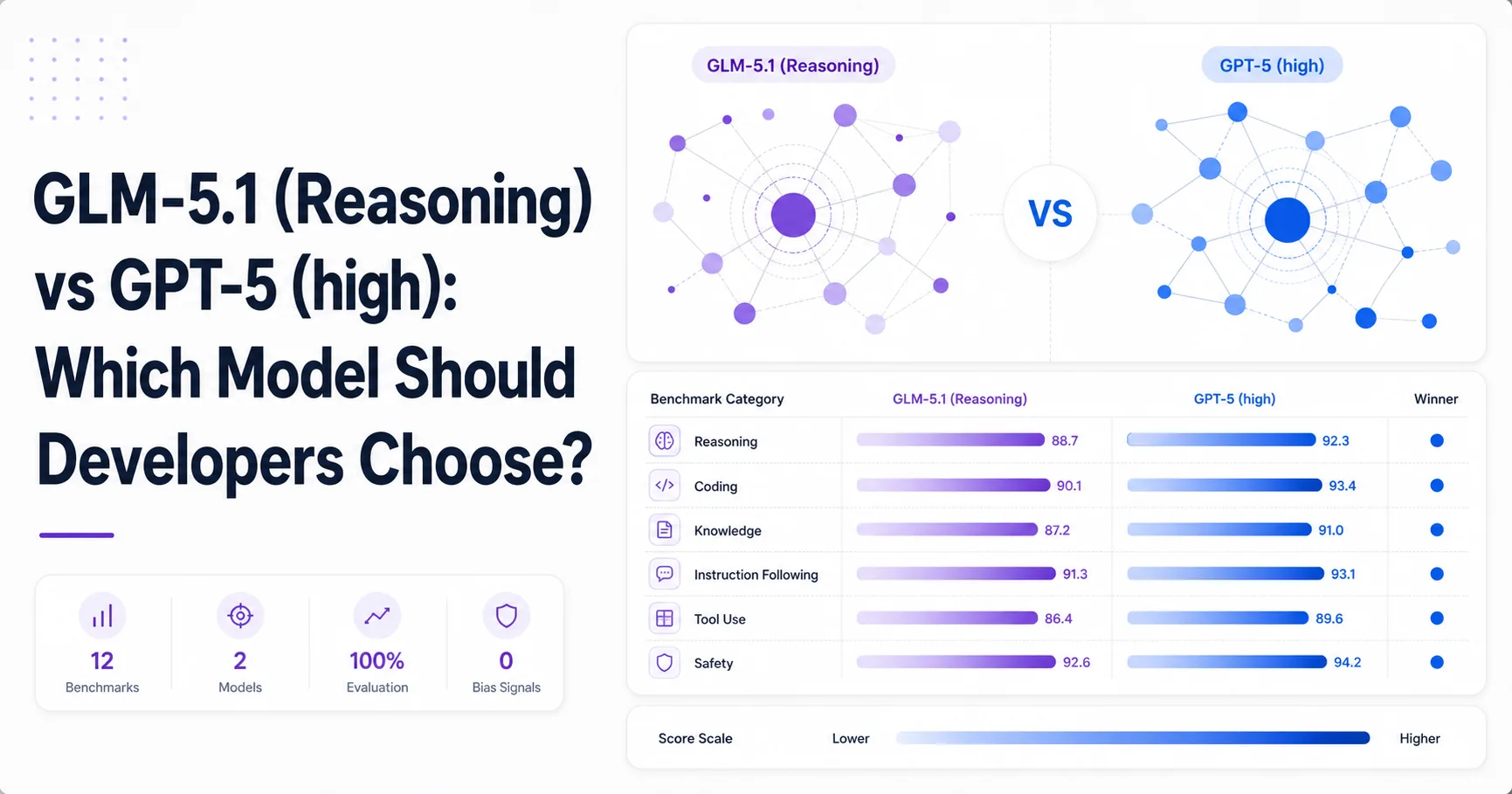
GLM-5.1 (Reasoning) is the stronger default for cost-sensitive coding workloads, but GPT-5 (high) is the safer documented choice for production teams.
The supplied data gives GLM-5.1 (Reasoning) a coding index of 55.8, compared with 37.8 for GPT-5 (high). GLM-5.1 also has a lower blended price of $2.135 per 1M tokens, while GPT-5 costs $3.4375. Both models report 0.3 seconds latency, and neither has a reported median output speed in the supplied snapshot.
That performance and price combination favors GLM-5.1 for code generation, repository work, and high-volume reasoning requests. The conclusion is incomplete, however, because the research brief found no verifiable GLM-5.1 documentation, API reference, stable alias, context window, or community test.
GPT-5 has the more established operating contract. OpenAI describes GPT-5 as a reasoning model for coding, reasoning, and agentic tasks, and its documentation specifies text and image input, structured outputs, function calling, streaming, and reasoning controls. Data provided by https://artificialanalysis.ai/ supplies the comparative scores, pricing, and latency values used here.
GLM-5.1 (Reasoning) leads the supplied coding and intelligence indices, while GPT-5 (high) leads only where the comparison includes a reported mathematics score.
GLM-5.1 scores 55.8 on the Artificial Analysis coding index and 40.2 on its intelligence index. GPT-5 scores 37.8 and 34.7 on those same measures. The supplied comparison therefore gives GLM-5.1 a coding advantage of 18 points and an intelligence advantage of 5.5 points. Those figures suggest a meaningful difference for software tasks, but they do not explain which programming languages, repository types, or interaction patterns produced the result.
GPT-5 has a reported mathematics index of 94.3. GLM-5.1 has no mathematics value in the snapshot, so the comparison cannot establish a winner for mathematics. Missing data is not evidence of weaker mathematics performance.
The larger selection difference concerns evidence quality. GPT-5 has a documented API identity, a stable alias named gpt-5, a fixed snapshot, published limits, pricing, supported endpoints, and official benchmark reporting. OpenAI's developer announcement documents its API positioning, controls, tool support, and benchmark results. The GPT-5 model documentation lists its model limits, modalities, prices, endpoints, and lifecycle status.
GLM-5.1 has a release date and benchmark snapshot in the supplied data, but the research brief found no verifiable vendor announcement, developer documentation, pricing page, or reliable community test. Developers should treat its apparent lead as a measured data point with an unresolved deployment question.
GLM-5.1 (Reasoning) is the better data-backed candidate for coding-heavy workflows, but GPT-5 offers broader documented controls and a clearer path from evaluation to implementation.
The coding index gap is the most decision-relevant result in this comparison. GLM-5.1 records 55.8, while GPT-5 records 37.8. A gap of 18 points is large enough to justify a controlled pilot for code completion, bug fixing, test creation, and repository-level changes. It does not prove that GLM-5.1 will produce fewer regressions in a specific codebase. The research brief contains no GLM-5.1 test method, task breakdown, or failure analysis.
The intelligence index points in the same direction, although less strongly. GLM-5.1 scores 40.2 versus GPT-5 at 34.7. This supports a cautious hypothesis that GLM-5.1 may be more effective across the supplied general evaluation, but the index alone cannot determine instruction following, tool reliability, or long-horizon agent behavior.
GPT-5's official feature set changes the practical interpretation of the score comparison. OpenAI documents reasoning_effort values of minimal, low, medium, and high, plus verbosity controls. The model documentation also lists function calling, structured outputs, streaming, custom tools, and image input. These features can reduce integration work even when a model has a lower coding index.
The mathematics result needs separate handling. GPT-5 has a mathematics index of 94.3, while GLM-5.1 has no reported value. A mathematics-heavy product should not infer parity from the coding lead. It should run the same task set against both models, because the supplied evidence does not answer whether GLM-5.1 is suitable for mathematical reasoning.
Latency does not separate the models. Both report 0.3 seconds, and neither has a reported median output speed. Teams optimizing interactive experiences therefore lack enough evidence to select either model on generation speed. The decisive variables may instead be queueing, streaming behavior, rate limits, and output length, none of which are provided for GLM-5.1.
GLM-5.1 (Reasoning) is the cheaper model for the supplied blended workload, but GPT-5 is slightly cheaper on input tokens alone.
The blended figure is $2.135 per 1M tokens for GLM-5.1 and $3.4375 for GPT-5. That difference makes GLM-5.1 attractive for applications that generate substantial reasoning, code, explanations, or tool arguments. The output price explains most of the economic advantage: GLM-5.1 costs $4.4 per 1M output tokens, while GPT-5 costs $10.
The conclusion flips for input-heavy workloads. GPT-5 input tokens cost $1.25 per 1M, compared with $1.38 for GLM-5.1. A system that sends large prompts but requests very short answers may therefore see a smaller GLM-5.1 advantage or no advantage after its actual input and output mix is applied.
The supplied blended value is useful for directional selection, not a universal invoice forecast. Real cost depends on prompt reuse, cached input, output length, retries, tool-call loops, and failure recovery. GPT-5's documentation lists cached input at $0.125 per 1M tokens, while the research brief does not provide a comparable GLM-5.1 cached-input price. The official GPT-5 pricing and model details are documented here.
Unknown availability creates a second cost risk for GLM-5.1. The research brief could not verify whether the model is directly callable, which alias to use, or whether its listed price is currently actionable. A nominally cheaper model can become more expensive if engineers spend time building around uncertain access, undocumented limits, or unstable behavior.
GPT-5 also has an operational lifecycle caveat. Its fixed snapshot gpt-5-2025-08-07 is marked Deprecated, although the gpt-5 alias remains listed. Teams choosing GPT-5 should budget migration work and validate alias behavior before committing to a long-lived integration.
GLM-5.1 (Reasoning) leads on 2 of 3 metrics
GLM-5.1 (Reasoning) is the best first pilot for coding-heavy teams that can tolerate unresolved documentation and availability risk.
Choose GLM-5.1 when the product's main workload is code generation, code transformation, debugging, or repository assistance. Its supplied coding index of 55.8 is materially above GPT-5's 37.8, and its $2.135 blended price is lower. Those advantages justify testing it first in a bounded evaluation with representative repositories, human review, regression tests, and explicit failure logging.
Choose GPT-5 when integration certainty matters more than the benchmark and price lead. Its public documentation defines the gpt-5 API alias, input modalities, output limits, reasoning controls, tool interfaces, and endpoint support. OpenAI's model documentation provides the implementation reference for these capabilities. GPT-5 is also the only model in the supplied comparison with a reported mathematics index, recorded as 94.3.
For agentic products, GPT-5's documented function calling, structured outputs, streaming, and custom tools may reduce engineering uncertainty. That does not establish superior agent quality. It establishes a clearer contract for building and testing the system.
For multimodal applications, GPT-5 is the only option supported by the supplied research. It accepts text and image input, but not audio or video. GLM-5.1 has no verifiable modality documentation, so the research cannot confirm whether it fits a multimodal workflow.
Do not make a final production decision from the supplied data alone. The missing GLM-5.1 documentation, unavailable output-speed value, absent mathematics score, and unverified community evidence are material gaps. The next decision should come from a task-matched pilot, not from assuming that a higher index automatically produces lower total cost or lower operational risk.
GLM-5.1 (Reasoning) is the stronger initial candidate for coding value, while GPT-5 remains the stronger candidate for documented production integration.
The comparison contains a clear measured advantage and a clear evidence advantage. Developers should keep those conclusions separate during procurement, architecture review, and pilot design.
GLM-5.1 (Reasoning) is the better coding candidate in the supplied comparison because its coding index is 55.8 versus GPT-5 (high) at 37.8. However, the research provides no GLM-5.1 test method, repository details, or reproducible failure analysis, so the score should guide a pilot rather than settle production suitability.
GLM-5.1 (Reasoning) is cheaper for the supplied blended workload at $2.135 per 1M tokens versus GPT-5 (high) at $3.4375. GPT-5 is cheaper for input tokens alone at $1.25 versus $1.38, so prompt-heavy applications should measure their actual input and output mix before choosing.
A production team should not trust GLM-5.1 by score alone because the supplied research cannot verify its API access, stable alias, context window, limits, pricing page, or failure modes. Teams may still run a contained pilot, provided access, behavior, regression risk, and operational support are independently validated.
GPT-5 (high) has a reported mathematics index of 94.3, while GLM-5.1 has no mathematics value in the supplied snapshot. The available evidence therefore supports GPT-5 as the only documented candidate for this criterion, but it cannot prove that GLM-5.1 performs worse because its result is missing.
GPT-5 (high) is the only model supported by the supplied research for a confirmed multimodal integration because its documentation specifies text and image input with text output. The same research does not verify any GLM-5.1 modality support, so GLM-5.1 requires direct vendor confirmation before selection.
The supplied snapshot reports equal latency of 0.3 seconds for GLM-5.1 (Reasoning) and GPT-5 (high), while neither model has a reported median output speed. Developers therefore cannot select between them on generation speed and should test streaming, queueing, rate limits, and output behavior directly.