
Time to First Token · GLM-5.2 (Non-reasoning)
1559ms
Time to First Token · o3
7185ms
Deep dive into reasoning, benchmarks, and latency insights.
The current catalog does not contain complete performance evidence for both models, so this page does not declare an overall winner. Use the available fields as comparison signals and validate the models on your own workload.
Key decision metrics at a glance.
| Model | Metric | Value | Unit | Source / snapshot |
|---|---|---|---|---|
| GLM-5.2 (Non-reasoning) | Reasoning | 6.0 | benchmark or capability score | Artificial Analysis · current catalog |
| o3 | Reasoning | 9.0 | benchmark or capability score | Artificial Analysis · current catalog |
| GLM-5.2 (Non-reasoning) | Coding | 5.0 | benchmark or capability score | Artificial Analysis · current catalog |
| o3 | Coding | 6.0 | benchmark or capability score | Artificial Analysis · current catalog |
| GLM-5.2 (Non-reasoning) | Multimodal | 3.0 | benchmark or capability score | Artificial Analysis · current catalog |
| o3 | Multimodal | 3.0 | benchmark or capability score | Artificial Analysis · current catalog |
| GLM-5.2 (Non-reasoning) | Long Context | 4.0 | benchmark or capability score | Artificial Analysis · current catalog |
| o3 | Long Context | 4.0 | benchmark or capability score | Artificial Analysis · current catalog |
| GLM-5.2 (Non-reasoning) | Blended Price / 1M tokens | $2.15 | USD per 1M tokens | Artificial Analysis · current catalog |
| o3 | Blended Price / 1M tokens | $3.5 | USD per 1M tokens | Artificial Analysis · current catalog |
| GLM-5.2 (Non-reasoning) | P95 Latency | — | milliseconds | Artificial Analysis · current catalog |
| o3 | P95 Latency | — | milliseconds | Artificial Analysis · current catalog |
| GLM-5.2 (Non-reasoning) | Tokens per second | 138.516 | tokens per second | Artificial Analysis · current catalog |
| o3 | Tokens per second | 119.185 | tokens per second | Artificial Analysis · current catalog |
Data provided by Artificial Analysis; live values use the current catalog.
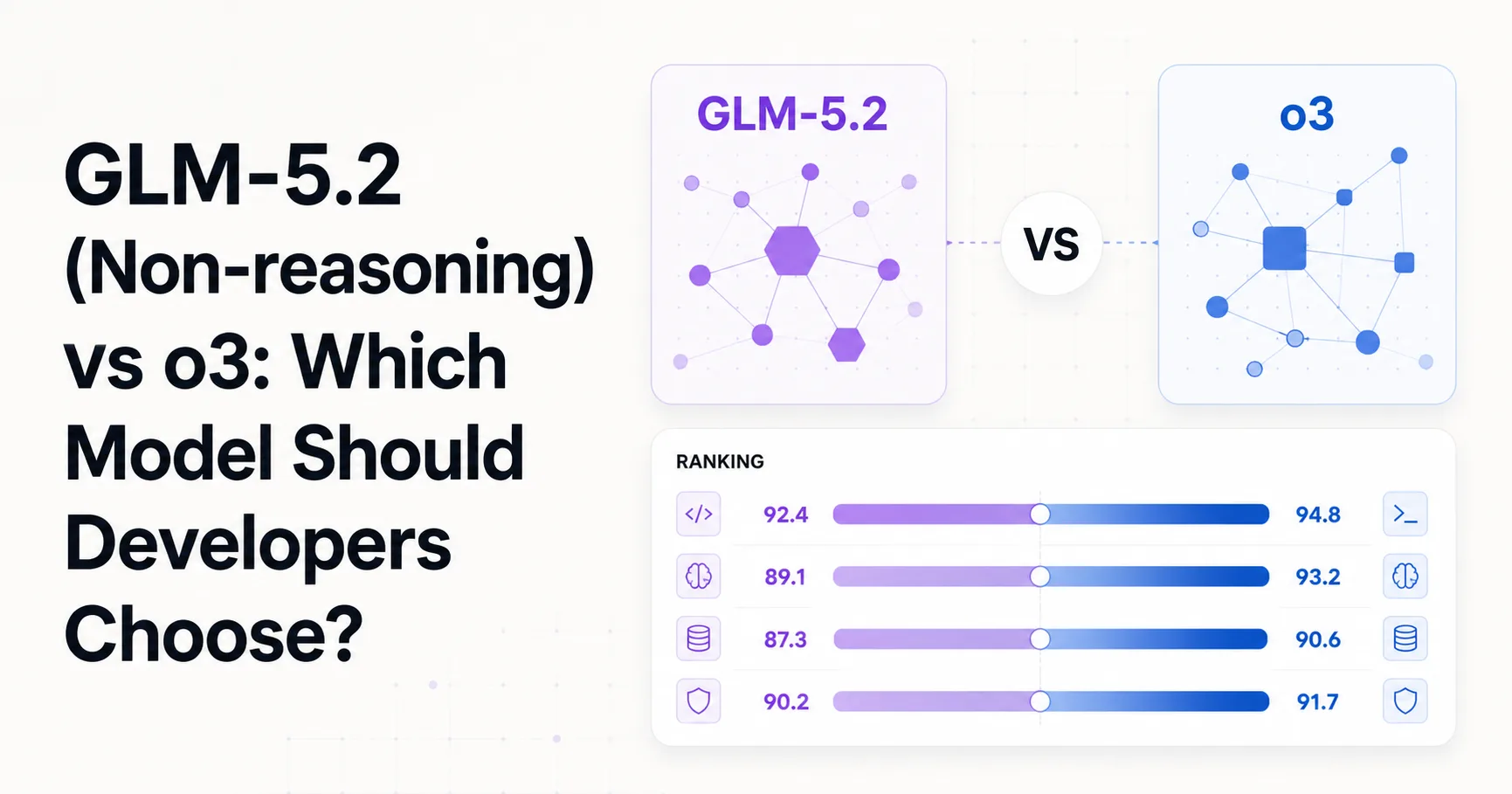
This radar chart visually maps the core capabilities (reasoning, coding, math proxy, multimodal, long context) of `GLM-5.2 (Non-reasoning)` vs `o3`.
This grouped bar chart provides a side-by-side comparison for each benchmark metric.
Lower time to first token is better; higher tokens per second is better.
Compare input and output pricing in USD per 1M tokens.
GLM-5.2 (Non-reasoning)$2.5
o3$4
GLM-5.2 (Non-reasoning) costs $1.5 less per run
This article is a dated snapshot published on 2026-08-07. Live cards above use the current catalog; missing live fields are not inferred.
GLM-5.2 (Non-reasoning) is the stronger default choice in this dataset because it combines the higher intelligence index, lower blended cost, and marginally higher output speed. The measured intelligence index is 34.1 for GLM-5.2 (Non-reasoning) and 30.4 for o3. The available pricing data also favors GLM-5.2 (Non-reasoning), especially for generated output. However, this is not a complete capability verdict. The brief provides a coding index only for GLM-5.2 (Non-reasoning), at 46.5, while o3 has no comparable coding value. It provides a math index only for o3, at 88.3, while GLM-5.2 (Non-reasoning) has no comparable math value. Neither model has a reported context window in the dataset. Developers should therefore treat the result as a selection guide under incomplete evidence, not as a universal ranking. Data provided by Artificial Analysis.
GLM-5.2 (Non-reasoning) offers the better measured general-purpose trade-off, while o3 retains a distinct math signal that cannot be compared directly. The available intelligence index favors GLM-5.2 (Non-reasoning) at 34.1 versus o3 at 30.4. That result supports choosing GLM-5.2 (Non-reasoning) for teams seeking a broad model with lower unit economics. It does not prove superior performance on every software task, because the coding comparison is incomplete. GLM-5.2 (Non-reasoning) has an Artificial Analysis coding index of 46.5, but the brief does not provide an o3 coding index. The reverse problem appears in mathematics: o3 has a math index of 88.3, while no GLM-5.2 (Non-reasoning) math value is available.
| Decision factor | GLM-5.2 (Non-reasoning) | o3 | Selection meaning |
|---|---|---|---|
| Intelligence index | 34.1 | 30.4 | GLM-5.2 (Non-reasoning) leads on the shared measure |
| Coding index | 46.5 | Not provided | No coding winner can be established |
| Math index | Not provided | 88.3 | o3 has the only reported math signal |
| Blended price per 1M tokens | $2.07575 | $3.5 | GLM-5.2 (Non-reasoning) is cheaper |
| Median output speed | 128.519 | 128.056 | The measured difference is operationally small |
| Latency | 0.3 seconds | 0.3 seconds | The dataset reports a tie |
Current product visibility adds another qualification. The provided OpenAI model catalog does not list o3 among the current models described in the research brief. The research brief also says that the provided catalog does not establish a stable alias, endpoint, or formal successor for o3. No equivalent verifiable official material was found for GLM-5.2 (Non-reasoning).
GLM-5.2 (Non-reasoning) has the better shared intelligence score, but the evidence does not establish a complete software-engineering winner. The 34.1 versus 30.4 intelligence result gives GLM-5.2 (Non-reasoning) a meaningful signal for broad task quality in this dataset. It can support a default evaluation path for classification, drafting, structured reasoning, and mixed developer workloads. The score alone cannot show whether the model follows repository conventions, edits safely, explains failures clearly, or produces maintainable code.
The coding evidence is asymmetric. GLM-5.2 (Non-reasoning) is listed at 46.5 on the Artificial Analysis coding index. The brief does not provide an o3 coding score, so developers cannot infer that GLM-5.2 (Non-reasoning) beats o3 at coding from this comparison. The responsible conclusion is narrower: GLM-5.2 (Non-reasoning) has a measured coding signal, while o3 remains unranked here.
The speed chart suggests near parity rather than a practical differentiator. GLM-5.2 (Non-reasoning) reports 128.519 median output tokens per second, compared with 128.056 for o3. Both models report 0.3 seconds of latency. In an interactive coding assistant, this means prompt design, tool-call behavior, streaming experience, and end-to-end system overhead may matter more than the small reported output-speed separation. Those factors are not covered by the supplied brief.
The missing context-window values are more important than the small speed gap for long-repository work. Neither model has a verified context-window value in the data snapshot. Developers should not assume that either model can ingest a large codebase, long logs, or extensive test output without a separate verification step. The OpenAI model catalog also does not supply the missing o3 details in the provided research material.
GLM-5.2 (Non-reasoning) is the clear cost choice, but o3 can still be rational when its task value offsets higher token spend. The blended price is $2.07575 per 1M tokens for GLM-5.2 (Non-reasoning) and $3.5 for o3. Input pricing is $1.351 for GLM-5.2 (Non-reasoning) and $2 for o3. Output pricing is $4.25 for GLM-5.2 (Non-reasoning) and $8 for o3.
The output price difference deserves attention because developer workflows often generate more text than a short chat exchange. Code patches, test explanations, migration plans, tool results, and review comments can all expand output volume. A model with an output price of $8 per 1M tokens may become materially more expensive in an agent loop, even if the initial prompt is small. The supplied data supports that cost direction, but it does not provide workload-specific token distributions or monthly usage, so no further bill estimate is justified.
GLM-5.2 (Non-reasoning) is therefore a strong fit for high-volume routing, first-pass code generation, routine transformations, and applications where the system can retry or escalate selected requests. o3 may make more sense for narrower tasks where its reported 88.3 math index is directly relevant and correctness has unusually high value. That is a conditional recommendation, not proof that o3 is better at every mathematical workload.
Availability uncertainty can also turn a nominally cheaper model into the more expensive operational choice. The brief does not verify whether GLM-5.2 (Non-reasoning) remains directly callable, has a stable alias, or has a current public price. It also says that the OpenAI pricing page does not list a current o3 price. Consequently, the chart values are useful for comparative economics, but procurement teams must confirm live billing before committing to either model.
GLM-5.2 (Non-reasoning) leads on 3 of 3 metrics
GLM-5.2 (Non-reasoning) should be the first evaluation candidate for most cost-sensitive, general-purpose developer applications. Its shared intelligence index is higher at 34.1, its blended price is $2.07575 per 1M tokens, and its reported median output speed is 128.519 tokens per second. Those signals point toward a practical default for teams that need broad capability and predictable unit economics.
Choose GLM-5.2 (Non-reasoning) first when the product serves many requests, generates substantial output, or needs a lower-cost initial pass before escalation. Its reported output price of $4.25 per 1M tokens is especially relevant to code-heavy agents. The recommendation remains provisional because the research brief contains no verifiable official documentation for its context window, API parameters, multimodal support, availability, or current public pricing.
Evaluate o3 first when mathematical reasoning is the central acceptance criterion. The only reported math signal is o3 at 88.3, and that may justify a focused bake-off for symbolic work, quantitative analysis, or code involving demanding numerical logic. The evidence does not show whether that advantage transfers to your exact prompts, tool chain, or error budget. The higher blended price of $3.5 per 1M tokens should be included in that evaluation.
Use a two-stage test before production selection. First, compare both models on the same private task set, with identical prompts, tools, context, and output limits. Second, validate live access, aliases, pricing, rate limits, and failure behavior. The provided OpenAI model catalog does not establish current o3 availability in the supplied research, and no reliable public source establishes the equivalent GLM-5.2 (Non-reasoning) details. The strongest conclusion is therefore a default preference for GLM-5.2 (Non-reasoning), followed by an availability and task-specific verification gate.
GLM-5.2 (Non-reasoning) and o3 both require live verification before a production commitment because the supplied evidence leaves important operational questions unanswered. The data snapshot gives comparative benchmark, speed, and pricing values, but the research brief does not verify context limits, stable identifiers, endpoint access, output constraints, or failure modes for either model. The OpenAI material is particularly important for o3: the current model catalog does not list it in the supplied research, and the current pricing page does not list its Standard, Batch, Flex, or Fast mode prices. Developers should record the exact endpoint, model identifier, billing terms, context behavior, and error responses during the bake-off. Data provided by Artificial Analysis.
GLM-5.2 (Non-reasoning) is the better default in this dataset because it has the higher intelligence index at 34.1, lower blended pricing at $2.07575, and nearly identical reported latency of 0.3 seconds.
The evidence does not establish that conclusion. GLM-5.2 (Non-reasoning) has a reported coding index of 46.5, but the supplied data provides no comparable o3 coding value.
A developer might choose o3 when mathematical reasoning is the main acceptance criterion because o3 has the only reported math index, at 88.3, although task-specific validation remains necessary.
GLM-5.2 (Non-reasoning) is cheaper for generated code in the supplied pricing data because its output price is $4.25 per 1M tokens, compared with $8 for o3.
Neither model should be approved from this comparison alone because the research does not verify current availability, stable aliases, context windows, API parameters, or failure behavior.