
Time to First Token · GLM-5 (Non-reasoning)
0ms
Time to First Token · o3
7185ms
Deep dive into reasoning, benchmarks, and latency insights.
The current catalog does not contain complete performance evidence for both models, so this page does not declare an overall winner. Use the available fields as comparison signals and validate the models on your own workload.
Key decision metrics at a glance.
| Model | Metric | Value | Unit | Source / snapshot |
|---|---|---|---|---|
| GLM-5 (Non-reasoning) | Reasoning | 6.0 | benchmark or capability score | Artificial Analysis · current catalog |
| o3 | Reasoning | 9.0 | benchmark or capability score | Artificial Analysis · current catalog |
| GLM-5 (Non-reasoning) | Coding | 6.0 | benchmark or capability score | Artificial Analysis · current catalog |
| o3 | Coding | 6.0 | benchmark or capability score | Artificial Analysis · current catalog |
| GLM-5 (Non-reasoning) | Multimodal | 3.0 | benchmark or capability score | Artificial Analysis · current catalog |
| o3 | Multimodal | 3.0 | benchmark or capability score | Artificial Analysis · current catalog |
| GLM-5 (Non-reasoning) | Long Context | 4.0 | benchmark or capability score | Artificial Analysis · current catalog |
| o3 | Long Context | 4.0 | benchmark or capability score | Artificial Analysis · current catalog |
| GLM-5 (Non-reasoning) | Blended Price / 1M tokens | $1.55 | USD per 1M tokens | Artificial Analysis · current catalog |
| o3 | Blended Price / 1M tokens | $3.5 | USD per 1M tokens | Artificial Analysis · current catalog |
| GLM-5 (Non-reasoning) | P95 Latency | — | milliseconds | Artificial Analysis · current catalog |
| o3 | P95 Latency | — | milliseconds | Artificial Analysis · current catalog |
| GLM-5 (Non-reasoning) | Tokens per second | 0 | tokens per second | Artificial Analysis · current catalog |
| o3 | Tokens per second | 119.185 | tokens per second | Artificial Analysis · current catalog |
Data provided by Artificial Analysis; live values use the current catalog.
This radar chart visually maps the core capabilities (reasoning, coding, math proxy, multimodal, long context) of `GLM-5 (Non-reasoning)` vs `o3`.
This grouped bar chart provides a side-by-side comparison for each benchmark metric.
Lower time to first token is better; higher tokens per second is better.
Compare input and output pricing in USD per 1M tokens.
GLM-5 (Non-reasoning)$1.8
o3$4
GLM-5 (Non-reasoning) costs $2.2 less per run
This article is a dated snapshot published on 2026-08-07. Live cards above use the current catalog; missing live fields are not inferred.
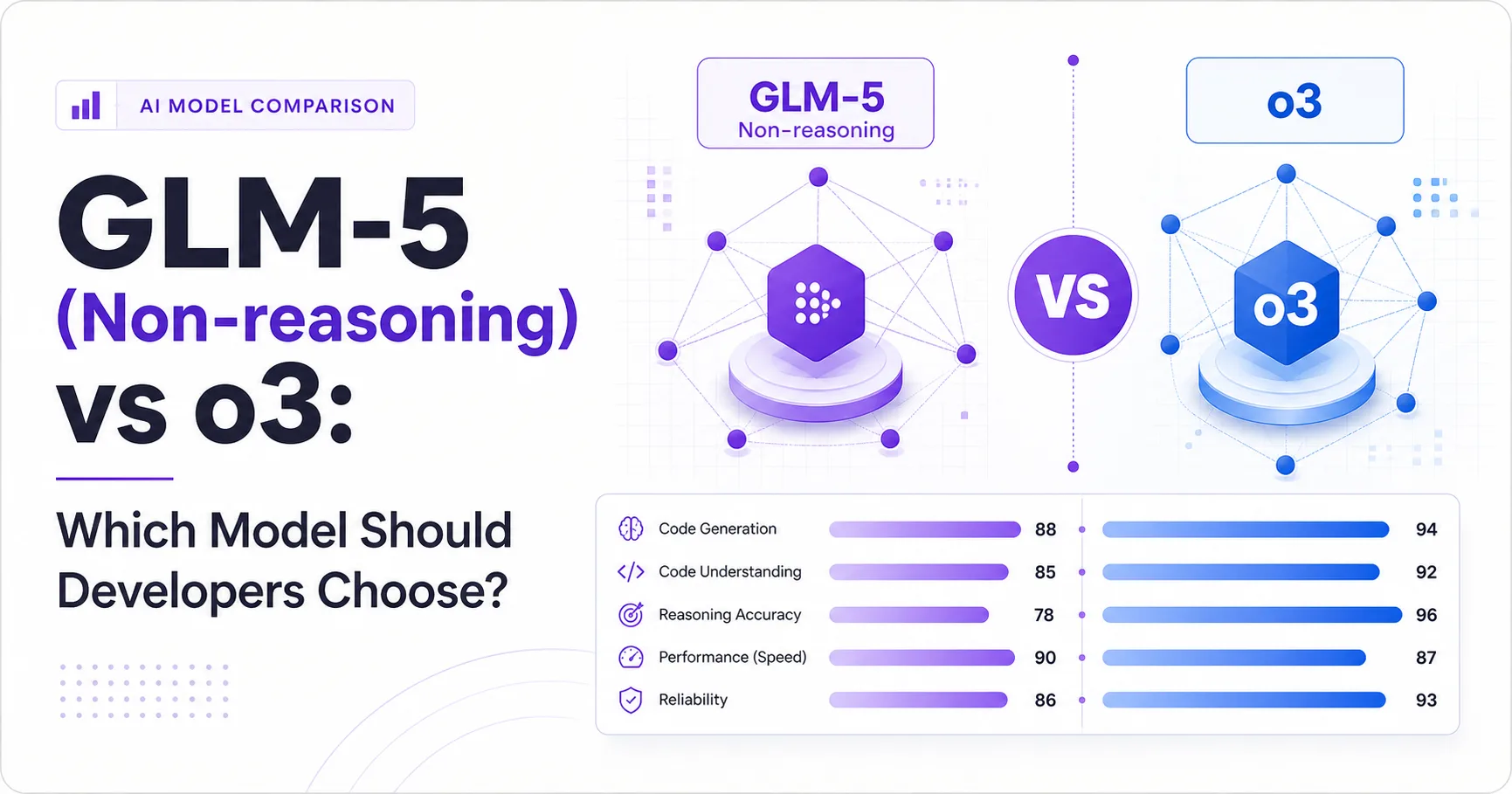
GLM-5 (Non-reasoning) is the stronger default for cost-sensitive general development, while o3 is the safer specialist choice for mathematics. The supplied data gives GLM-5 (Non-reasoning) an Artificial Analysis Intelligence Index of 32.4, compared with 30.4 for o3, and prices it at $1.5500000000000003 per 1M blended tokens versus $3.5 for o3. The data also reports o3 at 128.056 median output tokens per second, while GLM-5 (Non-reasoning) has no reported output-speed value. Latency is 0.3 seconds for each model, so the available evidence does not show a latency advantage. The key limitation is model visibility: the supplied research found no verifiable official release, documentation, pricing page, or community testing for GLM-5 (Non-reasoning). OpenAI's current model directory also does not list o3, and the current pricing page does not provide a current o3 price. Developers therefore face a measured performance and cost comparison, but incomplete deployment evidence.
GLM-5 (Non-reasoning) wins the measured general-intelligence and cost comparison, while o3 has the only reported mathematics result and the only reported generation-speed result.
| Decision factor | GLM-5 (Non-reasoning) | o3 | Practical reading |
|---|---|---|---|
| Artificial Analysis Intelligence Index | 32.4 | 30.4 | GLM-5 leads the reported general score |
| Artificial Analysis Math Index | Not reported | 88.3 | o3 has the only usable mathematics signal |
| Blended price per 1M tokens | $1.5500000000000003 | $3.5 | GLM-5 costs less in the supplied mix |
| Input price per 1M tokens | $1 | $2 | GLM-5 is cheaper for prompt-heavy workloads |
| Output price per 1M tokens | $3.2 | $8 | GLM-5 is cheaper for completion-heavy workloads |
| Latency | 0.3 seconds | 0.3 seconds | The supplied measurement is tied |
| Median output speed | Not reported | 128.056 tokens per second | Only o3 has a speed measurement |
This comparison does not establish that GLM-5 (Non-reasoning) is better at coding, tool use, instruction following, long-context work, or production reliability. The research brief found no reliable community tests or official technical documentation for GLM-5 (Non-reasoning). It also found no verified current endpoint, alias, or price for either model in the relevant official materials. OpenAI's current model directory and pricing page provide current catalog context, but neither page confirms a current o3 listing or price. The score advantage should therefore guide a shortlist, not replace a private task evaluation.
o3 is the better-supported performance choice for mathematics, while GLM-5 (Non-reasoning) leads only on the reported general intelligence index. The 32.4 versus 30.4 intelligence result suggests GLM-5 (Non-reasoning) may perform well across a broad evaluation mix, but the difference is small enough that task composition could change the practical winner. The data supplies no task-level breakdown, so developers cannot tell whether the gap comes from coding, knowledge work, reasoning, instruction following, or another category.
The mathematics evidence is more decisive but also asymmetric. o3 has a reported Artificial Analysis Math Index of 88.3. GLM-5 (Non-reasoning) has no corresponding value, so the comparison cannot show whether o3 beats GLM-5 on mathematics or merely has better reporting coverage. Developers building equation solvers, quantitative agents, verification pipelines, or mathematical research tools should treat o3 as the evidence-backed candidate. Developers choosing a general assistant should not infer a broad o3 advantage from that specialist score alone.
Speed has the same asymmetry. o3 is measured at 128.056 median output tokens per second, while GLM-5 (Non-reasoning) has no reported value. That result supports o3 for workloads where long responses, streaming completion time, or operator-perceived throughput matters. It does not prove that o3 will feel faster in production because the brief does not provide hardware, region, queue, prompt length, output length, or concurrency conditions. The measured latency is 0.3 seconds for each model, so the available data supports a tie at request-start responsiveness.
GLM-5 (Non-reasoning) is the clear price leader in the supplied billing comparison, especially for completion-heavy applications. Its blended price is $1.5500000000000003 per 1M tokens, compared with $3.5 for o3. Input tokens cost $1 for GLM-5 (Non-reasoning) and $2 for o3, while output tokens cost $3.2 and $8 respectively. These differences matter most in chat systems, coding agents, and content workflows that generate substantial completion text.
The cheaper model can still become more expensive at the application level if it requires retries, human review, routing to another model, or additional validation. The research brief provides no reliable evidence about GLM-5 (Non-reasoning)'s failure modes, coding behavior, tool calling, or production stability. It also provides no verified endpoint or current provider documentation. A lower token price therefore reduces one visible cost, but it does not establish a lower cost per successful task.
The same caution applies to o3. The supplied official OpenAI materials do not list a current o3 price. The current OpenAI pricing page is useful for checking the present catalog, but it does not validate the comparison price as a current public listing for o3. The data should be treated as the supplied benchmark snapshot, credited to Artificial Analysis, rather than as a promise of today's procurement terms. Teams should confirm actual availability and billing before committing architecture to either model.
GLM-5 (Non-reasoning) leads on 3 of 3 metrics
GLM-5 (Non-reasoning) is the best first candidate for high-volume general tasks when the team can validate availability and quality in its own environment. Its reported intelligence score is higher at 32.4, and its blended, input, and output prices are lower than o3's. That combination fits classification, drafting, summarization, routine coding assistance, and other workloads where token economics dominate and no specialist mathematics requirement has been established.
o3 is the better candidate when mathematical accuracy, measured generation speed, or a more recognizable vendor ecosystem carries greater operational value. Its 88.3 Math Index is the only reported mathematics signal, and its 128.056 median output tokens per second is the only reported speed measurement. Those results make o3 easier to justify for quantitative workflows, although the research does not establish current endpoint availability. OpenAI's model directory does not list o3 among the supplied current models, and the research found no official statement confirming a stable alias or replacement path.
The evidence is insufficient to recommend either model for regulated production, long-context systems, multimodal applications, or complex tool-using agents. Neither model has a reported context window in the supplied data. The research also found no reliable public tests covering coding experience, failure patterns, or behavioral preferences. A sensible selection process is to start with GLM-5 (Non-reasoning) for cost-sensitive general tasks and o3 for mathematics-heavy tasks, then require a private evaluation using representative prompts, successful-task rate, retries, review time, and real billed usage before rollout.
The evidence-led decision path is:
flowchart TD
    A[Define the dominant workload] --> B{Mathematics is core?}
    B -->|Yes| C[Shortlist o3]
    B -->|No| D{Token cost dominates?}
    D -->|Yes| E[Shortlist GLM-5 Non-reasoning]
    D -->|No| F[Evaluate both on private tasks]
    C --> G[Verify endpoint and current pricing]
    E --> G
    F --> G
    G --> H{Quality and availability pass?}
    H -->|Yes| I[Deploy with monitoring]
    H -->|No| J[Do not commit to the model]
GLM-5 (Non-reasoning) requires the most deployment verification because the supplied research found no reliable official or community evidence about its API, limitations, or operating behavior. o3 requires a different verification step because the current OpenAI catalog materials do not confirm its present availability or price. Developers should treat the comparison as a measured shortlist with explicit evidence gaps, not as a complete production-readiness assessment. The most important unanswered questions concern endpoint access, context limits, tool behavior, coding reliability, and the relationship between benchmark scores and successful application tasks.
GLM-5 (Non-reasoning) is the stronger cost-sensitive starting point for general software development because its intelligence score is 32.4 and its blended price is lower, but the supplied research has no reliable coding tests.
o3 is the evidence-backed choice for mathematics because it has a reported Artificial Analysis Math Index of 88.3, while GLM-5 (Non-reasoning) has no reported mathematics score for direct comparison.
GLM-5 (Non-reasoning) is cheaper on the supplied token prices, including $1.5500000000000003 blended pricing, but production cost is uncertain because failure rates, retries, review effort, and API availability are not documented.
o3 has the only reported output-speed measurement at 128.056 median output tokens per second, but the evidence does not prove it is faster overall because GLM-5 (Non-reasoning) has no corresponding speed value and both report 0.3 seconds latency.
Neither model can be cleared for production from this evidence alone because the supplied research does not verify complete API availability, context limits, failure modes, or current procurement terms for the intended deployment.