
Time to First Token · GLM 5V Turbo (Reasoning)
0ms
Time to First Token · GPT-5 (high)
0ms
Deep dive into reasoning, benchmarks, and latency insights.
The current catalog does not contain complete performance evidence for both models, so this page does not declare an overall winner. Use the available fields as comparison signals and validate the models on your own workload.
Key decision metrics at a glance.
| Model | Metric | Value | Unit | Source / snapshot |
|---|---|---|---|---|
| GLM 5V Turbo (Reasoning) | Reasoning | 6.0 | benchmark or capability score | Artificial Analysis · current catalog |
| GPT-5 (high) | Reasoning | 9.0 | benchmark or capability score | Artificial Analysis · current catalog |
| GLM 5V Turbo (Reasoning) | Coding | 6.0 | benchmark or capability score | Artificial Analysis · current catalog |
| GPT-5 (high) | Coding | 4.0 | benchmark or capability score | Artificial Analysis · current catalog |
| GLM 5V Turbo (Reasoning) | Multimodal | 3.0 | benchmark or capability score | Artificial Analysis · current catalog |
| GPT-5 (high) | Multimodal | 3.0 | benchmark or capability score | Artificial Analysis · current catalog |
| GLM 5V Turbo (Reasoning) | Long Context | 4.0 | benchmark or capability score | Artificial Analysis · current catalog |
| GPT-5 (high) | Long Context | 4.0 | benchmark or capability score | Artificial Analysis · current catalog |
| GLM 5V Turbo (Reasoning) | Blended Price / 1M tokens | $0 | USD per 1M tokens | Artificial Analysis · current catalog |
| GPT-5 (high) | Blended Price / 1M tokens | $3.438 | USD per 1M tokens | Artificial Analysis · current catalog |
| GLM 5V Turbo (Reasoning) | P95 Latency | — | milliseconds | Artificial Analysis · current catalog |
| GPT-5 (high) | P95 Latency | — | milliseconds | Artificial Analysis · current catalog |
| GLM 5V Turbo (Reasoning) | Tokens per second | 0 | tokens per second | Artificial Analysis · current catalog |
| GPT-5 (high) | Tokens per second | 0 | tokens per second | Artificial Analysis · current catalog |
Data provided by Artificial Analysis; live values use the current catalog.
This radar chart visually maps the core capabilities (reasoning, coding, math proxy, multimodal, long context) of `GLM 5V Turbo (Reasoning)` vs `GPT-5 (high)`.
This grouped bar chart provides a side-by-side comparison for each benchmark metric.
Lower time to first token is better; higher tokens per second is better.
Compare input and output pricing in USD per 1M tokens.
GLM 5V Turbo (Reasoning)$0
GPT-5 (high)$3.75
GLM 5V Turbo (Reasoning) costs $3.75 less per run
This article is a dated snapshot published on 2026-08-07. Live cards above use the current catalog; missing live fields are not inferred.
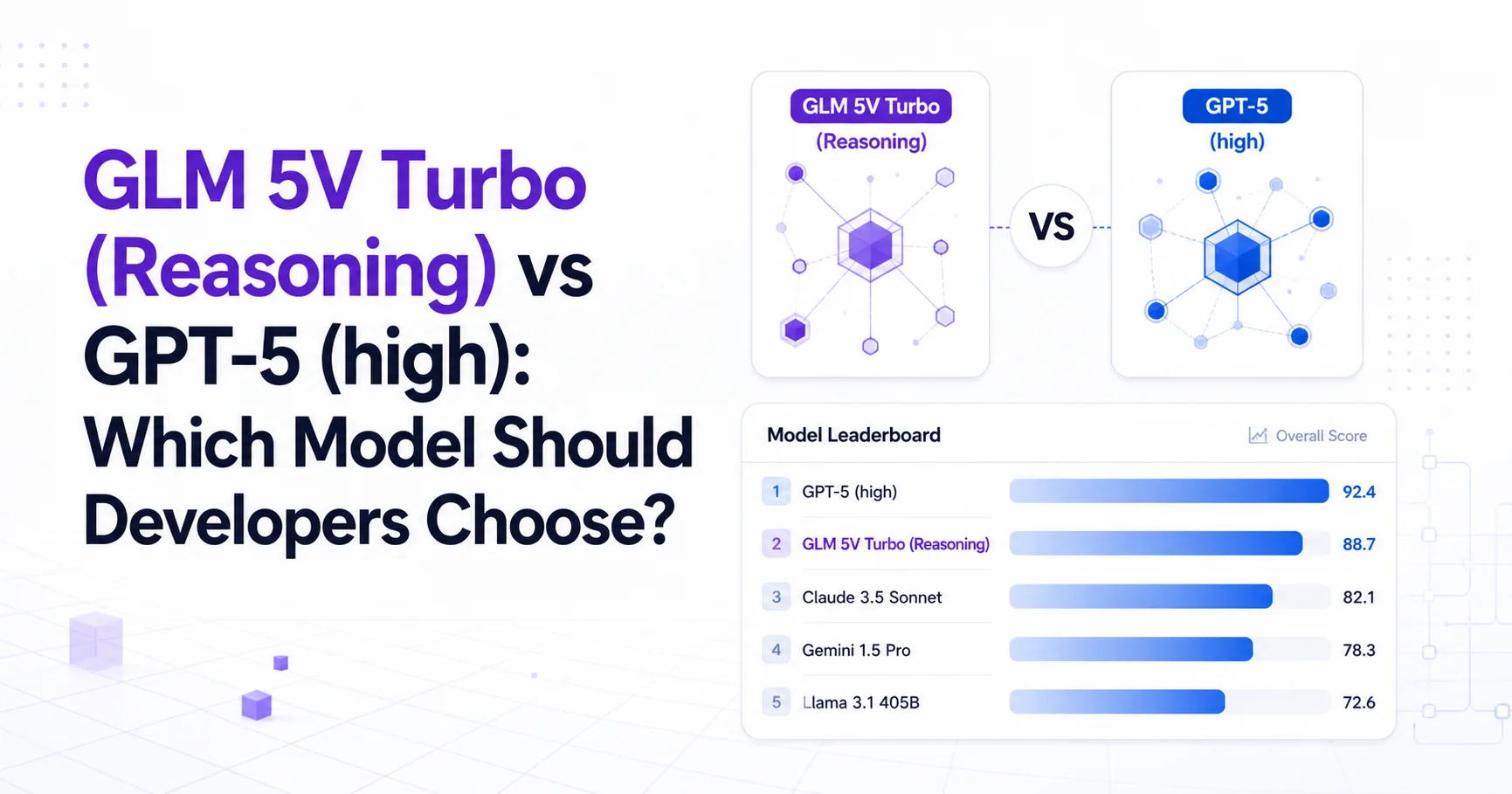
GPT-5 (high) is the safer developer choice because it has documented API behavior, stronger measured coverage, and a lower blended price than GLM 5V Turbo (Reasoning). The available data shows GPT-5 (high) at 34.7 on the Artificial Analysis Intelligence Index, compared with 34.5 for GLM 5V Turbo (Reasoning). Both models have a measured latency of 0.3 seconds. GPT-5 (high) costs $3.4375 per 1M blended tokens, while GLM 5V Turbo (Reasoning) costs $15. Data provided by https://artificialanalysis.ai/
GPT-5 (high) offers the stronger evidence-backed default for production development workloads. OpenAI positions GPT-5 as a reasoning model for coding, reasoning, and agentic tasks in its developer announcement. The GPT-5 model documentation also documents its API alias, endpoint availability, supported modalities, reasoning controls, and tool-related capabilities. GLM 5V Turbo (Reasoning) has no verifiable official documentation, community evidence, or public failure analysis in the supplied research brief. That absence does not prove that GLM 5V Turbo performs poorly. It does mean developers cannot confidently assess its API stability, context behavior, output limits, multimodal support, or operational continuity from the supplied evidence. The measured quality gap is small on the shared Intelligence Index, but GPT-5 has additional reported coding and math scores that GLM 5V Turbo does not have in the data snapshot. GPT-5 therefore wins on decision confidence, not merely on the narrow shared score. The main qualification is lifecycle risk: the fixed GPT-5 snapshot is marked Deprecated in the documentation, while the stable gpt-5 alias remains listed. Developers should validate the alias and migration path before building a long-lived dependency.
GPT-5 (high) has a substantially more complete public evidence trail, while GLM 5V Turbo (Reasoning) cannot be evaluated beyond the supplied measurement snapshot. The GPT-5 materials include official documentation and a community report describing useful small bug fixes, shorter output in some complete application tasks, and possible incorrect changes in complex existing codebases. The community report is explicitly subjective and non-controlled, so it should inform test design rather than determine a purchasing decision. GLM 5V Turbo has no cited official source or verified community report in the research brief. That creates an important asymmetry: GPT-5 has documented strengths and documented limitations, whereas GLM 5V Turbo has mostly unknowns. The brief does not establish whether GLM 5V Turbo has a stable API, what its model identifier means operationally, how its reasoning mode is configured, or whether its measured result reflects a generally available service. The brief also does not provide a direct coding or math comparison for GLM 5V Turbo. Developers should treat missing GLM evidence as uncertainty, not as a negative benchmark result. A fair evaluation would require identical prompts, tool settings, output constraints, workload samples, and production-like error handling.
GPT-5 (high) is the better-supported performance choice because its evidence covers coding and mathematical reasoning, while GLM 5V Turbo (Reasoning) has only a shared intelligence score in the snapshot. GPT-5 records 37.8 on the Artificial Analysis Coding Index and 94.3 on the Artificial Analysis Math Index. GLM 5V Turbo has no corresponding values in the supplied data, so the chart cannot establish a coding or math winner. The shared Intelligence Index is close: GPT-5 scores 34.7 and GLM 5V Turbo scores 34.5. That narrow difference suggests that a broad aggregate score alone should not decide the architecture. Task composition matters more. A coding assistant may benefit from GPT-5’s documented coding positioning and tool support, while a workload centered on another capability could produce a different result. The supplied data does not identify such a GLM-specific advantage. Latency is tied at 0.3 seconds, and neither model has a recorded median output-token speed in the snapshot. Developers therefore cannot claim that either model streams faster from the available evidence. The practical performance question is whether the model produces correct, reviewable changes under the project’s constraints. GPT-5’s community evidence warns about shorter or incomplete application implementations and possible incorrect edits in complex repositories, so repository-level tests and human review remain necessary.
GPT-5 (high) is the clear unit-cost winner, but GLM 5V Turbo (Reasoning) could only become economically attractive if it materially reduces retries, review effort, or task failures. GPT-5 costs $3.4375 per 1M blended tokens, compared with $15 for GLM 5V Turbo (Reasoning). Its input price is $1.25 per 1M tokens versus $10, and its output price is $10 per 1M tokens versus $30. These differences matter most for workloads with high request volume, long prompts, or substantial generated output. The price chart cannot show the cost of engineering rework. A cheaper model can become more expensive if developers must repeat requests, correct flawed patches, add extensive validation, or route difficult tasks to another model. The supplied research brief does not provide verified GLM failure rates, retry behavior, or production reliability data. It therefore cannot support a claim that GLM 5V Turbo offsets its higher listed price through better task completion. GPT-5 also has a cost caveat: reasoning effort and output length can affect actual token consumption, but the brief does not provide enough usage data to quantify that effect. The right comparison is successful task cost, measured on representative repositories and prompts, rather than listed token price alone. Based on the available figures, GPT-5 should be the default economic baseline.
GLM 5V Turbo (Reasoning) leads on 3 of 3 metrics
GPT-5 (high) should be the default pick for developers who need documented coding, reasoning, tool-calling, and structured-output behavior. OpenAI documents GPT-5 support for function calling, structured outputs, streaming, custom tools, and configurable reasoning effort in its developer announcement and model documentation. Those capabilities reduce integration uncertainty because the relevant controls and interfaces are described publicly. GPT-5 is also the stronger choice for math-heavy workflows because the snapshot reports an Artificial Analysis Math Index of 94.3, while no GLM value is available. GPT-5 is a sensible starting point for coding agents, repository maintenance, tool-driven workflows, and systems that need an inspectable API contract. Developers should still test complex codebase edits because the cited community evidence reports hallucinations or incorrect modifications in some existing repositories. GLM 5V Turbo (Reasoning) should be considered only after its availability, API contract, and task quality are independently verified. Its measured Intelligence Index is 34.5, close to GPT-5’s 34.7, so a private evaluation could reveal a useful niche. The current brief does not identify that niche. GLM might be worth piloting when a team has access to a reliable endpoint and can measure successful task cost, but its listed price of $15 per 1M blended tokens creates a high bar. Teams choosing GPT-5 should prefer the stable gpt-5 alias over assuming that gpt-5-high is a separate API model, because the brief finds no official gpt-5-high model identifier. They should also monitor the deprecated fixed snapshot before committing to long-term reproducibility.
GPT-5 (high) needs lifecycle and repository safeguards, while GLM 5V Turbo (Reasoning) needs basic discoverability and reproducibility checks before serious adoption. For GPT-5, confirm whether the application uses the stable gpt-5 alias or the fixed snapshot, then define a migration test because the fixed snapshot is marked Deprecated in the model documentation. Test text and image inputs separately if the product needs multimodal behavior, because the documented API does not support audio or video input and output. For coding agents, require patch inspection, tests, and rollback paths for changes to existing repositories. For GLM 5V Turbo, first verify that the model can be called under a stable identifier and that the observed service matches the evaluated model. Then measure coding success, reasoning quality, latency distribution, output length, retries, and review burden under the same workload used for GPT-5. The supplied brief provides no official GLM documentation to anchor those checks. That evidence gap is itself an operational risk. Neither model has a recorded median output-token speed in the data snapshot, so teams should not use streaming speed as a selection criterion until they collect it directly. Data provided by https://artificialanalysis.ai/
GPT-5 (high) is the answer for most documented developer use cases, but the final choice still depends on verified workload results. The supplied material leaves several questions open, especially for GLM 5V Turbo (Reasoning). No official GLM source confirms its API contract, context behavior, output limit, modalities, or availability. No controlled community evidence establishes its coding experience or failure patterns. The shared Intelligence Index is close, but missing coding and math values prevent a complete capability comparison. The questions below turn those gaps into concrete evaluation decisions.
GPT-5 (high) is the safer overall choice because it has documented coding and tool capabilities, broader evidence, a lower blended price, and a measured Intelligence Index of 34.7.
The supplied data does not show a speed winner because GLM 5V Turbo (Reasoning) and GPT-5 (high) both have a measured latency of 0.3 seconds, while output-token speed is unavailable for both.
GPT-5 (high) is cheaper at $3.4375 per 1M blended tokens, compared with $15 for GLM 5V Turbo (Reasoning), although retries and review effort still affect total task cost.
No. The research brief finds no official gpt-5-high model identifier; high refers to the reasoning_effort=high parameter used with the gpt-5 model.
No complete coding comparison is available because GPT-5 (high) has a Coding Index of 37.8, while the supplied data contains no corresponding GLM 5V Turbo coding value.
GPT-5 (high) carries lifecycle and integration risks because its fixed snapshot is marked Deprecated, and community reports describe possible incomplete application output or incorrect edits in complex codebases.
A controlled pilot could justify GLM 5V Turbo (Reasoning) if the team can verify availability and demonstrate lower successful-task cost or better results on its own workload, because current evidence does not identify a proven advantage.