
Time to First Token · GPT-4o mini
0ms
Time to First Token · GPT-5.6 Sol (max)
75247ms
Deep dive into reasoning, benchmarks, and latency insights.
The current catalog does not contain complete performance evidence for both models, so this page does not declare an overall winner. Use the available fields as comparison signals and validate the models on your own workload.
Key decision metrics at a glance.
| Model | Metric | Value | Unit | Source / snapshot |
|---|---|---|---|---|
| GPT-4o mini | Reasoning | 1.0 | benchmark or capability score | Artificial Analysis · current catalog |
| GPT-5.6 Sol (max) | Reasoning | 6.0 | benchmark or capability score | Artificial Analysis · current catalog |
| GPT-4o mini | Coding | 1.0 | benchmark or capability score | Artificial Analysis · current catalog |
| GPT-5.6 Sol (max) | Coding | 8.0 | benchmark or capability score | Artificial Analysis · current catalog |
| GPT-4o mini | Multimodal | 1.0 | benchmark or capability score | Artificial Analysis · current catalog |
| GPT-5.6 Sol (max) | Multimodal | 5.0 | benchmark or capability score | Artificial Analysis · current catalog |
| GPT-4o mini | Long Context | 1.0 | benchmark or capability score | Artificial Analysis · current catalog |
| GPT-5.6 Sol (max) | Long Context | 8.0 | benchmark or capability score | Artificial Analysis · current catalog |
| GPT-4o mini | Blended Price / 1M tokens | $0.262 | USD per 1M tokens | Artificial Analysis · current catalog |
| GPT-5.6 Sol (max) | Blended Price / 1M tokens | $11.25 | USD per 1M tokens | Artificial Analysis · current catalog |
| GPT-4o mini | P95 Latency | — | milliseconds | Artificial Analysis · current catalog |
| GPT-5.6 Sol (max) | P95 Latency | — | milliseconds | Artificial Analysis · current catalog |
| GPT-4o mini | Tokens per second | 0 | tokens per second | Artificial Analysis · current catalog |
| GPT-5.6 Sol (max) | Tokens per second | 68.734 | tokens per second | Artificial Analysis · current catalog |
Data provided by Artificial Analysis; live values use the current catalog.
This radar chart visually maps the core capabilities (reasoning, coding, math proxy, multimodal, long context) of `GPT-4o mini` vs `GPT-5.6 Sol (max)`.
This grouped bar chart provides a side-by-side comparison for each benchmark metric.
Lower time to first token is better; higher tokens per second is better.
Compare input and output pricing in USD per 1M tokens.
GPT-4o mini$0.3
GPT-5.6 Sol (max)$12.5
GPT-4o mini costs $12.2 less per run
This article is a dated snapshot published on 2026-08-07. Live cards above use the current catalog; missing live fields are not inferred.
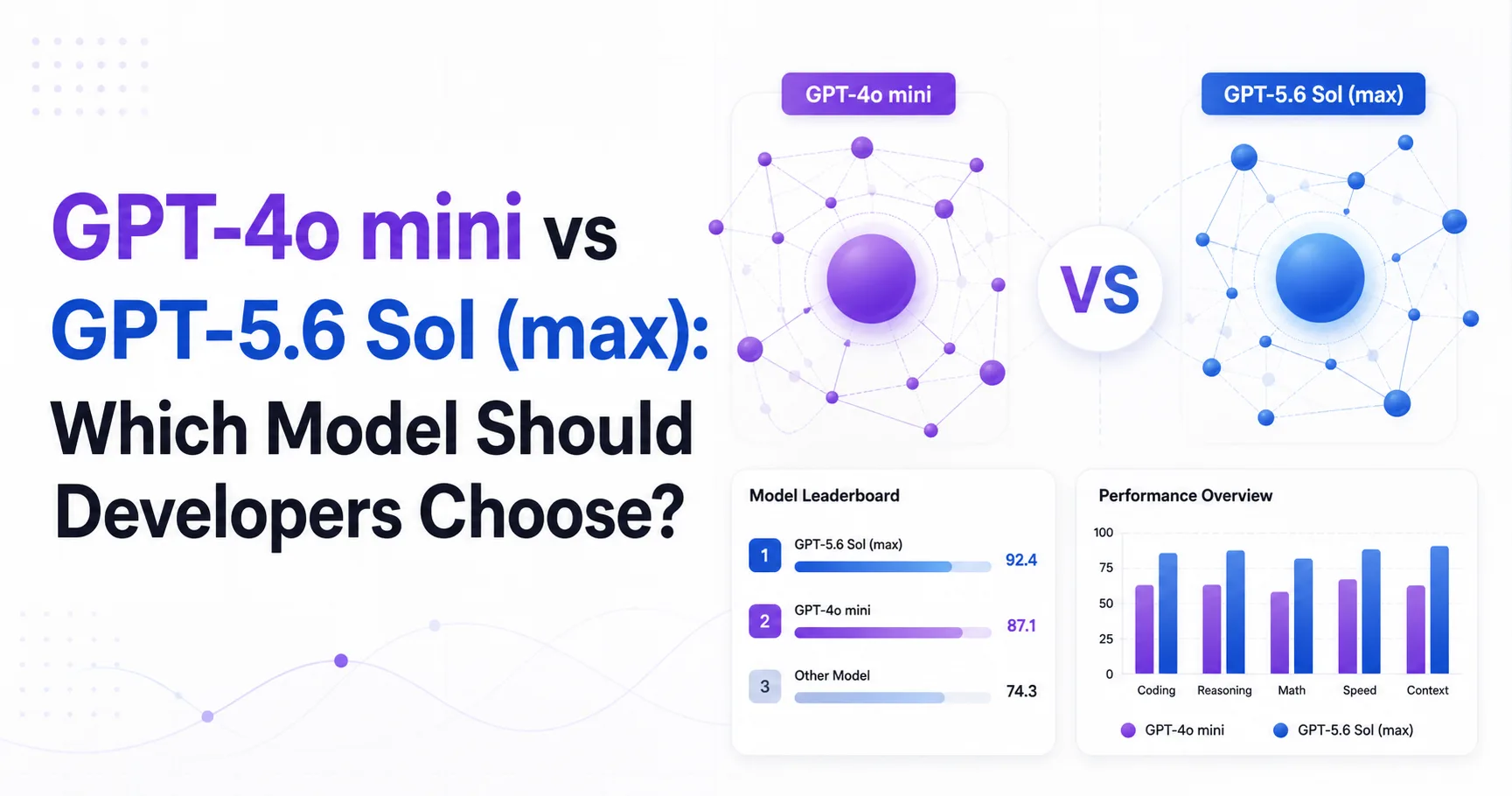
GPT-5.6 Sol (max) is the stronger choice for difficult software work, while GPT-4o mini remains the practical choice for inexpensive, high-volume automation. The Artificial Analysis Coding Index scores GPT-5.6 Sol (max) at 77.4 and GPT-4o mini at 11.4, but the blended token price is $11.25 versus $0.2625. Artificial Analysis supplies the comparison data, while OpenAI describes GPT-5.6 Sol as a flagship model for complex reasoning, programming, and demanding professional work in its model documentation. OpenAI describes GPT-4o mini as a small model designed for frequent, cost-efficient tasks in its launch announcement. The real decision is therefore not which model wins every category. It is whether the application benefits enough from stronger coding and reasoning to justify a substantially higher token bill and more careful reasoning controls.
GPT-5.6 Sol (max) delivers the clearer capability advantage, but GPT-4o mini offers the safer economics for routine production traffic. Artificial Analysis reports an Intelligence Index of 58.9 for GPT-5.6 Sol (max) and 6.9 for GPT-4o mini. Its Coding Index shows the same direction, with 77.4 for GPT-5.6 Sol (max) and 11.4 for GPT-4o mini. GPT-4o mini is also the only model in the supplied comparison with an Artificial Analysis Math Index value, at 14.7, so the material does not establish a math winner. Artificial Analysis is the source of these comparative index values.
OpenAI’s product documentation places GPT-5.6 Sol in a current flagship position and lists a 1,050,000-token context window with a 128,000-token maximum output. GPT-5.6 Sol documentation also documents Responses API support, reasoning controls, structured output, function calling, and a broad tool set. GPT-4o mini’s documentation lists a 128,000-token context window and a 16,384-token maximum output, with text and image input and text output. GPT-4o mini documentation
The version-management picture also differs. GPT-5.6 Sol remains listed without a Deprecated marker, while the current OpenAI model directory now emphasizes the GPT-5 family and does not state a current product position for GPT-4o mini. OpenAI’s current pricing page also does not list GPT-4o mini, so its supplied launch price should not be treated as a confirmed current quote.
GPT-5.6 Sol (max) is the better candidate for coding agents and complex reasoning workflows, while the supplied latency data does not separate the models. Artificial Analysis reports a Coding Index of 77.4 for GPT-5.6 Sol (max) versus 11.4 for GPT-4o mini. It reports an Intelligence Index of 58.9 versus 6.9. Those gaps suggest a meaningful difference in task-solving capability, but an index score does not tell a developer whether a specific repository migration, debugging loop, or code-review task will succeed without supervision. Artificial Analysis provides the comparison scores, not a guarantee for every workload.
The chart also cannot show the operational behavior behind a successful answer. GPT-5.6 Sol supports reasoning effort values from none through max, and OpenAI states that higher effort can increase reasoning token use, latency, and cost. Reasoning models recommends using higher effort only when measured gains justify those costs. GPT-5.6 Sol reports 77.617 median output tokens per second in the supplied data, while GPT-4o mini has no corresponding output-speed value. The latency value is 0.3 seconds for each model, so the available evidence does not prove that GPT-5.6 Sol produces faster end-to-end answers.
Developer reports add a caution that benchmark scores cannot capture. A Reddit tester described over-designed solutions and incomplete task completion, while Hacker News users described broad investigations, defensive code, and improvement after lowering reasoning effort. These reports lack reproducible tasks and controlled measurements, so they indicate possible workflow risk rather than a stable model property. See the Reddit report and Hacker News discussion.
GPT-4o mini is the clear choice for predictable token economics, but GPT-5.6 Sol (max) can be cheaper at the product level when stronger answers reduce retries and human intervention. The supplied blended price is $0.2625 per 1M tokens for GPT-4o mini and $11.25 for GPT-5.6 Sol (max). Input pricing is $0.15 versus $5, and output pricing is $0.6 versus $30. Artificial Analysis provides the blended comparison values.
A simple price chart cannot show how application behavior changes the bill. GPT-4o mini may fit classification, extraction, routing, short transformations, and other repeated calls where each request is cheap and failure has a low recovery cost. GPT-5.6 Sol may fit repository-wide changes, difficult debugging, security analysis, and tasks where an incorrect answer creates review work, failed builds, or another model call. The higher-priced model is not automatically economical, but the lower-priced model is not automatically cheaper once retries, validation, and engineer time enter the calculation.
GPT-5.6 Sol also has pricing modes and context rules that need explicit routing. OpenAI lists Standard, Batch, Flex, and Fast mode prices in its API pricing documentation. The model documentation states that requests above 272K input tokens receive higher input and output multipliers, while reasoning tokens occupy the context window and are billed as output tokens. GPT-5.6 Sol documentation therefore makes long-context caching, prompt trimming, and reasoning-effort selection part of cost control. GPT-4o mini’s current direct price remains uncertain because the current pricing page does not list it.
GPT-4o mini leads on 3 of 3 metrics
GPT-4o mini is the better default for volume, while GPT-5.6 Sol (max) earns its place behind a capability-sensitive router. Choose GPT-4o mini for high-frequency requests with bounded outputs, stable prompts, and inexpensive failure recovery. Its supplied price of $0.2625 per 1M blended tokens makes experimentation and broad deployment easier to budget. OpenAI’s launch material presents the model as a cost-efficient option for frequent tasks and reports official release benchmarks including MMLU at 82.0%, MGSM at 87.0%, HumanEval at 87.2%, and MMMU at 59.4%. GPT-4o mini launch announcement describes those results as release-time measurements, not universal task guarantees.
Choose GPT-5.6 Sol (max) for difficult coding, multi-step investigation, complex professional analysis, and workflows that can use Responses API tools. OpenAI documents support for function calling, structured output, web search, file search, code execution, computer use, MCP, and related tools in the GPT-5.6 Sol model page. The supplied Coding Index of 77.4 supports testing it on work where correctness and completion matter more than raw token price.
Use routing rather than a permanent winner when traffic is mixed. Start routine requests with GPT-4o mini. Escalate requests involving broad repository context, repeated failed tests, ambiguous requirements, or high review cost. Keep GPT-5.6 Sol at a lower reasoning effort unless an evaluation shows that max improves the business outcome. The evidence does not establish a universal quality threshold, a reliable math comparison, or a stable community consensus about speed and token consumption. Those gaps require workload-specific evaluation before production commitment.
GPT-5.6 Sol (max) should be evaluated as a workflow component, not judged only by its benchmark lead. The supplied evidence supports a coding advantage, but it does not establish universal superiority, current GPT-4o mini availability, or a reliable math comparison. Developers should test representative tasks with measured completion, retry, review, latency, and token outcomes before changing a default model.
GPT-5.6 Sol (max) is the stronger coding candidate because its Artificial Analysis Coding Index is 77.4 versus 11.4 for GPT-4o mini, although repository-specific validation is still required. Artificial Analysis supplies those scores, and the GPT-5.6 announcement reports additional coding-oriented evaluations.
GPT-4o mini is usually the better high-volume default because its supplied blended price is $0.2625 per 1M tokens versus $11.25 for GPT-5.6 Sol (max), provided its error and retry rate remains acceptable. Artificial Analysis supplies the pricing comparison.
GPT-5.6 Sol (max) has a reported median output speed of 77.617 tokens per second, but the supplied data gives no matching GPT-4o mini value and reports 0.3 seconds latency for each model. Artificial Analysis therefore does not establish a complete speed winner.
GPT-5.6 Sol (max) should not replace GPT-4o mini universally because its token prices are much higher, its reasoning settings can increase usage, and the evidence does not cover every production task. OpenAI documents these reasoning tradeoffs in Reasoning models.
GPT-4o mini’s current availability and direct price are unconfirmed in the supplied official evidence because the current model directory and pricing page do not clearly list its active product position or price. See the OpenAI model directory, OpenAI pricing page, and GPT-4o mini documentation.