
Time to First Token · GPT-4o (Nov '24)
0ms
Time to First Token · GPT-5.6 Sol (xhigh)
31324ms
Deep dive into reasoning, benchmarks, and latency insights.
The current catalog does not contain complete performance evidence for both models, so this page does not declare an overall winner. Use the available fields as comparison signals and validate the models on your own workload.
Key decision metrics at a glance.
| Model | Metric | Value | Unit | Source / snapshot |
|---|---|---|---|---|
| GPT-4o (Nov '24) | Reasoning | 1.0 | benchmark or capability score | Artificial Analysis · current catalog |
| GPT-5.6 Sol (xhigh) | Reasoning | 6.0 | benchmark or capability score | Artificial Analysis · current catalog |
| GPT-4o (Nov '24) | Coding | 6.0 | benchmark or capability score | Artificial Analysis · current catalog |
| GPT-5.6 Sol (xhigh) | Coding | 8.0 | benchmark or capability score | Artificial Analysis · current catalog |
| GPT-4o (Nov '24) | Multimodal | 1.0 | benchmark or capability score | Artificial Analysis · current catalog |
| GPT-5.6 Sol (xhigh) | Multimodal | 5.0 | benchmark or capability score | Artificial Analysis · current catalog |
| GPT-4o (Nov '24) | Long Context | 1.0 | benchmark or capability score | Artificial Analysis · current catalog |
| GPT-5.6 Sol (xhigh) | Long Context | 7.0 | benchmark or capability score | Artificial Analysis · current catalog |
| GPT-4o (Nov '24) | Blended Price / 1M tokens | $4.375 | USD per 1M tokens | Artificial Analysis · current catalog |
| GPT-5.6 Sol (xhigh) | Blended Price / 1M tokens | $11.25 | USD per 1M tokens | Artificial Analysis · current catalog |
| GPT-4o (Nov '24) | P95 Latency | — | milliseconds | Artificial Analysis · current catalog |
| GPT-5.6 Sol (xhigh) | P95 Latency | — | milliseconds | Artificial Analysis · current catalog |
| GPT-4o (Nov '24) | Tokens per second | 0 | tokens per second | Artificial Analysis · current catalog |
| GPT-5.6 Sol (xhigh) | Tokens per second | 64.533 | tokens per second | Artificial Analysis · current catalog |
Data provided by Artificial Analysis; live values use the current catalog.
This radar chart visually maps the core capabilities (reasoning, coding, math proxy, multimodal, long context) of `GPT-4o (Nov '24)` vs `GPT-5.6 Sol (xhigh)`.
This grouped bar chart provides a side-by-side comparison for each benchmark metric.
Lower time to first token is better; higher tokens per second is better.
Compare input and output pricing in USD per 1M tokens.
GPT-4o (Nov '24)$5
GPT-5.6 Sol (xhigh)$12.5
GPT-4o (Nov '24) costs $7.5 less per run
This article is a dated snapshot published on 2026-08-07. Live cards above use the current catalog; missing live fields are not inferred.
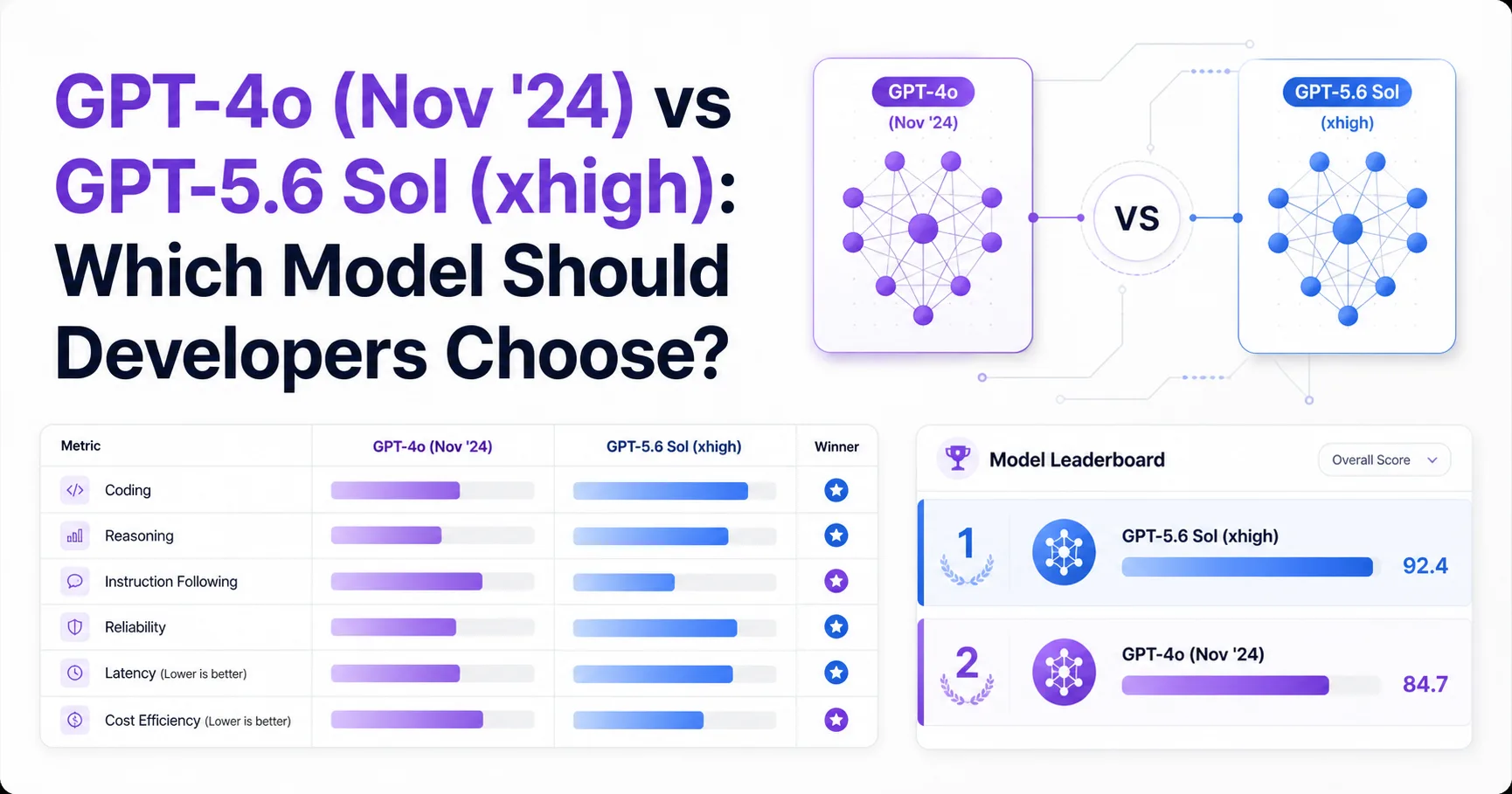
GPT-5.6 Sol (xhigh) is the stronger default for demanding development work, while GPT-4o (Nov '24) remains the lower-cost choice for simpler, high-volume workloads. The available evidence does not establish a complete apples-to-apples winner across every developer task. Artificial Analysis reports a much higher Intelligence Index for GPT-5.6 Sol (xhigh), while the official OpenAI materials position it for complex reasoning, programming, and professional work. GPT-5.6 release announcement
GPT-5.6 Sol (xhigh) offers the clearest capability advantage, but GPT-4o (Nov '24) offers the clearest cost advantage. Artificial Analysis scores GPT-5.6 Sol (xhigh) at 57.7 on its Intelligence Index and GPT-4o (Nov '24) at 11.2, a large difference that supports choosing Sol for reasoning-heavy work. Artificial Analysis model data
GPT-4o (Nov '24) costs $4.375 per 1M blended tokens, compared with $11.25 for GPT-5.6 Sol (xhigh). That makes the older model attractive for classification, extraction, drafting, and other tasks where errors are cheap and prompts are stable. The price gap matters more for output-heavy applications because the listed output prices are $10 and $30 per 1M tokens.
The models also differ in product certainty. The current OpenAI model directory does not list gpt-4o, so the supplied official material cannot confirm whether that identifier remains directly callable, has been retired, or has been replaced. The same directory lists gpt-5.6-sol as available. That availability difference should influence production planning, even before benchmark scores enter the discussion.
The evidence remains incomplete. The data provides no GPT-4o coding index, no GPT-5.6 Sol math index, no GPT-4o output-speed measurement, and no context-window values for either comparison entry. Therefore, developers should treat the recommendation as workload-specific rather than as proof that Sol dominates every metric.
GPT-5.6 Sol (xhigh) is the better candidate for tasks where reasoning quality, code planning, and tool-driven execution determine the final result. The official model page describes gpt-5.6-sol as supporting text and image input, text output, Chat Completions, Responses API, structured output, function calling, code execution, file search, web search, computer use, MCP, and other tools. GPT-5.6 Sol model page
That capability profile changes the economics of a development workflow. A model that can maintain a larger working state, call tools, and reason through multi-step changes may reduce the number of repair cycles required after the first answer. The available data supports the direction of that claim through the Intelligence Index, where Sol scores 57.7 and GPT-4o scores 11.2. It does not prove how many engineering hours either model saves on a specific repository.
GPT-4o (Nov '24) can still be the better performer in a narrow operational sense. Its measured latency is 0.3 seconds, matching GPT-5.6 Sol (xhigh) at 0.3 seconds. For short requests, equal latency and lower cost can matter more than deeper reasoning. Examples include UI copy generation, schema labeling, routine summarization, and simple transformations with strong validation around the output.
GPT-5.6 Sol (xhigh) reports a median output speed of 73.479 tokens per second, but the data provides no comparable GPT-4o value. The comparison therefore cannot establish a speed winner for streaming user experiences. It can establish a latency tie in the supplied measurement, while leaving sustained generation behavior unresolved.
The official reasoning guidance also warns that xhigh increases reasoning time and token consumption, and that a low output limit can produce an incomplete response before visible content appears. Reasoning models guide Developers should test complete task flows, not just first-token latency. Sol is also unsuitable for native audio or video input, and official materials state that it does not support fine-tuning. GPT-5.6 Sol model page
GPT-4o (Nov '24) is the clear price winner for workloads that produce acceptable answers on the first pass. Artificial Analysis lists blended pricing at $4.375 per 1M tokens for GPT-4o (Nov '24), versus $11.25 for GPT-5.6 Sol (xhigh). The lower input and output prices make GPT-4o attractive for large request volumes, especially when responses are short and failures are easy to detect. Artificial Analysis model data
The decision changes when model quality affects downstream labor. A cheaper response that needs manual review, retries, test repair, or a second model call may cost more than a single Sol request. The available data suggests this risk because Sol has a substantially higher Intelligence Index, but it does not quantify rework, review time, or task completion rates. Developers must measure those variables inside their own workflow.
GPT-5.6 Sol (xhigh) also has pricing behaviors that make prompt design important. Official pricing distinguishes standard, batch, flex, and fast modes, while the model documentation explains that reasoning tokens consume context and are billed as output tokens. OpenAI API pricing GPT-5.6 Sol model page A long repository prompt, repeated tool output, or unnecessarily high reasoning effort can therefore increase spend without improving the final artifact.
GPT-4o (Nov '24) has a different cost risk: its current official availability is unclear, and its official price is absent from the supplied OpenAI pricing directory. The $4.375 figure comes from the provided Artificial Analysis snapshot, not from the current OpenAI pricing page. That conflict means teams should verify the actual account-level route and price before committing to a long-lived integration.
The practical cost rule is simple. Use GPT-4o for validated, repetitive work with low failure cost. Use Sol where one strong attempt can replace several weaker attempts, then cap reasoning effort and output size through measured defaults.
GPT-4o (Nov '24) leads on 3 of 3 metrics
GPT-5.6 Sol (xhigh) should be the primary choice for complex coding, architecture changes, repository-level debugging, and tool-using agents. OpenAI positions it for complex reasoning and programming, and its official tool support covers the operations that make agentic development useful. GPT-5.6 release announcement GPT-5.6 Sol model page
GPT-4o (Nov '24) should be considered for high-volume tasks where latency is already equal in the supplied data and cost dominates the quality threshold. Good candidates include structured extraction, lightweight rewriting, routing, tagging, and simple code assistance. The model is especially reasonable when deterministic checks can reject weak outputs before they reach users.
A two-tier system is the strongest practical architecture when the product contains both task types. Route routine requests to GPT-4o, then escalate ambiguous, multi-step, or failed requests to GPT-5.6 Sol (xhigh). This keeps the cheaper model on the broad traffic path while reserving the more capable model for cases where reasoning quality has measurable value.
The biggest unresolved selection issue is not benchmark leadership. It is whether GPT-4o (Nov '24) is a stable production dependency. The current OpenAI model directory does not list it, and the supplied material contains no stable alias confirmation. GPT-5.6 Sol has a fixed model ID, gpt-5.6-sol, and a stable alias, gpt-5.6, according to its official model page. GPT-5.6 Sol model page
Community evidence does not resolve the gap. One Reddit report describes a successful coding task with GPT-5.6 Sol, while another reports over-engineering, excessive code, fast quota consumption, and remaining bugs. 5.6 Sol finished the feature in one prompt I spent two weeks testing GPT-5.6 These are useful hypotheses, not controlled evidence. The right final decision should come from a task set containing representative prompts, acceptance tests, retries, tool traces, and total cost.
GPT-5.6 Sol (xhigh) is the safer default when a developer needs advanced reasoning, coding support, and a currently documented production model. The official documentation gives Sol a fixed model ID, a stable alias, and a broad tool surface, while the supplied OpenAI directory does not list GPT-4o (Nov '24). GPT-5.6 Sol model page OpenAI model directory
GPT-4o (Nov '24) is the better default for cost-sensitive, repetitive workloads with strong validation. Its blended price is $4.375 per 1M tokens, compared with $11.25 for GPT-5.6 Sol (xhigh), and the supplied latency measurement is 0.3 seconds for both models. The evidence does not show whether GPT-4o remains directly callable today.
GPT-5.6 Sol (xhigh) is not automatically the better choice for every request because its reasoning mode can increase token use, latency, and cost. The official reasoning guide recommends using higher reasoning effort only when measured quality gains justify the operational tradeoff. Reasoning models guide
GPT-4o (Nov '24) cannot be declared worse for coding or math from this dataset because the comparison is incomplete. Artificial Analysis provides a coding index of 78.3 for GPT-5.6 Sol but no matching GPT-4o coding value, and a math index of 6 for GPT-4o but no matching Sol math value. Artificial Analysis model data
GPT-5.6 Sol (xhigh) is worth the higher price when stronger reasoning reduces retries, review, or debugging work, but the supplied data does not quantify those savings. Its Intelligence Index is 57.7, compared with 11.2 for GPT-4o (Nov '24), while blended pricing is $11.25 versus $4.375 per 1M tokens. Teams should validate total task cost with repository-level tests before switching all traffic.
GPT-4o (Nov '24) should be used only after confirming that its identifier remains callable and commercially available in the target account. The supplied current OpenAI model directory does not list gpt-4o, and the supplied pricing page does not list its official price. Artificial Analysis reports a blended price of $4.375 per 1M tokens, but that snapshot does not resolve current availability.
GPT-5.6 Sol (xhigh) cannot be declared faster overall because the supplied latency is 0.3 seconds for both models, while only Sol has a median output speed measurement of 73.479 tokens per second. The missing GPT-4o throughput value prevents a complete streaming comparison. Developers should test time to useful completion, not only first response latency.
GPT-5.6 Sol cannot directly replace a fine-tuned model when custom weight adaptation is required because the supplied official material states that GPT-5.6 Sol does not support fine-tuning. It may still replace some fine-tuned workflows through prompting, structured outputs, retrieval, and tools, but that substitution requires task-specific validation and does not follow from the benchmark data alone.
Developers should route requests to GPT-4o (Nov '24) when the task is repetitive, easy to validate, and sensitive to token cost rather than deep reasoning. Its blended price is $4.375 per 1M tokens, compared with $11.25 for GPT-5.6 Sol (xhigh). This routing decision should remain conditional on confirming GPT-4o availability and measuring the cost of retries or human review.