
Time to First Token · GPT-4o (Nov '24)
0ms
Time to First Token · GPT-5.6 Terra (max)
109872ms
Deep dive into reasoning, benchmarks, and latency insights.
The current catalog does not contain complete performance evidence for both models, so this page does not declare an overall winner. Use the available fields as comparison signals and validate the models on your own workload.
Key decision metrics at a glance.
| Model | Metric | Value | Unit | Source / snapshot |
|---|---|---|---|---|
| GPT-4o (Nov '24) | Reasoning | 1.0 | benchmark or capability score | Artificial Analysis · current catalog |
| GPT-5.6 Terra (max) | Reasoning | 6.0 | benchmark or capability score | Artificial Analysis · current catalog |
| GPT-4o (Nov '24) | Coding | 6.0 | benchmark or capability score | Artificial Analysis · current catalog |
| GPT-5.6 Terra (max) | Coding | 8.0 | benchmark or capability score | Artificial Analysis · current catalog |
| GPT-4o (Nov '24) | Multimodal | 1.0 | benchmark or capability score | Artificial Analysis · current catalog |
| GPT-5.6 Terra (max) | Multimodal | 5.0 | benchmark or capability score | Artificial Analysis · current catalog |
| GPT-4o (Nov '24) | Long Context | 1.0 | benchmark or capability score | Artificial Analysis · current catalog |
| GPT-5.6 Terra (max) | Long Context | 7.0 | benchmark or capability score | Artificial Analysis · current catalog |
| GPT-4o (Nov '24) | Blended Price / 1M tokens | $4.375 | USD per 1M tokens | Artificial Analysis · current catalog |
| GPT-5.6 Terra (max) | Blended Price / 1M tokens | $4.5 | USD per 1M tokens | Artificial Analysis · current catalog |
| GPT-4o (Nov '24) | P95 Latency | — | milliseconds | Artificial Analysis · current catalog |
| GPT-5.6 Terra (max) | P95 Latency | — | milliseconds | Artificial Analysis · current catalog |
| GPT-4o (Nov '24) | Tokens per second | 0 | tokens per second | Artificial Analysis · current catalog |
| GPT-5.6 Terra (max) | Tokens per second | 117.141 | tokens per second | Artificial Analysis · current catalog |
Data provided by Artificial Analysis; live values use the current catalog.
This radar chart visually maps the core capabilities (reasoning, coding, math proxy, multimodal, long context) of `GPT-4o (Nov '24)` vs `GPT-5.6 Terra (max)`.
This grouped bar chart provides a side-by-side comparison for each benchmark metric.
Lower time to first token is better; higher tokens per second is better.
Compare input and output pricing in USD per 1M tokens.
GPT-4o (Nov '24)$5
GPT-5.6 Terra (max)$5
This article is a dated snapshot published on 2026-08-07. Live cards above use the current catalog; missing live fields are not inferred.
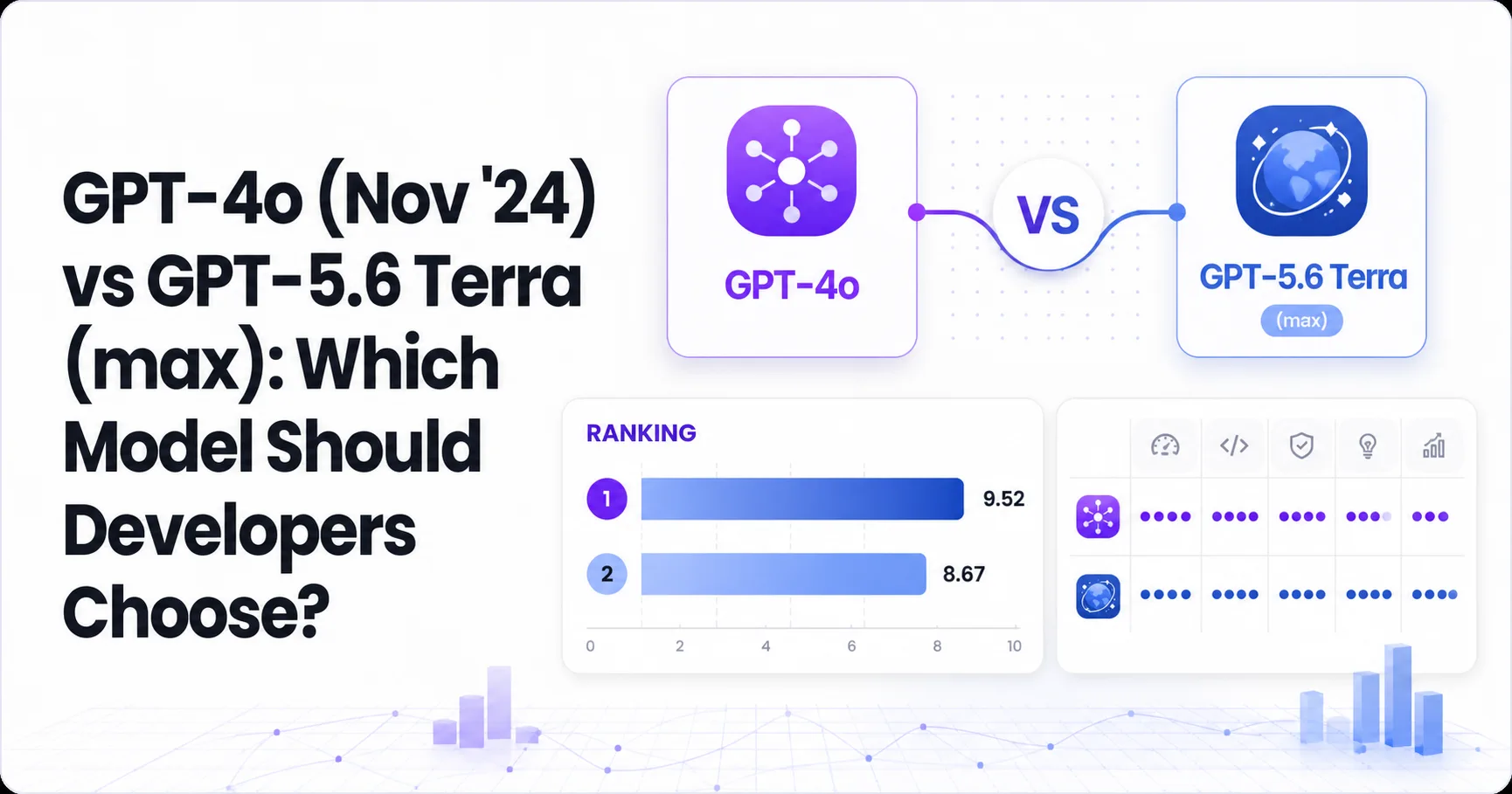
GPT-5.6 Terra (max) is the stronger default for new developer workloads because it combines a much higher measured intelligence score with documented reasoning and tool support. The Artificial Analysis Intelligence Index reports 55 for GPT-5.6 Terra (max) and 11.2 for GPT-4o (Nov '24) (Artificial Analysis data). GPT-5.6 Terra (max) also records 144.252 median output tokens per second, while the brief provides no comparable output-speed value for GPT-4o (Nov '24) (Artificial Analysis data).
GPT-4o (Nov '24) remains relevant when output pricing or an existing integration matters more than model capability evidence. Its blended price is $4.375 per 1M tokens, compared with $4.500000000000001 for GPT-5.6 Terra (max) (Artificial Analysis data). The price gap is therefore small in blended workloads, while the documented capability and lifecycle evidence is much stronger for GPT-5.6 Terra (max).
OpenAI’s current model catalogue does not list GPT-4o, so the supplied material cannot confirm whether the exact version remains directly callable, has been replaced, or is available only through an existing account configuration (OpenAI Models). GPT-5.6 Terra (max) has a documented model page and stable model ID, gpt-5.6-terra (GPT-5.6 Terra Model).
GPT-5.6 Terra (max) offers the more defensible choice for a new application, while GPT-4o (Nov '24) offers a narrow blended-cost advantage. The measured comparison shows GPT-5.6 Terra (max) at 55 on the Artificial Analysis Intelligence Index versus 11.2 for GPT-4o (Nov '24) (Artificial Analysis data). That result supports Terra for tasks where answer quality, reasoning, and reliable tool orchestration matter.
| Decision factor | GPT-4o (Nov '24) | GPT-5.6 Terra (max) |
|---|---|---|
| Blended price per 1M tokens | $4.375 | $4.500000000000001 |
| Input price per 1M tokens | $2.5 | $2 |
| Output price per 1M tokens | $10 | $12 |
| Latency | 0.3 seconds | 0.3 seconds |
| Intelligence Index | 11.2 | 55 |
| Coding Index | Not provided | 76.7 |
| Math Index | 6 | Not provided |
The table also exposes an important evidence boundary. The brief supplies a coding score only for GPT-5.6 Terra (max), and a math score only for GPT-4o (Nov '24), so it does not establish a direct winner for either coding or math (Artificial Analysis data). Developers should treat those single-model scores as signals, not head-to-head proof.
GPT-5.6 Terra (max) has documented support for text and image input, text output, structured outputs, function calling, file search, web search, and several hosted tools (GPT-5.6 Terra Model). GPT-4o’s exact current API status and version-specific feature set are not established by the supplied official material (OpenAI Models).
GPT-5.6 Terra (max) is the better-supported performance choice because the available evidence favors its intelligence and output throughput. The Artificial Analysis data reports an Intelligence Index of 55 for GPT-5.6 Terra (max), compared with 11.2 for GPT-4o (Nov '24), and reports 144.252 median output tokens per second for Terra (Artificial Analysis data). The reported latency is 0.3 seconds for each model, so the comparison does not suggest a latency advantage for either model (Artificial Analysis data).
For developers, the intelligence gap matters most in tasks that require multi-step judgment, code changes, tool selection, or constraint tracking. GPT-5.6 Terra (max) is documented as a reasoning model with structured outputs, function calling, file search, web search, and hosted development tools (GPT-5.6 Terra Model). Those features can reduce application-side coordination, although the supplied material does not provide a direct success-rate comparison against GPT-4o (Nov '24).
The speed result needs careful interpretation. A median output rate of 144.252 does not prove that a complete user request will finish sooner, because total completion time also depends on prompt size, reasoning work, tool calls, retries, and output length. The supplied data does not provide a comparable output-speed measurement for GPT-4o (Nov '24), so no fair throughput ranking can be made for that model (Artificial Analysis data).
GPT-5.6 Terra (max) also exposes reasoning controls, while the supplied GPT-4o material does not document an equivalent version-specific control surface (Reasoning models). That makes Terra easier to tune for quality and cost during a controlled pilot, but the exact best setting for a workload remains unverified.
GPT-4o (Nov '24) is cheaper on the supplied blended-token metric, but GPT-5.6 Terra (max) is cheaper for input-heavy traffic. The blended price is $4.375 for GPT-4o (Nov '24) and $4.500000000000001 for GPT-5.6 Terra (max) per 1M tokens (Artificial Analysis data). The difference is small enough that quality, retries, and engineering overhead can matter more than the listed blended price.
GPT-5.6 Terra (max) charges $2 per 1M input tokens, compared with $2.5 for GPT-4o (Nov '24), while GPT-4o (Nov '24) charges $10 per 1M output tokens, compared with $12 for Terra (Artificial Analysis data). Input-heavy applications such as document classification, retrieval orchestration, and repository analysis may therefore favor Terra on raw input spend. Output-heavy applications such as long-form generation may favor GPT-4o on output price, provided its availability and quality meet the requirement.
The blended result can reverse when a workload produces more output than the assumed mix. A 3-to-1 blended metric is useful for comparison, but it cannot represent every application’s token distribution (Artificial Analysis data). Developers should measure prompt tokens, visible output tokens, reasoning tokens, tool calls, and retries separately before making a production decision.
GPT-5.6 Terra (max) has an additional long-context cost boundary: requests above 272K input tokens receive higher input and output pricing (GPT-5.6 Terra Model). The supplied GPT-4o material does not provide a comparable current context or pricing policy, so the cost advantage for large prompts cannot be established. Terra’s max_output_tokens also covers reasoning and visible output, which can create incomplete responses if set too low (Reasoning models).
GPT-4o (Nov '24) leads on 2 of 3 metrics
GPT-5.6 Terra (max) should be the default pilot for new applications that need reasoning, coding workflows, or managed tools. The measured Intelligence Index is 55 for Terra versus 11.2 for GPT-4o (Nov '24), and Terra has a reported Coding Index of 76.7 (Artificial Analysis data). The coding result is not a direct comparison because the brief does not provide GPT-4o’s coding score, but it is still a relevant signal for a developer evaluating Terra.
Choose GPT-5.6 Terra (max) when the application needs a documented current model ID, Responses API support, structured outputs, function calling, file search, web search, or hosted development tools (GPT-5.6 Terra Model). Terra is also the more practical candidate for long-context experiments because its official page documents a context window and input limit, although the supplied GPT-4o material does not provide a comparable value (GPT-5.6 Terra Model).
Choose GPT-4o (Nov '24) only when an existing production integration already depends on it, output-heavy traffic makes its $10 output price valuable, or validation shows that its responses satisfy the workload at lower operational cost (Artificial Analysis data). OpenAI’s current model directory and pricing page do not list the exact model, so a new integration should verify account-level availability before committing to it (OpenAI Models; OpenAI Pricing).
The final choice should remain a measured rollout decision. The supplied research finds no reliable public community discussion for either exact model version, no Terra-specific official benchmark suite, and no comparable coding or math results for both models (GPT-5.6 Terra Model; Artificial Analysis data). A small replay set should therefore test correctness, tool-call reliability, refusal behavior, latency, and token mix before production migration.
GPT-5.6 Terra (max) is the safer starting point for a new integration because its model identity, API surface, and current product placement are documented. OpenAI lists Terra in its model documentation and describes it as a model balancing intelligence and cost (GPT-5.6 Terra Model; Models). GPT-4o (Nov '24) is absent from the supplied current model catalogue, so availability requires direct verification (OpenAI Models).
GPT-4o (Nov '24) may still be preferable for output-heavy workloads because its listed output price is $10 per 1M tokens, compared with $12 for GPT-5.6 Terra (max) (Artificial Analysis data). That price advantage does not settle the decision if weaker answers create retries, manual review, or application-side work.
GPT-5.6 Terra (max) should not be selected solely from the coding score because GPT-4o (Nov '24) has no corresponding coding score in the supplied data. The available evidence reports Terra at 76.7 on the Coding Index, but it does not establish a head-to-head result (Artificial Analysis data).
GPT-4o (Nov '24) cannot be judged as the math winner from the supplied data because only GPT-4o has a reported Math Index of 6. GPT-5.6 Terra (max) has no corresponding math value in the brief, so the evidence is insufficient for a direct math comparison (Artificial Analysis data).
GPT-5.6 Terra (max) is the stronger default for new developer workloads because it scores 55 versus 11.2 on the supplied Intelligence Index and has documented reasoning, structured outputs, function calling, and tool support (Artificial Analysis data; GPT-5.6 Terra Model).
GPT-4o (Nov '24) is cheaper on blended pricing at $4.375 per 1M tokens versus $4.500000000000001 for GPT-5.6 Terra (max), while Terra is cheaper on input tokens at $2 versus $2.5 (Artificial Analysis data).
GPT-5.6 Terra (max) is the only model with a supplied median output-speed measurement, at 144.252 tokens per second, while both models have reported latency of 0.3 seconds (Artificial Analysis data).
GPT-4o (Nov '24) requires an availability check before a new integration because the current OpenAI model catalogue and pricing page supplied for this comparison do not list the exact model (OpenAI Models; OpenAI Pricing).
GPT-5.6 Terra (max) has a reported Coding Index of 76.7, while GPT-4o (Nov '24) has a reported Math Index of 6, but the brief lacks matching scores for direct coding and math comparisons (Artificial Analysis data).