
Time to First Token · GPT-4o (Nov '24)
0ms
Time to First Token · GPT-5.6 Terra (xhigh)
8782ms
Deep dive into reasoning, benchmarks, and latency insights.
The current catalog does not contain complete performance evidence for both models, so this page does not declare an overall winner. Use the available fields as comparison signals and validate the models on your own workload.
Key decision metrics at a glance.
| Model | Metric | Value | Unit | Source / snapshot |
|---|---|---|---|---|
| GPT-4o (Nov '24) | Reasoning | 1.0 | benchmark or capability score | Artificial Analysis · current catalog |
| GPT-5.6 Terra (xhigh) | Reasoning | 6.0 | benchmark or capability score | Artificial Analysis · current catalog |
| GPT-4o (Nov '24) | Coding | 6.0 | benchmark or capability score | Artificial Analysis · current catalog |
| GPT-5.6 Terra (xhigh) | Coding | 7.0 | benchmark or capability score | Artificial Analysis · current catalog |
| GPT-4o (Nov '24) | Multimodal | 1.0 | benchmark or capability score | Artificial Analysis · current catalog |
| GPT-5.6 Terra (xhigh) | Multimodal | 4.0 | benchmark or capability score | Artificial Analysis · current catalog |
| GPT-4o (Nov '24) | Long Context | 1.0 | benchmark or capability score | Artificial Analysis · current catalog |
| GPT-5.6 Terra (xhigh) | Long Context | 7.0 | benchmark or capability score | Artificial Analysis · current catalog |
| GPT-4o (Nov '24) | Blended Price / 1M tokens | $4.375 | USD per 1M tokens | Artificial Analysis · current catalog |
| GPT-5.6 Terra (xhigh) | Blended Price / 1M tokens | $4.5 | USD per 1M tokens | Artificial Analysis · current catalog |
| GPT-4o (Nov '24) | P95 Latency | — | milliseconds | Artificial Analysis · current catalog |
| GPT-5.6 Terra (xhigh) | P95 Latency | — | milliseconds | Artificial Analysis · current catalog |
| GPT-4o (Nov '24) | Tokens per second | 0 | tokens per second | Artificial Analysis · current catalog |
| GPT-5.6 Terra (xhigh) | Tokens per second | 115.448 | tokens per second | Artificial Analysis · current catalog |
Data provided by Artificial Analysis; live values use the current catalog.
This radar chart visually maps the core capabilities (reasoning, coding, math proxy, multimodal, long context) of `GPT-4o (Nov '24)` vs `GPT-5.6 Terra (xhigh)`.
This grouped bar chart provides a side-by-side comparison for each benchmark metric.
Lower time to first token is better; higher tokens per second is better.
Compare input and output pricing in USD per 1M tokens.
GPT-4o (Nov '24)$5
GPT-5.6 Terra (xhigh)$5
This article is a dated snapshot published on 2026-08-07. Live cards above use the current catalog; missing live fields are not inferred.
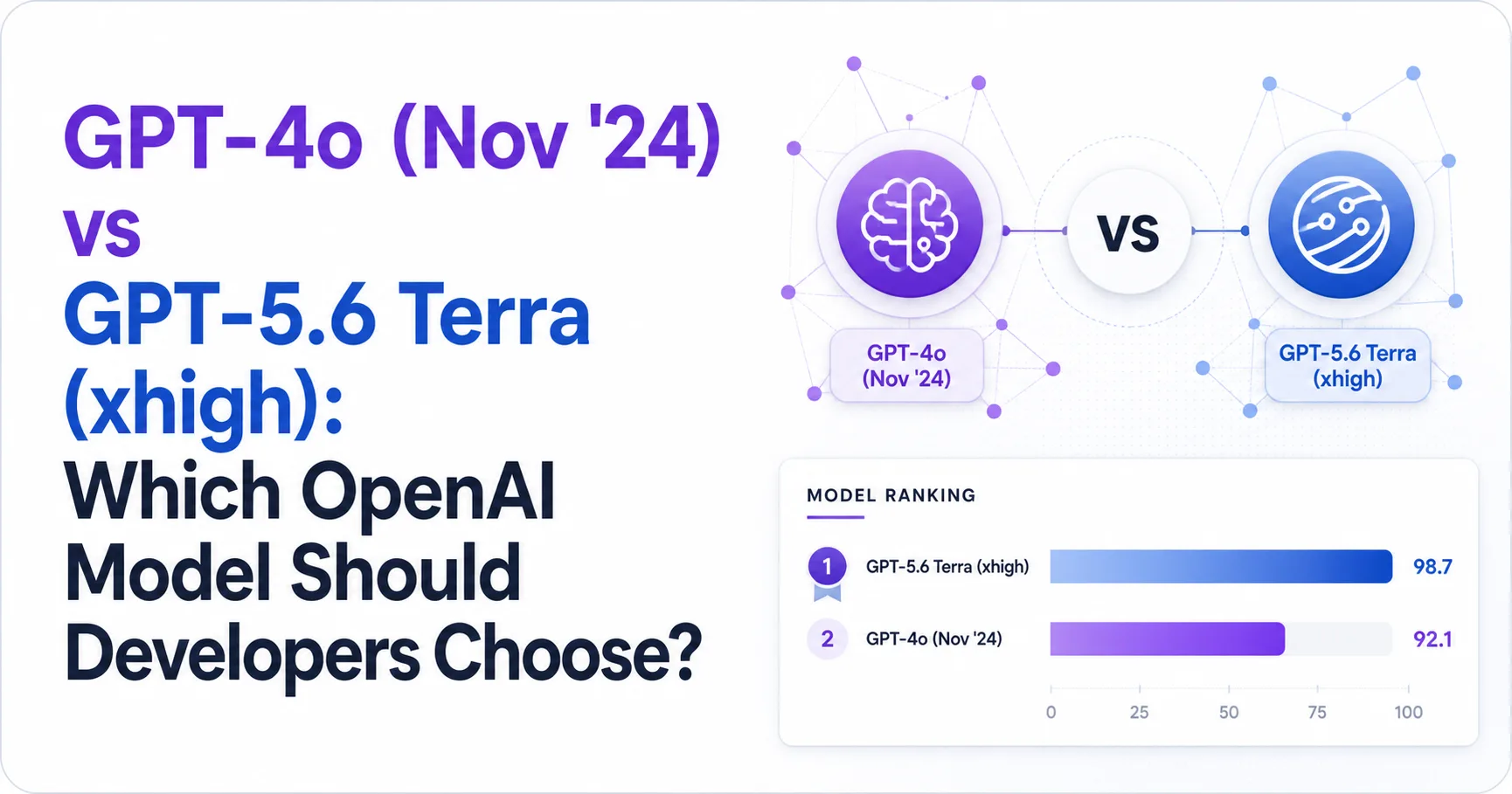
GPT-5.6 Terra (xhigh) is the stronger default for new developer workloads, while GPT-4o (Nov '24) remains attractive for teams optimizing blended-token cost. Artificial Analysis gives GPT-5.6 Terra (xhigh) an Intelligence Index of 51.6, compared with 11.2 for GPT-4o (Nov '24), and reports 121.137 median output tokens per second for GPT-5.6 Terra (xhigh). GPT-4o (Nov '24) costs $4.375 per 1M blended tokens, compared with $4.500000000000001 for GPT-5.6 Terra (xhigh). The practical decision depends on whether your workload rewards stronger reasoning and coding or prioritizes the lowest blended price. Data provided by Artificial Analysis.
GPT-5.6 Terra (xhigh) offers the clearer capability advantage, but GPT-4o (Nov '24) has the lower blended-token price and cheaper output tokens. The measured Intelligence Index is 51.6 for GPT-5.6 Terra (xhigh) and 11.2 for GPT-4o (Nov '24), which makes Terra the more compelling candidate for difficult analysis, planning, and software work. Artificial Analysis does not provide a comparable coding score for GPT-4o (Nov '24), so the available coding evidence cannot establish a complete head-to-head result. It also does not provide a comparable math score for GPT-5.6 Terra (xhigh).\n\nThe commercial difference is narrow at the blended level. GPT-4o (Nov '24) is priced at $4.375 per 1M blended tokens, while GPT-5.6 Terra (xhigh) is priced at $4.500000000000001. That small blended difference can hide a larger workload-specific difference because GPT-4o (Nov '24) has an output price of $10, while GPT-5.6 Terra (xhigh) has an output price of $12. GPT-5.6 Terra (xhigh) has the lower input price at $2, compared with $2.5 for GPT-4o (Nov '24).\n\nThe product-status evidence favors Terra for new integrations. The GPT-5.6 Terra model page presents a current model ID with documented API support, while the current OpenAI Models directory does not list GPT-4o. That absence does not prove that GPT-4o (Nov '24) is unavailable, retired, or replaced, but it creates a verification task for any new production dependency.
GPT-5.6 Terra (xhigh) is the better measured choice for quality-sensitive workloads, with a large Intelligence Index lead and reported output speed. The Intelligence Index is 51.6 for GPT-5.6 Terra (xhigh) and 11.2 for GPT-4o (Nov '24). That gap is large enough to change the economics of an application when model mistakes trigger human review, retries, tool calls, or failed downstream actions. A cheaper request is not necessarily cheaper work if it produces less usable output.\n\nGPT-5.6 Terra (xhigh) also records 121.137 median output tokens per second, while the brief reports no comparable output-speed value for GPT-4o (Nov '24). The missing GPT-4o measurement prevents a complete speed ranking. Both models show 0.3 seconds of reported latency in the dataset, so the available evidence does not suggest a latency advantage for either model. Developers should separate time to first response from sustained generation speed before making an interactive product decision.\n\nThe xhigh setting needs workload-specific validation. OpenAI describes xhigh as a reasoning-effort parameter for GPT-5.6 rather than a separate model ID in the model parameter migration guide. The same guide advises using higher reasoning effort when it creates measurable quality gains. That means a benchmark result for GPT-5.6 Terra (xhigh) should not automatically justify xhigh for every request class. Simple extraction, classification, and short transformations may not need the same reasoning setting.\n\nThe evidence boundary matters. Artificial Analysis reports no GPT-4o coding score and no GPT-5.6 Terra math score, so this comparison cannot prove that Terra wins every coding or mathematical workload. Teams should run representative prompts, tool traces, error checks, and human review measurements before replacing a stable workflow.
GPT-4o (Nov '24) is cheaper on blended tokens, but GPT-5.6 Terra (xhigh) is cheaper on input tokens and may be economically safer when better answers reduce rework. The blended prices are $4.375 for GPT-4o (Nov '24) and $4.500000000000001 for GPT-5.6 Terra (xhigh). That difference is small in a workload dominated by balanced input and output usage. It becomes less informative when the application has a strongly asymmetric token pattern.\n\nGPT-4o (Nov '24) has the lower output price at $10 versus $12 for GPT-5.6 Terra (xhigh). This favors long-form generation, large structured responses, and workflows where output tokens dominate. GPT-5.6 Terra (xhigh) has the lower input price at $2 versus $2.5. This favors retrieval-heavy prompts, repository analysis, document context, and repeated instructions where the input side is the larger cost driver.\n\nThe price chart cannot show the cost of failure. If GPT-4o (Nov '24) requires more retries, manual correction, or post-processing, its lower blended price may not produce the lower cost per accepted result. Conversely, if GPT-5.6 Terra (xhigh) is used for simple requests that do not benefit from higher reasoning effort, its capability premium may be wasted. The right unit for budgeting is accepted task, not request.\n\nOpenAI documents prompt caching, Batch API, and multiple service modes for GPT-5.6 Terra on the pricing page. Those options can change the operational cost profile, but the supplied Artificial Analysis comparison does not provide equivalent GPT-4o pricing details for every service mode. Do not treat Terra's standard comparison price as a complete estimate for a batch or caching-heavy architecture.
GPT-4o (Nov '24) leads on 2 of 3 metrics
GPT-5.6 Terra (xhigh) has a clearer current API identity, while GPT-4o (Nov '24) carries unresolved availability risk. The stable API model ID documented by OpenAI is gpt-5.6-terra; xhigh belongs in reasoning.effort, not in the model ID. The GPT-5.6 Terra model page documents the model and its supported interfaces. The OpenAI Models directory currently lists Terra but does not list gpt-4o.\n\nThat directory gap is not proof that GPT-4o (Nov '24) cannot be called. The research brief found no stable alias statement, dedicated version announcement, or current official price listing for that GPT-4o variant. The correct conclusion is uncertainty, not confirmed retirement. Teams considering GPT-4o should verify account-level availability, model routing, replacement behavior, and deprecation notices before committing to it as a new dependency.\n\nThe general gpt-5.6 alias should not be treated as a Terra alias because OpenAI's migration guide states that the alias routes to gpt-5.6-sol. Pin Terra explicitly when Terra is the intended model. OpenAI's deprecations documentation also belongs in the launch checklist, even though the supplied research found no evidence that Terra has been deprecated.
GPT-5.6 Terra (xhigh) offers the stronger documented tool surface, but deployment location can change the available capabilities. The GPT-5.6 Terra model page lists Responses API, Chat Completions API, Batch API, streaming, structured outputs, function calling, file search, image input, web search, prompt caching, and additional tools. That breadth makes Terra a better fit for agentic systems and applications that need structured interaction with external tools.\n\nThe capability list should not be copied directly into every hosting plan. OpenAI's Amazon Bedrock support guide documents deployment differences for Terra, including unavailable hosted file search, remote MCP servers, computer use, and image generation in that path. Bedrock billing may also follow AWS pricing rather than the direct API price.\n\nGPT-4o (Nov '24) cannot be evaluated fairly on tool breadth from the supplied official material because the current model documentation does not provide a dedicated version profile. The absence of evidence is especially important for teams migrating an existing integration. Confirm the exact endpoint, tool availability, structured-output behavior, and failure handling in the deployment path you will operate.
GPT-5.6 Terra (xhigh) is the recommended default for new, quality-sensitive systems, while GPT-4o (Nov '24) is best considered for cost-sensitive workloads with verified access. Terra's Intelligence Index of 51.6, reported 121.137 median output tokens per second, documented current model ID, and broader published tool surface give it the stronger starting position for coding assistants, complex planning, agent workflows, and tasks where wrong answers create operational cost.\n\nChoose GPT-4o (Nov '24) when output-heavy traffic makes the $10 output price important, when the existing application already depends on a verified GPT-4o deployment, or when your own acceptance tests show equivalent task quality. Its blended price of $4.375 is lower than Terra's $4.500000000000001, but that advantage is meaningful only if the model's correction and retry rate remains acceptable.\n\nChoose GPT-5.6 Terra (xhigh) when input-heavy context is central, since its input price is $2 compared with GPT-4o's $2.5. Use gpt-5.6-terra with reasoning.effort: "xhigh", then test whether the setting produces measurable gains for each request class.\n\nThe final choice remains partly unresolved because the benchmark matrix is incomplete. There is no comparable GPT-4o coding score, no comparable Terra math score, and no reliable community evidence for either exact version. A production decision should therefore combine the supplied measurements with a small acceptance suite built from the application's real prompts and tool calls.
GPT-5.6 Terra (xhigh) should be piloted against accepted-task outcomes before a production migration. Track correctness, retry rate, review time, tool-call success, output volume, and cost per accepted result. GPT-4o (Nov '24) should be checked for account availability and lifecycle status because the current official model directory does not list it. Keep the model ID and reasoning parameter separate, and test the actual hosting route because tool support can vary between direct OpenAI access and Bedrock. The supplied research contains no reliable community failure reports for either exact model, so internal evidence should carry more weight than informal reputation.
GPT-5.6 Terra (xhigh) is the stronger general recommendation because its Intelligence Index is 51.6 versus 11.2, its API identity is documented, and its published tool surface is broader. The comparison still cannot prove universal superiority because GPT-4o has no comparable coding score and Terra has no comparable math score in the supplied data.
GPT-4o (Nov '24) is cheaper on blended tokens at $4.375 versus $4.500000000000001 per 1M blended tokens, and its output price is $10 versus Terra's $12. GPT-5.6 Terra (xhigh) is cheaper on input tokens at $2 versus GPT-4o's $2.5, so workload composition determines the practical winner.
GPT-5.6 Terra (xhigh) is the only model with a reported median output speed, at 121.137 tokens per second, while both models have reported latency of 0.3 seconds. Because GPT-4o lacks a comparable output-speed measurement, the supplied evidence cannot establish a complete speed ranking.
Developers should use gpt-5.6-terra as the model ID and set reasoning.effort to xhigh. OpenAI's migration guide treats xhigh as a reasoning parameter, and the supplied research found no official gpt-5-6-terra-xhigh API model ID.
GPT-4o (Nov '24) is not safe to assume as a new production dependency until account availability and lifecycle status are verified. The current OpenAI model directory does not list gpt-4o, but that absence does not prove retirement, replacement, or universal unavailability.
GPT-4o (Nov '24) can become more expensive per accepted task when weaker results cause retries, manual review, correction, or downstream failures. Its lower blended price helps only when the application maintains an acceptable success rate and does not spend more operational effort repairing outputs.