
Time to First Token · GPT-4o (Nov '24)
0ms
Time to First Token · Kimi K3 (max)
2585ms
Deep dive into reasoning, benchmarks, and latency insights.
The current catalog does not contain complete performance evidence for both models, so this page does not declare an overall winner. Use the available fields as comparison signals and validate the models on your own workload.
Key decision metrics at a glance.
| Model | Metric | Value | Unit | Source / snapshot |
|---|---|---|---|---|
| GPT-4o (Nov '24) | Reasoning | 1.0 | benchmark or capability score | Artificial Analysis · current catalog |
| Kimi K3 (max) | Reasoning | 6.0 | benchmark or capability score | Artificial Analysis · current catalog |
| GPT-4o (Nov '24) | Coding | 6.0 | benchmark or capability score | Artificial Analysis · current catalog |
| Kimi K3 (max) | Coding | 8.0 | benchmark or capability score | Artificial Analysis · current catalog |
| GPT-4o (Nov '24) | Multimodal | 1.0 | benchmark or capability score | Artificial Analysis · current catalog |
| Kimi K3 (max) | Multimodal | 5.0 | benchmark or capability score | Artificial Analysis · current catalog |
| GPT-4o (Nov '24) | Long Context | 1.0 | benchmark or capability score | Artificial Analysis · current catalog |
| Kimi K3 (max) | Long Context | 7.0 | benchmark or capability score | Artificial Analysis · current catalog |
| GPT-4o (Nov '24) | Blended Price / 1M tokens | $4.375 | USD per 1M tokens | Artificial Analysis · current catalog |
| Kimi K3 (max) | Blended Price / 1M tokens | $6 | USD per 1M tokens | Artificial Analysis · current catalog |
| GPT-4o (Nov '24) | P95 Latency | — | milliseconds | Artificial Analysis · current catalog |
| Kimi K3 (max) | P95 Latency | — | milliseconds | Artificial Analysis · current catalog |
| GPT-4o (Nov '24) | Tokens per second | 0 | tokens per second | Artificial Analysis · current catalog |
| Kimi K3 (max) | Tokens per second | 38.637 | tokens per second | Artificial Analysis · current catalog |
Data provided by Artificial Analysis; live values use the current catalog.
This radar chart visually maps the core capabilities (reasoning, coding, math proxy, multimodal, long context) of `GPT-4o (Nov '24)` vs `Kimi K3 (max)`.
This grouped bar chart provides a side-by-side comparison for each benchmark metric.
Lower time to first token is better; higher tokens per second is better.
Compare input and output pricing in USD per 1M tokens.
GPT-4o (Nov '24)$5
Kimi K3 (max)$6.75
GPT-4o (Nov '24) costs $1.75 less per run
This article is a dated snapshot published on 2026-08-07. Live cards above use the current catalog; missing live fields are not inferred.
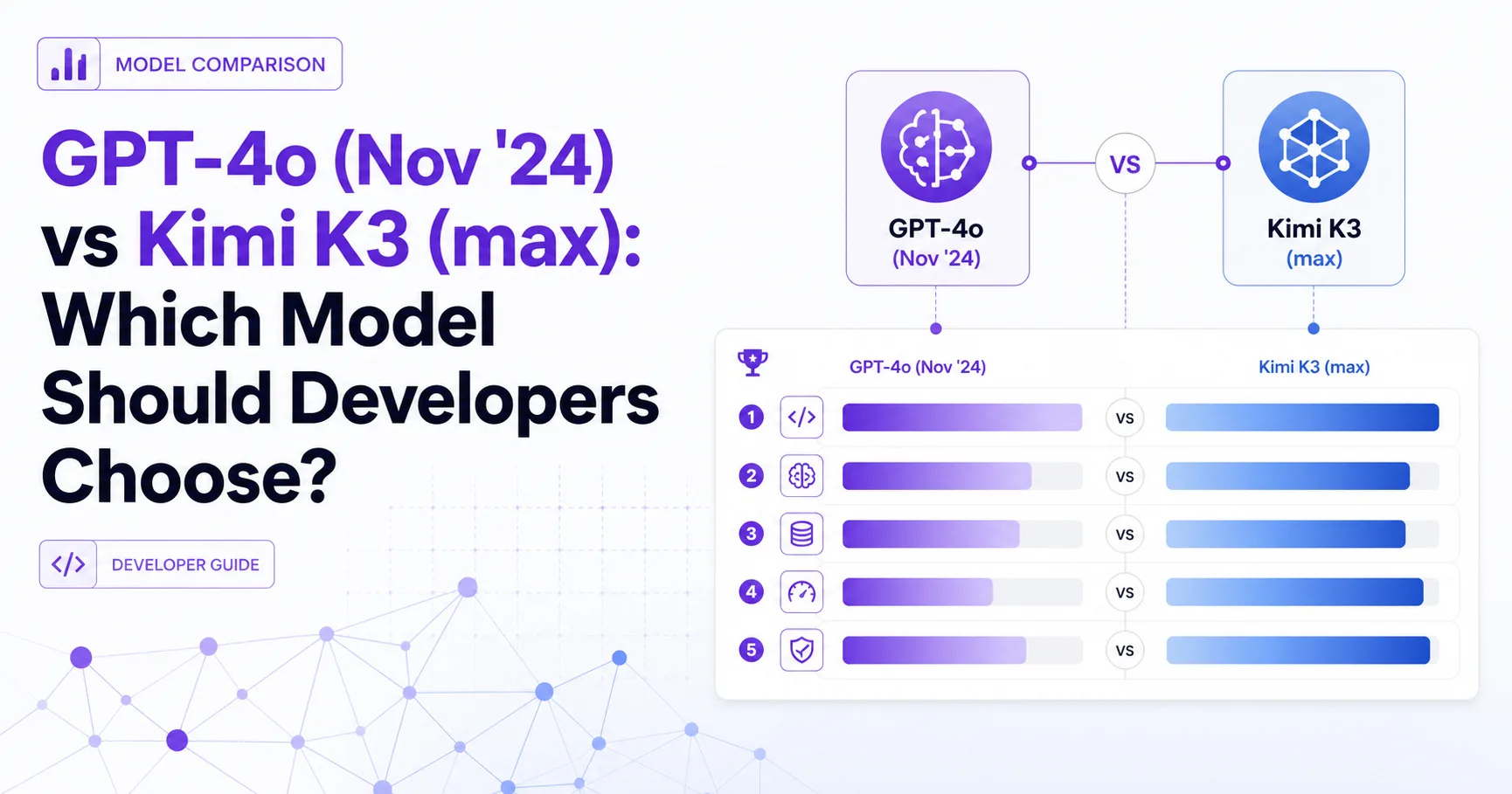
GPT-4o (Nov '24) is cheaper and equally fast on reported latency, while Kimi K3 (max) offers substantially stronger documented capability evidence for demanding development work.
The comparison has an important asymmetry. GPT-4o appears in the supplied Artificial Analysis snapshot with a release date of 2024-11-20, prices, latency, and evaluation values. However, the current OpenAI model directory does not list gpt-4o, and the current OpenAI pricing directory does not list its prices. That creates uncertainty about whether the snapshot describes a directly callable model, a historical entry, or a version that has been replaced.
Kimi K3 (max) has a clearer current API identity. The official API model name is kimi-k3, and max refers to the reasoning_effort setting rather than a separate model. Kimi also documents a very large context window, native vision, tool calls, structured output, and agent-oriented controls through its technical overview and Quickstart.
For a new application, the choice is therefore not simply quality versus price. It is documented capability and current operability versus lower measured cost with unresolved lifecycle status.
Kimi K3 (max) is the stronger documented choice for complex reasoning and agentic coding, while GPT-4o (Nov '24) remains attractive for predictable cost if its availability is confirmed.
The supplied benchmark snapshot gives Kimi K3 (max) an Artificial Analysis Intelligence Index of 57.1, compared with 11.2 for GPT-4o (Nov '24). That gap is large enough to change model routing decisions for tasks involving planning, multi-step analysis, or autonomous tool use. The snapshot also reports Kimi K3 coding data at 76.2, while GPT-4o has no corresponding coding value. GPT-4o has a math value of 6, while Kimi K3 has no corresponding math value. Those missing cells prevent a complete capability ranking.
| Decision factor | Better-supported choice | Why it matters |
|---|---|---|
| General intelligence evidence | Kimi K3 (max) | The available index is 57.1 versus 11.2 |
| Coding evidence | Kimi K3 (max) | Kimi has a reported coding index of 76.2; GPT-4o has no reported value |
| Math evidence | Unresolved | GPT-4o has a reported value of 6; Kimi K3 has no reported value |
| Blended token cost | GPT-4o (Nov '24) | The snapshot lists $4.375 versus $6 per 1M blended tokens |
| Current API identity | Kimi K3 (max) | kimi-k3 appears in the current Kimi model list |
| Version certainty | Kimi K3 (max) | OpenAI's current directory does not list GPT-4o |
Data provided by https://artificialanalysis.ai/
Kimi K3 (max) has the stronger available performance evidence, but the evidence does not establish a universal winner for every developer workload.
The Artificial Analysis snapshot reports a median output speed of 34.453 tokens per second for Kimi K3 (max). GPT-4o has no reported output-speed value in the snapshot. That missing measurement matters because interactive coding depends on more than model intelligence. A developer waiting for a patch, explanation, or tool decision experiences the combination of request latency, generated length, streaming behavior, and downstream tool time.
Reported latency is 0.3 seconds for each model. The equal figure suggests that neither model has a measured first-response disadvantage in this dataset. It does not prove equal user experience. Kimi's always-on reasoning mode can produce more internal work before a useful answer, while GPT-4o's unavailable output-speed value prevents a direct streaming comparison. The supplied materials do not provide a version-specific GPT-4o context window, output limit, or benchmark methodology.
Kimi's published capability profile is better aligned with long-running development agents. The official Kimi K3 technical blog reports DeepSWE at 67.3 with the Kimi Code harness and BrowseComp at 90.4 under a 1M-context setup. Those results are useful signals, not isolated model-only guarantees, because the blog states that evaluations use different agent harnesses.
The practical conclusion is narrow. Choose Kimi for agent loops, long code context, and tool orchestration when your harness preserves the required reasoning history. Treat GPT-4o as an open performance question until a current endpoint and comparable speed data are verified.
GPT-4o (Nov '24) is the lower-priced option in the supplied snapshot, but Kimi K3 (max) can justify its premium when stronger task completion reduces retries and human intervention.
The snapshot lists GPT-4o at $4.375 per 1M blended tokens and Kimi K3 (max) at $6. It also lists input prices of $2.5 and $3, and output prices of $10 and $15, respectively. The page charts can show those differences directly. The more important selection question is how your workload converts tokens into completed work.
A cheaper model becomes expensive when it needs repeated prompts, correction passes, additional routing, or manual review. That risk is most relevant for repository-wide changes, difficult debugging, and tasks where the model must preserve a long chain of decisions. Kimi's official materials position K3 for long-cycle coding and knowledge work, with a 1,048,576-token context window and automatic context caching. Its pricing page lists cached-input pricing at $0.30 per 1M tokens, uncached input at $3, and output at $15.
The supplied evidence does not provide enough information to calculate total cost per successful task. There is no comparable completion-rate study, retry rate, average response length, or production throughput measurement for these two exact versions. The Reddit report on Kimi K3 with Hermes describes substantial progress on a hardware project, but the task reached a token limit and required manual review. It is an anecdote, not a cost benchmark.
Use GPT-4o for high-volume, price-sensitive traffic only after confirming that the endpoint is available. Use Kimi when fewer failed iterations matter more than the lower sticker price.
GPT-4o (Nov '24) leads on 3 of 3 metrics
Kimi K3 (max) is the better default for new developer agents, while GPT-4o (Nov '24) fits controlled workloads that prioritize price and have a verified OpenAI deployment path.
Choose Kimi K3 (max) for repository-scale coding, long technical documents, structured tool workflows, and tasks that need explicit reasoning control. The Kimi K3 Quickstart documents JSON Mode, JSON Schema output, tool calls, tool_choice, dynamic tool loading, Partial Mode, and the reasoning_effort settings low, high, and max. These controls reduce integration ambiguity for agent builders.
Kimi requires careful harness design. The official Kimi K3 technical blog warns that output quality can become unstable when a harness does not return the full reasoning history or when a session switches from another model into K3. The same source describes K3 as highly proactive, which can cause unintended decisions when user intent is unclear. Strong system instructions and repository-level AGENTS.md rules are therefore part of the deployment design, not optional polish.
Choose GPT-4o for short conversational tasks, cost-sensitive classification, or an existing OpenAI integration where migration cost is high and the exact endpoint has been confirmed. The supplied OpenAI model documentation only provides general current-model guidance. It does not confirm GPT-4o-specific limits, aliases, or version behavior.
Do not select either model solely from the benchmark table. Run your own task set with representative repositories, tool traces, context lengths, and human-review criteria. The supplied materials do not establish Kimi's stable average speed, GPT-4o's current callable status, or a comparable success rate.
GPT-4o (Nov '24) and Kimi K3 (max) cannot be compared fairly on every capability because the supplied evidence contains important missing measurements.
The most consequential gap concerns GPT-4o's present status. The current OpenAI directory does not list gpt-4o, and the current pricing directory does not list a GPT-4o price. The data snapshot still includes a historical release date, latency, prices, and selected evaluations. Developers should treat those values as snapshot evidence, not automatic proof of current availability.
The second gap concerns benchmark coverage. Kimi has a coding index and general intelligence index, while GPT-4o has no coding value in the snapshot. GPT-4o has a math value, while Kimi has no math value. Missing values are not zeroes, and they should not be converted into a ranking.
The third gap concerns context limits. Kimi documents a 1,048,576-token context window and a maximum completion setting of 1,048,576. The supplied official OpenAI sources do not provide equivalent GPT-4o-specific values. A long-context selection therefore favors Kimi on documented capability, but not necessarily on independently verified task quality.
Kimi's web search is another deployment concern. The official Quickstart says the feature is being updated and is not currently recommended for production workflows. Teams that need web retrieval should isolate that capability behind a replaceable interface.
Choose Kimi K3 (max) for a new coding agent when long context, tool calls, structured output, and stronger documented coding evidence matter more than the lower token price. Confirm harness compatibility first.
The supplied evidence cannot confirm current GPT-4o availability because the current OpenAI model directory does not list gpt-4o, while the data snapshot still contains historical pricing and evaluation values.
GPT-4o (Nov '24) is cheaper in the supplied snapshot at $4.375 per 1M blended tokens versus $6 for Kimi K3 (max), but total task cost remains unproven without completion and retry data.
Kimi K3 (max) refers to the kimi-k3 API model running with reasoning_effort set to max; the official Quickstart does not describe kimi-k3-max as an independent model name.
Kimi K3 should not currently replace a production web-search service because the official Quickstart says its web search feature is being updated and is not recommended for production workflows.
The comparison is incomplete because GPT-4o has no reported coding index or output-speed value, while Kimi K3 has no reported math index, so missing measurements cannot support a complete ranking.