
Time to First Token · GPT-5.3 Codex (xhigh)
43466ms
Time to First Token · GPT-5 nano (high)
0ms
Deep dive into reasoning, benchmarks, and latency insights.
The current catalog does not contain complete performance evidence for both models, so this page does not declare an overall winner. Use the available fields as comparison signals and validate the models on your own workload.
Key decision metrics at a glance.
| Model | Metric | Value | Unit | Source / snapshot |
|---|---|---|---|---|
| GPT-5.3 Codex (xhigh) | Reasoning | 6.0 | benchmark or capability score | Artificial Analysis · current catalog |
| GPT-5 nano (high) | Reasoning | 8.0 | benchmark or capability score | Artificial Analysis · current catalog |
| GPT-5.3 Codex (xhigh) | Coding | 6.0 | benchmark or capability score | Artificial Analysis · current catalog |
| GPT-5 nano (high) | Coding | 6.0 | benchmark or capability score | Artificial Analysis · current catalog |
| GPT-5.3 Codex (xhigh) | Multimodal | 4.0 | benchmark or capability score | Artificial Analysis · current catalog |
| GPT-5 nano (high) | Multimodal | 2.0 | benchmark or capability score | Artificial Analysis · current catalog |
| GPT-5.3 Codex (xhigh) | Long Context | 6.0 | benchmark or capability score | Artificial Analysis · current catalog |
| GPT-5 nano (high) | Long Context | 3.0 | benchmark or capability score | Artificial Analysis · current catalog |
| GPT-5.3 Codex (xhigh) | Blended Price / 1M tokens | $4.813 | USD per 1M tokens | Artificial Analysis · current catalog |
| GPT-5 nano (high) | Blended Price / 1M tokens | $0.138 | USD per 1M tokens | Artificial Analysis · current catalog |
| GPT-5.3 Codex (xhigh) | P95 Latency | — | milliseconds | Artificial Analysis · current catalog |
| GPT-5 nano (high) | P95 Latency | — | milliseconds | Artificial Analysis · current catalog |
| GPT-5.3 Codex (xhigh) | Tokens per second | 132.294 | tokens per second | Artificial Analysis · current catalog |
| GPT-5 nano (high) | Tokens per second | 0 | tokens per second | Artificial Analysis · current catalog |
Data provided by Artificial Analysis; live values use the current catalog.
This radar chart visually maps the core capabilities (reasoning, coding, math proxy, multimodal, long context) of `GPT-5.3 Codex (xhigh)` vs `GPT-5 nano (high)`.
This grouped bar chart provides a side-by-side comparison for each benchmark metric.
Lower time to first token is better; higher tokens per second is better.
Compare input and output pricing in USD per 1M tokens.
GPT-5.3 Codex (xhigh)$5.25
GPT-5 nano (high)$0.15
GPT-5 nano (high) costs $5.1 less per run
This article is a dated snapshot published on 2026-08-07. Live cards above use the current catalog; missing live fields are not inferred.
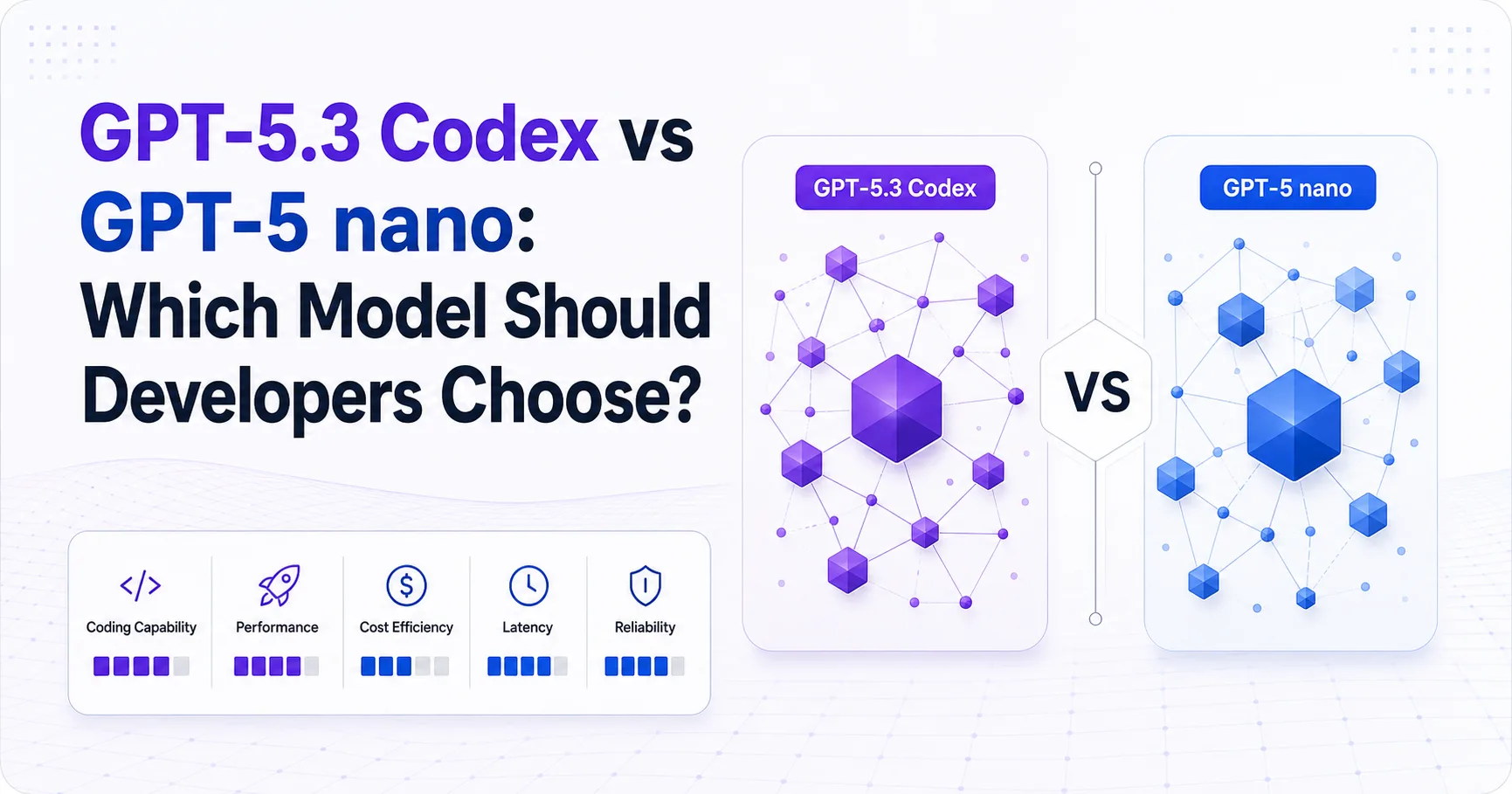
GPT-5.3 Codex is the safer primary choice for coding workflows, while GPT-5 nano is the cheaper option with materially greater availability risk. OpenAI places gpt-5.3-codex in its specialized Codex model category, which supports a coding-focused product interpretation (OpenAI Models). The current data snapshot gives GPT-5.3 Codex an Artificial Analysis Intelligence Index score of 44.3, compared with 19.9 for GPT-5 nano (Artificial Analysis).
GPT-5 nano has the stronger cost position by a wide margin. Its blended price is $0.1375 per 1M tokens, compared with $4.8125 for GPT-5.3 Codex (Artificial Analysis). That price difference makes GPT-5 nano attractive for classification, routing, extraction, and other high-volume tasks where a lower capability ceiling is acceptable.
The main complication is not a benchmark result. GPT-5 nano does not appear in the current official model directory or pricing page, according to the supplied research. GPT-5.3 Codex remains listed under Specialized models and has a stable alias, gpt-5.3-codex, on the current pricing page (OpenAI Pricing).
Data provided by https://artificialanalysis.ai/
GPT-5.3 Codex offers the stronger evidence-backed capability profile, while GPT-5 nano offers the stronger unit economics but weaker operational certainty. The comparison is therefore a choice between validated positioning and low-cost experimentation, rather than a simple quality-versus-price ranking.
| Decision factor | GPT-5.3 Codex | GPT-5 nano |
|---|---|---|
| Product positioning | OpenAI lists it as a specialized Codex model (OpenAI Models) | Current official directory does not list it (OpenAI Models) |
| Intelligence Index | 44.3 (Artificial Analysis) | 19.9 (Artificial Analysis) |
| Blended price | $4.8125 per 1M tokens (Artificial Analysis) | $0.1375 per 1M tokens (Artificial Analysis) |
| Median output speed | 129.381 tokens per second (Artificial Analysis) | Not provided in the data snapshot (Artificial Analysis) |
| Median latency | 0.3 seconds (Artificial Analysis) | 0.3 seconds (Artificial Analysis) |
GPT-5.3 Codex is easier to justify for a production coding assistant because its model identity, category, and pricing are visible in current official documentation. GPT-5 nano may still be useful if an existing deployment already depends on it, but the supplied evidence cannot confirm current direct access, a stable alias, or replacement status.
Neither model has a documented context window in the supplied sources. Developers should therefore avoid assuming that either model supports a particular repository size, prompt length, or output budget. The official overview describes broad capabilities for recent OpenAI models, but it does not clearly assign every listed capability to either model in this comparison (OpenAI Models).
GPT-5.3 Codex is the performance-led choice because the available intelligence score favors it, while GPT-5 nano lacks enough task-specific evidence for a confident coding verdict. The Artificial Analysis Intelligence Index reports 44.3 for GPT-5.3 Codex and 19.9 for GPT-5 nano, a recorded difference of 24.4 (Artificial Analysis). That gap suggests a meaningful capability distinction in broad evaluated work, but it does not prove that every coding task will show the same advantage.
The practical implication is task selection. A model with the higher general intelligence score is more defensible for multi-step code changes, repository reasoning, debugging, and decisions that require the model to preserve constraints across a longer interaction. The supplied evidence does not provide a coding benchmark, a tool-use benchmark, or a failure taxonomy, so those implications remain informed selection guidance rather than measured conclusions.
GPT-5.3 Codex also has a reported median output speed of 129.381 tokens per second. GPT-5 nano has no output-speed value in the supplied data, so no speed winner can be established (Artificial Analysis). Both models show 0.3 seconds of median latency in the data snapshot, which means initial response delay does not separate them in this comparison (Artificial Analysis).
The evidence is insufficient for claims about long-context reliability, complex refactoring accuracy, debugging success, tool calling, or output consistency. Official OpenAI pages also do not provide model-specific context limits, maximum output limits, or benchmark results for these entries (OpenAI Models). A developer should validate those dimensions with a representative task set before making a high-risk migration.
GPT-5 nano is the clear token-cost winner, but GPT-5.3 Codex can be economically preferable when higher task success reduces retries, review time, or downstream repair work. The blended price is $0.1375 per 1M tokens for GPT-5 nano and $4.8125 for GPT-5.3 Codex (Artificial Analysis). That difference makes GPT-5 nano compelling for workloads with simple prompts, predictable outputs, and low consequences for occasional mistakes.
The cost conclusion can flip when the model is part of a development loop. A weak first answer may trigger another request, a larger repair prompt, human review, or a failed build. The supplied data does not measure retry rates, defect rates, review time, or total task cost, so it cannot prove the point at a workflow level. It only establishes the large difference in listed token prices.
GPT-5.3 Codex has standard input pricing of $1.75 per 1M tokens and output pricing of $14.00 per 1M tokens. GPT-5 nano has input pricing of $0.05 and output pricing of $0.4 per 1M tokens in the data snapshot (Artificial Analysis). Output-heavy coding sessions therefore deserve special attention because generated patches, explanations, and test proposals can carry more cost than short classification prompts.
OpenAI also lists a Fast mode for GPT-5.3 Codex at $3.50 input and $28.00 output per 1M tokens (OpenAI Pricing). The supplied evidence does not establish whether GPT-5 nano has an equivalent mode, nor does it confirm batch or long-context pricing for either comparison target. Cost projections should use the actual endpoint and traffic mix, not a headline token rate alone.
GPT-5 nano (high) leads on 3 of 3 metrics
GPT-5.3 Codex should be the default pick for production coding assistance, while GPT-5 nano should be considered only for narrowly bounded, cost-sensitive workloads. GPT-5.3 Codex has an explicit Codex positioning in OpenAI’s current model documentation (OpenAI Models). Its recorded Intelligence Index score is also higher at 44.3, compared with 19.9 for GPT-5 nano (Artificial Analysis).
Choose GPT-5.3 Codex for repository-level changes, code review support, debugging flows, architectural tradeoffs, and tasks where an incorrect answer creates meaningful engineering cost. The recommendation reflects the available capability signal and clearer current product status. It does not rely on an official coding benchmark, because none was found in the supplied research.
Choose GPT-5 nano for lightweight classification, request routing, metadata extraction, simple transformations, and large-volume automation where a low token price matters more than broad reasoning depth. Its blended price of $0.1375 per 1M tokens is substantially lower than GPT-5.3 Codex at $4.8125 (Artificial Analysis). Before adopting it, confirm that the exact model identifier works in the intended account and region.
Do not select GPT-5 nano for a new production dependency solely because its price is attractive. The current official model directory and pricing page do not list it, so the supplied evidence cannot confirm current availability, stable naming, deprecation status, context limits, or API parameters (OpenAI Models; OpenAI Pricing).
The most defensible architecture is a capability-based split: use GPT-5.3 Codex for high-value coding decisions, and test GPT-5 nano as a bounded worker for low-risk volume. Keep the routing rule explicit and measure retries, acceptance, and repair effort before expanding the cheaper model’s scope.
GPT-5.3 Codex is the better starting point when the application needs a clearly documented, coding-oriented OpenAI model. OpenAI lists gpt-5.3-codex in the Specialized models Codex category, while the supplied research does not find GPT-5 nano in the current official directory (OpenAI Models).
GPT-5 nano is the better cost experiment when tasks are simple, high-volume, and easy to validate. The data snapshot lists a blended price of $0.1375 per 1M tokens, but the official pages do not confirm that gpt-5-nano remains directly callable (Artificial Analysis; OpenAI Models).
Neither model has enough published evidence here to support assumptions about context capacity, maximum output, tool calling, or specific coding failure modes. Developers should treat these as open validation questions and test them against their own prompts, repositories, and acceptance checks.
GPT-5.3 Codex is the stronger production default because OpenAI currently positions it as a specialized Codex model and the available Intelligence Index is 44.3, while GPT-5 nano is not confirmed in the current model directory.
GPT-5 nano is the cheaper choice on listed token pricing, at $0.1375 per 1M blended tokens versus $4.8125 for GPT-5.3 Codex, but retries and repair work are not measured here.
GPT-5.3 Codex is the only model with a reported median output speed, at 129.381 tokens per second, so the supplied evidence cannot establish a speed winner against GPT-5 nano.
Developers cannot assume current availability because the supplied research does not find GPT-5 nano or a stable gpt-5-nano alias in the current official model and pricing pages.
Neither model has a documented context window in the supplied evidence, so developers should not infer repository-size or prompt-length limits from other OpenAI models or product lines.