
Time to First Token · GPT-5.4 (low)
0ms
Time to First Token · o3
7185ms
Deep dive into reasoning, benchmarks, and latency insights.
The current catalog does not contain complete performance evidence for both models, so this page does not declare an overall winner. Use the available fields as comparison signals and validate the models on your own workload.
Key decision metrics at a glance.
| Model | Metric | Value | Unit | Source / snapshot |
|---|---|---|---|---|
| GPT-5.4 (low) | Reasoning | 6.0 | benchmark or capability score | Artificial Analysis · current catalog |
| o3 | Reasoning | 9.0 | benchmark or capability score | Artificial Analysis · current catalog |
| GPT-5.4 (low) | Coding | 6.0 | benchmark or capability score | Artificial Analysis · current catalog |
| o3 | Coding | 6.0 | benchmark or capability score | Artificial Analysis · current catalog |
| GPT-5.4 (low) | Multimodal | 3.0 | benchmark or capability score | Artificial Analysis · current catalog |
| o3 | Multimodal | 3.0 | benchmark or capability score | Artificial Analysis · current catalog |
| GPT-5.4 (low) | Long Context | 5.0 | benchmark or capability score | Artificial Analysis · current catalog |
| o3 | Long Context | 4.0 | benchmark or capability score | Artificial Analysis · current catalog |
| GPT-5.4 (low) | Blended Price / 1M tokens | $5.625 | USD per 1M tokens | Artificial Analysis · current catalog |
| o3 | Blended Price / 1M tokens | $3.5 | USD per 1M tokens | Artificial Analysis · current catalog |
| GPT-5.4 (low) | P95 Latency | — | milliseconds | Artificial Analysis · current catalog |
| o3 | P95 Latency | — | milliseconds | Artificial Analysis · current catalog |
| GPT-5.4 (low) | Tokens per second | 0 | tokens per second | Artificial Analysis · current catalog |
| o3 | Tokens per second | 119.185 | tokens per second | Artificial Analysis · current catalog |
Data provided by Artificial Analysis; live values use the current catalog.
This radar chart visually maps the core capabilities (reasoning, coding, math proxy, multimodal, long context) of `GPT-5.4 (low)` vs `o3`.
This grouped bar chart provides a side-by-side comparison for each benchmark metric.
Lower time to first token is better; higher tokens per second is better.
Compare input and output pricing in USD per 1M tokens.
GPT-5.4 (low)$6.25
o3$4
o3 costs $2.25 less per run
This article is a dated snapshot published on 2026-08-07. Live cards above use the current catalog; missing live fields are not inferred.
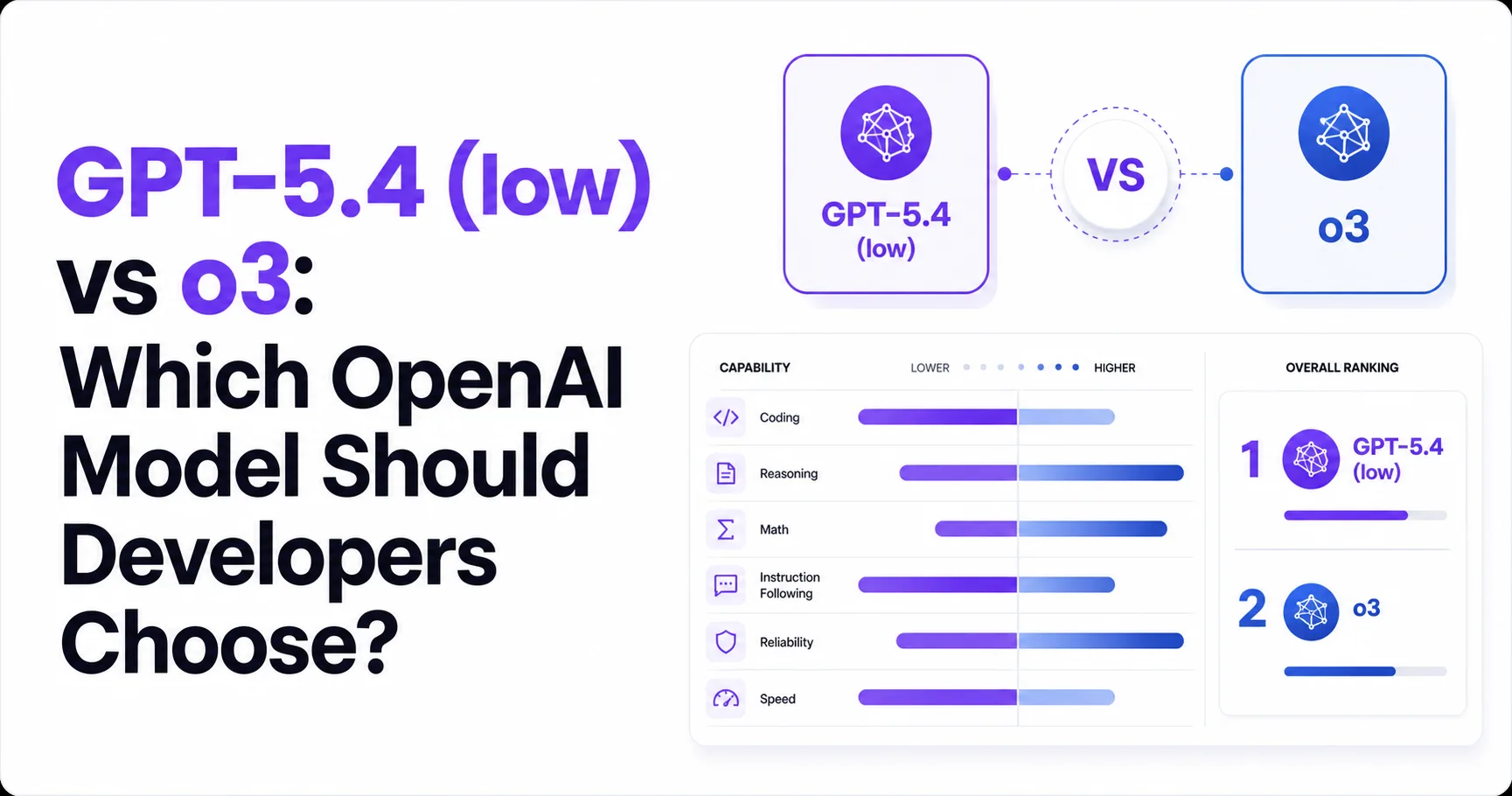
GPT-5.4 (low) is the stronger measured general-intelligence option, while o3 is cheaper and has the only reported output-speed result.
The data snapshot gives GPT-5.4 (low) an Artificial Analysis Intelligence Index score of 39.1, compared with 30.4 for o3. That is the clearest quality signal in this comparison, but it does not establish superiority for every coding, reasoning, or tool-use workload. The snapshot reports an o3 Artificial Analysis Math Index score of 88.3, while GPT-5.4 (low) has no corresponding value.
Both models show 0.3 seconds of latency in the supplied data. Only o3 has a reported median output speed, at 128.056 tokens per second. GPT-5.4 (low) costs $5.625 per 1M blended tokens, compared with $3.5 for o3. The supplied figures come from Artificial Analysis.
Availability creates a separate selection risk. OpenAI's current Models page does not list an independent gpt-5-4-low alias, and the provided materials do not list o3. The Pricing page lists gpt-5.4, but not gpt-5-4-low or o3. Treat the labels as evaluation subjects until your account and endpoint confirm the exact callable model.
GPT-5.4 (low) is the better default for quality-sensitive applications, but o3 remains the more economical choice when throughput and price control dominate.
| Decision factor | GPT-5.4 (low) | o3 | Practical reading |
|---|---|---|---|
| Intelligence Index | 39.1 | 30.4 | GPT-5.4 (low) has the stronger supplied general score |
| Math Index | Not reported | 88.3 | The comparison cannot establish a math winner |
| Latency | 0.3 seconds | 0.3 seconds | Supplied latency is tied |
| Median output speed | Not reported | 128.056 tokens per second | o3 has the only usable speed signal |
| Blended price | $5.625 | $3.5 | o3 is cheaper by the supplied blended metric |
| Input price | $2.5 | $2 | o3 is cheaper for input tokens |
| Output price | $15 | $8 | o3 is materially cheaper for generated tokens |
The table supports a qualified recommendation rather than a universal winner. GPT-5.4 (low) leads on the available general-intelligence measure. o3 has a published math result in the supplied snapshot, but GPT-5.4 (low) has no matching result, so the math comparison is incomplete. The same asymmetry affects speed because o3 has a reported value and GPT-5.4 (low) does not.
The official product evidence is also asymmetric. OpenAI's Models page describes the current catalog and does not independently document either compared label in the supplied material. The Pricing page gives prices for gpt-5.4, not a separately documented gpt-5-4-low configuration, and gives no current o3 price.
GPT-5.4 (low) has the stronger supplied intelligence score, but the evidence does not show whether that advantage survives every developer workload.
A 39.1 Intelligence Index score for GPT-5.4 (low), compared with 30.4 for o3, suggests a meaningful quality advantage on the measured composite. For an application that must plan, reason across constraints, or produce reliable first-pass answers, that gap can justify testing GPT-5.4 (low) first. The score still remains a benchmark signal, not a guarantee about repository-scale coding, structured tool calls, or production reliability.
The missing values matter as much as the reported values. GPT-5.4 (low) has no supplied median output-speed result, and the snapshot does not provide a matching math score. o3's 128.056 median output tokens per second therefore cannot prove that o3 is faster than GPT-5.4 (low); it only proves that o3 has the available speed measurement. Equal reported latency at 0.3 seconds also does not explain streaming behavior, queueing, time to first token, or long-response completion time.
The most defensible performance conclusion is workload-specific. Choose GPT-5.4 (low) when the measured intelligence signal maps to your acceptance tests. Choose o3 when its measured math result or observed generation speed is directly relevant. For coding agents, run the same repository tasks, tool schemas, retry policy, and output limits against both models because the supplied research found no reliable community tests or model-specific failure reports.
OpenAI's Models page does not supply the missing compared-model benchmark methodology, and the research brief found no independently verifiable community evaluation with disclosed test methods. Evidence is therefore insufficient for claims about coding style, long-context behavior, tool-call accuracy, or practical speed beyond the supplied figures.
o3 is cheaper on every supplied token-price measure, but GPT-5.4 (low) can be economically preferable if its quality reduces retries, review, or failed executions.
The supplied blended price is $3.5 per 1M tokens for o3 and $5.625 for GPT-5.4 (low). Input pricing is $2 for o3 versus $2.5 for GPT-5.4 (low), while output pricing is $8 versus $15. The output difference is the key operational risk for verbose applications, agent loops, and generated code that requires substantial completion text.
Price alone does not measure total task cost. A lower-priced model becomes more expensive in practice when it needs additional attempts, produces more invalid tool calls, requires human correction, or fails a workflow that must be rerun. The supplied research does not provide retry rates, token distributions, failure costs, or production-quality measurements, so no break-even claim can be calculated from the available evidence.
The reverse can also happen. GPT-5.4 (low) may cost more per request without improving the business result if your workload is short, deterministic, math-focused, or already passes with o3. The equal supplied latency of 0.3 seconds means the comparison should focus on successful task completion and total generated tokens, not just nominal response time.
OpenAI's Pricing page lists gpt-5.4 Standard prices of $2.50 for short-context input and $15.00 for output per 1M tokens. It does not separately document the low configuration in the provided material, and it does not list o3. Confirm billing behavior for the exact endpoint before committing production traffic.
o3 leads on 3 of 3 metrics
GPT-5.4 (low) is the recommended starting point for quality-sensitive engineering workflows, while o3 is the safer default for cost-sensitive, speed-observable workloads.
Pick GPT-5.4 (low) for a coding assistant, design-review agent, or planning workflow when your evaluation rewards broad reasoning and the 39.1 Intelligence Index signal matches the task. Its higher supplied score than o3 provides the strongest available argument for first-pass quality. Keep the recommendation conditional because the research does not provide model-specific coding results, failure modes, or a confirmed gpt-5-4-low API identity.
Pick o3 for high-volume generation, budget-constrained automation, or workloads where fast output and math behavior are central. Its $3.5 blended price is lower than $5.625 for GPT-5.4 (low), and it is the only model with a supplied median output-speed value, 128.056 tokens per second. Its 88.3 Math Index result is useful evidence for math-oriented testing, but it is not a head-to-head comparison because GPT-5.4 (low) has no matching value.
Use a two-stage routing policy if both exact endpoints are available. Send routine or price-sensitive tasks to o3, then escalate tasks that fail validation or require stronger reasoning to GPT-5.4 (low). That design is a recommendation pattern, not a measured result. The supplied materials contain no evidence for the routing threshold, failure rate, or savings.
Before launch, verify four points in your own account: the callable model identifier, pricing for that identifier, output-speed behavior, and pass rates on representative tasks. The current Models catalog does not resolve the compared labels clearly enough to remove that operational check.
o3 has more directly reported operational evidence than GPT-5.4 (low), but neither model has enough supplied documentation for a risk-free production choice.
The main unresolved issue is model identity. The research brief says OpenAI's current catalog does not list an independent gpt-5-4-low alias, while the supplied data names GPT-5.4 (low) as an evaluation subject. The same brief says the current catalog does not list o3. This does not prove that either model is unavailable. It means the provided sources do not confirm stable endpoint names, retirement status, version aliases, or the exact relationship between gpt-5.4 and the low setting.
Capability boundaries are also underdocumented. The official pages supplied for review do not provide compared-model context windows, output limits, API parameters, benchmark methods, or confirmed failure scenarios. The research also found no reliable community material with reproducible tests for coding, long context, tool calling, or speed. Developers should not convert missing evidence into either a capability claim or a limitation claim.
The cleanest next step is a controlled bake-off. Use production-shaped prompts, identical tools, fixed validation rules, and a cost ledger. Measure successful completion, correction effort, generated tokens, and latency distributions. Those measurements will answer questions that the supplied materials leave open. OpenAI's Models and Pricing pages remain the authoritative checks for current catalog visibility and listed pricing.
GPT-5.4 (low) has the stronger supplied general-intelligence score, 39.1 versus 30.4, but the available research does not include a reproducible coding benchmark or reliable community coding test. Developers should validate repository tasks directly before choosing it for coding.
o3 is cheaper on the supplied pricing measures, costing $3.5 per 1M blended tokens versus $5.625 for GPT-5.4 (low), with lower input and output prices as well. Total task cost can still change if one model causes more retries or manual fixes.
The available data does not prove that o3 is faster overall. o3 reports 128.056 median output tokens per second, while GPT-5.4 (low) has no reported value, and both models show 0.3 seconds of supplied latency.
o3 is the only model with a supplied Math Index result, scoring 88.3, so it is the better-supported choice for math-oriented testing. GPT-5.4 (low) has no matching math result, leaving the direct comparison unresolved.
The supplied official evidence does not confirm an independent gpt-5-4-low API alias. OpenAI lists gpt-5.4 on its pricing page, but developers should verify the exact callable identifier and account availability before deployment.