
Time to First Token · GPT-5.4 mini (xhigh)
0ms
Time to First Token · GPT-5 mini (high)
0ms
Deep dive into reasoning, benchmarks, and latency insights.
The current catalog does not contain complete performance evidence for both models, so this page does not declare an overall winner. Use the available fields as comparison signals and validate the models on your own workload.
Key decision metrics at a glance.
| Model | Metric | Value | Unit | Source / snapshot |
|---|---|---|---|---|
| GPT-5.4 mini (xhigh) | Reasoning | 6.0 | benchmark or capability score | Artificial Analysis · current catalog |
| GPT-5 mini (high) | Reasoning | 9.0 | benchmark or capability score | Artificial Analysis · current catalog |
| GPT-5.4 mini (xhigh) | Coding | 6.0 | benchmark or capability score | Artificial Analysis · current catalog |
| GPT-5 mini (high) | Coding | 2.0 | benchmark or capability score | Artificial Analysis · current catalog |
| GPT-5.4 mini (xhigh) | Multimodal | 3.0 | benchmark or capability score | Artificial Analysis · current catalog |
| GPT-5 mini (high) | Multimodal | 2.0 | benchmark or capability score | Artificial Analysis · current catalog |
| GPT-5.4 mini (xhigh) | Long Context | 5.0 | benchmark or capability score | Artificial Analysis · current catalog |
| GPT-5 mini (high) | Long Context | 3.0 | benchmark or capability score | Artificial Analysis · current catalog |
| GPT-5.4 mini (xhigh) | Blended Price / 1M tokens | $1.688 | USD per 1M tokens | Artificial Analysis · current catalog |
| GPT-5 mini (high) | Blended Price / 1M tokens | $0.688 | USD per 1M tokens | Artificial Analysis · current catalog |
| GPT-5.4 mini (xhigh) | P95 Latency | — | milliseconds | Artificial Analysis · current catalog |
| GPT-5 mini (high) | P95 Latency | — | milliseconds | Artificial Analysis · current catalog |
| GPT-5.4 mini (xhigh) | Tokens per second | 0 | tokens per second | Artificial Analysis · current catalog |
| GPT-5 mini (high) | Tokens per second | 0 | tokens per second | Artificial Analysis · current catalog |
Data provided by Artificial Analysis; live values use the current catalog.
This radar chart visually maps the core capabilities (reasoning, coding, math proxy, multimodal, long context) of `GPT-5.4 mini (xhigh)` vs `GPT-5 mini (high)`.
This grouped bar chart provides a side-by-side comparison for each benchmark metric.
Lower time to first token is better; higher tokens per second is better.
Compare input and output pricing in USD per 1M tokens.
GPT-5.4 mini (xhigh)$1.875
GPT-5 mini (high)$0.75
GPT-5 mini (high) costs $1.125 less per run
This article is a dated snapshot published on 2026-08-07. Live cards above use the current catalog; missing live fields are not inferred.
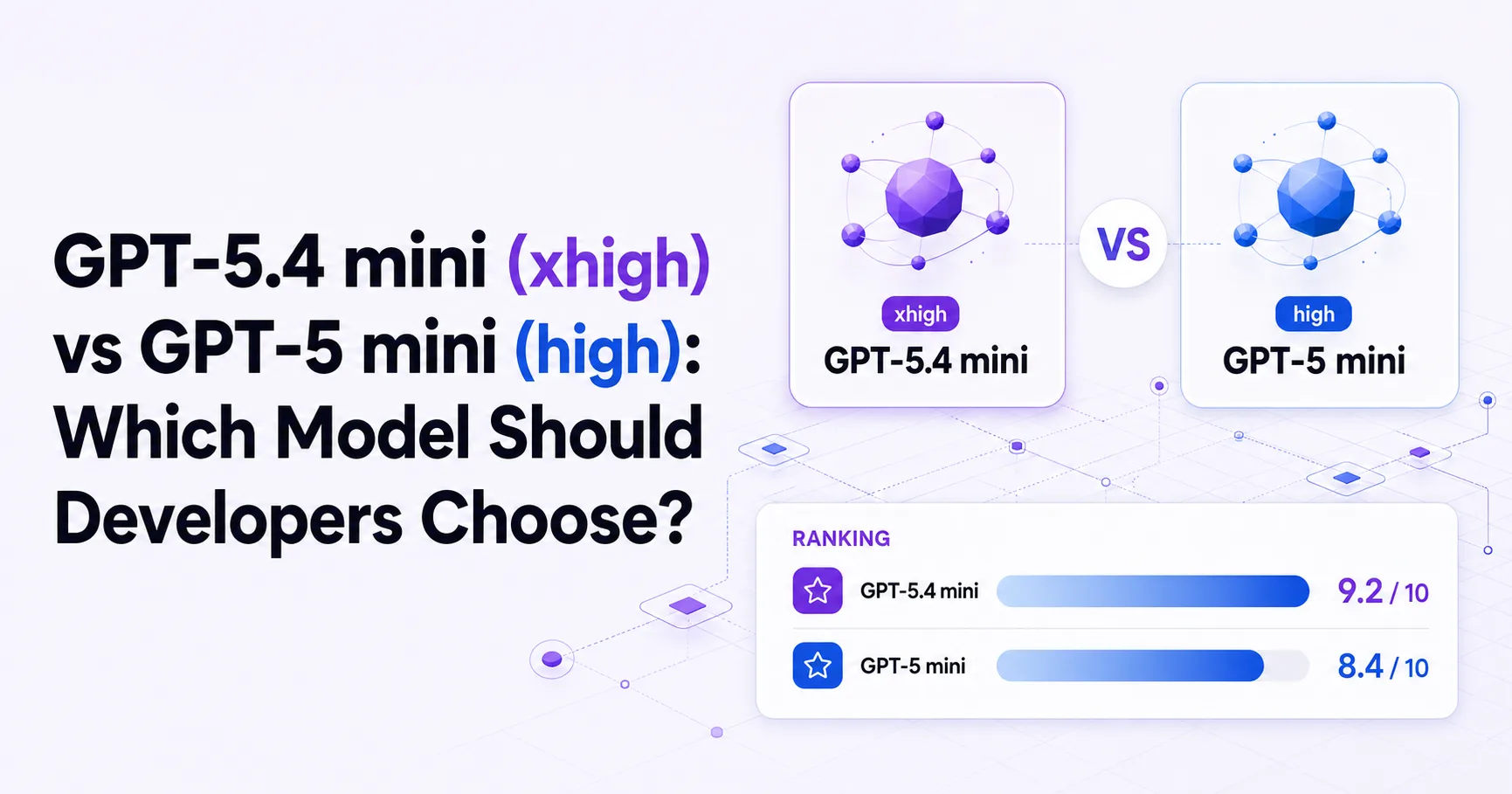
GPT-5.4 mini (xhigh) is the stronger default for developers who value measured coding and general intelligence over minimum token cost.
The available data points in the same direction. GPT-5.4 mini (xhigh) records an Artificial Analysis Coding Index of 56.1, while GPT-5 mini (high) records 15.6. GPT-5.4 mini (xhigh) also leads the Artificial Analysis Intelligence Index with 40, compared with 25.3 for GPT-5 mini (high). The data source is Artificial Analysis, and its snapshot supplies the quantitative comparison used throughout this article.
That advantage has a clear price. GPT-5 mini (high) costs $0.6875 per 1M blended tokens, compared with $1.6875 for GPT-5.4 mini (xhigh). The older model therefore remains attractive for high-volume workloads, especially where prompts are simple, outputs are short, and coding quality is not the primary success metric.
The comparison is less complete than the score gap suggests. Neither model has a documented context window in the supplied materials. Neither has a reliable median output-speed value. Official OpenAI pages also do not clearly explain whether “xhigh” and “high” are independent model IDs, reasoning settings, or product display labels. Developers should treat the scores as useful directional evidence, then verify the exact API identifier and behavior in their own account.
GPT-5.4 mini (xhigh) offers the more convincing engineering profile, while GPT-5 mini (high) offers the more defensible cost profile.
For coding, the difference is substantial in the supplied evaluation data. GPT-5.4 mini (xhigh) scores 56.1 on the Artificial Analysis Coding Index, compared with 15.6 for GPT-5 mini (high). That result supports choosing GPT-5.4 mini (xhigh) for code generation, repository changes, debugging, and tasks where the model must maintain structure across several constraints. It does not prove that every programming language, framework, or repository workflow will show the same gap.
For broader intelligence, GPT-5.4 mini (xhigh) again leads, scoring 40 against 25.3. The supplied data does not define the benchmark composition or provide task-level error analysis, so the index should guide prioritization rather than replace application testing.
GPT-5 mini (high) has one notable evaluation advantage. Its Artificial Analysis Math Index is 90.7, while no corresponding GPT-5.4 mini (xhigh) value is provided. That is not evidence that GPT-5 mini (high) is universally better at mathematics. It is evidence that the comparison is incomplete, and math-heavy teams should not infer a winner from the available cross-model scores alone.
The official documentation reinforces the uncertainty around product status. The OpenAI Models page lists GPT-5.4 mini, but the supplied materials do not identify a separate current entry for GPT-5 mini. The OpenAI Pricing page lists GPT-5.4 mini pricing, but not GPT-5 mini pricing. That difference affects deployment confidence, not just documentation convenience.
GPT-5.4 mini (xhigh) is the safer performance choice for code-centric workflows, although the evidence does not establish its speed or every capability boundary.
The coding score gap is the most decision-relevant result. GPT-5.4 mini (xhigh) reaches 56.1 on the Artificial Analysis Coding Index, while GPT-5 mini (high) reaches 15.6. A gap of 40.5 suggests that GPT-5.4 mini (xhigh) is more likely to follow repository conventions, preserve interfaces, reason through implementation constraints, and produce usable changes without repeated correction. Those are practical implications of the evaluation difference, not guarantees for a particular codebase.
The general intelligence gap is smaller but still meaningful. GPT-5.4 mini (xhigh) scores 40, compared with 25.3 for GPT-5 mini (high), a difference of 14.7. Developers building agents, support tools, structured extraction flows, or multi-step reasoning tasks may value that broader margin when failures are expensive to review.
Latency does not separate the models in the supplied snapshot. Each model is listed at 0.3 seconds. Median output tokens per second are unavailable for both models, so the evidence cannot answer which model streams faster after the first response begins. A team optimizing interactive feel should measure time to first token, output duration, retry rate, and tool-call completion in its own workload.
The official materials also leave important performance questions unanswered. The OpenAI Models documentation gives general information about current model capabilities, but it does not provide model-specific benchmark results, output limits, or a confirmed capability boundary for either display label. Community coding reports were not reliably available, so no stable anecdotal preference should override the measured coding result.
GPT-5 mini (high) is the clear token-cost choice, but GPT-5.4 mini (xhigh) can be cheaper at the system level if it prevents enough retries and review work.
GPT-5 mini (high) costs $0.6875 per 1M blended tokens, compared with $1.6875 for GPT-5.4 mini (xhigh). Its input price is $0.25 per 1M tokens, versus $0.75 for GPT-5.4 mini (xhigh). Its output price is $2 per 1M tokens, versus $4.5. The OpenAI Pricing page confirms the GPT-5.4 mini list price, while the supplied materials do not provide an official GPT-5 mini price entry.
The chart below the article can show the price difference directly. The more useful question is why the cost exists. Input-heavy classification, summarization, routing, and low-risk drafting can favor GPT-5 mini (high), because a lower input price applies across a large volume of predictable requests. Short outputs also reduce exposure to output pricing.
Coding agents change the calculation. A cheaper model that requires more correction passes can consume more total tokens, more tool calls, and more developer attention. The supplied coding scores make that risk plausible for GPT-5 mini (high), but the research brief does not provide retry rates, token usage by task, or production failure costs. The claim therefore remains a selection hypothesis, not a measured total-cost result.
GPT-5.4 mini (xhigh) also has documented Batch, Flex, and Fast mode prices in the supplied materials. GPT-5 mini (high) has no corresponding official prices in the provided source set. Developers using non-standard processing modes should verify availability and billing before treating the blended comparison as a complete budget forecast.
GPT-5 mini (high) leads on 3 of 3 metrics
GPT-5.4 mini (xhigh) should be the first candidate for coding and general-purpose agent workflows, while GPT-5 mini (high) should be tested for cost-sensitive, math-focused, or low-risk workloads.
Choose GPT-5.4 mini (xhigh) when the model must modify code, diagnose defects, navigate a repository, or handle instructions whose constraints interact. Its Coding Index of 56.1 is the strongest evidence in this comparison. Its Intelligence Index of 40 adds support for broader agent behavior. The higher price is easier to justify when human review, failed deployments, or repeated prompting are meaningful costs.
Choose GPT-5 mini (high) when request volume dominates quality requirements. Its blended price of $0.6875 is materially lower than $1.6875 for GPT-5.4 mini (xhigh). That makes it a reasonable evaluation candidate for routing, basic transformation, routine text generation, and workloads with straightforward acceptance checks. The low price should not be treated as proof of adequate quality for production coding.
Test GPT-5 mini (high) separately for mathematics. Its Math Index is 90.7, and GPT-5.4 mini (xhigh) has no supplied Math Index value. The evidence is insufficient to claim that GPT-5 mini (high) is the better math model, because the missing score prevents a direct comparison.
Treat deployment status as a release-management concern. The OpenAI Models page does not clearly document a current standalone GPT-5 mini entry in the supplied research. The OpenAI Pricing page does not provide GPT-5 mini prices. Before committing to either label, verify the model ID, account access, endpoint support, context behavior, and retirement policy in the target environment.
A practical selection sequence is simple: benchmark representative tasks, record correction and retry behavior, then compare total request cost. The supplied materials support GPT-5.4 mini (xhigh) as the quality-led default and GPT-5 mini (high) as the price-led candidate. They do not support a universal winner for every workload.
GPT-5.4 mini (xhigh) requires deployment verification before a production migration, because the supplied official materials do not resolve its label and availability details.
The research supports a cautious migration decision. The measured evidence favors GPT-5.4 mini (xhigh) for coding and general intelligence, while the cost evidence favors GPT-5 mini (high). Documentation favors neither model equally, because the official directory and pricing page describe their current presence differently. Developers should separate model quality, account availability, and billing behavior instead of treating them as one conclusion.
The missing evidence matters most for teams with strict operational requirements. Context windows, maximum output lengths, API parameters, tool support, and median output speed are not established for both comparison labels in the supplied materials. Community sources also do not provide reliable reproducible testing. A small internal benchmark is therefore necessary before production selection.
The OpenAI Models page and OpenAI Pricing page are the primary references used for documentation and pricing status. Quantitative evaluation values come from Artificial Analysis. Data provided by https://artificialanalysis.ai/
GPT-5.4 mini (xhigh) is the stronger coding candidate because its Artificial Analysis Coding Index is 56.1, compared with 15.6 for GPT-5 mini (high). The score does not guarantee identical results for every repository, language, or framework.
GPT-5 mini (high) is cheaper in the supplied data, at $0.6875 per 1M blended tokens versus $1.6875 for GPT-5.4 mini (xhigh). Total production cost can still change if the cheaper model needs more retries, corrections, or human review.
Neither model is faster on the supplied latency measure, because GPT-5.4 mini (xhigh) and GPT-5 mini (high) are both listed at 0.3 seconds. Median output tokens per second are unavailable, so streaming speed remains unverified.
GPT-5 mini (high) is worth testing for mathematics because its Artificial Analysis Math Index is 90.7, but the supplied materials contain no GPT-5.4 mini (xhigh) math score. The evidence is insufficient for a direct winner.
GPT-5.4 mini appears in the official model and pricing materials as gpt-5.4-mini, but the supplied sources do not confirm that xhigh is a separate API model ID. Developers should verify the exact identifier and supported configuration before deployment.
GPT-5 mini (high) cannot be confirmed as currently available from the supplied official pages, because the current model directory and pricing page do not list a dedicated gpt-5-mini entry. Account-level verification is required before migration planning.