
Time to First Token · GPT-5.4 nano (xhigh)
0ms
Time to First Token · o3
7185ms
Deep dive into reasoning, benchmarks, and latency insights.
The current catalog does not contain complete performance evidence for both models, so this page does not declare an overall winner. Use the available fields as comparison signals and validate the models on your own workload.
Key decision metrics at a glance.
| Model | Metric | Value | Unit | Source / snapshot |
|---|---|---|---|---|
| GPT-5.4 nano (xhigh) | Reasoning | 6.0 | benchmark or capability score | Artificial Analysis · current catalog |
| o3 | Reasoning | 9.0 | benchmark or capability score | Artificial Analysis · current catalog |
| GPT-5.4 nano (xhigh) | Coding | 6.0 | benchmark or capability score | Artificial Analysis · current catalog |
| o3 | Coding | 6.0 | benchmark or capability score | Artificial Analysis · current catalog |
| GPT-5.4 nano (xhigh) | Multimodal | 3.0 | benchmark or capability score | Artificial Analysis · current catalog |
| o3 | Multimodal | 3.0 | benchmark or capability score | Artificial Analysis · current catalog |
| GPT-5.4 nano (xhigh) | Long Context | 5.0 | benchmark or capability score | Artificial Analysis · current catalog |
| o3 | Long Context | 4.0 | benchmark or capability score | Artificial Analysis · current catalog |
| GPT-5.4 nano (xhigh) | Blended Price / 1M tokens | $0.463 | USD per 1M tokens | Artificial Analysis · current catalog |
| o3 | Blended Price / 1M tokens | $3.5 | USD per 1M tokens | Artificial Analysis · current catalog |
| GPT-5.4 nano (xhigh) | P95 Latency | — | milliseconds | Artificial Analysis · current catalog |
| o3 | P95 Latency | — | milliseconds | Artificial Analysis · current catalog |
| GPT-5.4 nano (xhigh) | Tokens per second | 0 | tokens per second | Artificial Analysis · current catalog |
| o3 | Tokens per second | 119.185 | tokens per second | Artificial Analysis · current catalog |
Data provided by Artificial Analysis; live values use the current catalog.
This radar chart visually maps the core capabilities (reasoning, coding, math proxy, multimodal, long context) of `GPT-5.4 nano (xhigh)` vs `o3`.
This grouped bar chart provides a side-by-side comparison for each benchmark metric.
Lower time to first token is better; higher tokens per second is better.
Compare input and output pricing in USD per 1M tokens.
GPT-5.4 nano (xhigh)$0.512
o3$4
GPT-5.4 nano (xhigh) costs $3.487 less per run
This article is a dated snapshot published on 2026-08-07. Live cards above use the current catalog; missing live fields are not inferred.
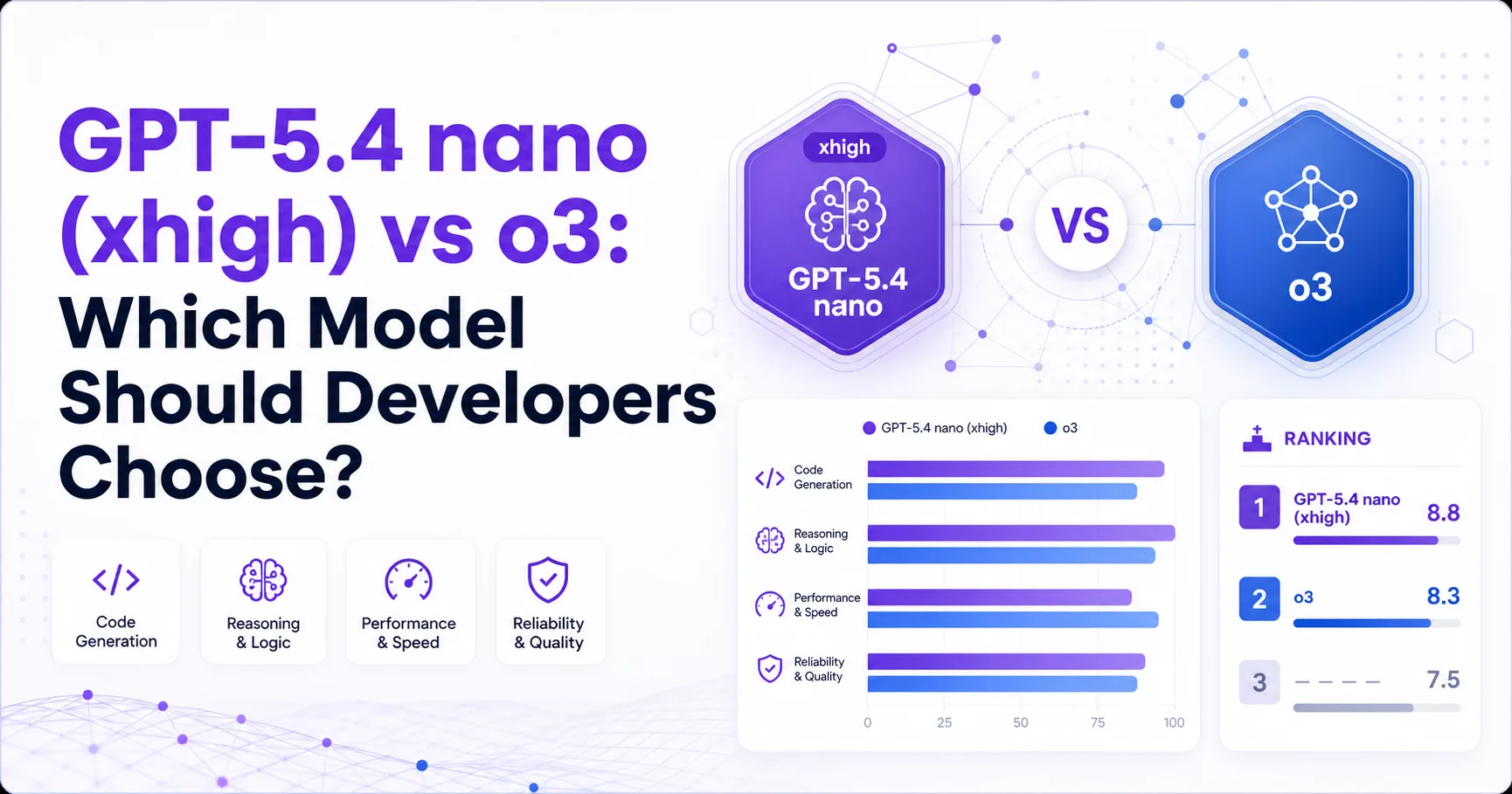
Data provided by https://artificialanalysis.ai/
GPT-5.4 nano (xhigh) is the safer default for most new developer workloads because it is currently listed, substantially cheaper, and scores higher on the available general intelligence measure. The supplied data gives GPT-5.4 nano (xhigh) an Artificial Analysis Intelligence Index score of 38.2, compared with 30.4 for o3, while its blended price is $0.4625 versus $3.5 per 1M blended tokens. Artificial Analysis provides the comparison data.\n\nThat conclusion has an important boundary. o3 has a reported Artificial Analysis Math Index score of 88.3, while GPT-5.4 nano (xhigh) has no corresponding math score in the supplied snapshot. o3 also has a reported median output speed of 128.056 tokens per second, while GPT-5.4 nano (xhigh) has no comparable output-speed value. The evidence therefore supports a default choice, not a universal capability ranking.
GPT-5.4 nano (xhigh) offers the stronger documented procurement case, while o3 remains relevant for math-heavy workloads with specialized evidence. The comparison is asymmetric because the supplied evaluation set does not measure both models on the same dimensions. Artificial Analysis is the source of the reported evaluation and pricing values.\n\n| Decision factor | GPT-5.4 nano (xhigh) | o3 | What it means |\n|---|---:|---:|---|\n| General intelligence index | 38.2 | 30.4 | The available broad index favors GPT-5.4 nano (xhigh). |\n| Coding index | 56.1 | Not reported | The data does not prove which model is better for coding. |\n| Math index | Not reported | 88.3 | The evidence specifically supports o3 for math-oriented evaluation. |\n| Blended price per 1M tokens | $0.4625 | $3.5 | GPT-5.4 nano (xhigh) has the lower listed blended cost. |\n| Median output speed | Not reported | 128.056 tokens per second | o3 has the only reported output-speed result. |\n| Latency | 0.3 seconds | 0.3 seconds | The reported latency is tied. |\n\nOpenAI’s current model documentation describes a unified model catalog with text and image input, text output, multilingual capability, visual capability, Responses API access, and official SDK access. The page does not assign every listed capability specifically to GPT-5.4 nano (xhigh), so developers should not treat the catalog description as a complete model specification. OpenAI Models\n\no3 has a weaker current-availability signal. The supplied model-directory evidence does not list o3 among the current models, and the supplied pricing evidence does not list a current Standard, Batch, Flex, or Fast mode price for it. OpenAI Models OpenAI Pricing
GPT-5.4 nano (xhigh) has the stronger broad evaluation result, but o3 has the only direct evidence for math performance and output throughput. The supplied Artificial Analysis snapshot reports 38.2 for GPT-5.4 nano (xhigh) and 30.4 for o3 on the Intelligence Index, while o3 alone has an 88.3 Math Index score and a median output speed of 128.056 tokens per second. Artificial Analysis provides these measurements.\n\nThe general-intelligence gap matters most when a product mixes tasks. A support agent, coding assistant, extraction pipeline, or internal copilot usually needs consistent behavior across several task families. The available broad index gives GPT-5.4 nano (xhigh) the better signal for that mixed workload. It does not prove that every task is better, and it does not isolate instruction following, tool use, code repair, or structured-output reliability.\n\no3’s math result changes the recommendation for a narrower workload. A system that spends most of its effort on symbolic reasoning, quantitative verification, or difficult mathematical derivations may value o3’s specialized evidence more than the broad index. The supplied materials do not explain the benchmark construction, test distribution, or failure patterns, so the score cannot establish production accuracy for a specific domain.\n\nCoding is the largest unresolved performance question. GPT-5.4 nano (xhigh) has a coding score of 56.1, but o3 has no coding score in the supplied snapshot. The comparison therefore cannot identify a coding winner. Developers should run a task set drawn from their own repository, especially for refactoring, test generation, debugging, and tool-calling workflows.\n\nLatency does not separate the models in the supplied data. Both are listed at 0.3 seconds, so the choice should not assume that the cheaper model is slower to first response. Output generation is different: only o3 has a reported throughput value. Because GPT-5.4 nano (xhigh) has no comparable value, the data does not establish an end-to-end speed winner.
GPT-5.4 nano (xhigh) is the clear price leader on the listed usage assumptions, but workload shape can still determine the real bill. The supplied data lists $0.4625 per 1M blended tokens for GPT-5.4 nano (xhigh) and $3.5 for o3, with input prices of $0.2 and $2 and output prices of $1.25 and $8 respectively. Artificial Analysis provides the comparison data.\n\nThe practical advantage is greatest in applications that generate large volumes of routine responses. Classification, retrieval-grounded answers, summarization, routing, and lower-risk code assistance can become expensive when each request is sent to a high-priced reasoning model. GPT-5.4 nano (xhigh) leaves more room for retries, background jobs, and broader feature coverage under the same budget.\n\no3 can still be cheaper at the product level if it prevents expensive downstream work. A math-focused model may justify its higher token price when a wrong derivation causes manual review, failed transactions, or repeated calls. The supplied evidence does not quantify accuracy, correction rates, or total application cost, so this is a decision rule rather than a measured saving.\n\nCaching and asynchronous processing may alter the economics. OpenAI lists GPT-5.4 nano (xhigh) cache input at $0.02 per 1M tokens, and its Batch and Flex input prices at $0.10 per 1M tokens, with corresponding output prices of $0.625 per 1M tokens. The pricing page does not list long-context pricing or a Fast mode price for GPT-5.4 nano (xhigh). OpenAI Pricing\n\nThe cost comparison has a procurement risk for o3. The supplied official pricing page does not provide a current o3 price, so the $3.5 blended value should be treated as the supplied comparison snapshot rather than a confirmed current purchase quote. OpenAI Pricing
GPT-5.4 nano (xhigh) leads on 3 of 3 metrics
GPT-5.4 nano (xhigh) should be the first model tested for new, mixed developer workloads because its current listing, broad score, and price create the strongest default case. OpenAI Models OpenAI Pricing\n\nChoose GPT-5.4 nano (xhigh) when the application needs high request volume, predictable listed pricing, general-purpose reasoning, or a single model for varied user tasks. Its reported coding score of 56.1 makes it a reasonable candidate for coding evaluation, but the absence of an o3 coding score means the choice still requires repository-specific testing. Artificial Analysis\n\nChoose o3 when mathematical reasoning is the central business requirement and the deployment path is already verified. The supplied data gives o3 an 88.3 Math Index score and a 128.056 median output speed, but it does not provide a matching math score for GPT-5.4 nano (xhigh) or a matching speed score for GPT-5.4 nano (xhigh). Artificial Analysis\n\nTreat availability as part of model selection, not an administrative detail. GPT-5.4 nano (xhigh) appears in the current OpenAI pricing catalog with the stable identifier gpt-5.4-nano. The supplied materials do not confirm a current o3 endpoint, stable alias, version suffix, or formal replacement status. OpenAI Pricing OpenAI Models\n\nThe best unresolved test is a paired evaluation using the same prompts, tools, context, acceptance checks, and retry policy. The supplied materials contain no reliable community posts, official benchmark results for these exact models, or documented model-specific failure modes. That evidence gap should lower confidence in any claim about coding behavior, tool-calling pitfalls, or production reliability.
GPT-5.4 nano (xhigh) is the better starting point for most developers because the supplied evidence combines a higher broad score with a lower listed price. Artificial Analysis
GPT-5.4 nano (xhigh) is the better default overall because it scores 38.2 versus o3’s 30.4 on the supplied Intelligence Index and costs $0.4625 versus $3.5 per 1M blended tokens. That conclusion does not establish superiority on math, coding, or every production task.
Developers should not choose o3 for coding based on this snapshot alone because o3 has no reported coding score, while GPT-5.4 nano (xhigh) has a coding score of 56.1. The evidence is incomplete, so a repository-specific evaluation remains necessary.
o3 may be worth its higher cost when mathematical reasoning is the core workload and its reported 88.3 Math Index score matches the application’s acceptance tests. The supplied materials do not quantify production accuracy, correction costs, or total workflow savings.
The supplied evidence does not establish a complete speed winner. o3 has the only reported median output speed, at 128.056 tokens per second, while both models have a listed latency of 0.3 seconds and GPT-5.4 nano (xhigh) has no comparable output-speed value.
The supplied official pages do not confirm that o3 is currently directly callable, has a stable alias, or has a replacement model. GPT-5.4 nano (xhigh) is listed in the current pricing catalog, while o3 is absent from the supplied current model and pricing listings. OpenAI Models OpenAI Pricing
The missing long-context price does not prove that GPT-5.4 nano (xhigh) lacks long-context support. It only shows that the supplied pricing page does not list a long-context price, so developers must verify applicable limits and billing before deployment. OpenAI Pricing