
Time to First Token · GPT-5.5 (high)
0ms
Time to First Token · o3
7185ms
Deep dive into reasoning, benchmarks, and latency insights.
The current catalog does not contain complete performance evidence for both models, so this page does not declare an overall winner. Use the available fields as comparison signals and validate the models on your own workload.
Key decision metrics at a glance.
| Model | Metric | Value | Unit | Source / snapshot |
|---|---|---|---|---|
| GPT-5.5 (high) | Reasoning | 6.0 | benchmark or capability score | Artificial Analysis · current catalog |
| o3 | Reasoning | 9.0 | benchmark or capability score | Artificial Analysis · current catalog |
| GPT-5.5 (high) | Coding | 7.0 | benchmark or capability score | Artificial Analysis · current catalog |
| o3 | Coding | 6.0 | benchmark or capability score | Artificial Analysis · current catalog |
| GPT-5.5 (high) | Multimodal | 5.0 | benchmark or capability score | Artificial Analysis · current catalog |
| o3 | Multimodal | 3.0 | benchmark or capability score | Artificial Analysis · current catalog |
| GPT-5.5 (high) | Long Context | 7.0 | benchmark or capability score | Artificial Analysis · current catalog |
| o3 | Long Context | 4.0 | benchmark or capability score | Artificial Analysis · current catalog |
| GPT-5.5 (high) | Blended Price / 1M tokens | $11.25 | USD per 1M tokens | Artificial Analysis · current catalog |
| o3 | Blended Price / 1M tokens | $3.5 | USD per 1M tokens | Artificial Analysis · current catalog |
| GPT-5.5 (high) | P95 Latency | — | milliseconds | Artificial Analysis · current catalog |
| o3 | P95 Latency | — | milliseconds | Artificial Analysis · current catalog |
| GPT-5.5 (high) | Tokens per second | 0 | tokens per second | Artificial Analysis · current catalog |
| o3 | Tokens per second | 119.185 | tokens per second | Artificial Analysis · current catalog |
Data provided by Artificial Analysis; live values use the current catalog.
This radar chart visually maps the core capabilities (reasoning, coding, math proxy, multimodal, long context) of `GPT-5.5 (high)` vs `o3`.
This grouped bar chart provides a side-by-side comparison for each benchmark metric.
Lower time to first token is better; higher tokens per second is better.
Compare input and output pricing in USD per 1M tokens.
GPT-5.5 (high)$12.5
o3$4
o3 costs $8.5 less per run
This article is a dated snapshot published on 2026-08-07. Live cards above use the current catalog; missing live fields are not inferred.
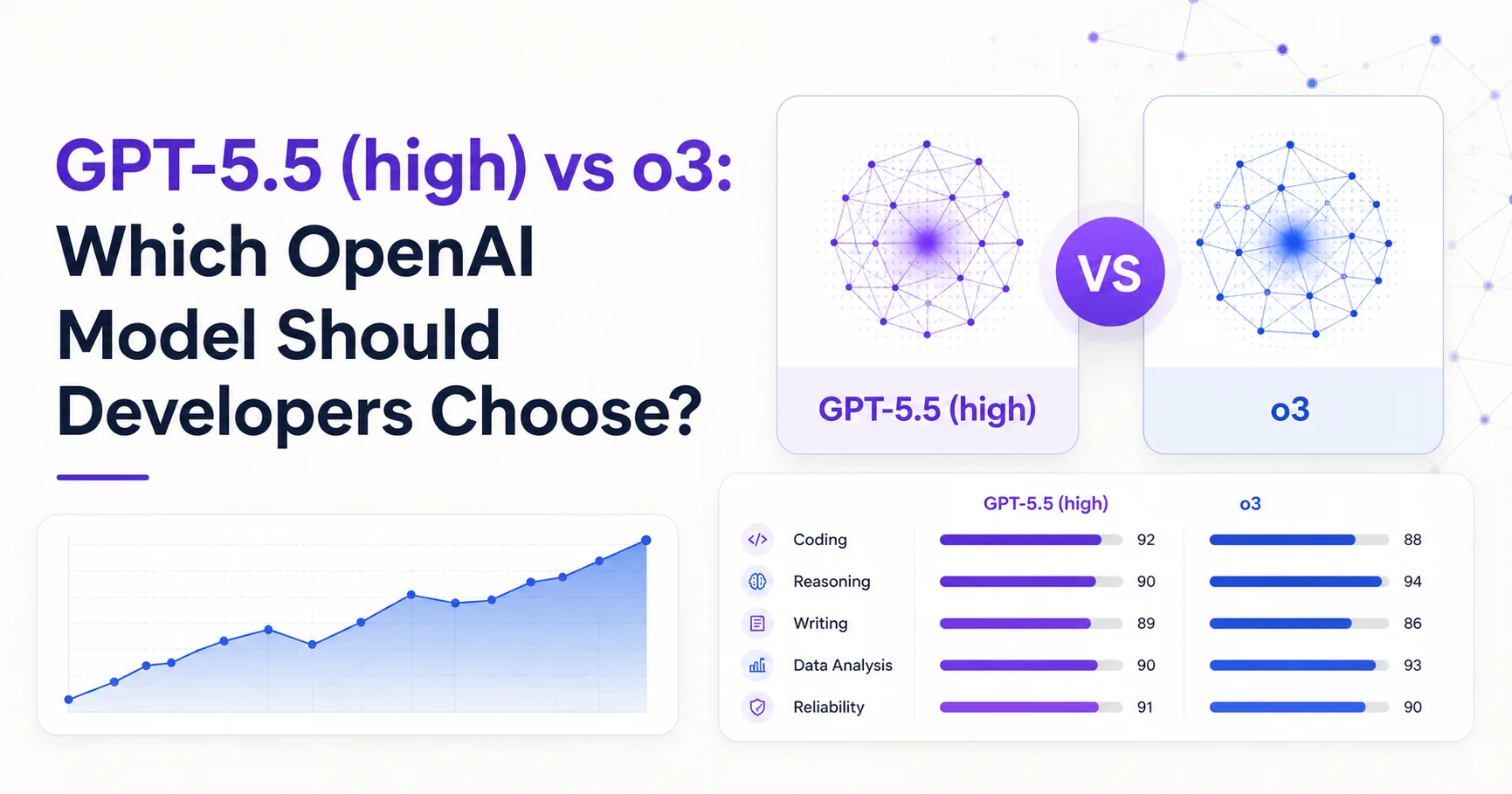
GPT-5.5 (high) is the stronger default for developers who need broad capability evidence and a documented agent workflow, while o3 is the lower-cost specialist option with the only reported output-speed result. Artificial Analysis scores GPT-5.5 (high) at 53.1 on its Intelligence Index, compared with 30.4 for o3, while o3 records 88.3 on the Math Index and GPT-5.5 (high) has no reported value for that metric. Artificial Analysis provides the comparison data used in this article.
The decision is not simply a contest between a newer model and a cheaper model. GPT-5.5 (high) has current official model documentation, a named API model, documented reasoning controls, and an explicit position in OpenAI's current product ecosystem. The supplied material does not establish the same current availability, API identity, or supported features for o3. That documentation gap is central to production selection because a model that is inexpensive on paper may still create migration, support, or availability risk.
GPT-5.5 (high) offers the better general-purpose engineering profile, while o3 offers the clearer cost advantage and a strong reported math score. GPT-5.5 (high) reaches 71.6 on the Artificial Analysis Coding Index, but the brief provides no comparable o3 coding value, so the coding lead cannot be stated as a measured head-to-head result. GPT-5.5 (high) also leads the reported Intelligence Index by 22.700000000000003 points, although the meaning of that composite difference depends on the benchmark's construction and workload relevance.
| Decision factor | Practical reading |
|---|---|
| General capability | GPT-5.5 (high) has the stronger reported Intelligence Index result. |
| Coding | GPT-5.5 (high) has a reported Coding Index value of 71.6; o3 has no comparable supplied value. |
| Mathematics | o3 has a reported Math Index value of 88.3; GPT-5.5 (high) has no comparable supplied value. |
| Blended cost | o3 costs $3.5 per 1M blended tokens versus $11.25 for GPT-5.5 (high). |
| Reported output speed | o3 reports 128.056 median output tokens per second; GPT-5.5 (high) has no supplied value. |
| Measured latency | Both models are listed at 0.3 seconds. |
| Documentation confidence | GPT-5.5 (high) has current official model and usage documentation; the supplied o3 evidence is limited to current directory and pricing checks. |
The safest conclusion is conditional. Choose GPT-5.5 (high) for a primary model that must cover coding, tools, retrieval, and professional reasoning. Choose o3 where cost control or a math-heavy workload dominates, but validate current API access and behavior before committing.
GPT-5.5 (high) is the better-supported choice for broad engineering workflows, but the supplied evidence does not prove a complete benchmark victory over o3. OpenAI describes GPT-5.5 as a frontier reasoning model for coding, tool-based agents, long-context retrieval, computer operation, knowledge work, and scientific research in the GPT-5.5 usage guide. The GPT-5.5 model page documents text and image input, structured output, function calling, file search, web search, code execution, computer use, MCP, and related tools.
Those capabilities matter because developer systems rarely ask a model only to produce an answer. They ask it to inspect files, call a function, preserve state, follow a workflow, and verify an outcome. GPT-5.5's documented support for the Responses API and reasoning controls gives developers explicit mechanisms for that operating pattern. The usage guide recommends the Responses API for reasoning, tool calls, and multi-turn state, and it advises developers to define success criteria, stopping conditions, tool rules, and verification steps.
The practical risk is that stronger reasoning does not automatically mean better execution. OpenAI warns that higher reasoning effort can produce unnecessary searching, overthinking, or lower quality when instructions conflict or tool access is too open. Community reports describe large files, duplicated logic, unwanted changes, regressions, and early completion claims in some GPT-5.5 workflows, but the reports lack controlled tests. The Reddit report is useful as a risk signal, not as a measured conclusion. The OpenAI Developer Community discussion likewise reports subjective experiences and explicitly lacks firm empirical evidence.
The o3 comparison is narrower. The supplied material gives o3 a Math Index value of 88.3 and an output-speed value of 128.056, but it does not provide official capability details, reproducible community tests, or a comparable coding score. Developers should therefore treat o3 as a potentially attractive specialist candidate, not as a fully documented platform equivalent.
o3 is the more attractive measured option for throughput-sensitive generation, while GPT-5.5 (high) is the more defensible option for heterogeneous tasks. The data brief reports o3 at 128.056 median output tokens per second and GPT-5.5 (high) without a reported output-speed value. That missing value prevents a fair speed ranking, even though the page lists 0.3 seconds latency for each model.
Latency and generation speed answer different operational questions. A short initial wait can still lead to a long total task if the model generates more reasoning, calls more tools, or revises its work. Conversely, a high output rate does not guarantee lower end-to-end time when the task requires external actions or verification. The available evidence does not report a comparable end-to-end agent duration, tool-call count, or task completion rate for either model.
For interactive coding assistance, o3's reported speed may improve perceived responsiveness and reduce the cost of repeated drafts. For repository-wide changes, however, the quality of planning, scope control, and verification may matter more than token emission. OpenAI's own guidance for GPT-5.5 emphasizes explicit stopping conditions and verification, which suggests that workflow design is part of the model's performance envelope. The community material raises concerns about instruction drift and regressions, but no reliable evidence shows whether o3 avoids those problems.
A production team should run task-level tests before treating the reported speed as a final decision. The test should include repository edits, structured tool calls, failure recovery, and verification. The supplied research does not contain such a comparison, so claims about superior real-world speed, reliability, or coding completion remain unproven.
o3 is the clear lower-cost option in the supplied pricing comparison, with a blended price of $3.5 per 1M tokens versus $11.25 for GPT-5.5 (high). Its listed input price is $2 and its output price is $8, compared with $5 input and $30 output for GPT-5.5 (high). The values come from the Artificial Analysis data brief, while current GPT-5.5 pricing details are documented on OpenAI's API pricing page.
The chart will show the direct price gap, but it cannot show whether a cheaper request produces an acceptable result on the first attempt. If o3 requires more retries, more manual correction, or a second model for tool coordination, the effective engineering cost can rise. If GPT-5.5 completes a complex task with fewer failed tool calls or less human review, its higher token price may be offset by lower operational effort. The supplied evidence does not quantify retries, completion rates, or review time, so no total-cost winner can be proven beyond token pricing.
GPT-5.5 also has important billing conditions for large contexts. The model page states that inputs above 272K tokens trigger higher pricing for the entire session, and the usage guide warns that high-detail image processing can increase input tokens and latency. These conditions make GPT-5.5 less attractive for large, repeated contexts unless caching and context management are designed carefully. The API changelog states that GPT-5.5 supports extended prompt caching but not in-memory prompt caching.
For ordinary short requests, o3's price advantage is difficult to ignore. For expensive engineering tasks, compare cost per accepted change, not cost per generated token. That metric is not available in the research brief and must be measured by the selecting team.
GPT-5.5 (high) becomes easier to justify when each successful run replaces substantial developer review, while o3 remains the rational default for high-volume low-risk work. A team building classification, extraction, simple transformations, or math-focused services may prefer o3 because the listed blended price is $3.5 per 1M tokens and the Math Index value is 88.3.
A team building an autonomous coding or research agent faces a different cost function. The model must interpret repository context, decide which tools to call, maintain task state, and recognize failure. GPT-5.5 has official documentation for these features and is positioned for coding and tool-based agents. That does not demonstrate lower total cost, but it reduces uncertainty around how the system should be integrated.
The highest-risk mistake is to apply one price to every request. GPT-5.5's standard input and output prices are $5 and $30, while o3's supplied prices are $2 and $8. Output-heavy workflows therefore expose a larger price difference than input-heavy workflows. Long-context usage adds another condition because GPT-5.5 sessions above 272K input tokens receive higher billing treatment.
The evidence is insufficient to recommend a fixed routing policy. A sensible evaluation should separate short answers, long-context retrieval, code changes, tool loops, and math tasks. Measure accepted output, retry count, human correction, and total request cost. Those measurements are absent from the supplied data, so the best current recommendation remains workload-specific.
o3 leads on 3 of 3 metrics
GPT-5.5 (high) should be the primary candidate for broad agentic development, while o3 should be tested as a lower-cost specialist or fallback. GPT-5.5 has a reported Intelligence Index of 53.1, a Coding Index of 71.6, and official guidance covering reasoning, tools, state, and verification. The supplied evidence does not provide an equivalent o3 coding score or current API specification.
Pick GPT-5.5 (high) when the application must combine repository work, tool calls, long-context retrieval, image understanding, structured outputs, or computer interaction. Its official model page documents those capabilities, and the usage guide explains how to control reasoning effort and response verbosity. The integration still needs guardrails because OpenAI warns that higher reasoning effort can worsen outcomes under ambiguous instructions, open-ended tool access, or weak stopping criteria.
Pick o3 when the workload is cost-sensitive, math-heavy, or throughput-sensitive, and the team can confirm that the model remains callable through its intended endpoint. The supplied data gives o3 a Math Index of 88.3, a blended price of $3.5 per 1M tokens, and a median output rate of 128.056 tokens per second. However, the current OpenAI model directory does not list o3 in the supplied research, and the OpenAI pricing page does not provide a current o3 price.
Do not select o3 solely because its historical identity is familiar. Do not select GPT-5.5 solely because its reported general score is higher. The decisive missing evidence is accepted-task performance under the team's own prompts, tools, repositories, and review process. Run a controlled pilot before making either model the sole production dependency.
The evidence supports a conditional choice, not a universal winner. GPT-5.5 (high) has broader current documentation, while o3 has lower supplied token prices and the only reported output-speed value.
GPT-5.5 (high) is the better-supported coding choice because the data brief reports a Coding Index of 71.6 and OpenAI documents coding and tool-agent workflows. The supplied material does not provide a comparable o3 coding score, so a measured head-to-head coding victory cannot be proven.
o3 is cheaper in the supplied comparison, costing $3.5 per 1M blended tokens versus $11.25 for GPT-5.5 (high). Its listed input and output prices are also lower, but the brief does not measure retries, review time, or cost per accepted result.
o3 is the only model with a reported median output speed, at 128.056 tokens per second. Both models show 0.3 seconds latency in the data brief, while GPT-5.5 (high) has no supplied output-speed value, so overall end-to-end speed remains unproven.
Developers should use o3 in production only after confirming current API availability, endpoint behavior, and operational support. The supplied research identifies no current o3 listing or pricing entry in the official OpenAI pages, despite its favorable cost and Math Index values.
GPT-5.5 (high) is worth testing when one workflow combines coding, retrieval, structured outputs, tool calls, or computer interaction and requires documented integration guidance. The available evidence does not prove a lower total cost, so teams should measure accepted work and review effort.