
Time to First Token · GPT-5.5 Instant (May 2026)
0ms
Time to First Token · o3
7185ms
Deep dive into reasoning, benchmarks, and latency insights.
The current catalog does not contain complete performance evidence for both models, so this page does not declare an overall winner. Use the available fields as comparison signals and validate the models on your own workload.
Key decision metrics at a glance.
| Model | Metric | Value | Unit | Source / snapshot |
|---|---|---|---|---|
| GPT-5.5 Instant (May 2026) | Reasoning | 6.0 | benchmark or capability score | Artificial Analysis · current catalog |
| o3 | Reasoning | 9.0 | benchmark or capability score | Artificial Analysis · current catalog |
| GPT-5.5 Instant (May 2026) | Coding | 6.0 | benchmark or capability score | Artificial Analysis · current catalog |
| o3 | Coding | 6.0 | benchmark or capability score | Artificial Analysis · current catalog |
| GPT-5.5 Instant (May 2026) | Multimodal | 3.0 | benchmark or capability score | Artificial Analysis · current catalog |
| o3 | Multimodal | 3.0 | benchmark or capability score | Artificial Analysis · current catalog |
| GPT-5.5 Instant (May 2026) | Long Context | 4.0 | benchmark or capability score | Artificial Analysis · current catalog |
| o3 | Long Context | 4.0 | benchmark or capability score | Artificial Analysis · current catalog |
| GPT-5.5 Instant (May 2026) | Blended Price / 1M tokens | $11.25 | USD per 1M tokens | Artificial Analysis · current catalog |
| o3 | Blended Price / 1M tokens | $3.5 | USD per 1M tokens | Artificial Analysis · current catalog |
| GPT-5.5 Instant (May 2026) | P95 Latency | — | milliseconds | Artificial Analysis · current catalog |
| o3 | P95 Latency | — | milliseconds | Artificial Analysis · current catalog |
| GPT-5.5 Instant (May 2026) | Tokens per second | 0 | tokens per second | Artificial Analysis · current catalog |
| o3 | Tokens per second | 119.185 | tokens per second | Artificial Analysis · current catalog |
Data provided by Artificial Analysis; live values use the current catalog.
This radar chart visually maps the core capabilities (reasoning, coding, math proxy, multimodal, long context) of `GPT-5.5 Instant (May 2026)` vs `o3`.
This grouped bar chart provides a side-by-side comparison for each benchmark metric.
Lower time to first token is better; higher tokens per second is better.
Compare input and output pricing in USD per 1M tokens.
GPT-5.5 Instant (May 2026)$12.5
o3$4
o3 costs $8.5 less per run
This article is a dated snapshot published on 2026-08-07. Live cards above use the current catalog; missing live fields are not inferred.
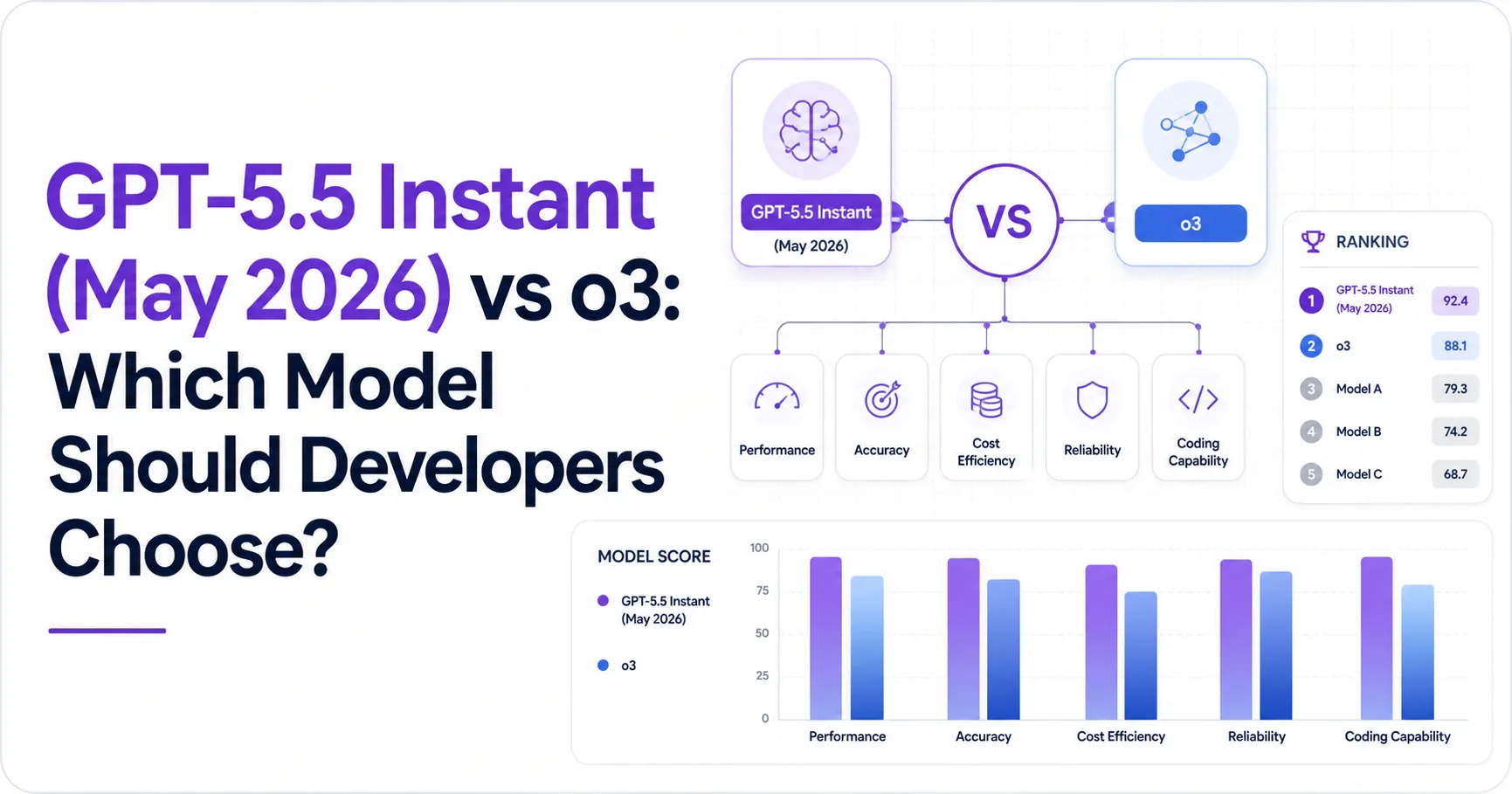
GPT-5.5 Instant (May 2026) leads the available intelligence score, while o3 is substantially cheaper and has the only reported output-speed measurement.
The measured advantage is narrow rather than decisive: GPT-5.5 Instant (May 2026) scores 33.5 on the Artificial Analysis Intelligence Index, compared with 30.4 for o3. That gap may matter for mixed workloads, but the supplied data does not identify which software tasks create it.
o3 has a clear economic advantage at $3.5 per 1M blended tokens, compared with $11.25 for GPT-5.5 Instant (May 2026). o3 also reports 128.056 median output tokens per second, while no corresponding GPT-5.5 Instant value is available. Both models show 0.3 seconds of latency in the data brief.
The largest selection risk is not benchmark performance. Neither name is currently visible as a standalone model in OpenAI's official directory. The directory lists current OpenAI models, but it does not list GPT-5.5 Instant (May 2026) or o3 as supplied here. OpenAI Models
Data provided by Artificial Analysis.
GPT-5.5 Instant (May 2026) offers the stronger measured general intelligence result, while o3 offers the stronger documented value and speed profile.
The comparison is asymmetric. GPT-5.5 Instant (May 2026) has an Intelligence Index value of 33.5, but the supplied brief contains no math score or output-speed value for it. o3 has an Intelligence Index value of 30.4, a Math Index value of 88.3, and a median output speed of 128.056 tokens per second. The missing GPT-5.5 Instant measurements prevent a complete capability ranking.
That asymmetry changes how developers should interpret the apparent winner. GPT-5.5 Instant (May 2026) wins the one shared intelligence measure. o3 is easier to evaluate for math-heavy or throughput-sensitive work because the brief provides additional measurements. The evidence does not prove that o3 is better at math than GPT-5.5 Instant, because no matching GPT-5.5 math result is supplied.
The official documentation also fails to settle whether either supplied identifier is a dependable current API choice. OpenAI's model directory does not list o3, and it does not list the Instant alias as a separate model. OpenAI Models
The naming issue is especially important for production systems. The research brief found no official confirmation that gpt-5-5-instant-05-26 remains callable, has a stable alias, or has a documented replacement. The same gap exists for o3. Developers should therefore treat measured scores as conditional evidence, not as proof of deployability.
o3 is the only model with a reported generation-speed result, while GPT-5.5 Instant (May 2026) has the higher shared intelligence score but insufficient speed evidence.
The page chart should carry the individual benchmark values. The practical question is what those values imply for an application. GPT-5.5 Instant (May 2026) reaches 33.5 on the shared Intelligence Index, compared with 30.4 for o3. This suggests a capability advantage for GPT-5.5 Instant on the tested composite, but the brief does not identify the tasks, weighting, or error distribution behind that index.
o3 reports 128.056 median output tokens per second. GPT-5.5 Instant has no corresponding value in the data brief. A developer can therefore make a positive speed claim about o3, but cannot make a fair relative speed claim. The absence of a GPT-5.5 Instant speed measurement is evidence of an incomplete comparison, not evidence that it is slower.
Both models have a reported latency of 0.3 seconds. Equal latency does not mean equal user experience. Time to first response and token generation rate affect interactive coding assistants, streaming research tools, and long-form transformations differently. The data brief does not provide enough detail to separate those effects.
The operational conclusion is workload-specific. o3 is the safer choice for applications where sustained streaming speed is already a selection requirement. GPT-5.5 Instant may be preferable when the shared intelligence score better reflects the task. The supplied materials do not provide coding evaluations, tool-use tests, context-window sizes, output limits, rate limits, or failure-case measurements for either exact identifier.
OpenAI's current model documentation also does not provide exact-model limits or API parameters for these supplied names. OpenAI Models
o3 is the clear price winner, but GPT-5.5 Instant (May 2026) could still be cheaper for workflows where better answers reduce retries or human review.
The page chart should show the individual price points. The selection meaning is straightforward: o3 costs $3.5 per 1M blended tokens, while GPT-5.5 Instant costs $11.25. The input prices are $2 and $5 per 1M tokens, and the output prices are $8 and $30. This makes o3 the default economic choice for high-volume generation when answer quality is acceptable.
The apparent price gap can reverse at the workflow level. A cheaper model becomes more expensive if it requires additional attempts, fallback calls, repair passes, or manual review. The supplied data does not measure retry rates, task success, correction cost, or production reliability, so it cannot establish the total cost of ownership for either model.
GPT-5.5 Instant's 33.5 Intelligence Index score versus o3's 30.4 provides a reason to test quality-sensitive workloads before selecting on price alone. It does not establish that GPT-5.5 Instant will produce fewer tokens, fewer failures, or fewer support incidents. Those outcomes are not reported.
The official pricing page creates a second cost risk. It lists prices for gpt-5.5, including Standard, Batch, Flex, and Fast mode offerings, but it does not list the supplied Instant alias. It also does not list an o3 price. OpenAI API Pricing
For budgeting, use the Artificial Analysis values as comparison data, then verify the exact billable model identifier and current account price before committing production traffic. Artificial Analysis
o3 leads on 3 of 3 metrics
o3 is the practical default for cost-sensitive production experiments, while GPT-5.5 Instant (May 2026) deserves a quality-first trial if its identifier can be verified.
Choose o3 when the workload has high request volume, benefits from measured streaming speed, or needs an available math result for initial screening. Its $3.5 blended-token price and 128.056 median output tokens per second make it the stronger starting point for economical interactive systems. The 88.3 Math Index result supports testing it for mathematical work, but it does not prove superiority against GPT-5.5 Instant because no matching GPT-5.5 math score is available.
Choose GPT-5.5 Instant (May 2026) when the shared Intelligence Index is the most relevant signal and a 33.5 result justifies a quality-focused evaluation. The score exceeds o3's 30.4, but the supplied materials do not show whether the difference affects code generation, structured extraction, tool calling, reasoning, or user preference.
Do not make either model the sole production dependency until the exact API identifier is confirmed. OpenAI's current model directory does not list either supplied model name, and the research brief found no official statement about stable aliases, direct callability, or replacement status. OpenAI Models
A sensible decision rule is to separate two gates:
The current evidence supports a conditional recommendation, not a universal winner. GPT-5.5 Instant leads the shared intelligence measure. o3 leads price and documented generation speed. Availability remains unresolved for both.
GPT-5.5 Instant (May 2026) and o3 cannot be ranked confidently on production readiness because the exact identifiers lack current official confirmation.
The research brief found no reliable community posts, disclosed independent tests, or exact-model failure reports for either model. It also found no official exact-model context window, maximum output, tool range, rate limit, or deprecation schedule. Those omissions matter more than small benchmark differences when developers are choosing a production dependency.
The official pages provide useful context about OpenAI's current catalog and pricing, but they do not resolve the identity of the supplied models. OpenAI Models OpenAI API Pricing
The right next step is targeted validation against the actual API account and workload. The data brief is enough to establish a quality signal, a price signal, and a speed signal. It is not enough to establish long-term availability, task-level reliability, or total operating cost.
GPT-5.5 Instant (May 2026) is better on the shared Artificial Analysis Intelligence Index, scoring 33.5 versus 30.4, but the evidence does not prove better coding, tool use, reliability, or production availability.
o3 is cheaper at $3.5 per 1M blended tokens versus $11.25 for GPT-5.5 Instant (May 2026), although retries, review work, and fallback calls could change the workflow-level cost.
o3 is the only model with a reported generation-speed measurement, at 128.056 median output tokens per second, while GPT-5.5 Instant (May 2026) has no comparable value in the supplied data.
The supplied research does not confirm that gpt-5-5-instant-05-26 is a stable, directly callable official identifier, and OpenAI's current model directory does not list it as a standalone model.
The supplied research does not establish whether o3 remains directly callable, has a stable alias, or has been replaced, because the current official model directory does not list o3.
o3 is the only compared model with a supplied Math Index result, scoring 88.3, so it deserves the first test for math-heavy work, but GPT-5.5 Instant cannot be judged without a matching measurement.