
Time to First Token · GPT-5.5 (Non-reasoning)
0ms
Time to First Token · o3
7185ms
Deep dive into reasoning, benchmarks, and latency insights.
The current catalog does not contain complete performance evidence for both models, so this page does not declare an overall winner. Use the available fields as comparison signals and validate the models on your own workload.
Key decision metrics at a glance.
| Model | Metric | Value | Unit | Source / snapshot |
|---|---|---|---|---|
| GPT-5.5 (Non-reasoning) | Reasoning | 6.0 | benchmark or capability score | Artificial Analysis · current catalog |
| o3 | Reasoning | 9.0 | benchmark or capability score | Artificial Analysis · current catalog |
| GPT-5.5 (Non-reasoning) | Coding | 6.0 | benchmark or capability score | Artificial Analysis · current catalog |
| o3 | Coding | 6.0 | benchmark or capability score | Artificial Analysis · current catalog |
| GPT-5.5 (Non-reasoning) | Multimodal | 3.0 | benchmark or capability score | Artificial Analysis · current catalog |
| o3 | Multimodal | 3.0 | benchmark or capability score | Artificial Analysis · current catalog |
| GPT-5.5 (Non-reasoning) | Long Context | 4.0 | benchmark or capability score | Artificial Analysis · current catalog |
| o3 | Long Context | 4.0 | benchmark or capability score | Artificial Analysis · current catalog |
| GPT-5.5 (Non-reasoning) | Blended Price / 1M tokens | $11.25 | USD per 1M tokens | Artificial Analysis · current catalog |
| o3 | Blended Price / 1M tokens | $3.5 | USD per 1M tokens | Artificial Analysis · current catalog |
| GPT-5.5 (Non-reasoning) | P95 Latency | — | milliseconds | Artificial Analysis · current catalog |
| o3 | P95 Latency | — | milliseconds | Artificial Analysis · current catalog |
| GPT-5.5 (Non-reasoning) | Tokens per second | 0 | tokens per second | Artificial Analysis · current catalog |
| o3 | Tokens per second | 119.185 | tokens per second | Artificial Analysis · current catalog |
Data provided by Artificial Analysis; live values use the current catalog.
This radar chart visually maps the core capabilities (reasoning, coding, math proxy, multimodal, long context) of `GPT-5.5 (Non-reasoning)` vs `o3`.
This grouped bar chart provides a side-by-side comparison for each benchmark metric.
Lower time to first token is better; higher tokens per second is better.
Compare input and output pricing in USD per 1M tokens.
GPT-5.5 (Non-reasoning)$12.5
o3$4
o3 costs $8.5 less per run
This article is a dated snapshot published on 2026-08-07. Live cards above use the current catalog; missing live fields are not inferred.
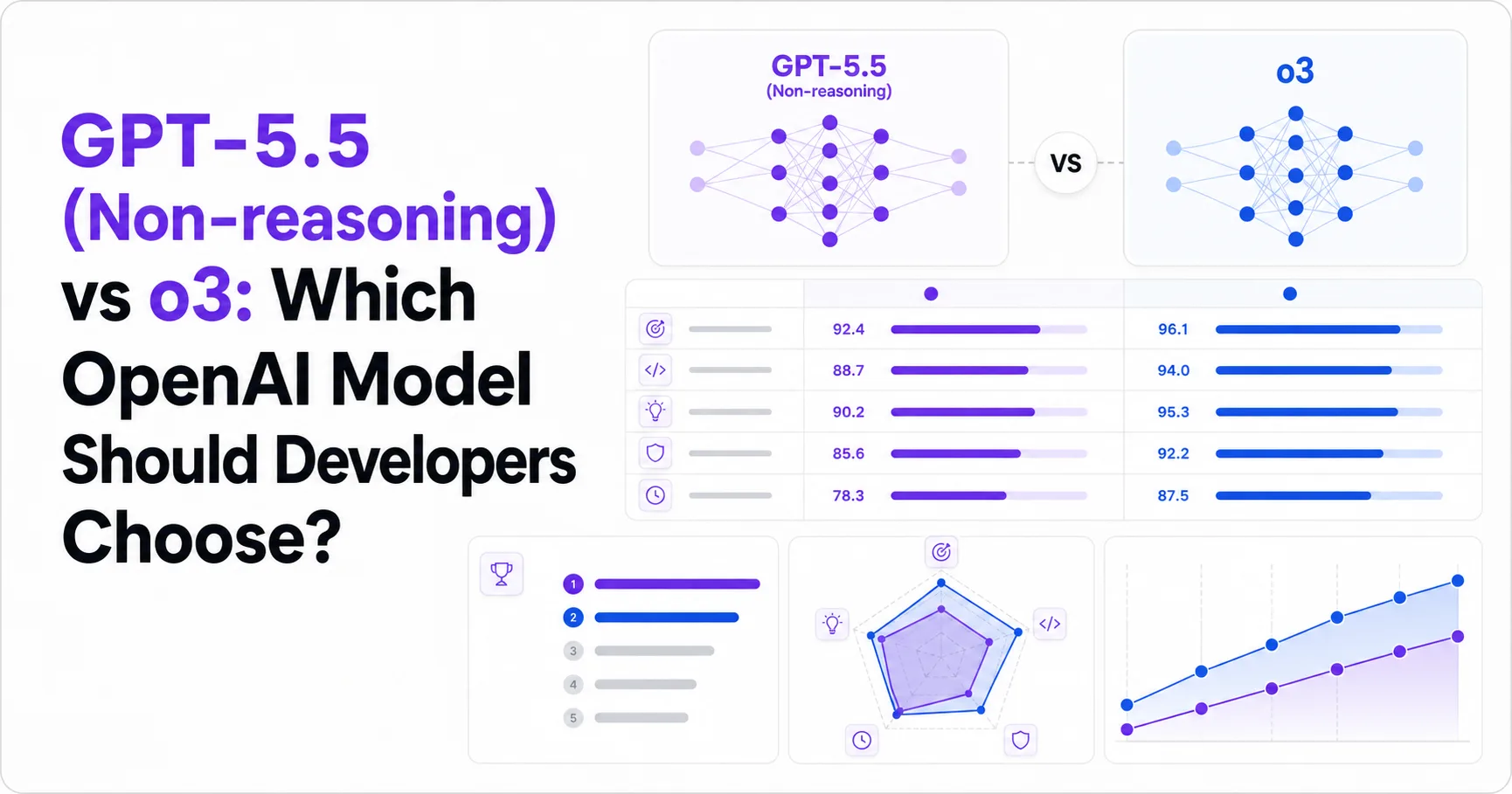
GPT-5.5 (Non-reasoning) is the stronger measured general-intelligence option, while o3 is the clearer value choice for cost-sensitive workloads. The Artificial Analysis snapshot gives GPT-5.5 (Non-reasoning) an Intelligence Index of 35.4, compared with 30.4 for o3. The same snapshot gives o3 a Math Index of 88.3, while GPT-5.5 (Non-reasoning) has no comparable math result in the supplied data. GPT-5.5 (Non-reasoning) has a Coding Index of 56.5, but o3 has no comparable coding result. That makes the overall decision less simple than choosing the model with the highest visible score.
The commercial situation adds a second layer of risk. OpenAI’s pricing page lists the gpt-5.5 API alias at $5 per 1M input tokens and $30 per 1M output tokens in standard short-context pricing. The same page does not list a current o3 price. The data snapshot nevertheless reports o3 at $2 per 1M input tokens, $8 per 1M output tokens, and $3.5 per 1M blended tokens. Developers should therefore separate benchmark selection from deployment verification. GPT-5.5 (Non-reasoning) is easier to price from current official material, while o3 is cheaper in the supplied comparison but less clearly documented in the current catalog.
GPT-5.5 (Non-reasoning) wins the available general-intelligence comparison, but o3 offers a much lower measured blended price and stronger evidence in math. The available Intelligence Index favors GPT-5.5 (Non-reasoning) at 35.4 versus 30.4 for o3. That result supports GPT-5.5 (Non-reasoning) for broad assistant, analysis, and mixed reasoning workloads, but it does not prove superiority on every developer task. The benchmark record is incomplete because the supplied data has no comparable o3 coding score and no comparable GPT-5.5 (Non-reasoning) math score.
The cost difference is substantial in the supplied snapshot. GPT-5.5 (Non-reasoning) costs $11.25 per 1M blended tokens, while o3 costs $3.5. Output-heavy applications face an especially important tradeoff because the supplied output prices are $30 for GPT-5.5 (Non-reasoning) and $8 for o3. A cheaper output rate can matter more than a small quality advantage when an application generates long responses, retries frequently, or serves high request volume.
Official visibility also favors GPT-5.5 (Non-reasoning), but only partially. OpenAI’s model documentation currently describes newer GPT-5.6 products and does not provide dedicated documentation for GPT-5.5 (Non-reasoning). It also does not list o3 in the supplied current catalog material. Neither model has a clearly documented current context window, output limit, parameter set, or complete official capability profile in the provided sources. The evidence supports a provisional choice, followed by a direct API validation before production.
o3 is the only model with a measured output-speed figure, so GPT-5.5 (Non-reasoning) cannot be called faster from the supplied evidence. The snapshot reports o3 at 128.056 median output tokens per second. GPT-5.5 (Non-reasoning) has no corresponding output-speed value. Both models show 0.3 seconds for latency in the supplied data, so the reported latency result is a tie, although it does not explain how much time each model spends generating the full answer.
The quality evidence points in different directions. GPT-5.5 (Non-reasoning) leads the available general intelligence measure at 35.4 versus 30.4 for o3. In practical terms, that supports testing GPT-5.5 (Non-reasoning) first for mixed tasks that combine interpretation, planning, summarization, and judgment. The result remains a benchmark signal rather than a guarantee for a specific application. Artificial Analysis does not provide a comparable o3 Coding Index in the supplied snapshot, so the GPT-5.5 (Non-reasoning) Coding Index of 56.5 cannot establish a coding winner.
Math creates the opposite uncertainty. o3 has a reported Math Index of 88.3, while GPT-5.5 (Non-reasoning) has no comparable value. Developers building symbolic, quantitative, or verification-heavy features should therefore run task-specific tests instead of transferring the general intelligence result into a math conclusion. The supplied research also contains no reliable, method-disclosed community testing for coding behavior, speed perception, model quirks, failure cases, or known limitations. Those gaps are decision inputs, not evidence that either model performs poorly.
o3 is the cost winner in the supplied data, but workload shape and quality failures can reverse the operational decision. The reported blended price is $3.5 per 1M tokens for o3 versus $11.25 for GPT-5.5 (Non-reasoning). The input prices are $2 and $5, while the output prices are $8 and $30 respectively. The output difference matters most for applications that produce long answers, generate code, or require several candidate responses.
A lower token price does not automatically produce a lower total application cost. If o3 requires more retries, additional validation calls, or a separate correction step for a particular workflow, its lower unit price may be offset by extra tokens and orchestration. The supplied evidence does not measure retry rates, task success rates, tool-call accuracy, or production completion cost, so this reversal remains a hypothesis to test rather than a documented result.
GPT-5.5 (Non-reasoning) also has a more explicit official price surface. OpenAI’s pricing documentation lists standard, Batch, Flex, and Fast mode prices for the gpt-5.5 alias. It does not list an o3 price in the supplied material. That creates a procurement and availability concern for o3, even though the comparison data assigns it the lower price. Developers should confirm the callable model identifier, account access, billing mode, and actual response behavior before committing to a cost forecast.
The cost conclusion is therefore two-part: choose o3 for the strongest price case in the snapshot, and choose GPT-5.5 (Non-reasoning) when its measured quality advantage reduces enough downstream work to justify the premium.
o3 leads on 3 of 3 metrics
GPT-5.5 (Non-reasoning) is the safer provisional default for broad developer workflows, while o3 is the better candidate for low-cost and math-focused experiments. Choose GPT-5.5 (Non-reasoning) when one model must handle varied requests and the available Intelligence Index is the most relevant signal. Its score of 35.4 exceeds o3’s 30.4, and its supplied Coding Index of 56.5 gives developers at least one direct coding-oriented signal. The coding comparison remains incomplete because the snapshot has no o3 Coding Index.
Choose o3 when token economics, measured speed, or mathematical evaluation matters more than broad benchmark leadership. o3 is reported at $3.5 per 1M blended tokens and 128.056 median output tokens per second. Its Math Index is 88.3, which makes it the model that deserves the first task-specific trial for quantitative workloads. That recommendation should not be read as proof that o3 is better for every reasoning task. The available material does not provide matched benchmark coverage across all relevant categories.
Treat production adoption as conditional for both models. OpenAI’s current model documentation does not provide a complete dedicated profile for GPT-5.5 (Non-reasoning), and the supplied current catalog material does not list o3. The documents do not establish whether either model remains directly callable under a stable alias, what context limits apply, or which model formally replaces either one. The strongest next step is a small blind evaluation using real prompts, expected outputs, retry behavior, and the exact account configuration. Those tests should measure successful task completion, not only token speed or benchmark scores.
The evidence-backed decision is GPT-5.5 (Non-reasoning) for breadth and o3 for price, speed evidence, and math evidence. The evidence is insufficient to declare a universal winner.
o3 is the better first test for developers who prioritize low token cost, reported output speed, or math-focused evaluation. GPT-5.5 (Non-reasoning) is the better first test for broader mixed workloads because its available Intelligence Index is higher. The supplied evidence does not settle coding quality because o3 lacks a comparable Coding Index.
GPT-5.5 (Non-reasoning) has the available Coding Index of 56.5, but the supplied data provides no comparable o3 coding score. That makes GPT-5.5 (Non-reasoning) the better-supported coding choice, not a proven universal winner. The research also found no reliable community coding evaluation with disclosed methods.
o3 is cheaper in the supplied data at $3.5 per 1M blended tokens, compared with $11.25 for GPT-5.5 (Non-reasoning). Its input price is $2 versus $5, and its output price is $8 versus $30. Developers should still verify o3 availability and billing before forecasting production spend.
o3 is the only model with a reported output-speed measurement, at 128.056 median output tokens per second. GPT-5.5 (Non-reasoning) has no corresponding value, so the supplied evidence cannot establish a complete speed ranking. Both models report 0.3 seconds of latency in the snapshot.
o3 is the stronger-supported choice for mathematical evaluation because the supplied data gives it a Math Index of 88.3, while GPT-5.5 (Non-reasoning) has no comparable math score. This remains a benchmark-based recommendation, and developers should validate their own mathematical prompts, verification needs, and error tolerance.
GPT-5.5 (Non-reasoning) is not fully documented as a dedicated model profile in the supplied official material. OpenAI’s pricing page lists the gpt-5.5 API alias, while the model page focuses on GPT-5.6 products. The documents do not clearly map the alias to the exact non-reasoning model name.
The supplied official pages do not establish whether o3 remains directly callable, has a stable alias, or has been formally replaced. The current model documentation does not list o3 in the provided material, and the pricing page does not list an o3 price. Developers should verify access in their own account before selecting it.