
Time to First Token · GPT-5.5 (xhigh)
0ms
Time to First Token · GPT-5.6 Sol (high)
10785ms
Deep dive into reasoning, benchmarks, and latency insights.
The current catalog does not contain complete performance evidence for both models, so this page does not declare an overall winner. Use the available fields as comparison signals and validate the models on your own workload.
Key decision metrics at a glance.
| Model | Metric | Value | Unit | Source / snapshot |
|---|---|---|---|---|
| GPT-5.5 (xhigh) | Reasoning | 6.0 | benchmark or capability score | Artificial Analysis · current catalog |
| GPT-5.6 Sol (high) | Reasoning | 6.0 | benchmark or capability score | Artificial Analysis · current catalog |
| GPT-5.5 (xhigh) | Coding | 7.0 | benchmark or capability score | Artificial Analysis · current catalog |
| GPT-5.6 Sol (high) | Coding | 8.0 | benchmark or capability score | Artificial Analysis · current catalog |
| GPT-5.5 (xhigh) | Multimodal | 5.0 | benchmark or capability score | Artificial Analysis · current catalog |
| GPT-5.6 Sol (high) | Multimodal | 5.0 | benchmark or capability score | Artificial Analysis · current catalog |
| GPT-5.5 (xhigh) | Long Context | 7.0 | benchmark or capability score | Artificial Analysis · current catalog |
| GPT-5.6 Sol (high) | Long Context | 7.0 | benchmark or capability score | Artificial Analysis · current catalog |
| GPT-5.5 (xhigh) | Blended Price / 1M tokens | $11.25 | USD per 1M tokens | Artificial Analysis · current catalog |
| GPT-5.6 Sol (high) | Blended Price / 1M tokens | $11.25 | USD per 1M tokens | Artificial Analysis · current catalog |
| GPT-5.5 (xhigh) | P95 Latency | — | milliseconds | Artificial Analysis · current catalog |
| GPT-5.6 Sol (high) | P95 Latency | — | milliseconds | Artificial Analysis · current catalog |
| GPT-5.5 (xhigh) | Tokens per second | 0 | tokens per second | Artificial Analysis · current catalog |
| GPT-5.6 Sol (high) | Tokens per second | 60.874 | tokens per second | Artificial Analysis · current catalog |
Data provided by Artificial Analysis; live values use the current catalog.
This radar chart visually maps the core capabilities (reasoning, coding, math proxy, multimodal, long context) of `GPT-5.5 (xhigh)` vs `GPT-5.6 Sol (high)`.
This grouped bar chart provides a side-by-side comparison for each benchmark metric.
Lower time to first token is better; higher tokens per second is better.
Compare input and output pricing in USD per 1M tokens.
GPT-5.5 (xhigh)$12.5
GPT-5.6 Sol (high)$12.5
This article is a dated snapshot published on 2026-08-05. Live cards above use the current catalog; missing live fields are not inferred.
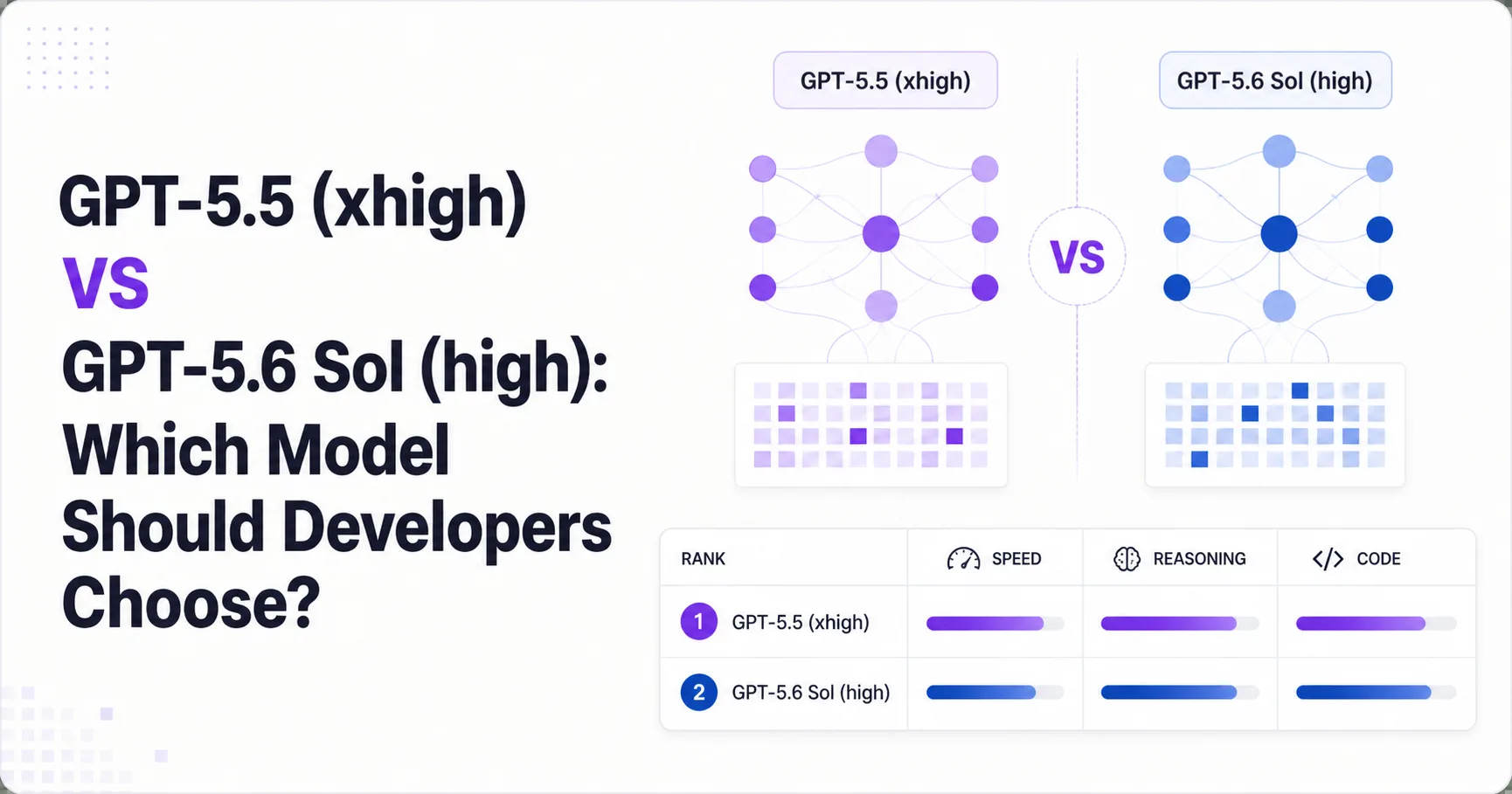
GPT-5.6 Sol (high) is the stronger default for coding-heavy selection because it leads the supplied quality indexes without a listed price premium, according to the supplied Artificial Analysis comparison. The quality lead is modest, so the recommendation is a default, not a universal verdict. GPT-5.6 Sol (high) names a model and a reasoning setting, rather than a separate high-specific model ID. OpenAI documents gpt-5.6-sol as the fixed model and gpt-5.6 as its stable alias, with reasoning.effort: high configured separately in the GPT-5.6 Sol model page and reasoning guide. GPT-5.5 (xhigh) follows the same pattern: gpt-5.5 is the model, while xhigh is an effort value, as documented in the GPT-5.5 model page and Using GPT-5.5. This distinction matters in deployment because a comparison label can create an invalid model ID or silently use the wrong effort setting. OpenAI currently presents the GPT-5.6 family as the flagship direction in its model directory, while GPT-5.5 remains directly callable with dedicated documentation and pricing. The supplied research found no official GPT-5.5 shutdown notice, so existing integrations do not need an emergency replacement. Data provided by https://artificialanalysis.ai/.
GPT-5.6 Sol (high) offers the stronger strategic fit because the supplied quality edge, current flagship positioning, and equal standard price align, based on Artificial Analysis and OpenAI's model directory. The comparison looks like this:
| Decision factor | GPT-5.5 (xhigh) | GPT-5.6 Sol (high) | Selection meaning |
|---|---|---|---|
| API shape | gpt-5.5 plus xhigh |
gpt-5.6-sol plus high |
Both labels combine a model with a reasoning setting |
| Coding Index | 74.9 | 77.2 | GPT-5.6 Sol (high) leads |
| Intelligence Index | 54.8 | 55.9 | GPT-5.6 Sol (high) leads |
| Blended price per 1M tokens | $11.25 | $11.25 | Price is tied |
| Input price per 1M tokens | $5 | $5 | Price is tied |
| Output price per 1M tokens | $30 | $30 | Price is tied |
| Latency | 0.3 seconds | 0.3 seconds | No measured latency advantage |
| Median output speed | Not supplied | 73.648 tokens per second | Speed evidence is incomplete |
The official model pages describe broadly similar developer surfaces. Both support text and image input, text output, structured outputs, function calling, file search, web search, prompt caching, and tool-oriented workflows through OpenAI APIs. These capabilities appear in the GPT-5.5 documentation and GPT-5.6 Sol documentation. The practical decision therefore rests on quality signals, model lifecycle, and workflow behavior rather than basic API coverage.
Community evidence does not produce a clean consensus. One GPT-5.5 coding discussion praises architecture review, debugging direction, planning, and long project sessions. Another GPT-5.5 discussion reports brevity, brittle code, weak domain mapping, and a need for stricter constraints. GPT-5.6 reports similarly diverge, with users describing both strong results and over-engineering or slow sessions.
GPT-5.6 Sol (high) has the clearer measured performance edge, but the evidence does not prove universal speed or task-level superiority, according to the Artificial Analysis comparison. GPT-5.6 Sol (high) reaches 77.2 on the supplied Coding Index versus 74.9 for GPT-5.5 (xhigh). Its Intelligence Index is 55.9 versus 54.8. For developer selection, the coding result is the more relevant signal because most model evaluations in this decision involve code generation, repository changes, debugging, or agent planning.
The gap should still be read as directional. An index does not reveal how many tool loops a task requires, how often a patch passes tests, or how much review a generated change needs. OpenAI positions GPT-5.5 for coding, tool-heavy agents, long-context retrieval, and complex professional work in Using GPT-5.5. OpenAI positions GPT-5.6 Sol for complex reasoning and coding in its GPT-5.6 announcement. Those positions support the use-case fit, but they do not replace repository-specific evaluation.
The speed evidence is especially incomplete. GPT-5.6 Sol (high) has a supplied median output speed of 73.648 tokens per second. GPT-5.5 has no supplied median output-speed value. Both models show 0.3 seconds of latency. A missing GPT-5.5 speed value is not a zero, so the snapshot cannot establish that GPT-5.6 Sol is faster across every workload.
Reasoning configuration can also reverse the user experience. OpenAI warns that GPT-5.5 xhigh can add delay, cost, or unproductive searching when tools are too open, instructions conflict, or stopping rules are weak in Using GPT-5.5. OpenAI's reasoning guide explains that reasoning tokens consume the output budget and can produce incomplete responses when the allowance is too low. Community reports add risk signals: users describe GPT-5.6 as slow or over-engineered in the Codex release discussion, while a Hacker News report describes investigations that drifted and improved after lowering reasoning effort. These reports are useful for test design, not population-level proof.
GPT-5.6 Sol (high) leads on 2 of 2 metrics
GPT-5.6 Sol (high) and GPT-5.5 tie on supplied prices, so execution efficiency, not list price, decides total cost, according to the Artificial Analysis comparison. Both models are listed at $5 per 1M input tokens and $30 per 1M output tokens. Both also show $11.25 per 1M blended tokens under the supplied 3-to-1 mix. There is no cheaper model in this snapshot.
The price tie removes a simple reason to prefer GPT-5.5. It does not make the invoices identical in every operating mode. OpenAI's API pricing documentation distinguishes standard, batch, flex, fast, cached, and long-context treatment. The GPT-5.6 material lists cache-write pricing, while the GPT-5.5 material does not list a separate cache-write price. Teams using prompt caching, long sessions, or asynchronous processing should therefore model the exact request pattern rather than rely only on the blended figure.
A model with the same token rate can still cost more if it needs more turns, produces more reasoning tokens, retries failed tool calls, or creates extra review work. That risk is explicit for GPT-5.5 xhigh, where OpenAI recommends using the setting only when the quality gain justifies added delay and cost in Using GPT-5.5. GPT-5.6 has a related budget issue because reasoning tokens count against the response budget, as described in the reasoning guide.
The evidence is insufficient to name a total-cost winner. The supplied data does not include task-level token usage, retry rates, tool-call volume, or success-adjusted cost for either model. For a real product, measure cost per accepted change or completed workflow, then compare that result with the tied $11.25 blended price.
GPT-5.6 Sol (high) is the default pick for a new coding agent, while GPT-5.5 remains reasonable for a validated existing xhigh workflow, based on the Artificial Analysis results and OpenAI's current model directory.
Choose GPT-5.6 Sol (high) for greenfield coding agents. The model leads the supplied Coding Index at 77.2, matches GPT-5.5 on the listed standard prices, and occupies the current flagship position in OpenAI's model catalog. The GPT-5.6 Sol model page also gives the deployment path clearly: use gpt-5.6-sol or its stable alias, then set the reasoning effort separately.
Keep GPT-5.5 when the existing system already works. GPT-5.5 remains directly callable as gpt-5.5, and the GPT-5.5 model page continues to document its API surface. A prompt library, tool harness, or evaluation suite tuned for xhigh can be worth preserving until GPT-5.6 passes the same acceptance tests.
Treat reasoning effort as a product setting. Do not assume high or xhigh is automatically best. OpenAI recommends explicit success criteria, test expectations, reuse rules, delegation boundaries, and stopping conditions in Using GPT-5.5. The reasoning models guide adds budget and incomplete-response constraints.
Run a controlled migration test before switching traffic. Use the same repository tasks, tool permissions, prompts, output limits, and acceptance checks. A Hacker News rewrite-task report shows why configuration-level testing can expose differences, but its limited task scope cannot establish a universal winner.
The final choice should be based on accepted task outcomes, not release recency alone. GPT-5.6 Sol (high) is the recommended starting point, while GPT-5.5 stays justified when its existing workflow has already demonstrated reliable results.
GPT-5.6 Sol (high) is the safer starting point for most developer evaluations, but GPT-5.5 deserves a control run when an existing xhigh workflow already performs well, according to Artificial Analysis and Using GPT-5.5. The unresolved questions are practical: whether the measured quality lead survives your repository, whether missing speed data hides a throughput tradeoff, and whether reasoning behavior increases retries or review effort. The supplied sources do not provide a reproducible independent benchmark for average success, speed, or cost-adjusted productivity. The FAQ separates measured facts from working recommendations.
GPT-5.6 Sol (high) is the better measured coding choice in the supplied snapshot, with a Coding Index of 77.2 versus 74.9, according to the Artificial Analysis comparison. That edge should guide testing, not replace task-level validation, because community reports lack standardized evaluation methods.
GPT-5.6 Sol (high) is not more expensive in the supplied standard snapshot: both models list $5 input, $30 output, and $11.25 blended per 1M tokens. OpenAI pricing shows that service mode, caching, and context treatment can still alter invoices.
GPT-5.6 Sol (high) is the only model with a supplied median output-speed value, 73.648 tokens per second, while both models show 0.3 seconds of latency according to Artificial Analysis. GPT-5.5 cannot be declared slower because its speed field is missing.
GPT-5.6 Sol (high) is configured with reasoning.effort: high, not a separate gpt-5.6-sol-high model ID; GPT-5.5 xhigh follows the same model-plus-setting pattern. The GPT-5.6 Sol model page, GPT-5.5 model page, and reasoning guide document this separation.
GPT-5.6 Sol (high) merits a controlled migration trial rather than an automatic replacement. OpenAI's current model directory favors the newer family, but community reports describe slow, over-engineered, or directionally uncertain sessions in the GPT-5.6 release discussion and Hacker News, so acceptance tests should decide.