
Time to First Token · GPT-5.5 (xhigh)
0ms
Time to First Token · GPT-5 nano (high)
0ms
Deep dive into reasoning, benchmarks, and latency insights.
The current catalog does not contain complete performance evidence for both models, so this page does not declare an overall winner. Use the available fields as comparison signals and validate the models on your own workload.
Key decision metrics at a glance.
| Model | Metric | Value | Unit | Source / snapshot |
|---|---|---|---|---|
| GPT-5.5 (xhigh) | Reasoning | 6.0 | benchmark or capability score | Artificial Analysis · current catalog |
| GPT-5 nano (high) | Reasoning | 8.0 | benchmark or capability score | Artificial Analysis · current catalog |
| GPT-5.5 (xhigh) | Coding | 7.0 | benchmark or capability score | Artificial Analysis · current catalog |
| GPT-5 nano (high) | Coding | 6.0 | benchmark or capability score | Artificial Analysis · current catalog |
| GPT-5.5 (xhigh) | Multimodal | 5.0 | benchmark or capability score | Artificial Analysis · current catalog |
| GPT-5 nano (high) | Multimodal | 2.0 | benchmark or capability score | Artificial Analysis · current catalog |
| GPT-5.5 (xhigh) | Long Context | 7.0 | benchmark or capability score | Artificial Analysis · current catalog |
| GPT-5 nano (high) | Long Context | 3.0 | benchmark or capability score | Artificial Analysis · current catalog |
| GPT-5.5 (xhigh) | Blended Price / 1M tokens | $11.25 | USD per 1M tokens | Artificial Analysis · current catalog |
| GPT-5 nano (high) | Blended Price / 1M tokens | $0.138 | USD per 1M tokens | Artificial Analysis · current catalog |
| GPT-5.5 (xhigh) | P95 Latency | — | milliseconds | Artificial Analysis · current catalog |
| GPT-5 nano (high) | P95 Latency | — | milliseconds | Artificial Analysis · current catalog |
| GPT-5.5 (xhigh) | Tokens per second | 0 | tokens per second | Artificial Analysis · current catalog |
| GPT-5 nano (high) | Tokens per second | 0 | tokens per second | Artificial Analysis · current catalog |
Data provided by Artificial Analysis; live values use the current catalog.
This radar chart visually maps the core capabilities (reasoning, coding, math proxy, multimodal, long context) of `GPT-5.5 (xhigh)` vs `GPT-5 nano (high)`.
This grouped bar chart provides a side-by-side comparison for each benchmark metric.
Lower time to first token is better; higher tokens per second is better.
Compare input and output pricing in USD per 1M tokens.
GPT-5.5 (xhigh)$12.5
GPT-5 nano (high)$0.15
GPT-5 nano (high) costs $12.35 less per run
This article is a dated snapshot published on 2026-08-07. Live cards above use the current catalog; missing live fields are not inferred.
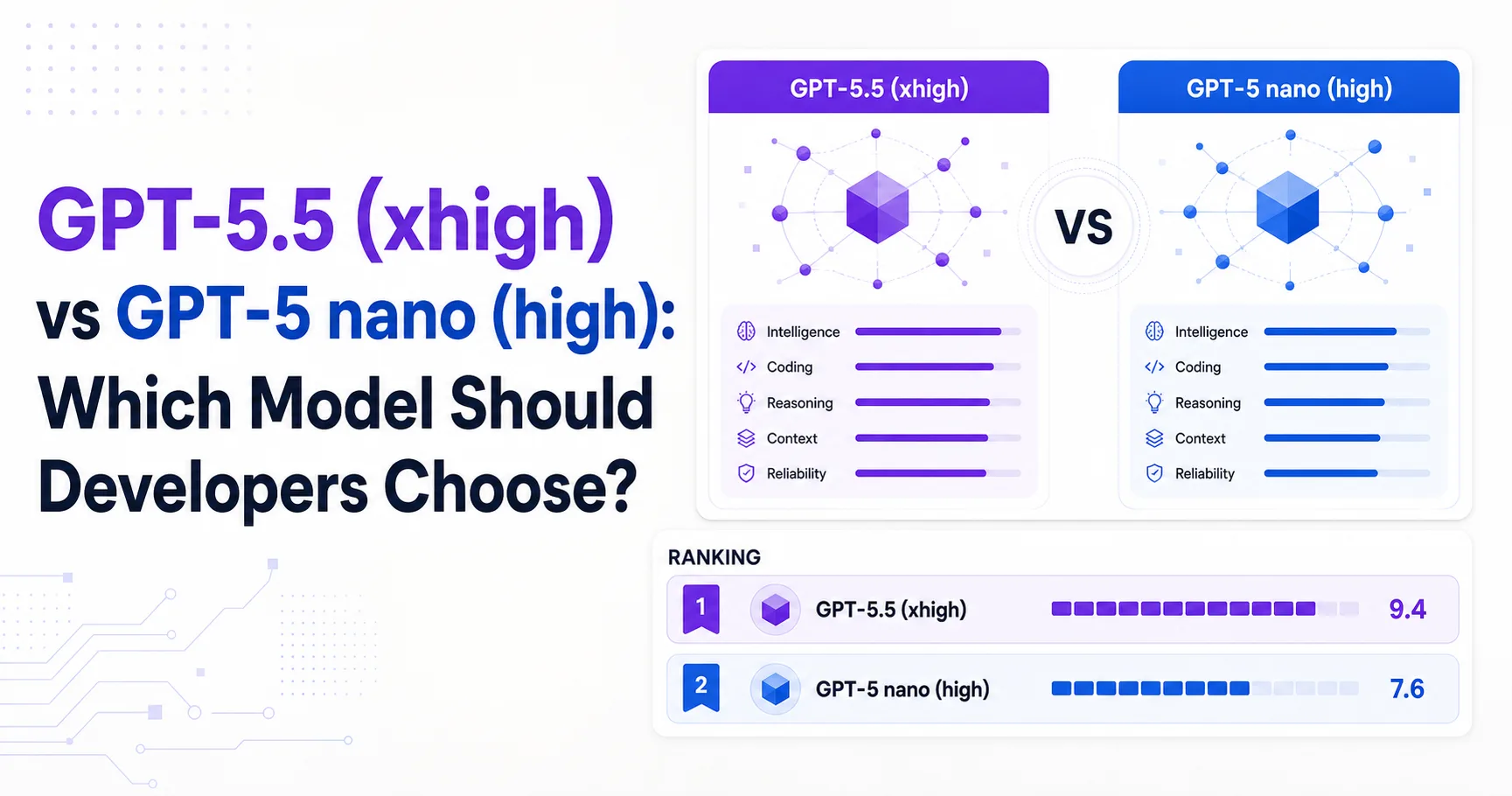
GPT-5.5 (xhigh) is the safer choice for demanding developer workflows, while GPT-5 nano (high) is a far cheaper option with unresolved availability and capability evidence.
The comparison is asymmetric. GPT-5.5 has a current model document, a stable model ID, documented reasoning controls, published tool support, and a current pricing entry at OpenAI’s GPT-5.5 model documentation. GPT-5 nano (high) appears in the supplied evaluation data, but the current OpenAI model directory does not list GPT-5 nano or gpt-5-nano.
That difference changes the selection question. Developers are not choosing between two equally documented products. They are choosing between a documented production model and a low-cost model whose current endpoint, limits, and official positioning cannot be confirmed from the available official pages.
Data provided by https://artificialanalysis.ai/ supplies the comparative evaluation and pricing snapshot used in this article. The snapshot reports GPT-5.5 at 54.8 on the Intelligence Index and GPT-5 nano at 19.9. It also reports the nano model at 83.7 on the Math Index, which prevents a simple claim that GPT-5.5 dominates every specialized task.
For most teams, GPT-5.5 should be the default candidate for evaluation. GPT-5 nano deserves consideration only when its actual endpoint, limits, and task-specific behavior have been verified in the target environment.
GPT-5.5 (xhigh) offers the stronger general-purpose developer profile, while GPT-5 nano (high) wins decisively on the supplied blended-token price.
| Decision factor | GPT-5.5 (xhigh) | GPT-5 nano (high) | Selection meaning |
|---|---|---|---|
| Intelligence Index | 54.8 | 19.9 | GPT-5.5 has the stronger broad capability signal |
| Math Index | Not available | 83.7 | Nano may suit narrow mathematical workloads, but evidence is incomplete |
| Coding Index | 74.9 | Not available | GPT-5.5 has the available coding signal |
| Blended price per 1M tokens | $11.25 | $0.1375 | Nano is dramatically cheaper in the supplied snapshot |
| Latency | 0.3 seconds | 0.3 seconds | The snapshot shows a tie |
| Release date | 2026-04-23 | 2025-08-07 | The models have different release histories |
GPT-5.5 is documented for complex professional work, coding, tool-intensive agents, long-context retrieval, and converting product specifications into plans in Using GPT-5.5. Those use cases align closely with the needs of developers building systems rather than isolated text transformations.
GPT-5 nano cannot be assessed with the same confidence. The official directory does not provide a dedicated model entry, and the current OpenAI pricing page lists gpt-5.4-nano, not gpt-5-nano. The supplied data therefore supports a cost advantage, but it does not prove that the model is currently callable, stable, or suitable for production.
The practical summary is simple: choose GPT-5.5 for uncertain, multi-step, or code-heavy work. Test GPT-5 nano only for workloads where low cost is the primary objective and the endpoint can be independently confirmed.
GPT-5.5 (xhigh) is the stronger performance candidate for general developer work, even though the supplied latency snapshot shows no speed advantage.
The chart’s equal 0.3-second latency should not be read as equal usefulness. Latency measures how quickly a request is served, while developer value depends on whether the response identifies the right architecture, preserves constraints, edits safely, and completes tool-driven work. The supplied Intelligence Index gives GPT-5.5 a 54.8 score compared with 19.9 for GPT-5 nano. That gap is more relevant to open-ended engineering tasks than a tied latency figure.
The available coding evidence also favors GPT-5.5 because the snapshot reports a Coding Index of 74.9 for GPT-5.5 and no corresponding nano value. This does not establish a complete coding ranking. It does establish that the evidence is stronger for GPT-5.5 in the area most developers are likely to care about.
GPT-5.5’s documented support for structured outputs, function calling, file search, web search, Code Interpreter, hosted shell, computer use, and MCP appears in the GPT-5.5 model documentation. These tools can reduce application-side orchestration, but they also create more failure paths. The guide recommends explicit reuse requirements, testing expectations, acceptance criteria, and stopping conditions in Using GPT-5.5.
GPT-5 nano may still be attractive for narrow mathematical or highly repetitive tasks because its supplied Math Index is 83.7. The evidence is insufficient to know whether that result transfers to the intended prompts, API endpoint, or production constraints. No comparable nano coding, context, tool, or failure data is available.
GPT-5 nano (high) is the clear unit-cost winner, but GPT-5.5 (xhigh) can be cheaper for workflows where weak outputs create retries, review, or repair work.
The supplied blended price is $0.1375 per 1M tokens for GPT-5 nano and $11.25 for GPT-5.5. That difference makes nano compelling for high-volume classification, routing, extraction, or other tasks with narrow acceptance criteria. It also makes nano a reasonable candidate for a cheap first-pass system if a verified endpoint exists.
Price alone is less decisive for engineering agents. A model that produces an incomplete plan, fragile code, or an incorrect domain mapping may require additional calls and human review. The available GPT-5.5 community evidence describes useful architecture feedback, debugging direction, planning, and code review in long project sessions, although the reports do not provide reproducible tests in this r/AIcodingProfessionals discussion. A separate discussion reports concerns about terse answers, brittle implementation choices, and weak domain mapping in this r/codex thread.
Those reports do not prove a total cost advantage for GPT-5.5. They show why application cost should include retries, review, test failures, and correction time. GPT-5.5’s official pricing also has different short-context, long-context, Batch, Flex, and Fast mode conditions in OpenAI API Pricing. The supplied comparison uses the blended value, so teams should validate their own input-output mix before budgeting.
The largest cost risk is selecting nano because it is cheap before confirming that it is available and production-ready. A low listed price is not an operational saving if the model cannot be called reliably.
GPT-5 nano (high) leads on 3 of 3 metrics
GPT-5.5 (xhigh) has a verifiable current API identity, while GPT-5 nano (high) has an unresolved product-status problem.
GPT-5.5 uses the stable model ID gpt-5.5, with the documented snapshot gpt-5.5-2026-04-23, according to the GPT-5.5 model page. The same documentation identifies xhigh as a reasoning-effort setting rather than a separate model ID. That distinction matters for implementation, logging, and future migration.
GPT-5 nano is different. The current official model directory does not list GPT-5 nano, gpt-5-nano, or gpt-5-nano-2025-08-07, according to OpenAI’s models page. The current pricing page also does not list gpt-5-nano; it lists gpt-5.4-nano instead in OpenAI API Pricing. The available evidence does not establish whether the nano entry in the data snapshot is a legacy endpoint, an evaluation label, or a model still accessible through a separate environment.
The release dates in the supplied data are also different: GPT-5.5 is dated 2026-04-23, while GPT-5 nano is dated 2025-08-07. Release age alone does not determine quality, but it increases the need to verify aliases, documentation, and support status before building a dependency around nano.
This is the most important unanswered question in the comparison. No available source confirms nano’s current API contract, context window, maximum output, supported parameters, or deprecation state. Teams should treat those fields as unknown, not as inherited from another nano model.
GPT-5.5 (xhigh) should be the default choice for complex development workflows, while GPT-5 nano (high) should be a gated experiment for verified narrow tasks.
Choose GPT-5.5 when the system must reason across a repository, translate product requirements into implementation plans, call tools, preserve long context, or produce code that passes review with limited correction. OpenAI positions GPT-5.5 for complex professional work and tool-intensive agents in Using GPT-5.5. The supplied data also gives it the available general Intelligence Index and Coding Index signals.
Choose GPT-5 nano only when all of the following conditions hold: the actual endpoint is confirmed, the task has a narrow acceptance test, failure recovery is inexpensive, and the workload benefits from the $0.1375 blended price. Mathematical workloads deserve a specific experiment because nano has a supplied Math Index of 83.7. That result should not be generalized to coding, agent planning, or tool use because those measurements are unavailable.
A two-tier architecture may be sensible. Use nano for low-risk screening or simple transformations, then route uncertain cases to GPT-5.5. The routing policy should be based on observable failure signals, such as schema violations, low retrieval confidence, test failures, or unresolved tool calls. The supplied materials do not provide routing thresholds, so teams must establish them with their own workload.
Do not set GPT-5.5 to xhigh by default. OpenAI advises using higher reasoning effort only when measured quality gains justify additional latency and cost, and warns that open-ended tools, conflicting instructions, or weak stopping conditions can cause unproductive searching in Using GPT-5.5.
The final recommendation is therefore conditional but clear: start the production evaluation with GPT-5.5, and add GPT-5 nano only after availability and task-specific quality are verified.
GPT-5 nano (high) cannot be responsibly selected for production until its current identity and operating limits are verified.
The supplied materials do not establish nano’s context window, maximum output, supported APIs, tool support, reasoning controls, or official benchmark coverage. The official model directory provides only a general description of current OpenAI model capabilities and does not explicitly identify GPT-5 nano, as shown on OpenAI’s models page.
The materials also do not provide a reproducible head-to-head coding test. GPT-5.5 has a Coding Index of 74.9 in the supplied data, but nano has no coding value. Nano has a Math Index of 83.7, but GPT-5.5 has no corresponding math value. These missing cells prevent a complete capability ranking.
Community evidence is similarly incomplete. Positive GPT-5.5 reports describe architecture, debugging, planning, and large refactors, while negative reports describe terse explanations, brittle code, and domain-modeling problems. The discussions do not disclose a shared test set, sample size, or controlled comparison in the positive coding workflow discussion and the mixed r/codex discussion.
The evidence is therefore strong enough for a risk-aware default, not for universal claims. GPT-5.5 has the clearer production case. GPT-5 nano has the clearer price case. The materials do not show whether nano can deliver that price advantage on a verified, supported production endpoint.
GPT-5.5 (xhigh) is the model teams can validate immediately from the supplied official documentation, while GPT-5 nano requires an availability check before deeper testing.
The questions below focus on decisions that the benchmark chart cannot settle. They separate measured signals from unknown operational facts, so a team can turn this comparison into a practical evaluation plan.
GPT-5.5 (xhigh) is the better-supported coding choice because the supplied data reports a Coding Index of 74.9, while GPT-5 nano has no coding score and no confirmed current API documentation. The result still requires validation on the team’s repository, tests, and tool workflow.
GPT-5 nano (high) is worth testing when unit cost dominates and the task has narrow, inexpensive failure recovery. Its supplied blended price is $0.1375 per 1M tokens, and its Math Index is 83.7, but its current endpoint and general developer capabilities remain unconfirmed.
The supplied snapshot shows a latency of 0.3 seconds for GPT-5.5 and 0.3 seconds for GPT-5 nano, so the measured result is a tie. It does not establish equal output speed, tool completion time, retry rate, or end-to-end workflow duration.
The available evidence does not confirm that GPT-5 nano can be used as a stable production dependency today. The current OpenAI model directory and pricing page do not list it, so teams must verify the endpoint, alias, limits, support status, and billing behavior directly.
Developers should not always use xhigh reasoning effort with GPT-5.5. OpenAI recommends choosing higher effort only when measured quality gains justify added cost and latency, and warns that weak stopping conditions or open-ended tools can produce unproductive searches.