
Time to First Token · GPT-5.5 (xhigh)
0ms
Time to First Token · o3
7185ms
Deep dive into reasoning, benchmarks, and latency insights.
The current catalog does not contain complete performance evidence for both models, so this page does not declare an overall winner. Use the available fields as comparison signals and validate the models on your own workload.
Key decision metrics at a glance.
| Model | Metric | Value | Unit | Source / snapshot |
|---|---|---|---|---|
| GPT-5.5 (xhigh) | Reasoning | 6.0 | benchmark or capability score | Artificial Analysis · current catalog |
| o3 | Reasoning | 9.0 | benchmark or capability score | Artificial Analysis · current catalog |
| GPT-5.5 (xhigh) | Coding | 7.0 | benchmark or capability score | Artificial Analysis · current catalog |
| o3 | Coding | 6.0 | benchmark or capability score | Artificial Analysis · current catalog |
| GPT-5.5 (xhigh) | Multimodal | 5.0 | benchmark or capability score | Artificial Analysis · current catalog |
| o3 | Multimodal | 3.0 | benchmark or capability score | Artificial Analysis · current catalog |
| GPT-5.5 (xhigh) | Long Context | 7.0 | benchmark or capability score | Artificial Analysis · current catalog |
| o3 | Long Context | 4.0 | benchmark or capability score | Artificial Analysis · current catalog |
| GPT-5.5 (xhigh) | Blended Price / 1M tokens | $11.25 | USD per 1M tokens | Artificial Analysis · current catalog |
| o3 | Blended Price / 1M tokens | $3.5 | USD per 1M tokens | Artificial Analysis · current catalog |
| GPT-5.5 (xhigh) | P95 Latency | — | milliseconds | Artificial Analysis · current catalog |
| o3 | P95 Latency | — | milliseconds | Artificial Analysis · current catalog |
| GPT-5.5 (xhigh) | Tokens per second | 0 | tokens per second | Artificial Analysis · current catalog |
| o3 | Tokens per second | 119.185 | tokens per second | Artificial Analysis · current catalog |
Data provided by Artificial Analysis; live values use the current catalog.
This radar chart visually maps the core capabilities (reasoning, coding, math proxy, multimodal, long context) of `GPT-5.5 (xhigh)` vs `o3`.
This grouped bar chart provides a side-by-side comparison for each benchmark metric.
Lower time to first token is better; higher tokens per second is better.
Compare input and output pricing in USD per 1M tokens.
GPT-5.5 (xhigh)$12.5
o3$4
o3 costs $8.5 less per run
This article is a dated snapshot published on 2026-08-07. Live cards above use the current catalog; missing live fields are not inferred.
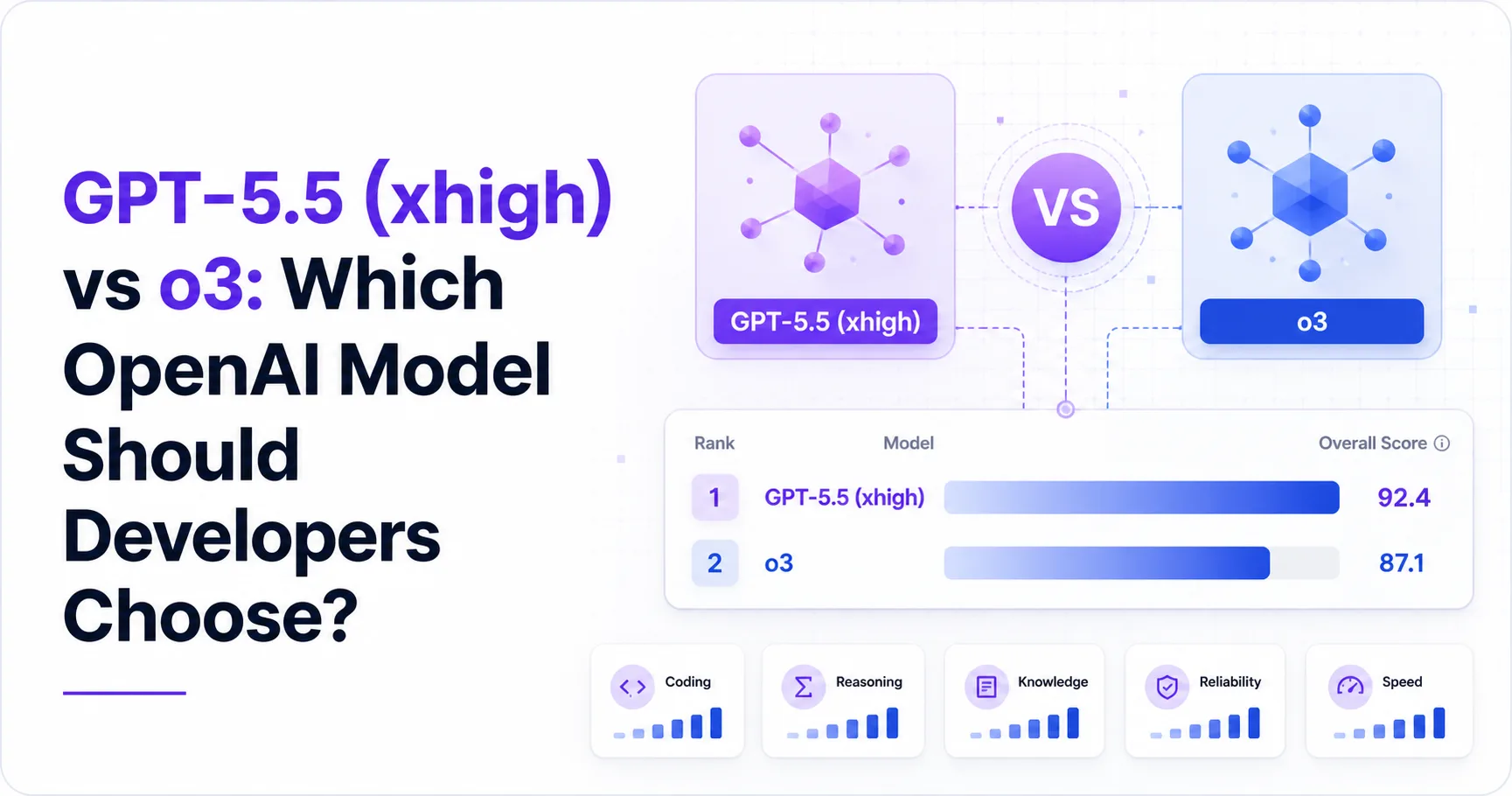
GPT-5.5 (xhigh) is the stronger default for demanding developer workflows, while o3 is the lower-cost choice with a reported output speed of 128.056 median output tokens per second. The Artificial Analysis Intelligence Index gives GPT-5.5 a score of 54.8 and o3 a score of 30.4, but the available evidence does not establish a complete coding or speed comparison. Artificial Analysis provides the comparison data used in this article.
GPT-5.5 is an OpenAI reasoning model identified by the stable model ID gpt-5.5; xhigh describes the reasoning.effort setting rather than a separate model. OpenAI’s GPT-5.5 model documentation lists none, low, medium, high, and xhigh as supported effort levels, with medium as the default.
The practical decision is therefore not simply “newer versus older.” GPT-5.5 has current, detailed documentation and a stated focus on complex professional work. o3 has a lower listed price in the supplied data, but the provided official material does not confirm its current API availability, stable alias, context window, or supported features. OpenAI’s model directory currently emphasizes the GPT-5.6 family and does not list o3.
GPT-5.5 offers the stronger documented platform position, while o3 offers a major cost advantage and the only reported output-speed figure in the supplied data.
GPT-5.5 scores 54.8 on the Artificial Analysis Intelligence Index, compared with 30.4 for o3. That 24.4-point gap is the clearest direct capability signal in the dataset. It suggests that GPT-5.5 is the safer candidate for applications requiring broad reasoning, planning, and multi-step task execution. The score does not prove superiority on every workload, because the supplied comparison does not include a directly comparable o3 coding score.
GPT-5.5 also has a reported Artificial Analysis Coding Index score of 74.9. No o3 coding score is provided, so developers should not describe GPT-5.5 as the coding benchmark winner from this dataset alone. The comparison is asymmetric. o3 instead has a reported Artificial Analysis Math Index score of 88.3, while GPT-5.5 has no corresponding value. The available evidence therefore supports a broad-intelligence advantage for GPT-5.5, but it does not resolve the math-specialist question.
The platform evidence favors GPT-5.5 more clearly than the benchmark evidence. GPT-5.5’s model documentation documents a 1,050,000-token context window, a 128,000-token maximum output, text and image input, and support for Responses API, Chat Completions API, and Batch API. It also documents structured outputs, function calling, file search, web search, image generation, Code Interpreter, Hosted Shell, apply_patch, Skills, Computer Use, and MCP.
The evidence for o3 is materially thinner. The current OpenAI model directory does not list o3, and the supplied official material does not verify its current endpoint, stable alias, context capacity, output limit, or multimodal support. That absence is not proof that o3 cannot be called. It is a deployment-risk signal because a developer cannot verify those properties from the supplied official sources.
GPT-5.5 is the better-supported performance choice for complex engineering workflows, but the available speed data cannot prove that it generates tokens faster than o3.
The direct capability evidence points toward GPT-5.5 for broad developer work. Its Artificial Analysis Intelligence Index is 54.8 versus 30.4 for o3, a difference of 24.4. GPT-5.5 also has a reported Coding Index value of 74.9. In practical terms, these signals make GPT-5.5 the more defensible candidate for tasks that combine code generation with architecture decisions, repository planning, debugging, tool use, and long-running context. OpenAI describes GPT-5.5 as targeting complex professional work, coding, tool-heavy agents, long-context retrieval, and the conversion of product specifications into plans.
The chart cannot answer whether GPT-5.5 produces tokens faster. The supplied data reports 128.056 median output tokens per second for o3 and no value for GPT-5.5. Both models have a reported latency of 0.3 seconds, so latency is a tie in this snapshot. Developers should separate request latency from sustained generation speed. A model may begin responding at the same time while producing the rest of a long answer at a different rate.
The o3 math result complicates a simple “GPT-5.5 wins” conclusion. o3 records 88.3 on the Artificial Analysis Math Index, while GPT-5.5 has no supplied value. That result may make o3 attractive for narrowly defined mathematical workloads, but the material does not explain test composition, prompt distribution, or operational reliability. No official o3 benchmark result is available in the supplied research.
Community evidence supports the value of GPT-5.5 for architecture, debugging direction, planning, code review, and long project sessions, but the reports are personal experiences without reproducible test sets. One developer discussion describes useful feedback after one or two attempts. Another discussion reports disagreement about xhigh, code maintainability, domain modeling, and large refactors. These reports should guide pilot design, not replace it.
o3 is the clear price winner at $3.5 per 1M blended tokens, but GPT-5.5 can be cheaper at the system level if it prevents retries, review cycles, or orchestration overhead.
The supplied price comparison shows o3 at $3.5 per 1M blended tokens versus GPT-5.5 at $11.25. o3 also costs $2 per 1M input tokens and $8 per 1M output tokens, compared with GPT-5.5 at $5 and $30. The output-price gap matters most for verbose agents, code explanations, repository plans, and tool-driven workflows that return large responses.
A token price is not the same as a task price. If o3 requires more attempts, stricter external validation, or a second model for planning and review, its lower unit price may not produce a lower cost per accepted change. The supplied research does not provide retry rates, success rates, token utilization, or production workload distributions, so no reliable break-even point can be calculated.
GPT-5.5’s official pricing adds operational conditions that can materially change its economics. OpenAI’s pricing page lists Standard short-context pricing at $5 input and $30 output per 1M tokens, with separate long-context prices. It also lists Batch, Flex, and Fast mode pricing. The GPT-5.5 model documentation states that sessions exceeding 272K input tokens receive higher Standard, Batch, and Flex charges, with full-session input charged at 2 times the input price and output charged at 1.5 times the output price.
Long-context coding agents therefore need a budget policy. Reusing a large repository context can improve continuity, but it can also push requests into a more expensive pricing tier. Cached input, Batch, or Flex may change the decision for asynchronous workloads, while Fast mode raises the price for latency-sensitive workloads. The supplied o3 material does not confirm whether comparable modes or long-context rules exist today.
o3 leads on 3 of 3 metrics
GPT-5.5 is the recommended primary model for complex engineering agents, while o3 is the better candidate for cost-sensitive experiments and narrowly scoped mathematical work.
Choose GPT-5.5 when the application must translate requirements into implementation plans, inspect a large codebase, call tools, preserve long context, or produce changes that need strong architectural judgment. Its documented tool surface and 1,050,000-token context window make the integration story easier to validate. OpenAI’s GPT-5.5 usage guide recommends explicit instructions for reuse, delegation, testing expectations, acceptance criteria, and stop conditions. That guidance implies an important design rule: GPT-5.5 is capable, but it still needs an orchestrator with clear boundaries.
Use xhigh selectively. OpenAI states that higher reasoning effort should be used only when measured quality gains justify extra latency and cost. The same guidance warns that conflicting instructions, unrestricted tool access, and weak stopping conditions can cause excessive searching, additional cost, or lower-quality results. A practical rollout should compare medium, high, and xhigh on accepted-task rate, not on response impressiveness.
Consider o3 when unit economics dominate, the task is short and well specified, or the workload is mathematical and the reported Math Index score of 88.3 matches your evaluation set. The current evidence does not establish whether o3 remains directly callable or how its current API behaves. Confirm those facts before committing production architecture to it. OpenAI’s model directory and OpenAI’s pricing page do not currently provide that confirmation in the supplied material.
Do not select either model solely from community anecdotes. Reports about GPT-5.5 range from strong large-refactor performance to concerns about terse explanations, fragile code, weak domain mapping, and monolithic changes. The positive workflow report and the mixed experience report lack controlled methodology. Build a private evaluation using representative repositories, acceptance tests, tool permissions, retry limits, and a fixed cost budget.
GPT-5.5 should be piloted against your real acceptance criteria because the supplied comparison leaves important o3 deployment and coding evidence unresolved.
The most important unanswered questions concern o3’s current API availability, stable model naming, context capacity, supported tools, and production pricing. The research explicitly marks those facts as not found. A developer choosing o3 should verify them directly before implementation. A developer choosing GPT-5.5 should still test reasoning effort, tool boundaries, output length, and long-context cost against real workloads.
GPT-5.5 is the safer coding choice based on the available evidence, because it has a reported Coding Index score of 74.9 and documented support for complex coding agents. However, no comparable o3 coding score is supplied, so the dataset cannot prove a coding win.
o3 is cheaper in the supplied comparison, costing $3.5 per 1M blended tokens versus $11.25 for GPT-5.5. Its listed input price is $2 and output price is $8 per 1M tokens, compared with GPT-5.5 at $5 and $30.
o3 has the only reported sustained generation figure, at 128.056 median output tokens per second. Both models have a reported latency of 0.3 seconds, while GPT-5.5 has no supplied median output-speed value, so overall speed superiority remains unproven.
Developers should not use GPT-5.5 xhigh by default. OpenAI recommends selecting higher reasoning effort only when measured quality gains justify additional latency and cost, and warns that weak stop conditions or open-ended tools can reduce efficiency and quality.
The supplied official material does not confirm whether o3 is still directly callable, whether it has a stable alias, or which endpoint supports it. The current model directory does not list o3, so developers should verify availability before production planning.