
Time to First Token · GPT-5.6 Sol (low)
2516ms
Time to First Token · o3
7185ms
Deep dive into reasoning, benchmarks, and latency insights.
The current catalog does not contain complete performance evidence for both models, so this page does not declare an overall winner. Use the available fields as comparison signals and validate the models on your own workload.
Key decision metrics at a glance.
| Model | Metric | Value | Unit | Source / snapshot |
|---|---|---|---|---|
| GPT-5.6 Sol (low) | Reasoning | 6.0 | benchmark or capability score | Artificial Analysis · current catalog |
| o3 | Reasoning | 9.0 | benchmark or capability score | Artificial Analysis · current catalog |
| GPT-5.6 Sol (low) | Coding | 7.0 | benchmark or capability score | Artificial Analysis · current catalog |
| o3 | Coding | 6.0 | benchmark or capability score | Artificial Analysis · current catalog |
| GPT-5.6 Sol (low) | Multimodal | 4.0 | benchmark or capability score | Artificial Analysis · current catalog |
| o3 | Multimodal | 3.0 | benchmark or capability score | Artificial Analysis · current catalog |
| GPT-5.6 Sol (low) | Long Context | 6.0 | benchmark or capability score | Artificial Analysis · current catalog |
| o3 | Long Context | 4.0 | benchmark or capability score | Artificial Analysis · current catalog |
| GPT-5.6 Sol (low) | Blended Price / 1M tokens | $11.25 | USD per 1M tokens | Artificial Analysis · current catalog |
| o3 | Blended Price / 1M tokens | $3.5 | USD per 1M tokens | Artificial Analysis · current catalog |
| GPT-5.6 Sol (low) | P95 Latency | — | milliseconds | Artificial Analysis · current catalog |
| o3 | P95 Latency | — | milliseconds | Artificial Analysis · current catalog |
| GPT-5.6 Sol (low) | Tokens per second | 58.884 | tokens per second | Artificial Analysis · current catalog |
| o3 | Tokens per second | 119.185 | tokens per second | Artificial Analysis · current catalog |
Data provided by Artificial Analysis; live values use the current catalog.
This radar chart visually maps the core capabilities (reasoning, coding, math proxy, multimodal, long context) of `GPT-5.6 Sol (low)` vs `o3`.
This grouped bar chart provides a side-by-side comparison for each benchmark metric.
Lower time to first token is better; higher tokens per second is better.
Compare input and output pricing in USD per 1M tokens.
GPT-5.6 Sol (low)$12.5
o3$4
o3 costs $8.5 less per run
This article is a dated snapshot published on 2026-08-07. Live cards above use the current catalog; missing live fields are not inferred.
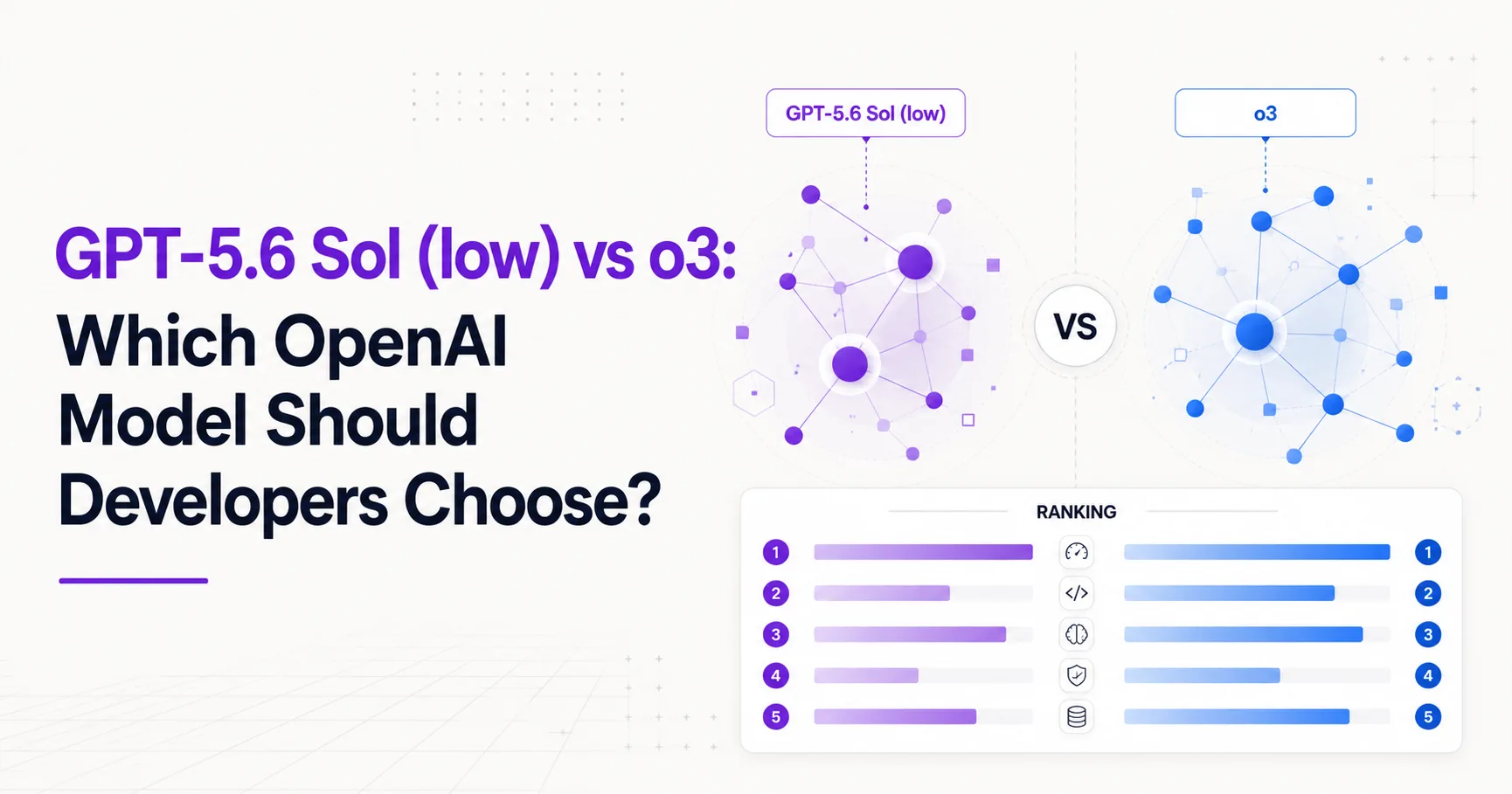
gpt-5-6-sol-low is an independently callable or separately priced modelGPT-5.6 Sol (low) is the stronger measured general-purpose option, while o3 is faster, cheaper, and stronger on the available math index.
The choice is not simply a quality-versus-price decision. The supplied evidence shows a large gap on the Artificial Analysis Intelligence Index, a separate math result for o3, and a coding result only for GPT-5.6 Sol (low). It also shows a major cost advantage for o3 and a higher median output speed.
A separate operational concern affects the decision. OpenAI’s current model documentation describes the gpt-5.6-sol family, but does not clearly identify gpt-5-6-sol-low as an independently callable alias. OpenAI also does not currently expose o3 in the supplied model-directory evidence. Developers should therefore validate availability and billing behavior in their own account before committing production traffic. OpenAI Models
GPT-5.6 Sol (low) leads the available broad intelligence comparison, but o3 offers the clearer value proposition for cost-sensitive and latency-sensitive workloads.
GPT-5.6 Sol (low) records an Artificial Analysis Intelligence Index of 49.4, compared with 30.4 for o3. The available difference is 19 points in favor of GPT-5.6 Sol (low). That result supports choosing Sol for workloads where broad reasoning quality is the primary selection criterion.
o3 has an available Artificial Analysis Math Index of 88.3, while no corresponding math value is supplied for GPT-5.6 Sol (low). GPT-5.6 Sol (low) has an available Artificial Analysis Coding Index of 69.7, while no corresponding coding value is supplied for o3. These are incomplete cross-model comparisons, so neither result proves superiority across every technical domain.
o3 costs $3.5 per 1M blended tokens, compared with $11.25 for GPT-5.6 Sol (low). o3 also costs $2 per 1M input tokens and $8 per 1M output tokens, versus $5 and $30 for GPT-5.6 Sol (low). The output price gap is especially important for long answers, agent traces, code generation, and iterative debugging.
Data provided by https://artificialanalysis.ai/
OpenAI positions gpt-5.6-sol as a flagship model for complex reasoning and coding, but the supplied documentation does not separately confirm the low configuration. OpenAI Models
o3 is the faster model, but GPT-5.6 Sol (low) has the stronger available broad-intelligence result.
The measured output-speed difference is substantial: o3 reaches 128.056 median output tokens per second, while GPT-5.6 Sol (low) reaches 69.917. That advantage should matter in interactive developer tools, streaming responses, terminal assistants, and workflows where users judge quality through both correctness and waiting time. The supplied latency value is 0.3 seconds for each model, so the speed result does not imply a difference in initial response latency.
GPT-5.6 Sol (low) scores 49.4 on the Artificial Analysis Intelligence Index, compared with 30.4 for o3. A broad index result favors Sol for mixed workloads that combine planning, explanation, synthesis, and coding-related reasoning. It does not establish that Sol wins every specialized task.
o3’s available Math Index value is 88.3. That makes o3 a serious candidate for mathematically demanding workloads, even though the supplied material does not provide a directly comparable math value for GPT-5.6 Sol (low). GPT-5.6 Sol (low) has a Coding Index value of 69.7, but the supplied material does not provide an equivalent coding value for o3. The evidence therefore supports a directional choice, not a complete benchmark ranking.
The qualitative evidence is also limited. No reliably verifiable community posts or disclosed test methods were supplied for either model’s coding experience, speed perception, behavioral preferences, or failure cases. Developers should treat benchmark separation as useful screening evidence, then test representative prompts, tool calls, retries, and structured outputs before deployment.
o3 is the clear price winner, especially for output-heavy developer workloads.
The blended price is $3.5 per 1M tokens for o3 and $11.25 for GPT-5.6 Sol (low). Input pricing is $2 for o3 versus $5 for GPT-5.6 Sol (low), while output pricing is $8 versus $30. The output difference matters more than the input difference when a workflow generates long explanations, code patches, test plans, or multi-step agent transcripts.
The cheaper model can become the more expensive operational choice if it requires more retries, more repair prompts, or additional validation passes. The supplied data does not measure reliability, retry frequency, tool-use success, or production task completion. Evidence is therefore insufficient to convert token prices into a total cost of ownership.
GPT-5.6 Sol (low) may still justify its higher price when its broad intelligence advantage reduces human review or shortens a multi-turn task. That claim remains a hypothesis because the supplied research does not provide task-completion rates, production case studies, or controlled cost-per-success measurements.
OpenAI’s pricing page lists gpt-5.6-sol prices, but it does not separately confirm a price for gpt-5-6-sol-low. The listed standard-mode figures are therefore not proof of an independent low-configuration price. OpenAI Pricing
o3 leads on 3 of 3 metrics
GPT-5.6 Sol (low) is the better default for broad reasoning and coding evaluation, while o3 is the better default for speed and cost control.
Choose GPT-5.6 Sol (low) when your application combines several difficult behaviors in one request: planning, code generation, explanation, and general reasoning. Its Intelligence Index value of 49.4 exceeds o3’s 30.4 by 19 points, and its Coding Index value is 69.7. The supplied evidence does not show whether that advantage survives your prompts, tools, context, or output constraints, so a focused acceptance test remains necessary.
Choose o3 when response throughput and token economics dominate. Its median output speed is 128.056 tokens per second, compared with 69.917 for GPT-5.6 Sol (low). Its blended price is $3.5 per 1M tokens, compared with $11.25. o3 is also the only model with a supplied Math Index value, 88.3, which makes it especially worth testing for mathematical workloads.
Do not make either model your production default until availability is confirmed. The supplied OpenAI model documentation does not list o3 in the current directory and does not clearly identify gpt-5-6-sol-low as a standalone model. The same documentation describes the gpt-5.6-sol family as a flagship option for complex reasoning and coding, but that family-level statement cannot confirm the low variant’s API identity or capability boundary. OpenAI Models
The safest selection process is staged: verify the exact model identifier, verify the account’s price mapping, run representative coding and reasoning tasks, then compare successful task completion rather than token output alone.
o3 has a stronger documented math result in the supplied data, but the evidence does not establish a complete capability hierarchy.
The research brief provides no confirmed context-window value, maximum output limit, detailed API parameter set, or official benchmark result for either compared identifier. It also provides no reliable community test reports, disclosed methodology, or verified failure examples. OpenAI’s current pages provide family-level or directory-level information, not a complete operational specification for these exact comparison entries. OpenAI Models
That uncertainty changes the buying decision. Developers should regard the comparison as evidence for an initial shortlist, not as a substitute for testing the exact endpoint, configuration, prompt format, and billing path they intend to use.
GPT-5.6 Sol (low) is better on the available broad intelligence result, scoring 49.4 versus o3’s 30.4, but o3 is faster, cheaper, and has the available math result of 88.3.
o3 is cheaper at $3.5 per 1M blended tokens, with $2 input tokens and $8 output tokens, compared with GPT-5.6 Sol (low) at $11.25, $5, and $30.
o3 is faster by the supplied output-speed measure, reaching 128.056 median output tokens per second versus 69.917 for GPT-5.6 Sol (low), while both list 0.3 seconds latency.
Developers should not treat it as an official guarantee because the supplied official documentation discusses gpt-5.6-sol at family level and does not separately confirm the low configuration.
The supplied current model-directory evidence does not list o3, and it does not confirm a stable alias, endpoint, version suffix, or replacement relationship for o3.