
Time to First Token · GPT-5.6 Sol (medium)
4237ms
Time to First Token · GPT-5 mini (high)
0ms
Deep dive into reasoning, benchmarks, and latency insights.
The current catalog does not contain complete performance evidence for both models, so this page does not declare an overall winner. Use the available fields as comparison signals and validate the models on your own workload.
Key decision metrics at a glance.
| Model | Metric | Value | Unit | Source / snapshot |
|---|---|---|---|---|
| GPT-5.6 Sol (medium) | Reasoning | 6.0 | benchmark or capability score | Artificial Analysis · current catalog |
| GPT-5 mini (high) | Reasoning | 9.0 | benchmark or capability score | Artificial Analysis · current catalog |
| GPT-5.6 Sol (medium) | Coding | 8.0 | benchmark or capability score | Artificial Analysis · current catalog |
| GPT-5 mini (high) | Coding | 2.0 | benchmark or capability score | Artificial Analysis · current catalog |
| GPT-5.6 Sol (medium) | Multimodal | 5.0 | benchmark or capability score | Artificial Analysis · current catalog |
| GPT-5 mini (high) | Multimodal | 2.0 | benchmark or capability score | Artificial Analysis · current catalog |
| GPT-5.6 Sol (medium) | Long Context | 7.0 | benchmark or capability score | Artificial Analysis · current catalog |
| GPT-5 mini (high) | Long Context | 3.0 | benchmark or capability score | Artificial Analysis · current catalog |
| GPT-5.6 Sol (medium) | Blended Price / 1M tokens | $11.25 | USD per 1M tokens | Artificial Analysis · current catalog |
| GPT-5 mini (high) | Blended Price / 1M tokens | $0.688 | USD per 1M tokens | Artificial Analysis · current catalog |
| GPT-5.6 Sol (medium) | P95 Latency | — | milliseconds | Artificial Analysis · current catalog |
| GPT-5 mini (high) | P95 Latency | — | milliseconds | Artificial Analysis · current catalog |
| GPT-5.6 Sol (medium) | Tokens per second | 55.669 | tokens per second | Artificial Analysis · current catalog |
| GPT-5 mini (high) | Tokens per second | 0 | tokens per second | Artificial Analysis · current catalog |
Data provided by Artificial Analysis; live values use the current catalog.
This radar chart visually maps the core capabilities (reasoning, coding, math proxy, multimodal, long context) of `GPT-5.6 Sol (medium)` vs `GPT-5 mini (high)`.
This grouped bar chart provides a side-by-side comparison for each benchmark metric.
Lower time to first token is better; higher tokens per second is better.
Compare input and output pricing in USD per 1M tokens.
GPT-5.6 Sol (medium)$12.5
GPT-5 mini (high)$0.75
GPT-5 mini (high) costs $11.75 less per run
This article is a dated snapshot published on 2026-08-07. Live cards above use the current catalog; missing live fields are not inferred.
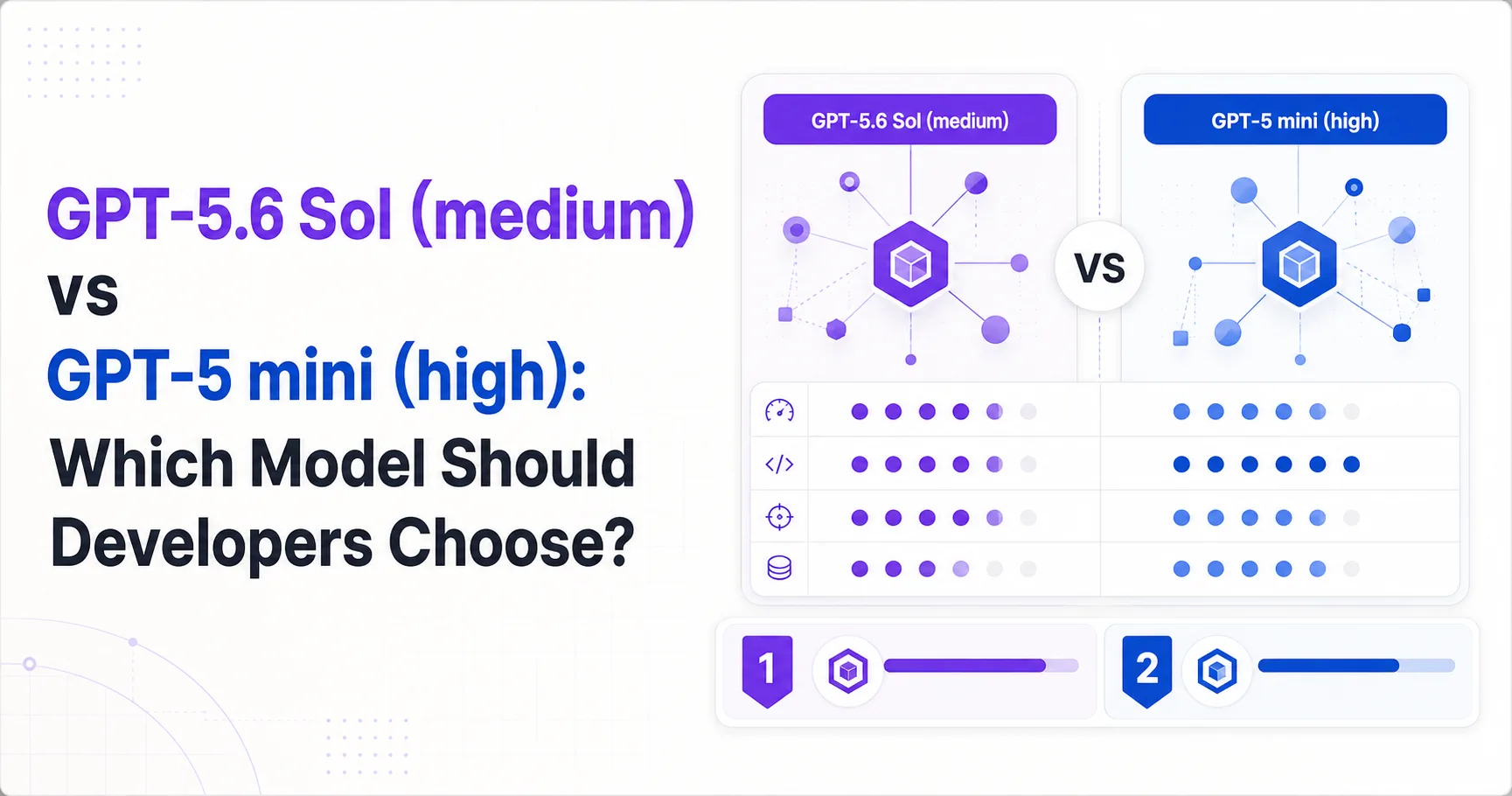
GPT-5.6 Sol (medium) is the stronger developer model, while GPT-5 mini (high) is the cheaper but poorly documented option.
The available evaluation data gives GPT-5.6 Sol (medium) a 76.3 Artificial Analysis coding index and a 53.6 intelligence index. GPT-5 mini (high) records 15.6 for coding and 25.3 for intelligence, while its math index is 90.7. Those results point to a clear division: GPT-5.6 Sol (medium) is the safer choice for broad software work, while GPT-5 mini (high) may fit narrow, cost-sensitive workloads where coding quality is less demanding.
The documentation gap is central to this comparison. OpenAI currently lists GPT-5.6 Sol as a flagship model for complex reasoning and coding in its model directory. The GPT-5.6 Sol model page documents its model ID, context limits, APIs, modalities, tools, and pricing rules. By contrast, the current OpenAI Models page does not provide a dedicated GPT-5 mini entry, and the OpenAI Pricing page does not list its price.
Data provided by https://artificialanalysis.ai/ supplies the comparison metrics used in this article. The evaluation snapshot identifies GPT-5.6 Sol (medium) with a release date of 2026-07-09 and GPT-5 mini (high) with a release date of 2025-08-07.
GPT-5.6 Sol (medium) offers the more defensible production choice because its capabilities and operational behavior are documented, while GPT-5 mini (high) lacks current official confirmation.
| Decision area | Better choice | Why it matters |
|---|---|---|
| Coding quality | GPT-5.6 Sol (medium) | Its coding index is 76.3 versus 15.6. |
| General intelligence | GPT-5.6 Sol (medium) | Its intelligence index is 53.6 versus 25.3. |
| Math evaluation | GPT-5 mini (high) in the available data | GPT-5 mini (high) records 90.7, while GPT-5.6 Sol (medium) has no reported value. |
| Blended token cost | GPT-5 mini (high) | The listed blended price is $0.6875 versus $11.25 per 1M tokens. |
| Documented API surface | GPT-5.6 Sol (medium) | OpenAI documents Responses API, Chat Completions API, Batch API, tools, image input, and structured outputs for GPT-5.6 Sol. |
| Current availability evidence | GPT-5.6 Sol (medium) | OpenAI lists GPT-5.6 Sol and its stable alias, but provides no equivalent confirmation for GPT-5 mini. |
GPT-5.6 Sol (medium) should be the default for coding agents, repository changes, code review, debugging, and tasks where correctness reduces supervision. Its documented reasoning.effort setting supports medium as a balanced starting point.
GPT-5 mini (high) remains attractive for high-volume classification, lightweight transformations, routing, and simple extraction. The price advantage is substantial in the supplied data, but the model’s current API identity, context window, output limit, tool support, and stable alias are unverified. That uncertainty can matter more than a low token price when a production integration needs predictable behavior.
GPT-5.6 Sol (medium) is the better performance choice for software engineering because its coding and intelligence results are materially stronger, even though the available speed evidence is incomplete.
The coding gap is the most consequential signal for developers. GPT-5.6 Sol (medium) scores 76.3 on the Artificial Analysis coding index, compared with 15.6 for GPT-5 mini (high). That difference suggests a different supervision burden. A stronger coding model can spend more of a task budget producing useful changes, while a weaker model may require more review, retries, narrower prompts, or human intervention. The evaluation does not prove success on every repository, but it makes GPT-5.6 Sol (medium) the more credible default for complex implementation work.
General reasoning follows the same direction. GPT-5.6 Sol (medium) records 53.6 on the intelligence index, versus 25.3 for GPT-5 mini (high). GPT-5 mini (high) does show a 90.7 math index, but GPT-5.6 Sol (medium) has no reported math value in the supplied snapshot. That is a genuine evidence gap, not a reason to claim a winner for mathematical work.
The speed comparison is also asymmetric. Artificial Analysis reports 69.865 median output tokens per second for GPT-5.6 Sol (medium), but no value for GPT-5 mini (high). Both models show 0.3 seconds of latency in the snapshot, so the data does not establish a latency advantage. A Hacker News discussion and its corresponding comment discuss possible benefits of fast generation for repository search and agent workflows, but they do not provide independent GPT-5.6 Sol measurements.
Developers should therefore treat GPT-5.6 Sol (medium) as the documented quality and measured-throughput choice. They should benchmark GPT-5 mini (high) themselves before assuming that its lower cost preserves acceptable task completion quality.
GPT-5 mini (high) is dramatically cheaper per token, but GPT-5.6 Sol (medium) can be cheaper for work where additional retries and review dominate spend.
The supplied blended price is $0.6875 per 1M tokens for GPT-5 mini (high), compared with $11.25 for GPT-5.6 Sol (medium). Input pricing is $0.25 versus $5, and output pricing is $2 versus $30. Those figures make GPT-5 mini (high) the obvious candidate for workloads with large request volume, short outputs, predictable prompts, and low failure costs.
Token price alone does not determine total engineering cost. If a coding task needs repeated corrections, additional context, manual review, or a second model call, the lower-priced model can consume more workflow resources. The supplied data does not measure retries, task completion, human review time, or production error rates, so it cannot establish total cost of ownership. This is one of the most important unanswered questions for procurement.
GPT-5.6 Sol (medium) also has a documented long-context pricing risk. The GPT-5.6 Sol model page states that requests above 272K input tokens receive higher whole-request pricing. Large repositories, extended conversations, and document batches can therefore cost more than a short-context estimate suggests. Its page also documents cache pricing and different service modes, while the OpenAI API pricing page lists Standard, Batch, Flex, and Fast mode prices for GPT-5.6 Sol.
The practical choice depends on failure economics. Use GPT-5 mini (high) for cheap first-pass work when failures are easy to detect and recover. Use GPT-5.6 Sol (medium) when correctness, tool use, and reduced supervision justify the higher token rate. The available materials do not show whether GPT-5 mini (high) supports equivalent caching, batch processing, tools, or long-context behavior.
GPT-5 mini (high) leads on 3 of 3 metrics
GPT-5.6 Sol (medium) should power complex coding and reasoning workflows, while GPT-5 mini (high) should be considered only after availability and quality are verified.
Choose GPT-5.6 Sol (medium) for:
Choose GPT-5 mini (high) for:
The recommendation changes if your own task set shows that GPT-5 mini (high) reaches an acceptable completion rate with minimal retries. The supplied math result of 90.7 also makes it worth testing for focused mathematical workloads, although GPT-5.6 Sol (medium) has no corresponding math score in the snapshot.
Before production adoption, verify the exact API model ID, availability, context window, output limit, reasoning controls, tools, and current price for GPT-5 mini (high). OpenAI’s current model directory and pricing page do not confirm those details. GPT-5.6 Sol (medium) is the safer default because OpenAI documents it as a flagship model for complex reasoning and coding, and the deprecation directory does not show evidence in the brief that it has entered a replacement or deprecation process.
Community evidence should be weighted lightly. One Reddit report describes excessive output and incomplete coding work, but its author did not provide a reproducible task set or measurement method. Comments in the same thread dispute the conclusion. That disagreement supports local testing, not a universal failure claim.
GPT-5.6 Sol (medium) has the stronger documented case, but neither model’s supplied evidence answers every deployment question.
The largest uncertainty concerns GPT-5 mini (high). The research brief found no current official model entry, stable alias, API parameter mapping, dedicated price, context limit, output limit, or reliable community test. The data snapshot still reports useful evaluation and cost values for GPT-5 mini (high), but those values do not establish that the model remains directly callable under the same name.
The second uncertainty concerns real task economics. The benchmark data shows a large coding advantage for GPT-5.6 Sol (medium), yet it does not report completion rates, retry counts, review time, defect escape rates, or tool-call success. A developer choosing on operating cost should measure those variables with representative tasks.
The third uncertainty concerns math. GPT-5 mini (high) records a 90.7 math index, but GPT-5.6 Sol (medium) has no math value in the provided data. The article can identify the reported result without claiming that GPT-5 mini (high) is universally better at mathematics.
A sensible evaluation should compare identical prompts, repository tasks, validation tests, retry policies, and output budgets. It should record successful task completion, total tokens, wall-clock time, human intervention, and defect rate. Those measurements are absent from the research brief, so readers should not treat this comparison as a substitute for an application-specific pilot.
Developers should choose GPT-5.6 Sol (medium) for coding agents because its coding index is 76.3 versus 15.6, and OpenAI documents it for complex reasoning and coding workflows.
GPT-5 mini (high) is the better token-price value at $0.6875 per 1M blended tokens, but its current API availability and production behavior require direct verification.
GPT-5.6 Sol (medium) is the only model with a reported speed value, at 69.865 median output tokens per second, so the supplied data cannot prove a comparative speed winner.
GPT-5 mini (high) records a 90.7 math index, but GPT-5.6 Sol (medium) has no reported math score, so the available evidence cannot establish a complete comparison.
GPT-5.6 Sol (medium) carries a higher token price and higher pricing above 272K input tokens, while community reports of inefficient coding remain unverified and disputed.