
Time to First Token · GPT-5.6 Sol (Non-reasoning)
1221ms
Time to First Token · GPT-5 mini (high)
0ms
Deep dive into reasoning, benchmarks, and latency insights.
The current catalog does not contain complete performance evidence for both models, so this page does not declare an overall winner. Use the available fields as comparison signals and validate the models on your own workload.
Key decision metrics at a glance.
| Model | Metric | Value | Unit | Source / snapshot |
|---|---|---|---|---|
| GPT-5.6 Sol (Non-reasoning) | Reasoning | 6.0 | benchmark or capability score | Artificial Analysis · current catalog |
| GPT-5 mini (high) | Reasoning | 9.0 | benchmark or capability score | Artificial Analysis · current catalog |
| GPT-5.6 Sol (Non-reasoning) | Coding | 7.0 | benchmark or capability score | Artificial Analysis · current catalog |
| GPT-5 mini (high) | Coding | 2.0 | benchmark or capability score | Artificial Analysis · current catalog |
| GPT-5.6 Sol (Non-reasoning) | Multimodal | 3.0 | benchmark or capability score | Artificial Analysis · current catalog |
| GPT-5 mini (high) | Multimodal | 2.0 | benchmark or capability score | Artificial Analysis · current catalog |
| GPT-5.6 Sol (Non-reasoning) | Long Context | 5.0 | benchmark or capability score | Artificial Analysis · current catalog |
| GPT-5 mini (high) | Long Context | 3.0 | benchmark or capability score | Artificial Analysis · current catalog |
| GPT-5.6 Sol (Non-reasoning) | Blended Price / 1M tokens | $11.25 | USD per 1M tokens | Artificial Analysis · current catalog |
| GPT-5 mini (high) | Blended Price / 1M tokens | $0.688 | USD per 1M tokens | Artificial Analysis · current catalog |
| GPT-5.6 Sol (Non-reasoning) | P95 Latency | — | milliseconds | Artificial Analysis · current catalog |
| GPT-5 mini (high) | P95 Latency | — | milliseconds | Artificial Analysis · current catalog |
| GPT-5.6 Sol (Non-reasoning) | Tokens per second | 68.929 | tokens per second | Artificial Analysis · current catalog |
| GPT-5 mini (high) | Tokens per second | 0 | tokens per second | Artificial Analysis · current catalog |
Data provided by Artificial Analysis; live values use the current catalog.
This radar chart visually maps the core capabilities (reasoning, coding, math proxy, multimodal, long context) of `GPT-5.6 Sol (Non-reasoning)` vs `GPT-5 mini (high)`.
This grouped bar chart provides a side-by-side comparison for each benchmark metric.
Lower time to first token is better; higher tokens per second is better.
Compare input and output pricing in USD per 1M tokens.
GPT-5.6 Sol (Non-reasoning)$12.5
GPT-5 mini (high)$0.75
GPT-5 mini (high) costs $11.75 less per run
This article is a dated snapshot published on 2026-08-07. Live cards above use the current catalog; missing live fields are not inferred.
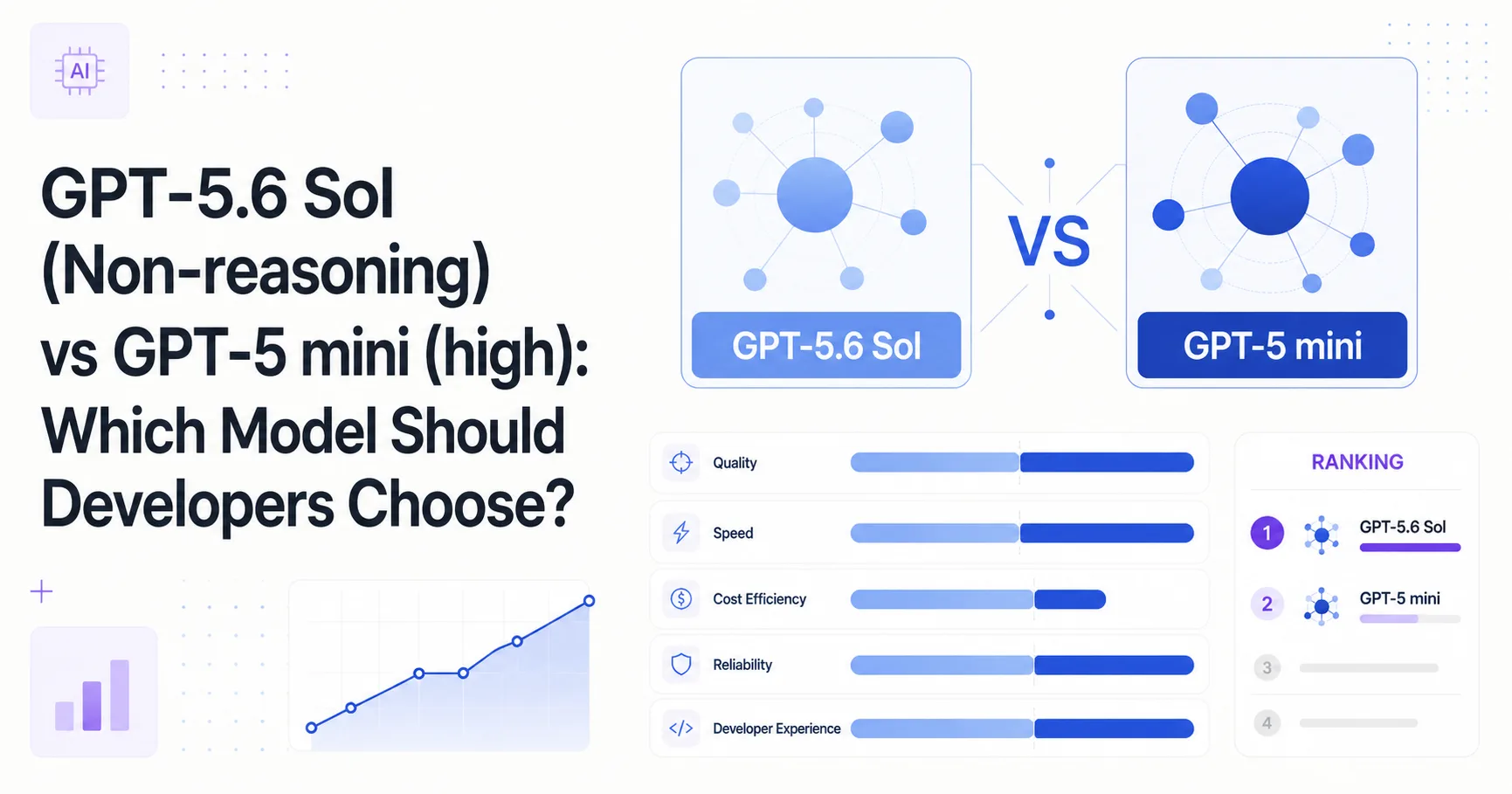
GPT-5.6 Sol (Non-reasoning) is the stronger measured coding choice, while GPT-5 mini (high) is the far cheaper option for cost-sensitive workloads. The comparison data gives GPT-5.6 Sol (Non-reasoning) a coding index of 65.1, compared with 15.6 for GPT-5 mini (high). It also gives GPT-5.6 Sol (Non-reasoning) an intelligence index of 41.2, compared with 25.3 for GPT-5 mini (high).\n\nThat performance advantage comes with a major price difference. The blended price is $11.25 per 1M tokens for GPT-5.6 Sol (Non-reasoning), compared with $0.6875 for GPT-5 mini (high). GPT-5.6 Sol (Non-reasoning) also has a measured median output speed of 69.306 tokens per second, while the supplied data contains no corresponding speed value for GPT-5 mini (high). Both models show latency of 0.3 seconds in the supplied comparison.\n\nThe central selection risk is model identity. OpenAI’s Models page describes the gpt-5.6-sol family but does not clearly distinguish the non-reasoning name used here. The same page does not list gpt-5-mini or confirm high as an independent model identifier. The supplied evidence therefore supports a benchmark comparison, but it does not fully prove that either evaluated label is a currently stable public API target.\n\nData provided by https://artificialanalysis.ai/
GPT-5.6 Sol (Non-reasoning) is the better default for coding-heavy applications because its measured coding result is substantially higher, but GPT-5 mini (high) is the rational default for high-volume, low-risk generation.\n\nThe coding gap is the most important result. GPT-5.6 Sol (Non-reasoning) scores 65.1 on the Artificial Analysis coding index, while GPT-5 mini (high) scores 15.6. That difference suggests a meaningful change in expected performance for code generation, code transformation, debugging, and repository-oriented tasks. It does not prove that every programming task will show the same gap, because the supplied material does not provide task-level examples, test methodology, or failure breakdowns.\n\nThe intelligence index points in the same direction, with GPT-5.6 Sol (Non-reasoning) at 41.2 and GPT-5 mini (high) at 25.3. GPT-5 mini (high) has one notable measured strength: a math index of 90.7. GPT-5.6 Sol (Non-reasoning) has no corresponding math score in the supplied data, so the evidence cannot establish a winner for mathematical work.\n\nThe official positioning also favors GPT-5.6 Sol (Non-reasoning) for demanding work. OpenAI describes the gpt-5.6-sol family as suitable for complex reasoning and coding in its Models documentation. That statement does not independently validate the exact non-reasoning variant, so developers should treat it as family-level positioning rather than variant-specific proof.\n\nFor selection, use GPT-5.6 Sol (Non-reasoning) when incorrect code is expensive and quality is the primary constraint. Use GPT-5 mini (high) when token volume, budget, or cheap retries dominates the economics. Test the exact production identifier before committing to either.
GPT-5.6 Sol (Non-reasoning) has the stronger measured coding profile, but the available evidence is too incomplete to establish a universal performance winner.\n\nThe coding index difference is large enough to affect architecture decisions. A model scoring 65.1 against a competing score of 15.6 should be evaluated first for tasks where a single poor answer creates downstream engineering work. Examples include multi-file changes, debugging unfamiliar code, API integration, and tests that require understanding existing behavior. The index alone cannot tell developers whether the gap comes from planning, syntax accuracy, repository comprehension, or test completion. The supplied research does not include those failure categories.\n\nGPT-5.6 Sol (Non-reasoning) also records a median output speed of 69.306 tokens per second. GPT-5 mini (high) has no supplied output-speed value, so the data cannot support a speed ranking between the two models. Both models have latency of 0.3 seconds, which means the measured first-response timing does not separate them in this comparison. Output speed and latency answer different operational questions: latency affects time before generation begins, while output speed affects how quickly a long answer arrives.\n\nThe performance conclusion therefore depends on workload shape. For short prompts, equal latency may make the models feel similar before answer quality is considered. For long coding responses, the verified speed value for GPT-5.6 Sol (Non-reasoning) is useful, but the missing GPT-5 mini (high) value prevents a complete throughput comparison.\n\nGPT-5 mini (high) should not be dismissed for mathematical workflows. Its math index is 90.7, while GPT-5.6 Sol (Non-reasoning) has no math result in the supplied snapshot. That is evidence for a specialized strength, not evidence that it will produce reliable production code. Developers need task-specific validation before using either index as a proxy for their application.
GPT-5 mini (high) is dramatically cheaper, but its lower unit price can become misleading when weaker outputs create review, retry, or repair work.\n\nThe blended price is $0.6875 per 1M tokens for GPT-5 mini (high), versus $11.25 for GPT-5.6 Sol (Non-reasoning). Input pricing is $0.25 versus $5, and output pricing is $2 versus $30. These differences make GPT-5 mini (high) attractive for classification, extraction, drafting, routing, and other workloads where each response is cheap to verify or replace.\n\nGPT-5.6 Sol (Non-reasoning) can still be the cheaper operational choice when quality failures are expensive. A coding response that needs substantial human correction can consume more engineering time than its token bill. The supplied data does not provide correction rates, retry rates, review time, or task success rates, so it cannot calculate a true cost per successful result. That missing evidence is the main limitation of the pricing comparison.\n\nThe best cost strategy is often asymmetric routing. Send routine, low-consequence requests to GPT-5 mini (high), then reserve GPT-5.6 Sol (Non-reasoning) for code changes, difficult debugging, or responses that fail validation. This approach is only sensible if the application can detect failure cheaply. The research brief does not confirm whether either exact model name supports the required production API path. OpenAI’s Pricing page also does not list gpt-5-mini separately, while it lists the gpt-5.6-sol family rather than the exact non-reasoning label.\n\nDevelopers should compare cost per accepted output, not price per token alone. The current evidence establishes a large token-price advantage for GPT-5 mini (high), but it does not establish which model minimizes total engineering cost for a completed task.
GPT-5 mini (high) leads on 3 of 3 metrics
GPT-5.6 Sol (Non-reasoning) is the recommended first test for production coding, while GPT-5 mini (high) is the recommended first test for inexpensive scale.\n\nChoose GPT-5.6 Sol (Non-reasoning) for an autonomous coding assistant, repository maintenance tool, code review workflow, or developer product where incorrect output can damage trust. Its coding index of 65.1 is the clearest evidence in the comparison, and its official family positioning includes complex reasoning and coding through the OpenAI Models documentation. The evidence still does not specify the model’s context window, output limit, parameter support, or known failure modes.\n\nChoose GPT-5 mini (high) for large volumes of short requests, early product experiments, content transformation, structured extraction, or applications with strong validation and easy retries. Its blended price of $0.6875 per 1M tokens makes broad experimentation affordable. Its math index of 90.7 also makes it worth testing for mathematical workloads, although no supplied source explains how that score translates to the user’s exact task.\n\nUse a two-model routing policy only if the product can measure quality. A validator can send simple failures to retry, while difficult or high-impact requests can move to GPT-5.6 Sol (Non-reasoning). The supplied research does not prove that such routing will improve total cost, because it contains no production success-rate data.\n\nBefore implementation, verify three things against the live account and API: whether gpt-5.6-sol-non-reasoning is callable, whether gpt-5-mini is callable, and whether high is a supported setting rather than a display label. OpenAI’s Models and Pricing pages do not resolve those exact identity questions in the supplied evidence. That uncertainty should be treated as a release blocker for a model-specific dependency.
GPT-5.6 Sol (Non-reasoning) is the safer quality-first candidate, but model availability and task-level behavior still require direct validation. The following questions address the gaps that the supplied benchmark and research materials do not settle.
GPT-5.6 Sol (Non-reasoning) is the stronger measured coding candidate, with a 65.1 coding index versus 15.6 for GPT-5 mini (high). The score does not reveal task-level reliability, repository behavior, or correction effort, so teams should validate representative coding tasks before deployment.
GPT-5 mini (high) is worth choosing when low token cost, high request volume, and easy validation matter more than maximum coding quality. Its blended price is $0.6875 per 1M tokens, and its math index is 90.7, but the supplied evidence does not establish its production coding reliability.
GPT-5.6 Sol (Non-reasoning) has a measured median output speed of 69.306 tokens per second, while GPT-5 mini (high) has no supplied speed value. Both models show latency of 0.3 seconds, so the evidence supports equal initial response timing but not equal total generation speed.
GPT-5 mini (high) is cheaper on every supplied token-price measure, including $0.6875 per 1M blended tokens, $0.25 per 1M input tokens, and $2 per 1M output tokens. Total cost per successful result remains unknown because retry and correction rates are unavailable.
Developers should verify the exact identifiers before relying on them in production. The OpenAI Models page does not independently list gpt-5-mini or clearly distinguish gpt-5.6-sol-non-reasoning, and the Pricing page does not separately price gpt-5-mini.
GPT-5 mini (high) has the only supplied math result, with a math index of 90.7. GPT-5.6 Sol (Non-reasoning) has no corresponding math value in the snapshot, so the evidence supports testing GPT-5 mini (high) for math but cannot establish a complete head-to-head winner.