
Time to First Token · GPT-5.6 Sol (max)
75247ms
Time to First Token · Grok-1
0ms
Deep dive into reasoning, benchmarks, and latency insights.
The current catalog does not contain complete performance evidence for both models, so this page does not declare an overall winner. Use the available fields as comparison signals and validate the models on your own workload.
Key decision metrics at a glance.
| Model | Metric | Value | Unit | Source / snapshot |
|---|---|---|---|---|
| GPT-5.6 Sol (max) | Reasoning | 6.0 | benchmark or capability score | Artificial Analysis · current catalog |
| Grok-1 | Reasoning | 6.0 | benchmark or capability score | Artificial Analysis · current catalog |
| GPT-5.6 Sol (max) | Coding | 8.0 | benchmark or capability score | Artificial Analysis · current catalog |
| Grok-1 | Coding | 6.0 | benchmark or capability score | Artificial Analysis · current catalog |
| GPT-5.6 Sol (max) | Multimodal | 5.0 | benchmark or capability score | Artificial Analysis · current catalog |
| Grok-1 | Multimodal | 1.0 | benchmark or capability score | Artificial Analysis · current catalog |
| GPT-5.6 Sol (max) | Long Context | 8.0 | benchmark or capability score | Artificial Analysis · current catalog |
| Grok-1 | Long Context | 1.0 | benchmark or capability score | Artificial Analysis · current catalog |
| GPT-5.6 Sol (max) | Blended Price / 1M tokens | $11.25 | USD per 1M tokens | Artificial Analysis · current catalog |
| Grok-1 | Blended Price / 1M tokens | $0 | USD per 1M tokens | Artificial Analysis · current catalog |
| GPT-5.6 Sol (max) | P95 Latency | — | milliseconds | Artificial Analysis · current catalog |
| Grok-1 | P95 Latency | — | milliseconds | Artificial Analysis · current catalog |
| GPT-5.6 Sol (max) | Tokens per second | 68.734 | tokens per second | Artificial Analysis · current catalog |
| Grok-1 | Tokens per second | 0 | tokens per second | Artificial Analysis · current catalog |
Data provided by Artificial Analysis; live values use the current catalog.
This radar chart visually maps the core capabilities (reasoning, coding, math proxy, multimodal, long context) of `GPT-5.6 Sol (max)` vs `Grok-1`.
This grouped bar chart provides a side-by-side comparison for each benchmark metric.
Lower time to first token is better; higher tokens per second is better.
Compare input and output pricing in USD per 1M tokens.
GPT-5.6 Sol (max)$12.5
Grok-1$0
Grok-1 costs $12.5 less per run
This article is a dated snapshot published on 2026-08-07. Live cards above use the current catalog; missing live fields are not inferred.
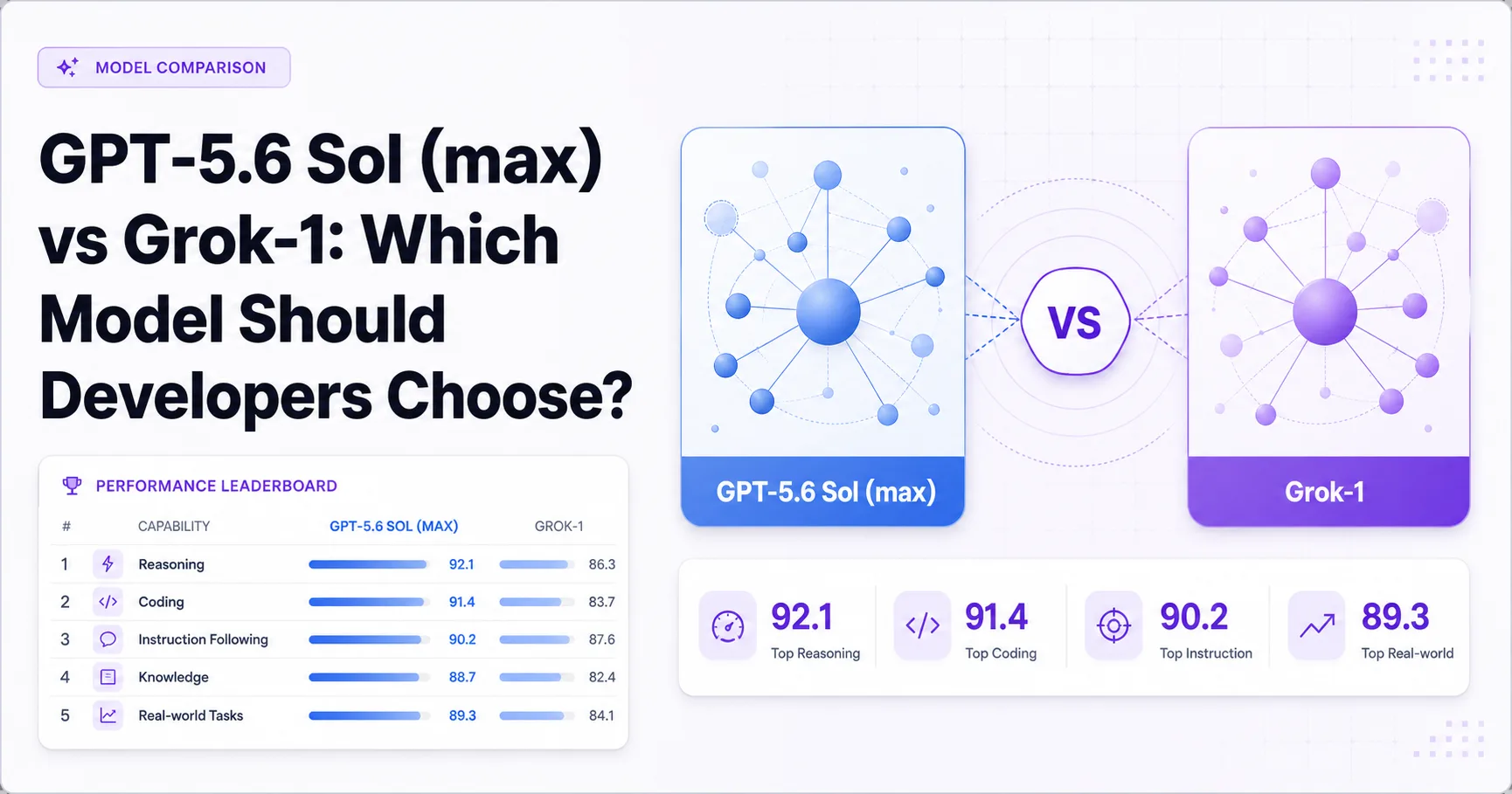
GPT-5.6 Sol (max) is the safer developer choice because it has current official documentation, measured intelligence evidence, and lower blended pricing than Grok-1. The available data gives GPT-5.6 Sol (max) an Artificial Analysis Intelligence Index score of 58.9, while Grok-1 scores 6. GPT-5.6 Sol (max) also has a recorded median output speed of 77.617 tokens per second and a latency of 0.3 seconds. Grok-1 has the same recorded latency, but no comparable output-speed value. Data provided by Artificial Analysis. OpenAI describes GPT-5.6 Sol as its flagship model for complex reasoning, programming, and demanding professional work in the OpenAI model catalog.
GPT-5.6 Sol (max) offers the stronger documented selection case, while Grok-1 remains difficult to evaluate because its current product and API status cannot be verified from the supplied research. OpenAI currently documents GPT-5.6 Sol as an available model with a stable GPT-5.6 alias in the model catalog and the GPT-5.6 Sol model page. The documentation describes text and image input, text output, Responses API support, Chat Completions support, function calling, structured outputs, streaming, and several hosted tools. Those details matter because developers can assess integration risk before building around the model.
Grok-1 has a measured Intelligence Index score of 6 in the supplied data, compared with 58.9 for GPT-5.6 Sol (max). The gap is large enough to make GPT-5.6 Sol (max) the default choice for general reasoning workloads, but it does not prove superiority on every production task. The supplied data has no Grok-1 coding score, output-speed score, context value, API specification, or verified current price page. The absence of evidence is itself a selection risk, not proof that Grok-1 lacks those capabilities.
The official GPT-5.6 release announcement reports strong results across several proprietary evaluations, including a Coding Agent Index result of 80, but those values are not the same as the Artificial Analysis values used in the comparison dataset. Developers should treat vendor-reported and independent measurements as separate evidence streams. The GPT-5.6 announcement supports the model's positioning, while the supplied Artificial Analysis snapshot supports the cross-model numerical comparison.
GPT-5.6 Sol (max) is the only model in this comparison with measured evidence for both broad intelligence and output speed. The supplied Artificial Analysis data records an Intelligence Index score of 58.9 for GPT-5.6 Sol (max), compared with 6 for Grok-1. It also records a Coding Index score of 77.4 for GPT-5.6 Sol (max), while Grok-1 has no comparable value. That means the data supports choosing GPT-5.6 Sol (max) for reasoning-heavy development workflows, but it does not support declaring a coding benchmark winner.
The practical implication is important. A higher general intelligence score can justify sending GPT-5.6 Sol (max) tasks that involve repository interpretation, architectural tradeoffs, debugging hypotheses, or multi-step implementation planning. The coding result strengthens that case, yet the missing Grok-1 coding measurement prevents a controlled comparison. Teams should still test their own repository tasks before assigning the model autonomous write access.
GPT-5.6 Sol (max) records 77.617 median output tokens per second and 0.3 seconds of latency. Grok-1 also records 0.3 seconds of latency, but its output-speed field is unavailable. Similar latency therefore does not mean similar interactive behavior. Token streaming, reasoning duration, output length, and tool-call pauses can materially change perceived responsiveness.
OpenAI documents adjustable reasoning effort, including none, low, medium, high, xhigh, and max, in its reasoning models guide. The max setting can improve difficult-task performance, but OpenAI also warns that higher reasoning effort increases token use, latency, and cost. Community reports describe over-design and investigation drift, but the Reddit testing discussion and Hacker News discussion do not provide reproducible enough methods to establish stable failure rates.
GPT-5.6 Sol (max) has the lower measured blended price, but its reasoning behavior can make workload design more important than the headline rate. The supplied data lists $11.25 per 1M blended tokens for GPT-5.6 Sol (max), compared with $15 for Grok-1. GPT-5.6 Sol (max) also lists $5 per 1M input tokens, compared with $10 for Grok-1, while both list $30 per 1M output tokens.
The direct price advantage favors GPT-5.6 Sol (max) for workloads with substantial input volume. That advantage can reverse in practice if teams select max reasoning for routine transformations, allow oversized repository context, or trigger repeated tool-assisted investigations. OpenAI states that reasoning tokens are hidden from users, consume context capacity, and are billed as output tokens in the reasoning models guide. The same guide recommends confirming that higher reasoning effort produces enough evaluation benefit to justify its extra cost.
OpenAI's API pricing page also lists separate Standard, Batch, Flex, and Fast mode prices. Those modes create operational choices that are not represented by the single blended comparison value. Batch or Flex may suit offline evaluation and migration work, while Fast mode may suit latency-sensitive interactions, subject to the applicable price. The comparison therefore supports GPT-5.6 Sol (max) as the lower-cost default, not as a guarantee of lower total spend.
The strongest cost control is routing. Use lower reasoning effort for predictable tasks, reserve max for tasks where evaluation shows a meaningful success-rate improvement, and measure total tokens per completed task. Grok-1 cannot be cost-modeled with the same confidence because the supplied research found no verifiable current pricing or API documentation.
Grok-1 leads on 3 of 3 metrics
GPT-5.6 Sol (max) is the recommended default for developers who need a documented, tool-capable model for complex reasoning and coding workflows. OpenAI documents support for Responses API and Chat Completions, plus structured outputs, function calling, streaming, web search, file search, code execution, hosted shell, patch application, computer use, MCP, and tool search on the GPT-5.6 Sol model page. That documented surface reduces uncertainty around integration and orchestration.
Choose GPT-5.6 Sol (max) for repository-level debugging, code generation that requires architectural judgment, technical research with tool calls, and professional workflows where traceable API behavior matters. Start with a lower reasoning effort for routine work, then promote selected tasks to max after measuring completion quality and total token consumption. The official reasoning documentation supports this configuration approach.
Treat Grok-1 as an experimental candidate rather than a production default. The supplied research contains no verifiable official documentation, pricing page, current availability record, context specification, API parameter reference, or community test that can support a reliable operational recommendation. Its Intelligence Index score of 6 is measurable, but the missing coding and systems evidence leaves important selection questions unanswered.
The recommendation should change only if a direct Grok-1 evaluation supplies comparable evidence on the same tasks, with current pricing and reproducible API conditions. Until that evidence exists, GPT-5.6 Sol (max) wins on documented capability, measured general intelligence, measured coding evidence, measured output speed, and blended price. The conclusion remains evidence-based rather than universal: no supplied benchmark establishes that GPT-5.6 Sol (max) wins every developer task.
GPT-5.6 Sol (max) should pass a task-specific acceptance test before a team grants it broad autonomy. The supplied comparison establishes a strong default, but it does not answer repository-specific reliability, defect escape rate, or total cost per completed change. Those questions require controlled evaluation against the team's own codebase and workflows.
A useful evaluation should compare completed tasks rather than raw generation speed. Record whether the model reaches a working result, how much human correction is needed, how many tool calls occur, and how much input and output usage the task consumes. Keep reasoning settings explicit, because OpenAI documents meaningful differences across reasoning effort levels in the reasoning models guide.
Grok-1 should remain in the test plan only if the team can first verify an active API, current pricing, and comparable task evidence. The supplied research does not provide those facts. GPT-5.6 Sol (max) has the clearer path to production because its official model and pricing documentation are accessible through the OpenAI model catalog and OpenAI API pricing.
GPT-5.6 Sol (max) is the better-supported coding choice because it has a Coding Index score of 77.4 and documented programming capabilities, while Grok-1 has no comparable coding score in the supplied data. That evidence supports GPT-5.6 Sol (max), but it does not prove superiority on every repository, language, or software task.
GPT-5.6 Sol (max) is cheaper on the supplied blended comparison, at $11.25 per 1M blended tokens versus $15 for Grok-1. Its input price is also lower at $5 versus $10, while both models list $30 for output tokens. Actual project spend can still rise when max reasoning produces more billed tokens.
GPT-5.6 Sol (max) has the only available output-speed measurement, at 77.617 median output tokens per second, while both models list 0.3 seconds of latency. That makes GPT-5.6 Sol (max) the better-supported speed choice, but missing Grok-1 streaming data prevents a complete interactive comparison.
Developers should not assume production readiness for Grok-1 from the supplied evidence because no verifiable current API documentation, pricing page, availability record, or operating specification was found. Grok-1 may still be usable, but the team must independently confirm access and run comparable acceptance tests before adoption.
Every task should not use maximum reasoning effort because OpenAI states that higher reasoning effort can increase token use, latency, and cost. GPT-5.6 Sol (max) is most defensible for difficult tasks where evaluation shows a meaningful quality benefit. Routine transformations should be tested with lower effort settings before teams standardize on max.