
Time to First Token · GPT-5.6 Sol (max)
75247ms
Time to First Token · o3
7185ms
Deep dive into reasoning, benchmarks, and latency insights.
The current catalog does not contain complete performance evidence for both models, so this page does not declare an overall winner. Use the available fields as comparison signals and validate the models on your own workload.
Key decision metrics at a glance.
| Model | Metric | Value | Unit | Source / snapshot |
|---|---|---|---|---|
| GPT-5.6 Sol (max) | Reasoning | 6.0 | benchmark or capability score | Artificial Analysis · current catalog |
| o3 | Reasoning | 9.0 | benchmark or capability score | Artificial Analysis · current catalog |
| GPT-5.6 Sol (max) | Coding | 8.0 | benchmark or capability score | Artificial Analysis · current catalog |
| o3 | Coding | 6.0 | benchmark or capability score | Artificial Analysis · current catalog |
| GPT-5.6 Sol (max) | Multimodal | 5.0 | benchmark or capability score | Artificial Analysis · current catalog |
| o3 | Multimodal | 3.0 | benchmark or capability score | Artificial Analysis · current catalog |
| GPT-5.6 Sol (max) | Long Context | 8.0 | benchmark or capability score | Artificial Analysis · current catalog |
| o3 | Long Context | 4.0 | benchmark or capability score | Artificial Analysis · current catalog |
| GPT-5.6 Sol (max) | Blended Price / 1M tokens | $11.25 | USD per 1M tokens | Artificial Analysis · current catalog |
| o3 | Blended Price / 1M tokens | $3.5 | USD per 1M tokens | Artificial Analysis · current catalog |
| GPT-5.6 Sol (max) | P95 Latency | — | milliseconds | Artificial Analysis · current catalog |
| o3 | P95 Latency | — | milliseconds | Artificial Analysis · current catalog |
| GPT-5.6 Sol (max) | Tokens per second | 68.734 | tokens per second | Artificial Analysis · current catalog |
| o3 | Tokens per second | 119.185 | tokens per second | Artificial Analysis · current catalog |
Data provided by Artificial Analysis; live values use the current catalog.
This radar chart visually maps the core capabilities (reasoning, coding, math proxy, multimodal, long context) of `GPT-5.6 Sol (max)` vs `o3`.
This grouped bar chart provides a side-by-side comparison for each benchmark metric.
Lower time to first token is better; higher tokens per second is better.
Compare input and output pricing in USD per 1M tokens.
GPT-5.6 Sol (max)$12.5
o3$4
o3 costs $8.5 less per run
This article is a dated snapshot published on 2026-08-07. Live cards above use the current catalog; missing live fields are not inferred.
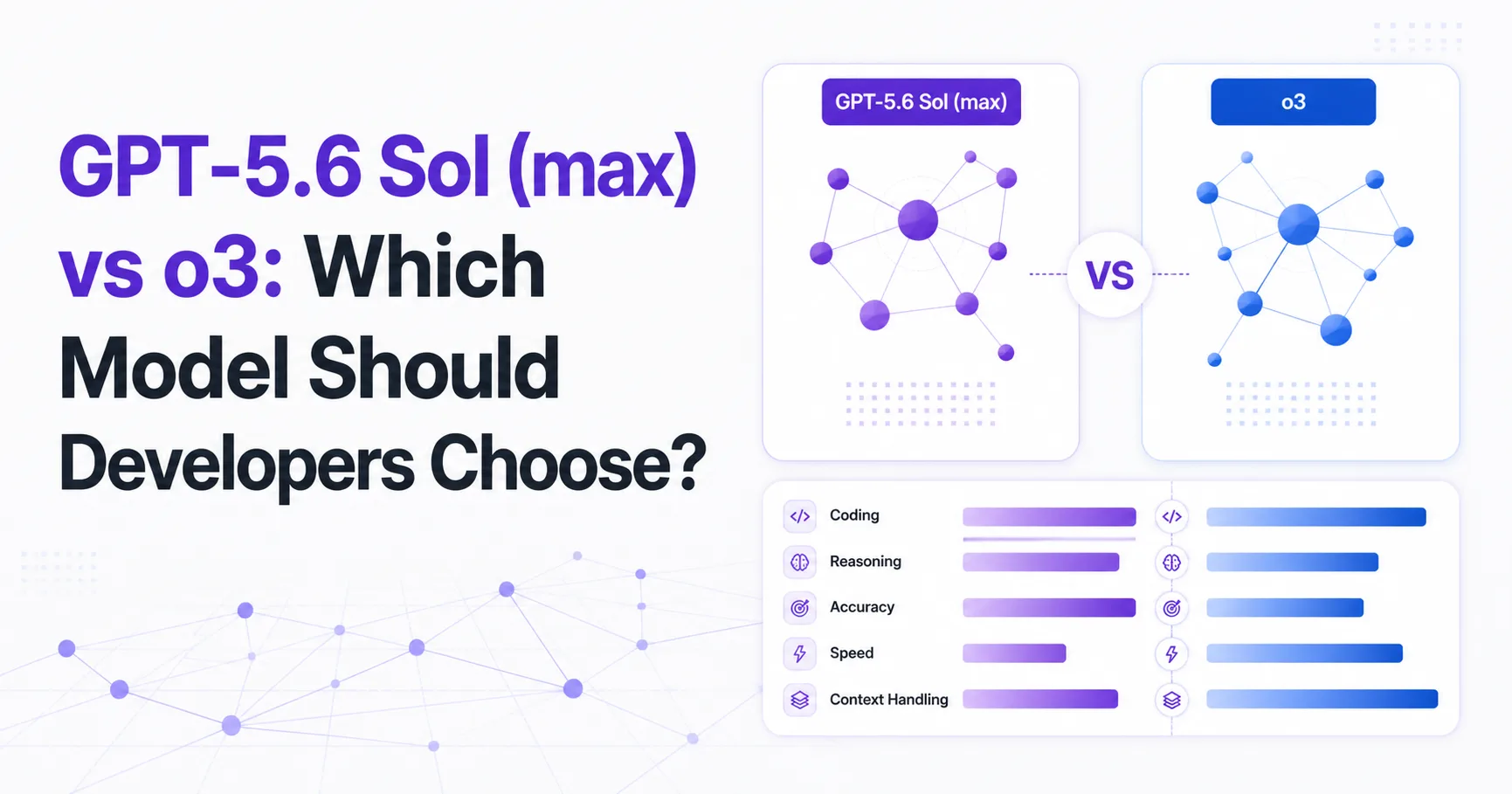
GPT-5.6 Sol (max) is the stronger default for developers who prioritize broad intelligence and complex coding over operating cost. The comparison data gives Sol an Artificial Analysis Intelligence Index of 58.9, compared with 30.4 for o3. Sol also has a reported Coding Index of 77.4, while no comparable o3 coding score appears in the supplied data.
That advantage comes with a substantial price and speed trade-off. o3 costs $3.5 per 1M blended tokens, while Sol costs $11.25. o3 also produces a median 128.056 output tokens per second, compared with 77.617 for Sol. Both models show 0.3 seconds of latency in the dataset.
The practical decision is therefore not simply old model versus new model. It is capability coverage versus economics. Sol has current official documentation, a documented API position, and a broader set of supported developer workflows. o3 has a compelling cost and throughput profile, but the supplied official sources do not establish its current API availability, limits, or replacement status.
Data provided by https://artificialanalysis.ai/
GPT-5.6 Sol (max) offers the better documented choice for demanding development work, while o3 offers the better measured economics and output speed.
| Decision factor | GPT-5.6 Sol (max) | o3 |
|---|---|---|
| Artificial Analysis Intelligence Index | 58.9 | 30.4 |
| Artificial Analysis Coding Index | 77.4 | Not available |
| Artificial Analysis Math Index | Not available | 88.3 |
| Blended price per 1M tokens | $11.25 | $3.5 |
| Input price per 1M tokens | $5 | $2 |
| Output price per 1M tokens | $30 | $8 |
| Median output speed | 77.617 tokens per second | 128.056 tokens per second |
| Latency | 0.3 seconds | 0.3 seconds |
Sol is the more defensible selection when a team needs one model for difficult coding, investigation, and professional reasoning tasks. OpenAI describes Sol as a flagship frontier model for complex reasoning, programming, and complex professional work in its current model directory and Sol model documentation.
o3 is the more attractive option for high-volume workloads where cost and generation speed dominate. The data shows a large price gap, but the supplied sources do not provide a current o3 model page, official capability list, or community testing evidence. That missing evidence matters for production planning because a low listed cost is useful only if the model remains directly callable under the required API contract.
The benchmark evidence also has an important asymmetry. Sol has a measured coding result, while o3 has a measured math result of 88.3. The supplied data does not support a direct coding winner or a direct math winner. Developers should avoid treating Sol's coding score as proof that it dominates every software task, or treating o3's math score as proof that it is the better general-purpose engineer.
GPT-5.6 Sol (max) is the safer performance choice for complex coding workflows because its available evidence covers both broad intelligence and coding, not only generation speed.
The most useful result for software teams is not the raw output rate. It is whether the model can maintain a coherent plan across repository exploration, implementation, debugging, and verification. Sol's 77.4 Coding Index provides evidence for that category, although the supplied material does not reveal the individual tasks or scoring distribution behind the index. o3 has no comparable coding value in the dataset, so the relative coding capability remains unresolved rather than favorable to either model.
The speed chart points in the opposite direction. o3 reaches 128.056 median output tokens per second, while Sol reaches 77.617. That difference can matter in interactive coding assistants, code review comments, and workloads that generate many short responses. It matters less when a developer spends more time reviewing patches, running tests, or waiting for external tools.
The equal 0.3-second latency values suggest that first-response timing does not separate the models in this dataset. The measured distinction appears after generation begins. A faster stream can still produce a less useful answer if the task requires careful repository reasoning, so teams should test completion quality and correction rate alongside throughput.
Sol's official reasoning documentation explains that higher reasoning effort can increase reasoning token use, latency, and cost. That creates a tunable performance trade-off, but the supplied evidence does not show which effort setting produced the comparison score or how o3 was configured. Any production benchmark should therefore hold prompt, tool access, effort settings, and stopping criteria constant.
Community reports add a warning about Sol, but not a reliable ranking. A Reddit test report describes over-engineered code and inconsistent token use without a reproducible benchmark. A Hacker News discussion reports investigation drift and subjective improvement after lowering reasoning effort. These reports identify risks worth testing, not measured defects.
o3 is the clear measured cost winner, but GPT-5.6 Sol (max) can be cheaper in practice when stronger first-pass results reduce human review and rework.
The direct price difference is substantial. o3 costs $3.5 per 1M blended tokens, compared with $11.25 for Sol. Its input price is $2 rather than $5, and its output price is $8 rather than $30. For workloads dominated by repeated prompts, bulk classification, or fast response generation, o3's economics are difficult for Sol to match.
The blended figure should not be treated as a universal application bill. It depends on the input and output mix represented by the comparison. Applications that generate long answers will feel the output price difference more strongly. Applications with repeated context may depend on caching behavior, while applications using difficult reasoning may incur additional hidden reasoning tokens that are billed as output tokens according to the supplied reasoning guide.
Sol's higher price may still be rational for tasks where an incorrect patch creates engineering work. A model that needs fewer retries, less correction, or less manual investigation can have a lower total workflow cost than its token price suggests. The supplied materials do not include retry rates, defect rates, review time, or total cost per accepted change, so this claim remains a hypothesis for customer-side validation.
The pricing source also documents multiple Sol modes, including Standard, Batch, Flex, and Fast mode, in the OpenAI API pricing page. Those options can change the economics of a Sol deployment, but the data brief compares one blended price for each model. It does not provide an equivalent current o3 price matrix. Teams should therefore compare complete deployment configurations, not only model names.
The biggest evidence gap is o3's current commercial status. The supplied official model directory and pricing page do not list a current o3 price or documented availability. The $3.5 figure is valid for this comparison dataset, but developers should verify that it maps to an account-accessible endpoint before committing architecture to it.
o3 leads on 3 of 3 metrics
GPT-5.6 Sol (max) is the recommended primary model for high-stakes coding and broad reasoning, while o3 is the recommended candidate for cost-sensitive throughput workloads.
Choose Sol when the model must handle difficult software tasks with limited model switching. Its 77.4 Coding Index and 58.9 Intelligence Index make it the stronger evidence-backed general choice in this comparison. OpenAI's GPT-5.6 announcement positions Sol around frontier reasoning, programming, and professional work. The official Sol documentation also describes support for developer-oriented API workflows and tools.
Choose o3 when the workload is repetitive, price-sensitive, and easy to validate automatically. Its $3.5 blended price and 128.056 median output tokens per second favor batch transformations, draft generation, test-case expansion, and other tasks where a fast, inexpensive answer can be checked by code. Its Math Index of 88.3 may also justify a focused evaluation for mathematical workloads, but the supplied materials do not establish how that result transfers to production software tasks.
Use a two-tier policy when the workload contains both routine and difficult requests. Route predictable work to o3 if the required endpoint is available and local tests confirm acceptable quality. Escalate ambiguous repository changes, difficult debugging, and broad investigations to Sol. This policy should be measured using accepted changes, retries, review time, and spend, because the supplied sources do not provide those operational metrics.
Do not select based on speed alone. o3's higher output rate does not resolve the missing evidence around its current API status, coding capability, or failure modes. Do not select Sol blindly at max reasoning effort either. OpenAI states in its reasoning guide that higher effort can raise latency and token consumption. A staged evaluation should compare the lowest Sol effort that meets the acceptance threshold.
GPT-5.6 Sol (max) is the better-documented production candidate, but o3 requires an availability and task-quality check before adoption.
The supplied materials answer the headline comparison clearly on measured intelligence, speed, and price. They do not answer several questions that determine production risk. The official sources do not provide a current o3 endpoint, alias, context limit, output limit, or modality description. They also do not provide a comparable o3 coding score. Community material does not fill that gap because no reliable, reproducible o3 testing evidence was supplied.
A production review should therefore confirm three points before choosing o3: the exact callable model identifier, the account-level price, and performance on the team's own coding tasks. A Sol review should confirm whether max reasoning effort is necessary, since higher effort can increase cost and latency. The comparison data shows equal 0.3-second latency, but it also shows a large output-speed difference, so teams should separate first-token experience from full-task completion time.
The right decision depends on the cost of failure. If an incorrect code change is expensive to review, Sol's stronger available coding evidence may justify its $11.25 blended price. If automatic validation catches most errors, o3's $3.5 price and 128.056 output speed may be more valuable.
GPT-5.6 Sol (max) is the better-supported coding choice because it has a 77.4 Coding Index, while the supplied data contains no comparable o3 coding score. That is an evidence advantage, not proof that Sol wins every programming task.
o3 is cheaper at $3.5 per 1M blended tokens, compared with $11.25 for GPT-5.6 Sol (max). o3 also has lower input and output prices, but teams should verify that the listed o3 price remains available for their endpoint.
o3 generates faster at 128.056 median output tokens per second, compared with 77.617 for GPT-5.6 Sol (max). Both models show 0.3 seconds of latency, so the main measured difference appears during output generation.
o3 has the only supplied Artificial Analysis Math Index, at 88.3, while GPT-5.6 Sol (max) has no math value in the dataset. The materials do not support a direct mathematical comparison or a claim about broader engineering quality.
Developers should use maximum reasoning effort only when testing shows that its quality gain pays for higher token use, latency, and cost. The supplied reasoning guidance recommends evaluating that trade-off instead of assuming max is optimal for every request.
Developers should verify o3's endpoint, pricing, limits, and availability before production adoption because the supplied current official pages do not document those details. The comparison data supports its cost and speed case, but not its current API status.