
Time to First Token · GPT-5.6 Sol (xhigh)
31324ms
Time to First Token · Grok-1
0ms
Deep dive into reasoning, benchmarks, and latency insights.
The current catalog does not contain complete performance evidence for both models, so this page does not declare an overall winner. Use the available fields as comparison signals and validate the models on your own workload.
Key decision metrics at a glance.
| Model | Metric | Value | Unit | Source / snapshot |
|---|---|---|---|---|
| GPT-5.6 Sol (xhigh) | Reasoning | 6.0 | benchmark or capability score | Artificial Analysis · current catalog |
| Grok-1 | Reasoning | 6.0 | benchmark or capability score | Artificial Analysis · current catalog |
| GPT-5.6 Sol (xhigh) | Coding | 8.0 | benchmark or capability score | Artificial Analysis · current catalog |
| Grok-1 | Coding | 6.0 | benchmark or capability score | Artificial Analysis · current catalog |
| GPT-5.6 Sol (xhigh) | Multimodal | 5.0 | benchmark or capability score | Artificial Analysis · current catalog |
| Grok-1 | Multimodal | 1.0 | benchmark or capability score | Artificial Analysis · current catalog |
| GPT-5.6 Sol (xhigh) | Long Context | 7.0 | benchmark or capability score | Artificial Analysis · current catalog |
| Grok-1 | Long Context | 1.0 | benchmark or capability score | Artificial Analysis · current catalog |
| GPT-5.6 Sol (xhigh) | Blended Price / 1M tokens | $11.25 | USD per 1M tokens | Artificial Analysis · current catalog |
| Grok-1 | Blended Price / 1M tokens | $0 | USD per 1M tokens | Artificial Analysis · current catalog |
| GPT-5.6 Sol (xhigh) | P95 Latency | — | milliseconds | Artificial Analysis · current catalog |
| Grok-1 | P95 Latency | — | milliseconds | Artificial Analysis · current catalog |
| GPT-5.6 Sol (xhigh) | Tokens per second | 64.533 | tokens per second | Artificial Analysis · current catalog |
| Grok-1 | Tokens per second | 0 | tokens per second | Artificial Analysis · current catalog |
Data provided by Artificial Analysis; live values use the current catalog.
This radar chart visually maps the core capabilities (reasoning, coding, math proxy, multimodal, long context) of `GPT-5.6 Sol (xhigh)` vs `Grok-1`.
This grouped bar chart provides a side-by-side comparison for each benchmark metric.
Lower time to first token is better; higher tokens per second is better.
Compare input and output pricing in USD per 1M tokens.
GPT-5.6 Sol (xhigh)$12.5
Grok-1$0
Grok-1 costs $12.5 less per run
This article is a dated snapshot published on 2026-08-07. Live cards above use the current catalog; missing live fields are not inferred.
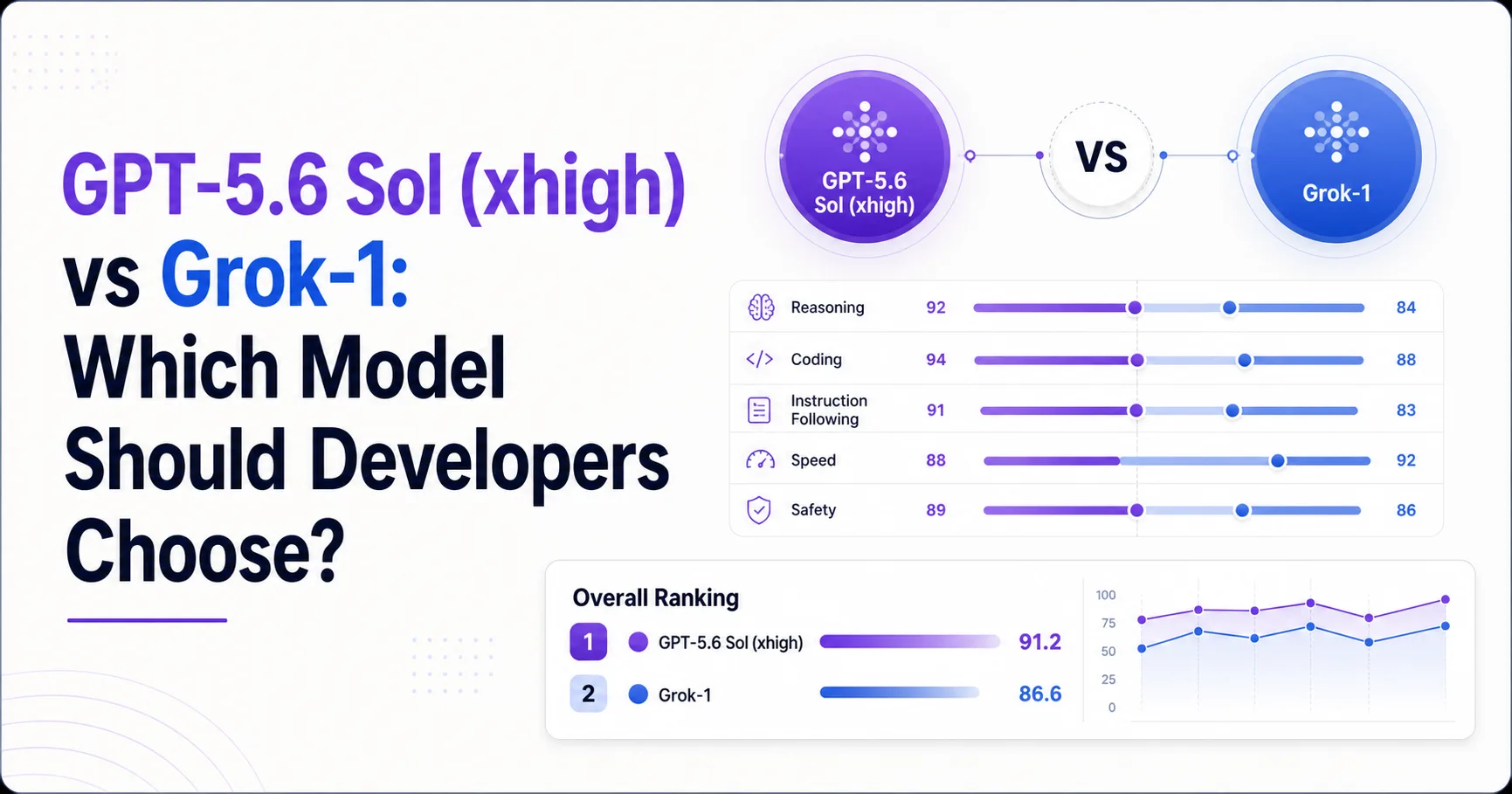
GPT-5.6 Sol (xhigh) is the safer developer choice because it has current official documentation, measurable capability evidence, and lower blended pricing than Grok-1. The comparison is asymmetric: GPT-5.6 Sol has a documented API identity, supported interfaces, tools, and published evaluations, while the research brief found no verifiable official documentation or pricing for Grok-1. The data snapshot records GPT-5.6 Sol at 57.7 on the Artificial Analysis Intelligence Index, compared with 6 for Grok-1. It also records blended pricing of $11.25 versus $15 per 1M tokens. Data provided by Artificial Analysis.
GPT-5.6 Sol (xhigh) offers the stronger evidence-backed foundation for serious application development. OpenAI positions GPT-5.6 Sol as a flagship model for complex reasoning, programming, and professional work in its release announcement. Its official model page documents the gpt-5.6-sol model ID, the gpt-5.6 stable alias, supported APIs, and tool integrations through the GPT-5.6 Sol model page. The xhigh label is a reasoning-effort setting, not a separate model ID, according to the reasoning models guide.
Grok-1 cannot receive the same operational recommendation because the research found no verifiable vendor documentation, pricing page, or current availability record. That absence does not prove that Grok-1 is unusable. It does mean a team cannot responsibly infer its production contract from this brief. The measurable comparison favors GPT-5.6 Sol on intelligence, blended cost, and input cost. Coding evidence is incomplete because the data snapshot reports 78.3 for GPT-5.6 Sol and no corresponding Grok-1 value.
The official product directory still lists GPT-5.6 Sol as directly callable in the checked materials, with no documented successor replacing it in that directory. The relevant source is the OpenAI model catalog. Developers should still validate regional access, quotas, latency, and task-specific quality before committing to a large migration.
GPT-5.6 Sol (xhigh) has materially stronger measured intelligence evidence, while Grok-1 lacks enough comparable data for a balanced coding or speed verdict. The Artificial Analysis snapshot gives GPT-5.6 Sol an Intelligence Index of 57.7 and Grok-1 a score of 6. That gap suggests a meaningful advantage for tasks requiring multi-step analysis, code planning, or decisions across conflicting constraints. It does not establish success rates for a particular repository, agent loop, or production workload.
The coding comparison is deliberately incomplete. GPT-5.6 Sol has a Coding Index score of 78.3, but Grok-1 has no corresponding value in the snapshot. Therefore, GPT-5.6 Sol should be treated as the only model with positive coding evidence here, not as a proven winner on a head-to-head coding benchmark. OpenAI's own announcement reports additional coding and agent results, but those are vendor-published results rather than independent replications, and the announcement documents important evaluation conditions at GPT-5.6 release.
The speed evidence is also asymmetric. GPT-5.6 Sol records 73.479 median output tokens per second, while Grok-1 has no reported output-speed value. Both models show 0.3 seconds of latency in the data snapshot, but equal latency does not imply equal time to a useful answer. Output speed, reasoning depth, tool calls, retries, and visible completion length can change end-to-end performance. The research does not provide enough information to determine which model finishes a real software task faster.
Community evidence reinforces that caution. One Reddit report describes a usable coding feature completed in about 15 minutes, while another reports over-engineering, excessive code, fast quota consumption, and remaining bugs. The latter discussion also contains disagreement among commenters, so these are task-specific observations rather than reliability rates. See the one-prompt coding report and the two-week testing report.
GPT-5.6 Sol (xhigh) is cheaper on the measured blended and input prices, but its reasoning behavior can still raise the cost of completed work. The snapshot lists $11.25 versus $15 per 1M blended tokens, and $5 versus $10 per 1M input tokens. Output pricing is tied at $30 per 1M tokens. This makes GPT-5.6 Sol the clear unit-price choice in the supplied data, especially for input-heavy workloads.
The practical cost question is how many tokens each model needs to solve the same task. OpenAI explains that reasoning tokens consume context and are charged as output tokens in its reasoning models guide. The same guide warns that xhigh can increase reasoning time and token usage. A cheaper token rate can therefore lose its advantage if the model generates excessive plans, repeats tool calls, or requires more verification cycles.
Long prompts create another reversal condition. The official model page states that requests above the documented threshold receive higher input and output multipliers, as described in the GPT-5.6 Sol model documentation. This matters for repository-scale agents, large specifications, and repeated context injection. Prompt caching, batching, context reuse, and stopping rules may matter more than the headline blended price.
Grok-1's lack of verifiable official pricing is itself a procurement risk. The data snapshot provides a $15 blended value, but the research brief could not confirm a vendor price page, current endpoint, or billing policy. Developers should not treat that number as a complete commercial contract. Before selecting Grok-1, a team needs reproducible billing data, quota behavior, and token accounting. Those facts are absent from the supplied research.
Grok-1 leads on 3 of 3 metrics
GPT-5.6 Sol (xhigh) should be the default pick for production development workflows that need a documented API contract and evidence-backed reasoning quality. The GPT-5.6 Sol model page documents Chat Completions and Responses API support, while OpenAI recommends Responses API usage for reasoning models. The documented tool surface includes function calling, structured outputs, web search, file search, code execution, computer use, MCP, and patch-oriented workflows. That combination reduces integration uncertainty for coding agents and tool-using applications.
Choose GPT-5.6 Sol for complex code review, repository changes, architecture analysis, multi-step debugging, and professional workflows where correctness is worth additional reasoning cost. Start with a lower reasoning setting when latency or spend matters, then test xhigh only if the quality gain survives your own evaluation. Set output limits carefully because the limit covers reasoning, visible output, and formatting tokens. An overly low limit can produce an incomplete response while still incurring input and reasoning charges, according to the reasoning models guide.
Do not select Grok-1 as the primary production model based on this brief alone. Its measured Intelligence Index value of 6 is far below GPT-5.6 Sol's 57.7, and no comparable coding or output-speed result is supplied. More importantly, the research cannot verify Grok-1's current API, support policy, pricing, context behavior, or failure modes. Grok-1 could still be worth a controlled experiment if a team has a confirmed endpoint and a concrete reason to test it. The experiment should compare completed-task quality, retries, token use, and operational stability on the same workload.
GPT-5.6 Sol is unsuitable when native audio or video input is required, and the official documentation also states that fine-tuning is unsupported. Those constraints are clear enough to exclude it from some product designs. For the remaining developer use cases covered by the evidence, GPT-5.6 Sol is the defensible default, while Grok-1 remains an evidence-gap candidate rather than a validated alternative.
GPT-5.6 Sol (xhigh) requires workload-specific validation because published capability, token usage, and operational behavior can diverge. Developers should test the exact prompts, tools, repositories, and stopping conditions that their application will use. The current evidence supports a default recommendation, but it does not establish universal superiority for every task or every deployment environment.
GPT-5.6 Sol (xhigh) is not a separate model ID; gpt-5.6-sol is the model, gpt-5.6 is the stable alias, and xhigh specifies reasoning effort.
GPT-5.6 Sol (xhigh) is cheaper in the supplied snapshot at $11.25 versus $15 per 1M blended tokens, while output pricing is tied at $30 per 1M tokens.
GPT-5.6 Sol (xhigh) is the only model with a reported output-speed measurement, at 73.479 median output tokens per second, so a complete head-to-head speed winner cannot be established.
Developers should not make Grok-1 the primary production choice from this evidence alone because current API availability, pricing, limits, coding performance, and failure behavior remain unverified.
Developers should avoid GPT-5.6 Sol when native audio or video input is required, when fine-tuning is mandatory, or when workload testing cannot justify its reasoning time and token consumption.