
Time to First Token · GPT-5.6 Sol (xhigh)
31324ms
Time to First Token · o3
7185ms
Deep dive into reasoning, benchmarks, and latency insights.
The current catalog does not contain complete performance evidence for both models, so this page does not declare an overall winner. Use the available fields as comparison signals and validate the models on your own workload.
Key decision metrics at a glance.
| Model | Metric | Value | Unit | Source / snapshot |
|---|---|---|---|---|
| GPT-5.6 Sol (xhigh) | Reasoning | 6.0 | benchmark or capability score | Artificial Analysis · current catalog |
| o3 | Reasoning | 9.0 | benchmark or capability score | Artificial Analysis · current catalog |
| GPT-5.6 Sol (xhigh) | Coding | 8.0 | benchmark or capability score | Artificial Analysis · current catalog |
| o3 | Coding | 6.0 | benchmark or capability score | Artificial Analysis · current catalog |
| GPT-5.6 Sol (xhigh) | Multimodal | 5.0 | benchmark or capability score | Artificial Analysis · current catalog |
| o3 | Multimodal | 3.0 | benchmark or capability score | Artificial Analysis · current catalog |
| GPT-5.6 Sol (xhigh) | Long Context | 7.0 | benchmark or capability score | Artificial Analysis · current catalog |
| o3 | Long Context | 4.0 | benchmark or capability score | Artificial Analysis · current catalog |
| GPT-5.6 Sol (xhigh) | Blended Price / 1M tokens | $11.25 | USD per 1M tokens | Artificial Analysis · current catalog |
| o3 | Blended Price / 1M tokens | $3.5 | USD per 1M tokens | Artificial Analysis · current catalog |
| GPT-5.6 Sol (xhigh) | P95 Latency | — | milliseconds | Artificial Analysis · current catalog |
| o3 | P95 Latency | — | milliseconds | Artificial Analysis · current catalog |
| GPT-5.6 Sol (xhigh) | Tokens per second | 64.533 | tokens per second | Artificial Analysis · current catalog |
| o3 | Tokens per second | 119.185 | tokens per second | Artificial Analysis · current catalog |
Data provided by Artificial Analysis; live values use the current catalog.
This radar chart visually maps the core capabilities (reasoning, coding, math proxy, multimodal, long context) of `GPT-5.6 Sol (xhigh)` vs `o3`.
This grouped bar chart provides a side-by-side comparison for each benchmark metric.
Lower time to first token is better; higher tokens per second is better.
Compare input and output pricing in USD per 1M tokens.
GPT-5.6 Sol (xhigh)$12.5
o3$4
o3 costs $8.5 less per run
This article is a dated snapshot published on 2026-08-07. Live cards above use the current catalog; missing live fields are not inferred.
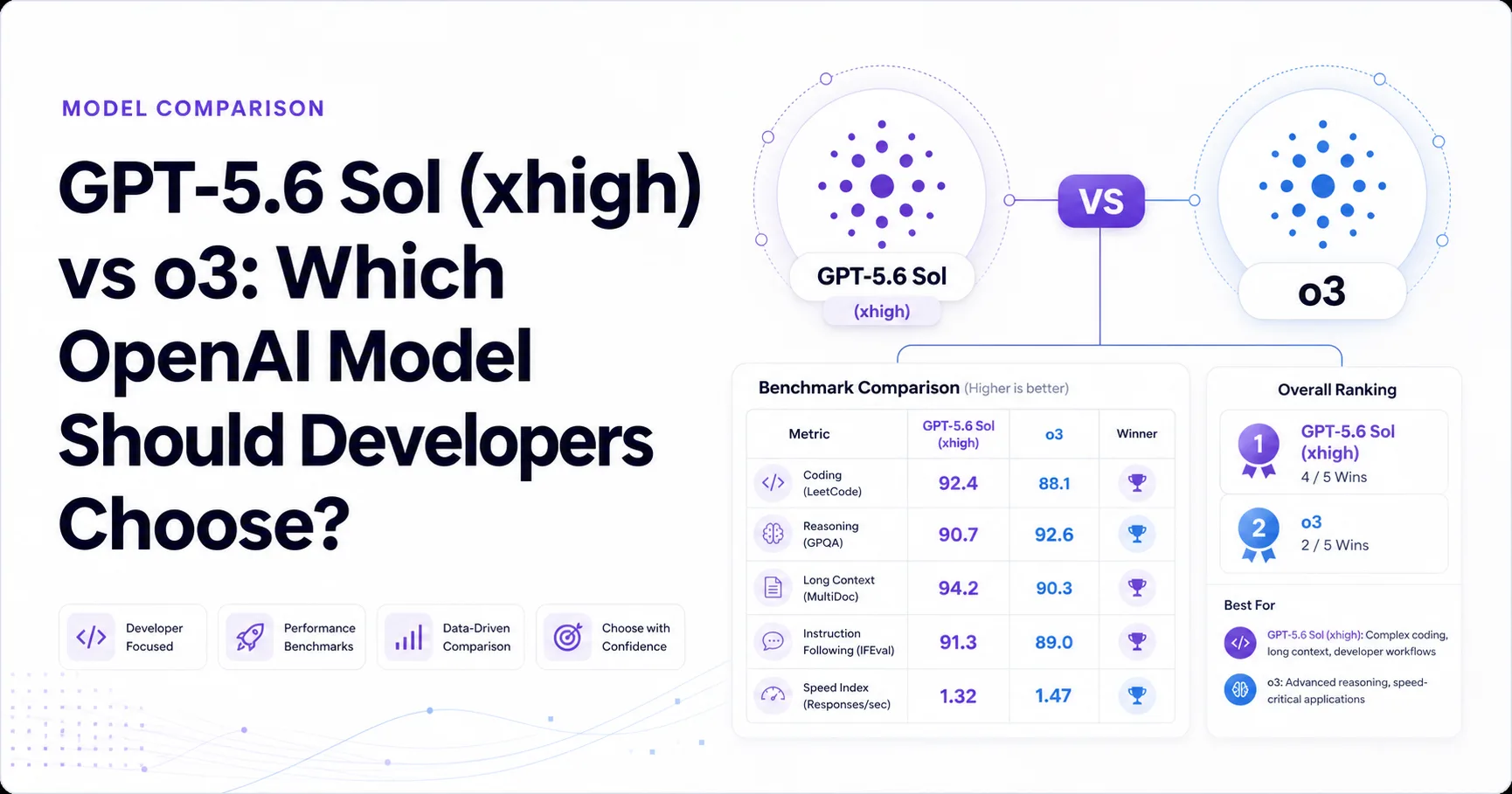
GPT-5.6 Sol (xhigh) is the stronger default for demanding developer workflows, while o3 is the better cost and throughput choice when its narrower evidence base fits the task. The Artificial Analysis snapshot gives GPT-5.6 Sol (xhigh) an Intelligence Index of 57.7, compared with 30.4 for o3, but it gives no directly comparable coding score for o3 or math score for GPT-5.6 Sol (xhigh). That missing overlap matters more than a simple leaderboard ranking.
OpenAI positions GPT-5.6 Sol as a flagship model for complex reasoning, programming, and professional work in its release announcement. Its official model page documents the gpt-5.6-sol model ID and the gpt-5.6 stable alias, while xhigh is a reasoning-effort setting rather than a separate model ID. See the GPT-5.6 Sol model page and Reasoning models guide.
The central decision is therefore not simply whether GPT-5.6 Sol scores higher. Developers must decide whether broader current documentation and stronger general intelligence evidence justify a blended-token price of $11.25, compared with $3.5 for o3. They must also verify o3 availability and behavior independently before committing to production.
GPT-5.6 Sol (xhigh) offers the more complete current product story, while o3 offers the lower measured cost and higher measured output speed. The snapshot records GPT-5.6 Sol (xhigh) at 57.7 on the Artificial Analysis Intelligence Index and o3 at 30.4. It also records o3 at 128.056 median output tokens per second, compared with 73.479 for GPT-5.6 Sol (xhigh). Both models show 0.3 seconds of latency in the supplied data.
| Decision factor | GPT-5.6 Sol (xhigh) | o3 |
|---|---|---|
| Intelligence Index | 57.7 | 30.4 |
| Coding Index | 78.3 | Not provided |
| Math Index | Not provided | 88.3 |
| Blended price per 1M tokens | $11.25 | $3.5 |
| Input price per 1M tokens | $5 | $2 |
| Output price per 1M tokens | $30 | $8 |
| Median output tokens per second | 73.479 | 128.056 |
| Latency | 0.3 seconds | 0.3 seconds |
The comparison is asymmetric. GPT-5.6 Sol has a supplied coding score, while o3 has a supplied math score. The materials do not establish that GPT-5.6 Sol beats o3 at mathematics or that o3 beats GPT-5.6 Sol at coding. They establish a general-intelligence advantage for GPT-5.6 Sol and an operational advantage for o3 on price and output speed.
The official documentation adds another qualification. The current OpenAI model directory lists GPT-5.6 Sol among current frontier models but does not list o3 in the supplied research. The data snapshot still records o3 with a release date of 2025-04-16 and current comparison prices. That conflict is unresolved by the supplied sources, so availability should be treated as a launch-blocking verification item, not an assumption.
GPT-5.6 Sol (xhigh) is the safer capability bet for mixed, difficult workflows, while o3 is the better responsiveness bet for high-volume interactions. The supplied Intelligence Index is 57.7 for GPT-5.6 Sol (xhigh) and 30.4 for o3, which suggests a meaningful difference in broad task coverage within this snapshot. It does not prove superiority on every developer workload because the benchmark overlap is incomplete.
For an interactive coding assistant, o3's 128.056 median output tokens per second can make long responses feel more immediate than GPT-5.6 Sol's 73.479. That advantage matters when users read generated code continuously, when an agent emits frequent intermediate messages, or when many requests compete for a fixed user budget. The equal 0.3-second latency values indicate that initial response delay does not distinguish the models in this dataset. The practical difference appears after generation starts.
GPT-5.6 Sol's official positioning emphasizes complex reasoning and programming, and its announcement reports an Artificial Analysis Coding Agent Index of 80, SWE-Bench Pro of 64.6%, DeepSWE v1.1 of 72.7%, and Terminal-Bench 2.1 of 88.8%. These are publisher-reported results, not independent reproduction. The GPT-5.6 release announcement also says some security evaluations used relaxed safeguards or special testing conditions, so those results should not be treated as ordinary production behavior.
The right performance test should mirror the agent loop. Measure accepted patches, test pass rate, correction turns, tool-call failures, and total completion cost. The supplied research does not provide equivalent o3 measurements for those outcomes. It also provides no reliable community benchmark for o3. Developers should therefore pilot both models on representative repositories before declaring a universal coding winner.
o3 is the clear listed-price winner, but GPT-5.6 Sol (xhigh) can still be the economical choice when stronger first-pass results reduce retries and human intervention. The snapshot lists o3 at $3.5 blended per 1M tokens, versus $11.25 for GPT-5.6 Sol (xhigh). It also lists input pricing of $2 versus $5 and output pricing of $8 versus $30. Those figures make o3 the natural starting point for workloads dominated by predictable, frequent, and easily validated requests.
Price per token is not price per outcome. A model that produces a usable patch earlier can avoid repeated prompts, agent iterations, failed tool calls, and review time. The supplied materials do not quantify those factors for either model, so no reliable break-even point can be calculated. This is a central evidence gap, especially for autonomous coding systems where output quality determines how many additional turns follow.
GPT-5.6 Sol also has documented pricing modes and context-dependent billing rules. The OpenAI pricing page lists Standard, Batch, Flex, and Fast mode prices for GPT-5.6 Sol. Its model documentation states that requests above 272K input tokens receive higher input and output multipliers, while reasoning tokens consume context and are billed as output tokens. The reasoning guide warns that xhigh can increase reasoning time and token consumption.
For short, bounded requests, o3's lower output price is decisive. For large repository analysis or difficult multi-step changes, estimate total attempts rather than multiplying token prices alone. The research does not establish o3's context limits, billing rules, or current availability, so its apparent savings require confirmation before procurement.
o3 leads on 3 of 3 metrics
GPT-5.6 Sol (xhigh) is the better primary choice for complex coding agents, while o3 is the better candidate for cost-sensitive, latency-sensitive workloads that can tolerate documentation uncertainty. Choose GPT-5.6 Sol when the workflow combines repository-scale reasoning, code generation, structured outputs, and tools. Its official page documents support for function calling, structured outputs, web search, file search, code execution, computer use, MCP, hosted shell, and related Responses API tools. The GPT-5.6 Sol model page provides the relevant capability record.
Choose o3 when the application values lower token cost and fast streaming output, and when its exact endpoint, alias, limits, and current commercial status have been verified. The current OpenAI model directory and OpenAI pricing page do not provide the o3 details needed to make that verification from the supplied official material. The data snapshot contains prices and benchmark values, but the official pages do not confirm that those values represent a currently selectable production offering.
GPT-5.6 Sol is a poor fit for native audio or video input because the official model page lists text and image input with text output, while audio and video are unsupported. It also does not support fine-tuning according to the same documentation. For those requirements, neither model should be selected without an additional model evaluation.
Community evidence does not settle the choice. One Reddit report describes a usable feature completed in roughly 15 minutes after a large instruction prompt. Another Reddit report describes over-engineering, excess code, rapid quota use, and remaining bugs. Neither report provides a reproducible benchmark, so treat both as hypotheses for pilot testing.
GPT-5.6 Sol (xhigh) is the better-documented production candidate, but the unresolved o3 record should be checked before any final architecture decision. The supplied research establishes useful differences in price, speed, and general-intelligence evidence. It does not establish comparable coding performance, a current o3 API contract, or a verified task-level cost advantage.
A practical evaluation should use the same prompts, repositories, tools, output limits, validation tests, and retry policy for each model. Record successful completions, correction work, response speed, and total token usage. Keep the model-selection decision tied to the actual workflow rather than treating one index as a universal answer.
The questions below focus on the gaps most likely to change a developer's choice.
GPT-5.6 Sol (xhigh) is the stronger default for complex coding agents because the supplied snapshot gives it a 57.7 Intelligence Index and a 78.3 Coding Index, while comparable o3 coding evidence is not provided. Developers should still validate repository-specific success rates before production.
o3 is cheaper on listed snapshot prices at $3.5 blended per 1M tokens versus $11.25 for GPT-5.6 Sol (xhigh), but the materials do not measure retries, correction turns, review effort, or completed-task cost. Its lower token price therefore does not prove a lower total operating cost.
o3 generates output faster in the supplied data, with a median of 128.056 output tokens per second versus 73.479 for GPT-5.6 Sol (xhigh). Both models show 0.3 seconds of latency, so the observed advantage concerns generation speed rather than initial response delay.
The evidence does not prove that conclusion because the snapshot provides GPT-5.6 Sol's 78.3 Coding Index but no comparable o3 coding score, and o3's 88.3 Math Index but no comparable GPT-5.6 Sol math score. It supports only the supplied general-intelligence comparison.
Developers should not assume current o3 availability from the supplied materials. The data snapshot includes o3 pricing and a 2025-04-16 release date, but the provided current OpenAI model directory and pricing page do not list the required o3 API details or confirm its present production status.
Developers should avoid GPT-5.6 Sol when native audio or video input, fine-tuning, or tightly controlled low-cost generation is mandatory. Its official documentation excludes audio and video input and fine-tuning, while the supplied price snapshot lists materially higher input, output, and blended prices than o3.