
Time to First Token · GPT-5.6 Terra (high)
2425ms
Time to First Token · GPT-5 mini (high)
0ms
Deep dive into reasoning, benchmarks, and latency insights.
The current catalog does not contain complete performance evidence for both models, so this page does not declare an overall winner. Use the available fields as comparison signals and validate the models on your own workload.
Key decision metrics at a glance.
| Model | Metric | Value | Unit | Source / snapshot |
|---|---|---|---|---|
| GPT-5.6 Terra (high) | Reasoning | 6.0 | benchmark or capability score | Artificial Analysis · current catalog |
| GPT-5 mini (high) | Reasoning | 9.0 | benchmark or capability score | Artificial Analysis · current catalog |
| GPT-5.6 Terra (high) | Coding | 7.0 | benchmark or capability score | Artificial Analysis · current catalog |
| GPT-5 mini (high) | Coding | 2.0 | benchmark or capability score | Artificial Analysis · current catalog |
| GPT-5.6 Terra (high) | Multimodal | 4.0 | benchmark or capability score | Artificial Analysis · current catalog |
| GPT-5 mini (high) | Multimodal | 2.0 | benchmark or capability score | Artificial Analysis · current catalog |
| GPT-5.6 Terra (high) | Long Context | 6.0 | benchmark or capability score | Artificial Analysis · current catalog |
| GPT-5 mini (high) | Long Context | 3.0 | benchmark or capability score | Artificial Analysis · current catalog |
| GPT-5.6 Terra (high) | Blended Price / 1M tokens | $4.5 | USD per 1M tokens | Artificial Analysis · current catalog |
| GPT-5 mini (high) | Blended Price / 1M tokens | $0.688 | USD per 1M tokens | Artificial Analysis · current catalog |
| GPT-5.6 Terra (high) | P95 Latency | — | milliseconds | Artificial Analysis · current catalog |
| GPT-5 mini (high) | P95 Latency | — | milliseconds | Artificial Analysis · current catalog |
| GPT-5.6 Terra (high) | Tokens per second | 98.562 | tokens per second | Artificial Analysis · current catalog |
| GPT-5 mini (high) | Tokens per second | 0 | tokens per second | Artificial Analysis · current catalog |
Data provided by Artificial Analysis; live values use the current catalog.
This radar chart visually maps the core capabilities (reasoning, coding, math proxy, multimodal, long context) of `GPT-5.6 Terra (high)` vs `GPT-5 mini (high)`.
This grouped bar chart provides a side-by-side comparison for each benchmark metric.
Lower time to first token is better; higher tokens per second is better.
Compare input and output pricing in USD per 1M tokens.
GPT-5.6 Terra (high)$5
GPT-5 mini (high)$0.75
GPT-5 mini (high) costs $4.25 less per run
This article is a dated snapshot published on 2026-08-07. Live cards above use the current catalog; missing live fields are not inferred.
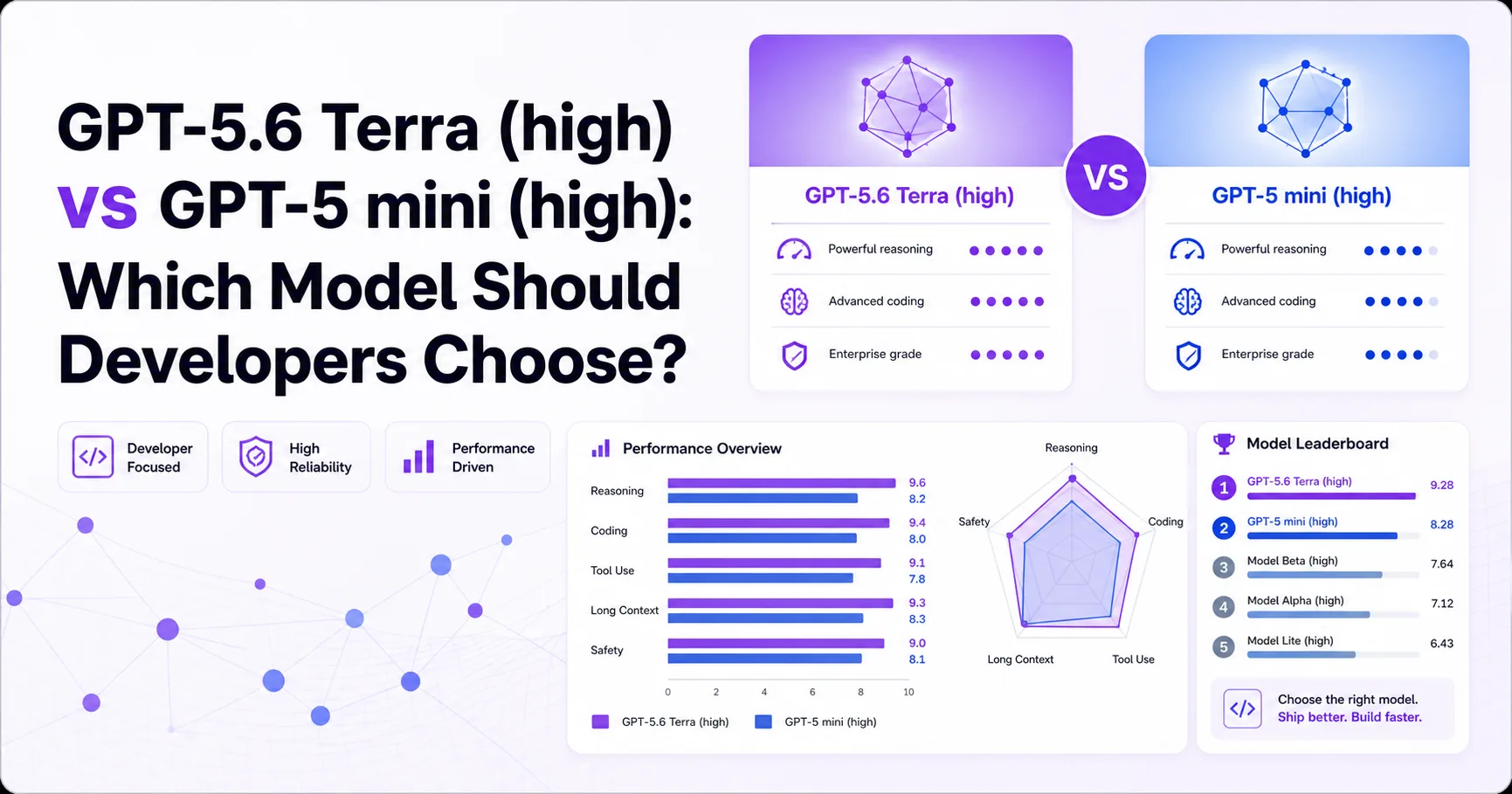
GPT-5.6 Terra (high) is the stronger default for demanding development work, while GPT-5 mini (high) is the economical choice for high-volume tasks. The data brief gives GPT-5.6 Terra (high) a Coding Index of 67.1 and an Intelligence Index of 49. GPT-5 mini (high) records 15.6 for coding, 25.3 for intelligence, and 90.7 for math. GPT-5.6 Terra (high) also reports a median output speed of 121.89 tokens per second. GPT-5 mini (high) has no reported output-speed value. Both models report 0.3-second latency. The central selection question is therefore not simply which model scores higher. It is whether the quality gap matters more than the large price gap for your workload.
OpenAI’s current model documentation identifies gpt-5.6-terra as the confirmed API alias, but does not independently document gpt-5-6-terra-high. OpenAI’s model documentation also does not provide a dedicated context window, output limit, or benchmark profile for either comparison label. That naming gap matters before implementation. A developer should validate the exact model ID through the live API model list before production use.
GPT-5.6 Terra (high) offers the clearer capability advantage for coding and general intelligence, while GPT-5 mini (high) offers the clearer cost advantage. Artificial Analysis reports a Coding Index of 67.1 for GPT-5.6 Terra (high), compared with 15.6 for GPT-5 mini (high). The Intelligence Index values are 49 and 25.3. These results support choosing Terra for code generation, debugging, repository changes, and tasks where a weak first answer creates expensive review work.
GPT-5 mini (high) is priced at $0.6875 per 1M blended tokens, compared with $4.500000000000001 for GPT-5.6 Terra (high). Its listed input price is $0.25, compared with $2, and its output price is $2, compared with $12. The lower price makes mini attractive for classification, routing, extraction, short transformations, and other workloads with predictable evaluation criteria.
The comparison has an important asymmetry. GPT-5 mini (high) reports a Math Index of 90.7, while Terra has no Math Index value in the supplied data. That does not establish mini as the better mathematical model. It establishes that the available evidence is incomplete. The same caution applies to context limits, output limits, tool support, and API reasoning controls. OpenAI’s model page does not provide dedicated specifications for these comparison labels.
The official status is also uneven. OpenAI’s pricing page lists gpt-5.6-terra, but the supplied research did not find gpt-5-mini or gpt-5-6-terra-high listed as current standalone entries. Developers should separate benchmark preference from deployment availability.
GPT-5.6 Terra (high) is the safer choice when coding correctness and multi-step reasoning dominate the workflow. The Coding Index of 67.1 versus 15.6 is large enough to change how a team should structure automation. Terra is a plausible primary model for generating implementation plans, editing several related files, diagnosing unfamiliar code, and producing patches that require fewer corrective turns. The score does not prove success on every repository. It does indicate that coding quality is the strongest evidence-backed reason to pay for Terra.
GPT-5 mini (high) can still be useful around the coding workflow, especially when the task is narrow and the acceptance test is cheap. It may fit issue labeling, code search query generation, simple documentation edits, formatting transformations, or first-pass triage. The supplied evidence does not show that mini is unreliable for every coding task. It shows a much lower aggregate Coding Index, so developers should avoid treating it as a direct substitute for Terra in open-ended engineering work.
GPT-5.6 Terra (high) reports 121.89 median output tokens per second, while GPT-5 mini (high) has no output-speed value in the data brief. Terra therefore has the stronger evidence for streaming-heavy interfaces. The latency values are 0.3 seconds for both models, so the available latency evidence does not distinguish them. A fast first token can improve perceived responsiveness, but output speed and end-to-end completion time are different operational measurements.
GPT-5 mini (high) has the only supplied Math Index, at 90.7. That result deserves a targeted mathematical evaluation before selection, because Terra has no corresponding value in the snapshot. The evidence cannot answer whether mini is better for your specific math workload. It can justify running a focused test rather than assuming the coding ranking applies to every domain.
OpenAI’s public model documentation describes current models in general terms, including text and image input, text output, multilingual capability, and vision support, but it does not confirm that every statement applies to these historical or display-level labels. The official model documentation also does not publish dedicated failure modes or context limits here. Treat repository tests and production telemetry as necessary evidence.
GPT-5 mini (high) is the obvious price winner, but GPT-5.6 Terra (high) can be economically preferable when weak outputs create review, retry, or escalation work. The blended prices are $0.6875 for mini and $4.500000000000001 for Terra per 1M blended tokens. Mini also has lower listed input and output prices, at $0.25 and $2. Terra is listed at $2 and $12. Those figures favor mini for large volumes of routine requests.
GPT-5 mini (high) becomes less attractive when a task requires multiple attempts, human correction, or a second model pass. The data brief does not provide retry rates, token consumption by task, reviewer time, or production success rates, so no break-even point can be calculated responsibly. The practical test is simple: compare complete task cost, not just API token cost. Include failed patches, extra prompts, test runs, queue time, and human intervention.
GPT-5.6 Terra (high) may earn its higher token price on tasks where correctness reduces downstream work. This is especially relevant for migrations, security-sensitive changes, complex debugging, and code that touches several dependencies. A lower-cost model can cost more overall if it produces plausible but incorrect changes that pass superficial review.
Batch and Flex prices are available for Terra on the official pricing page, while the supplied research did not find current pricing for gpt-5-mini. OpenAI’s pricing documentation lists Terra’s Short context Standard input price as $2.00 and output price as $12.00, with different modes and context categories. The page also describes a possible 10% regional-processing surcharge for eligible models, but the supplied research does not confirm whether Terra qualifies. Pricing should therefore be checked again during deployment review.
GPT-5 mini (high) leads on 3 of 3 metrics
GPT-5.6 Terra (high) should be the primary choice for developers who value coding quality over minimum token spend. Its Coding Index of 67.1 and Intelligence Index of 49 provide the strongest evidence for repository-level engineering, complex debugging, architectural reasoning, and code review support. Use it when an incorrect answer can create substantial rework or operational risk.
GPT-5 mini (high) should be the first candidate for cheap, repeatable, and easily validated work. Its blended price of $0.6875 per 1M tokens makes it suitable for high-volume routing, extraction, summarization, structured transformations, and lightweight assistant interactions. It is also worth testing for math-heavy workflows because its supplied Math Index is 90.7. That single metric is not enough to generalize across all mathematical tasks.
A two-tier architecture is the most defensible practical design. Route routine requests to mini, then escalate ambiguous, failed, or high-impact requests to Terra. Keep the routing rule based on task type and evaluation results. Do not infer model identity from the display string alone. The supplied research confirms gpt-5.6-terra as an official alias, but does not confirm gpt-5-6-terra-high as a directly callable model ID. OpenAI’s model documentation should be checked alongside a live API model-list response.
The evidence is insufficient to recommend either model for long-context workloads, because neither model has a supplied context-window value. The evidence is also insufficient to compare tool behavior, output limits, failure modes, and high reasoning semantics. Validate those properties before committing to a production contract. OpenAI’s pricing documentation should also be consulted for the final model alias and applicable billing mode.
GPT-5.6 Terra (high) is the better starting point when your first concern is reliable coding performance. The available evidence does not support a universal winner for every workload. GPT-5 mini (high) is substantially cheaper and has a strong reported Math Index, but its current API availability, output speed, context limit, and dedicated failure profile remain unclear. Developers should treat this comparison as a routing decision supported by incomplete public documentation, then close the gaps with a small task-specific evaluation.
GPT-5.6 Terra (high) is the stronger coding choice because its reported Coding Index is 67.1, compared with 15.6 for GPT-5 mini (high). The result does not guarantee repository-level success, so validate it on representative issues, tests, and review criteria before production adoption.
GPT-5 mini (high) is cheaper at $0.6875 per 1M blended tokens, compared with $4.500000000000001 for GPT-5.6 Terra (high). The cheaper model may still cost more overall if it requires retries, human correction, escalation, or additional validation passes.
GPT-5 mini (high) has the only supplied Math Index, at 90.7, so it deserves a focused mathematics evaluation. Terra has no Math Index value in the snapshot, which means the available evidence cannot establish a direct mathematical ranking.
GPT-5.6 Terra (high) is not confirmed as the exact API identifier gpt-5-6-terra-high. OpenAI’s documentation confirms gpt-5.6-terra as an alias, while the model directory does not document the hyphenated high-suffix identifier.
GPT-5.6 Terra (high) has the reported output-speed value, at 121.89 median output tokens per second. GPT-5 mini (high) has no supplied output-speed value, while both models report 0.3-second latency, so the complete speed comparison remains incomplete.