
Time to First Token · GPT-5.6 Terra (high)
2425ms
Time to First Token · o3
7185ms
Deep dive into reasoning, benchmarks, and latency insights.
The current catalog does not contain complete performance evidence for both models, so this page does not declare an overall winner. Use the available fields as comparison signals and validate the models on your own workload.
Key decision metrics at a glance.
| Model | Metric | Value | Unit | Source / snapshot |
|---|---|---|---|---|
| GPT-5.6 Terra (high) | Reasoning | 6.0 | benchmark or capability score | Artificial Analysis · current catalog |
| o3 | Reasoning | 9.0 | benchmark or capability score | Artificial Analysis · current catalog |
| GPT-5.6 Terra (high) | Coding | 7.0 | benchmark or capability score | Artificial Analysis · current catalog |
| o3 | Coding | 6.0 | benchmark or capability score | Artificial Analysis · current catalog |
| GPT-5.6 Terra (high) | Multimodal | 4.0 | benchmark or capability score | Artificial Analysis · current catalog |
| o3 | Multimodal | 3.0 | benchmark or capability score | Artificial Analysis · current catalog |
| GPT-5.6 Terra (high) | Long Context | 6.0 | benchmark or capability score | Artificial Analysis · current catalog |
| o3 | Long Context | 4.0 | benchmark or capability score | Artificial Analysis · current catalog |
| GPT-5.6 Terra (high) | Blended Price / 1M tokens | $4.5 | USD per 1M tokens | Artificial Analysis · current catalog |
| o3 | Blended Price / 1M tokens | $3.5 | USD per 1M tokens | Artificial Analysis · current catalog |
| GPT-5.6 Terra (high) | P95 Latency | — | milliseconds | Artificial Analysis · current catalog |
| o3 | P95 Latency | — | milliseconds | Artificial Analysis · current catalog |
| GPT-5.6 Terra (high) | Tokens per second | 98.562 | tokens per second | Artificial Analysis · current catalog |
| o3 | Tokens per second | 119.185 | tokens per second | Artificial Analysis · current catalog |
Data provided by Artificial Analysis; live values use the current catalog.
This radar chart visually maps the core capabilities (reasoning, coding, math proxy, multimodal, long context) of `GPT-5.6 Terra (high)` vs `o3`.
This grouped bar chart provides a side-by-side comparison for each benchmark metric.
Lower time to first token is better; higher tokens per second is better.
Compare input and output pricing in USD per 1M tokens.
GPT-5.6 Terra (high)$5
o3$4
o3 costs $1 less per run
This article is a dated snapshot published on 2026-08-07. Live cards above use the current catalog; missing live fields are not inferred.
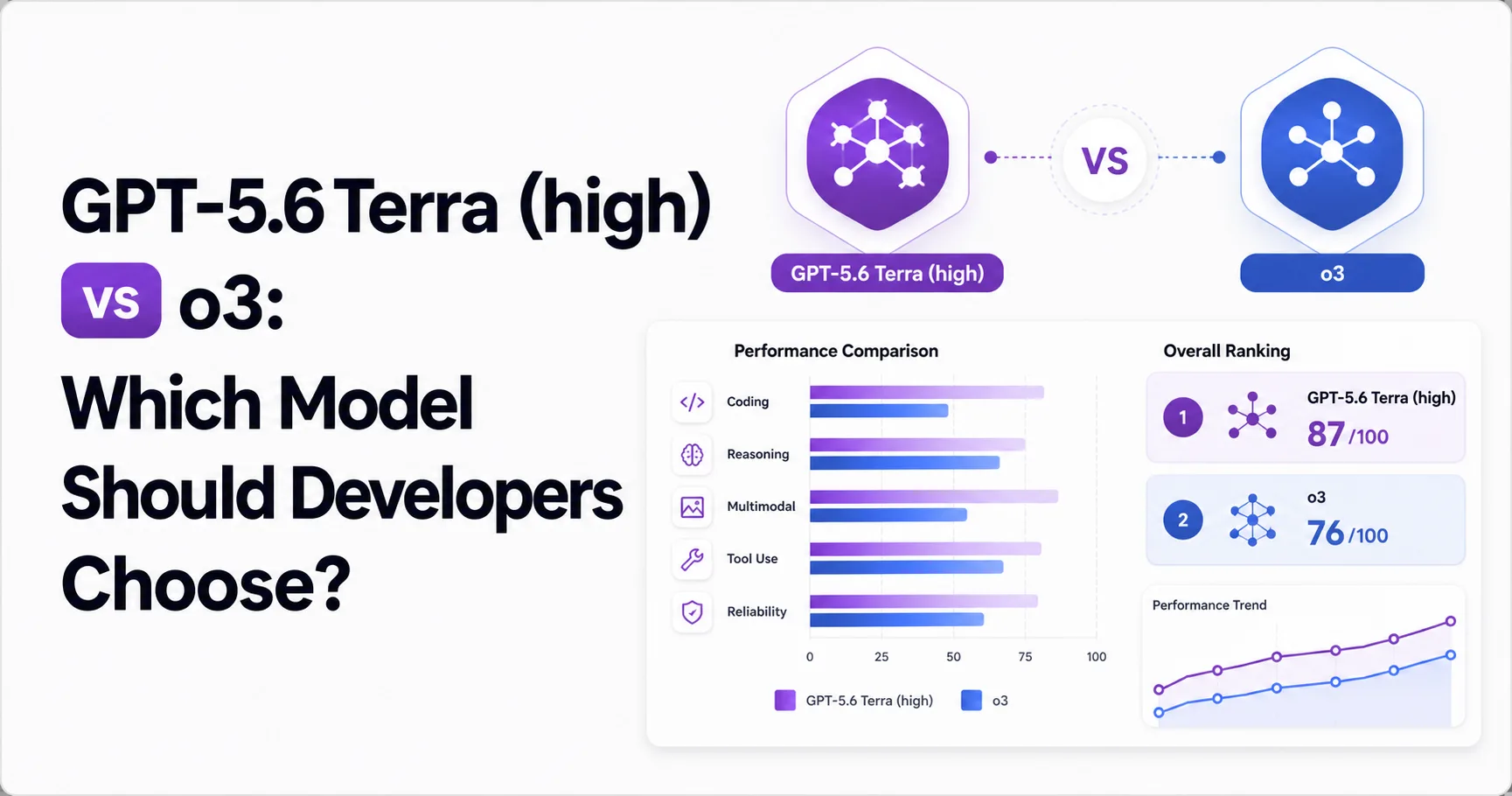
GPT-5.6 Terra (high) is the stronger general-purpose choice in the available comparison data, while o3 is cheaper, slightly faster, and the only model with a reported math index. The central selection problem is not simply capability versus price. It is capability evidence versus deployment certainty. OpenAI’s current model documentation confirms the gpt-5.6-terra alias, but it does not separately confirm gpt-5-6-terra-high. The same documentation does not list o3 in the current model directory.\n\nThe available data gives GPT-5.6 Terra (high) an Artificial Analysis Intelligence Index of 49, compared with 30.4 for o3. o3 reaches 128.056 median output tokens per second, compared with 121.89 for GPT-5.6 Terra (high). Both models show 0.3 seconds latency. The blended price is $4.500000000000001 for GPT-5.6 Terra (high) and $3.5 for o3.\n\nData provided by https://artificialanalysis.ai/
GPT-5.6 Terra (high) leads the available general-intelligence evidence, but o3 remains the lower-cost and faster option for workloads that value those advantages.\n\n| Decision area | Better signal | What it means for developers |
|---|---|---|
| General intelligence | GPT-5.6 Terra (high), 49 vs 30.4 | Prefer Terra for broad reasoning and mixed workloads |
| Math evidence | o3, 88.3 | Prefer o3 when mathematical performance is the primary tested requirement |
| Coding evidence | GPT-5.6 Terra (high), 67.1 | Terra has a reported coding score, but no directly comparable o3 coding score is available |
| Output speed | o3, 128.056 vs 121.89 | o3 may finish streamed outputs sooner |
| Latency | Tie at 0.3 seconds | The measured latency does not separate the models |
| Blended cost | o3, $3.5 vs $4.500000000000001 | o3 reduces token cost when output usage is material |
\nThe comparison is asymmetric. GPT-5.6 Terra (high) has a reported intelligence and coding score. o3 has a reported intelligence and math score. The missing cross-model scores prevent a complete capability ranking. The data does not show whether Terra is better at math than o3, or whether o3 is better at coding than Terra.\n\nThe official product picture is also asymmetric. OpenAI’s model page describes gpt-5.6-terra, while the pricing page lists that alias rather than a separate high variant. Those pages do not establish a current stable o3 endpoint or price. Treat the benchmark slugs and production API identifiers as separate questions.
GPT-5.6 Terra (high) is the better-supported general reasoning candidate, while o3 is the better-supported specialist candidate for math-oriented evaluation.\n\nTerra’s Intelligence Index of 49 versus o3’s 30.4 is the clearest directional result in the dataset. For developers, that gap suggests a higher chance of consistent performance across mixed tasks such as planning, synthesis, debugging, and instruction following. It does not prove superiority on every task. Artificial Analysis does not expose the benchmark construction or task distribution in the supplied brief, so the score should guide a trial rather than replace one.\n\no3’s Math Index of 88.3 is a strong reason to keep o3 in consideration for symbolic reasoning, quantitative verification, and math-heavy agent steps. Terra has no reported math value in this snapshot. That absence is evidence about reporting coverage, not evidence of poor math ability. A selection team should avoid converting a missing value into a zero.\n\nTerra also has a reported Coding Index of 67.1. No directly comparable o3 coding value is available. Therefore, the data supports Terra as the safer coding bet only in the limited sense that it has positive measured evidence. It cannot establish a coding winner.\n\nThe speed result favors o3, but only narrowly in practical terms: 128.056 median output tokens per second versus 121.89. Both models report 0.3 seconds latency. That combination makes o3 attractive for interactive streaming, yet the latency tie means perceived responsiveness may depend more on prompt length, output length, network conditions, and application behavior than on model choice. Those factors are not measured here.
o3 is the lower-cost option in the supplied blended-token comparison, but GPT-5.6 Terra (high) can still be cheaper at the application level when it prevents retries or extra orchestration.\n\nThe blended price is $3.5 for o3 and $4.500000000000001 for GPT-5.6 Terra (high). Input pricing is tied at $2 per 1M input tokens. Output pricing creates the main difference: o3 is $8 per 1M output tokens, while Terra is $12. For applications that generate substantial output, o3’s cost advantage compounds directly.\n\nThat arithmetic does not settle total operating cost. A weaker result can require a second pass, an evaluator call, a repair prompt, or a human review. The supplied data does not report retry rates, task success rates, or cost per accepted answer. Evidence is therefore insufficient to claim that either model has the lower cost per completed task.\n\nThe official pricing page adds an important deployment caveat. OpenAI’s pricing documentation lists Standard, Batch, Flex, and Fast mode prices for gpt-5.6-terra, but it does not list gpt-5-6-terra-high separately. The page also describes a possible 10% regional-processing surcharge for eligible models, without confirming whether GPT-5.6 Terra qualifies. Do not build a final budget from the high-variant label until the live account and API model list confirm its billing identity.\n\nFor low-volume prototypes, the price difference may matter less than API availability and output quality. For high-output production systems, o3’s $8 output rate deserves serious weight.
o3 leads on 2 of 3 metrics
GPT-5.6 Terra (high) is the recommended default for broad developer workloads, provided the live API confirms that the requested high variant is available.\n\nChoose GPT-5.6 Terra (high) for a general assistant, coding copilot, planning agent, or mixed enterprise workflow where one model must handle varied tasks. Its Intelligence Index of 49 is the strongest broad capability signal in the comparison. Its Coding Index of 67.1 also gives it direct evidence for software work. The recommendation remains conditional because the official pages confirm gpt-5.6-terra, not a separately documented gpt-5-6-terra-high.\n\nChoose o3 when mathematical reasoning is central, output cost is tightly controlled, or fast streaming matters. o3 has the reported Math Index of 88.3, the lower blended price of $3.5, and the higher median output speed of 128.056 tokens per second. The official materials supplied here do not confirm its current API availability or price, so deployment verification is mandatory.\n\nUse a small task-based bake-off before committing either model to a critical workflow. Include representative coding changes, mathematical checks, long-form synthesis, structured extraction, and failure recovery. Measure accepted answers, retry frequency, latency at the user interface, and total tokens. The supplied sources do not provide those production-specific measurements.\n\nThe most defensible choice today is Terra for breadth and o3 for math-cost efficiency. That is a decision under incomplete evidence, not a universal capability verdict.
GPT-5.6 Terra (high) requires an API identity check before production adoption, while o3 requires both availability and billing checks.\n\nOpenAI’s model documentation confirms the gpt-5.6-terra alias and does not separately document gpt-5-6-terra-high. OpenAI’s pricing documentation likewise lists gpt-5.6-terra, not the high-variant slug. The supplied material also does not confirm a current o3 endpoint, stable alias, context window, output limit, or adjustable parameter set.\n\nThis creates a practical preflight sequence: confirm the model identifier through the live API model list, run representative prompts, verify the account’s effective rate, and test the failure behavior that matters to the product. The available evidence does not establish context-window suitability for either model because the data snapshot reports null context-window values.\n\nCommunity evidence is also insufficient. No verifiable Reddit, Hacker News, or X material was available for coding feel, speed perception, or recurring model quirks. Developers should treat anecdotal claims about either model as unverified until they can reproduce them.
GPT-5.6 Terra (high) is the safer coding choice in this dataset because it has a reported Coding Index of 67.1, while no comparable o3 coding score is available. That result does not prove Terra wins every coding task. It means Terra has direct positive coding evidence and o3 does not have a directly comparable reported value here. Test repository-specific work before committing.
o3 is cheaper in the supplied blended comparison at $3.5 per 1M tokens versus $4.500000000000001 for GPT-5.6 Terra (high). Input pricing is tied at $2 per 1M tokens, while output pricing is $8 for o3 and $12 for Terra. Total cost per accepted task remains unknown because retry and success-rate data is unavailable.
o3 is faster by the reported median output rate, reaching 128.056 tokens per second versus 121.89 for GPT-5.6 Terra (high). Both models report 0.3 seconds latency, so the speed advantage may be less visible in short responses. Network conditions, prompt size, output length, and streaming implementation can materially affect user-perceived responsiveness.
Developers should verify the slug before using it because the official documentation confirms gpt-5.6-terra, not gpt-5-6-terra-high. The official model and pricing pages do not separately document the high variant. The benchmark label may represent an evaluation configuration rather than a directly callable production identifier. Confirm the live API model list and billing behavior first.
o3 is the better-supported mathematical choice because the supplied data reports a Math Index of 88.3, while GPT-5.6 Terra (high) has no reported math value. The missing Terra score does not establish weakness. It only means the comparison lacks a directly reported Terra math result. Use representative mathematical tasks to validate accuracy, explanation quality, and error recovery.