
Time to First Token · GPT-5.6 Terra (Non-reasoning)
698ms
Time to First Token · o3
7185ms
Deep dive into reasoning, benchmarks, and latency insights.
The current catalog does not contain complete performance evidence for both models, so this page does not declare an overall winner. Use the available fields as comparison signals and validate the models on your own workload.
Key decision metrics at a glance.
| Model | Metric | Value | Unit | Source / snapshot |
|---|---|---|---|---|
| GPT-5.6 Terra (Non-reasoning) | Reasoning | 6.0 | benchmark or capability score | Artificial Analysis · current catalog |
| o3 | Reasoning | 9.0 | benchmark or capability score | Artificial Analysis · current catalog |
| GPT-5.6 Terra (Non-reasoning) | Coding | 5.0 | benchmark or capability score | Artificial Analysis · current catalog |
| o3 | Coding | 6.0 | benchmark or capability score | Artificial Analysis · current catalog |
| GPT-5.6 Terra (Non-reasoning) | Multimodal | 3.0 | benchmark or capability score | Artificial Analysis · current catalog |
| o3 | Multimodal | 3.0 | benchmark or capability score | Artificial Analysis · current catalog |
| GPT-5.6 Terra (Non-reasoning) | Long Context | 4.0 | benchmark or capability score | Artificial Analysis · current catalog |
| o3 | Long Context | 4.0 | benchmark or capability score | Artificial Analysis · current catalog |
| GPT-5.6 Terra (Non-reasoning) | Blended Price / 1M tokens | $4.5 | USD per 1M tokens | Artificial Analysis · current catalog |
| o3 | Blended Price / 1M tokens | $3.5 | USD per 1M tokens | Artificial Analysis · current catalog |
| GPT-5.6 Terra (Non-reasoning) | P95 Latency | — | milliseconds | Artificial Analysis · current catalog |
| o3 | P95 Latency | — | milliseconds | Artificial Analysis · current catalog |
| GPT-5.6 Terra (Non-reasoning) | Tokens per second | 92.071 | tokens per second | Artificial Analysis · current catalog |
| o3 | Tokens per second | 119.185 | tokens per second | Artificial Analysis · current catalog |
Data provided by Artificial Analysis; live values use the current catalog.
This radar chart visually maps the core capabilities (reasoning, coding, math proxy, multimodal, long context) of `GPT-5.6 Terra (Non-reasoning)` vs `o3`.
This grouped bar chart provides a side-by-side comparison for each benchmark metric.
Lower time to first token is better; higher tokens per second is better.
Compare input and output pricing in USD per 1M tokens.
GPT-5.6 Terra (Non-reasoning)$5
o3$4
o3 costs $1 less per run
This article is a dated snapshot published on 2026-08-07. Live cards above use the current catalog; missing live fields are not inferred.
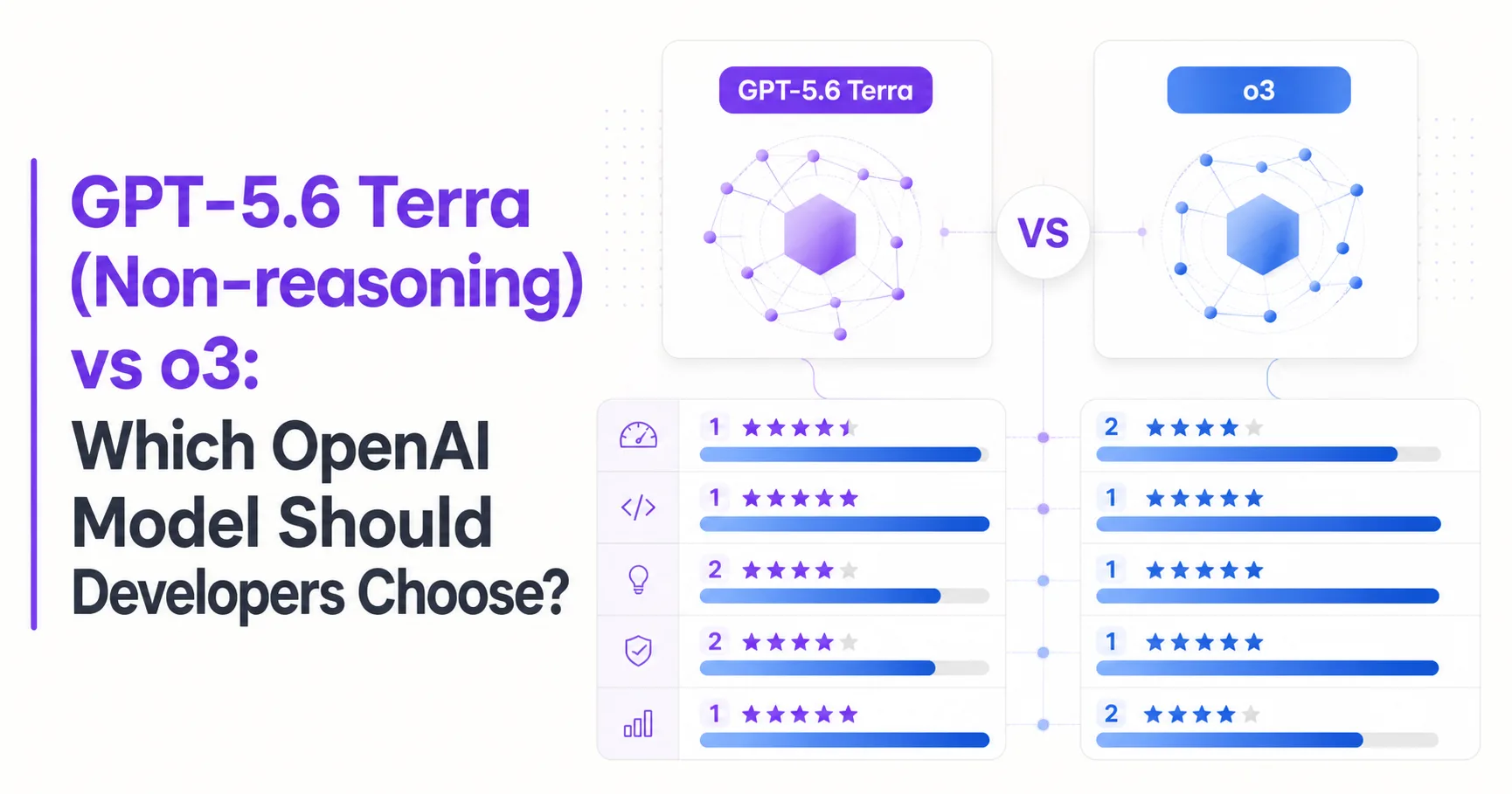
GPT-5.6 Terra (Non-reasoning) is the stronger default for new OpenAI API builds, while o3 remains cheaper and slightly faster in the supplied measurements. The data snapshot reports Terra at 34 on the Artificial Analysis Intelligence Index, compared with 30.4 for o3. o3 costs $3.5 per 1M blended tokens, compared with $4.5 for Terra, and reaches 128.056 median output tokens per second. Both models show 0.3 seconds latency. Data provided by Artificial Analysis
The practical decision is therefore not a simple capability ranking. Terra has clearer current product status and official API positioning. o3 has stronger evidence for math in the supplied data, but its current official availability and pricing are not established by the cited OpenAI pages.
GPT-5.6 Terra (Non-reasoning) offers the safer general-purpose choice, while o3 is more attractive for price-sensitive workloads with a math-heavy evaluation profile. The supplied data gives Terra an Artificial Analysis Intelligence Index of 34, versus 30.4 for o3. It gives o3 a Math Index of 88.3, while no comparable Terra math value appears. Terra also has a Coding Index of 52.3, but no comparable o3 coding value appears. The Artificial Analysis data snapshot therefore supports directional conclusions, not a complete capability leaderboard.
OpenAI’s current model documentation lists GPT-5.6 Terra among its Frontier models and describes support for text and image input, text output, multilingual use, and vision capabilities. OpenAI’s model documentation does not provide the same confirmed details for o3. The page also does not document either model’s context window, maximum output length, or complete parameter limits in the supplied evidence.
That documentation gap matters for production design. A developer choosing a model needs to know whether long prompts, structured outputs, tool calls, and multimodal inputs fit the intended contract. The provided materials do not answer those questions for either model, so application-level tests remain necessary.
o3 is marginally faster in generation, while GPT-5.6 Terra (Non-reasoning) has the stronger available general intelligence score. The supplied measurements report 128.056 median output tokens per second for o3 and 122.922 for Terra. Both models report 0.3 seconds latency, so the speed distinction is more relevant to sustained output than to initial responsiveness. The supplied performance data does not show whether that difference remains stable across prompt length, concurrency, tool use, or streaming workloads.
For interactive applications, the output-rate gap may affect how quickly users see long answers complete. It should matter less for short responses where the reported latency is equal. For batch generation, the cheaper o3 price may matter more than the modest throughput advantage. These conclusions describe workload economics, not a universal user experience, because no community measurements with verified methods were found.
Capability evidence is uneven. Terra records 34 on the Artificial Analysis Intelligence Index, versus 30.4 for o3. o3 records 88.3 on the Math Index, but Terra has no matching math result in the supplied snapshot. Terra records 52.3 on the Coding Index, but o3 has no matching coding result. The data supports Terra as the better-supported general-purpose candidate, not as a proven winner across every technical task.
The evidence is insufficient to identify failure modes, coding habits, instruction-following differences, or reasoning reliability for either model. OpenAI’s current model documentation also does not publish official benchmark results for Terra or o3 in the supplied material. Developers should test representative prompts before treating the index results as a deployment guarantee.
o3 is the lower-cost option in the supplied comparison because its blended price is $3.5 versus $4.5 for GPT-5.6 Terra (Non-reasoning). The input price is $2 for each model, while the output price is $8 for o3 and $12 for Terra. The Artificial Analysis pricing snapshot therefore points to o3 for workloads that generate substantial output.
The price gap becomes more important when responses are long, repeated, or generated at scale. It matters less for input-dominant applications because the supplied input price is equal. A workload with large prompts and short answers may see little difference between the models. A workload with concise prompts and long generated documents is more exposed to Terra’s higher output price.
The conclusion can also flip if Terra prevents expensive downstream work. A higher-priced model may cost less overall if it reduces retries, manual review, routing complexity, or post-processing. The supplied materials do not provide verified failure rates, quality-adjusted costs, or task-level accuracy, so no claim can be made that Terra’s higher price pays back in a specific workflow.
There is an important documentation conflict. The data brief supplies o3 comparison prices, but OpenAI’s current pricing page does not list o3 under the cited material. The same page identifies gpt-5.6-terra as the stable API pricing alias, while the supplied research did not find a separate gpt-5-6-terra-non-reasoning API identifier. Confirm account-level access and billing behavior before committing to o3 or mapping the data label directly to production configuration.
o3 leads on 2 of 3 metrics
GPT-5.6 Terra (Non-reasoning) is the recommended starting point for new OpenAI integrations, while o3 should be selected only when its access and task advantage are verified. OpenAI’s current model page lists Terra among the current Frontier models and documents its availability through the Responses API and OpenAI Client SDK. The same supplied page does not list o3 in the current model directory.
Choose Terra when the project needs a current, documented OpenAI model with broad modality claims and a stronger available general intelligence signal. Terra is also the better default when the team wants to minimize uncertainty about the model name used for pricing and API integration. The supplied evidence does not establish Terra’s context window, maximum output length, or full parameter limits, so those requirements still need direct verification.
Choose o3 when the application is strongly cost-sensitive, benefits from the supplied 88.3 Math Index, and can confirm that the model remains callable in the target account. Its $3.5 blended price and 128.056 median output speed are meaningful advantages for suitable workloads. They do not compensate for an unavailable endpoint, undocumented lifecycle status, or a quality gap on the application’s primary tasks.
A sensible rollout uses a small evaluation set drawn from real prompts. Compare correctness, retries, output length, tool behavior, and human review effort. The supplied research found no reliable community posts or verified failure cases for either model, so developer testing is the only evidence available for those dimensions. OpenAI’s current pricing documentation also does not clarify o3’s present price or stable alias in the cited material.
GPT-5.6 Terra (Non-reasoning) has the clearer documented production path, but neither model has enough public evidence to remove the need for validation. OpenAI’s model documentation supports Terra’s current positioning and API usage, yet the supplied page does not confirm o3’s current availability. OpenAI’s pricing documentation confirms Terra’s stable pricing alias but does not list o3 in the cited material.
The unresolved questions are operational rather than cosmetic: can the target account call the desired model, which exact identifier should the application send, what context and output limits apply, and how do the models behave on the project’s real prompts? The supplied data offers useful signals for intelligence, math, coding, speed, latency, and cost. It does not establish quality-adjusted cost, reliability, failure patterns, or lifecycle guarantees. Those gaps should be recorded as selection risks, not silently filled with assumptions.
GPT-5.6 Terra (Non-reasoning) is the safer overall choice because it scores 34 versus o3’s 30.4 on the supplied Artificial Analysis Intelligence Index and has clearer current OpenAI documentation. The evidence does not prove Terra is better for math, because o3 has an 88.3 Math Index and Terra has no comparable math value.
o3 is cheaper in the supplied comparison at $3.5 per 1M blended tokens versus $4.5 for GPT-5.6 Terra (Non-reasoning). Their input price is equal at $2, while o3 has the lower output price at $8 versus Terra’s $12. OpenAI’s current pricing page does not list o3 in the cited material, so production billing must be verified.
o3 is faster on median output generation at 128.056 tokens per second versus 122.922 for GPT-5.6 Terra (Non-reasoning). Both models report 0.3 seconds latency, so the practical difference should be more visible during longer responses than during initial response time. The supplied evidence does not show how speed changes with concurrency or tools.
Developers should migrate only after testing real application prompts, because Terra has a higher general intelligence score but also a higher blended price and output price. OpenAI’s current model page lists Terra among Frontier models, while the supplied page does not list o3. The research does not establish o3 deprecation, so migration should be driven by verified access, quality, and cost results.